Nineteenth Sunday in Ordinary Time – Lectionary: 115
A Whisper on the Mountain, a Voice on the Waves
Somewhere between the roar of a storm and the hush that follows it, God waits to be heard. The readings for the Nineteenth Sunday in Ordinary Time gather around one central theme: God reveals himself in quiet, faithful presence rather than in noise and spectacle, and he asks for a faith that listens for him and steps toward him even when the wind is against it. On Mount Horeb, an exhausted Elijah discovers that the Lord is not in the wind, the earthquake, or the fire, but in a tiny whispering sound. Psalm 85 answers with the posture every believer needs, a heart resolved to hear what God proclaims. Saint Paul, in The Letter to the Romans, reveals an anguished love for his people Israel, a love formed by God’s patient fidelity to his covenants. Then, on the Sea of Galilee, Jesus comes walking across the waves in the darkest watch of the night, speaks peace into the terror of his disciples, and catches Peter the moment he begins to sink. The ancient world expected its gods to announce themselves with thunder; the living God prefers a whisper, a psalm, a promise kept, an outstretched hand. These readings arrive in the middle of Ordinary Time, when prayer can feel dry, and they pose a piercing question. When the noise of life dies down, is there still a heart willing to listen? This Sunday is an invitation to answer yes.
First Reading — 1 Kings 19:9a, 11-13a
When God Refuses to Shout
The scene needs its backstory. In The First Book of Kings, chapter 18, Elijah has just won the greatest triumph of his career, calling down fire from heaven against the prophets of Baal on Mount Carmel. Yet within a single chapter he is running for his life from Queen Jezebel, collapsing under a broom tree and begging God to let him die. Fed by an angel, he walks forty days and forty nights to Horeb, the mountain of God, where Moses received the covenant, retracing the steps of his people back to the source. There, in a cave on the holy mountain, God meets his burned-out prophet in a way that overturns every expectation.
1 Kings 19:9a, 11-13a
At the mountain of God, Horeb,
Elijah came to a cave where he took shelter.
Then the LORD said to him,
“Go outside and stand on the mountain before the LORD;
the LORD will be passing by.”
A strong and heavy wind was rending the mountains
and crushing rocks before the LORD—
but the LORD was not in the wind.
After the wind there was an earthquake—
but the LORD was not in the earthquake.
After the earthquake there was fire—
but the LORD was not in the fire.
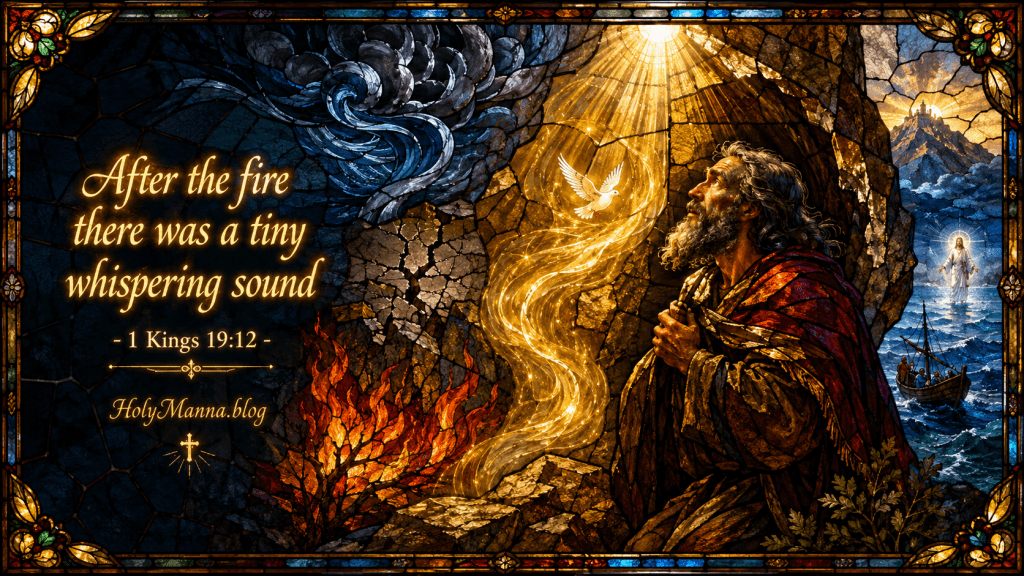
After the fire there was a tiny whispering sound.
When he heard this,
Elijah hid his face in his cloak
and went and stood at the entrance of the cave.
Detailed Exegesis
Verse 9a: “At the mountain of God, Horeb, Elijah came to a cave where he took shelter.”
Horeb is another name for Sinai, the mountain of the covenant. The Hebrew says Elijah came to “the cave,” long connected with the cleft of the rock where Moses was hidden when God’s glory passed by in Exodus 33. Elijah arrives not as a conqueror but as a refugee.
Verse 11: “Go outside and stand on the mountain before the LORD; the LORD will be passing by.” A strong and heavy wind was rending the mountains and crushing rocks before the LORD—but the LORD was not in the wind. After the wind there was an earthquake—but the LORD was not in the earthquake.
Wind and earthquake were classic signs of the Sinai theophany in Exodus 19, and Elijah would expect God to arrive the same way. Twice the sacred author repeats the stunning refrain that the Lord was not in it, dismantling the assumption that power and noise are the surest marks of God’s presence.
Verse 12: “After the earthquake there was fire—but the LORD was not in the fire. After the fire there was a tiny whispering sound.”
Fire had been Elijah’s signature on Carmel, yet now even fire is emptied of the divine presence. The Hebrew behind “a tiny whispering sound” is famously hard to translate, meaning something like a sound of sheer silence. God reveals himself in the gentlest form imaginable, perceptible only to someone who has stopped running and started listening.
Verse 13a: “When he heard this, Elijah hid his face in his cloak and went and stood at the entrance of the cave.”
Elijah covers his face just as Moses did before the burning bush in Exodus 3, for no one may look upon God and live. The whisper accomplishes what wind, earthquake, and fire could not; it draws the prophet out of hiding, back into the presence of God who will renew his mission.
Teachings
The Church reads this scene as a school of prayer. The Catechism of the Catholic Church teaches in CCC 2583, “Finally, taking the desert road that leads to the place where the living and true God reveals himself to his people, Elijah, like Moses before him, hides ‘in a cleft of the rock’ until the mysterious presence of God has passed by. But only on the mountain of the Transfiguration will Moses and Elijah behold the unveiled face of him whom they sought; ‘the light of the knowledge of the glory of God [shines] in the face of Christ,’ crucified and risen.” The whisper at Horeb was pointing forward to Jesus Christ, and Elijah would one day stand on Tabor and see the face behind the voice. The Catechism likewise describes contemplative prayer in CCC 2717 as “silence, the ‘symbol of the world to come’ or ‘silent love.’” Elijah’s cave becomes a preview of every adoration chapel, where a believer sits before God with nothing to offer but attention.
Reflection
Modern life is Carmel without Horeb, all fire and no silence. Noise trains the soul to expect God only in the dramatic, then to doubt him when the drama fades. This week, carve out ten minutes of genuine silence each day, phone in another room, and simply tell God you are listening. If you are exhausted, remember that God fed Elijah and let him rest before asking anything more of him. When were you last quiet long enough to hear a whisper? Do you secretly expect God to prove himself with fire before you trust him? What cave of discouragement might God be calling you to step out of this week?
Responsorial Psalm — Psalm 85:8-14
The Song of a People Learning to Listen
Psalm 85 is attributed to the sons of Korah, the Levitical singers of the temple, and most commentators place it after the return from the Babylonian exile. The people had come home, but home was harder than expected, with ruined walls, poor harvests, and the fear that God’s anger had not fully passed. The psalm begins as a plea for revival and then pivots, right where the selection begins, into confident listening. The refrain comes from verse 8, “Lord, let us see your kindness, and grant us your salvation,” while the strophes follow in verses 9 through 14 of the NABRE numbering. The Lectionary sets this psalm beside Elijah’s whisper because the psalmist models the exact posture the prophet had to learn on Horeb, a whole people leaning in to listen for the quiet voice of God.
Psalm 85:8-14
R. (8) Lord, let us see your kindness, and grant us your salvation.
I will hear what God proclaims;
the LORD — for he proclaims peace.
Near indeed is his salvation to those who fear him,
glory dwelling in our land.
R. Lord, let us see your kindness, and grant us your salvation.
Kindness and truth shall meet;
justice and peace shall kiss.
Truth shall spring out of the earth,
and justice shall look down from heaven.
R. Lord, let us see your kindness, and grant us your salvation.
The LORD himself will give his benefits;
our land shall yield its increase.
Justice shall walk before him,
and prepare the way of his steps.
R. Lord, let us see your kindness, and grant us your salvation.
Detailed Exegesis
Verse 9: “I will hear what God proclaims; the LORD — for he proclaims peace.”
The psalmist makes a decision of the will before God says a single word. Listening comes first, and the content of God’s speech is peace, in Hebrew shalom, the wholeness only God can give. This verse is the hinge that turns lament into hope.
Verse 10: “Near indeed is his salvation to those who fear him, glory dwelling in our land.”
Salvation is near, not distant, for those who hold God in loving reverence. Glory dwelling in the land recalls God’s presence in the temple and foreshadows the Word made flesh dwelling among his people.
Verse 11: “Kindness and truth shall meet; justice and peace shall kiss.”
Four great attributes of God are personified as friends embracing after long separation. Fallen humanity splits them apart, choosing kindness without truth or justice without peace; in God they meet and kiss.
Verse 12: “Truth shall spring out of the earth, and justice shall look down from heaven.”
Heaven and earth cooperate in salvation. Christian tradition, especially in the Advent liturgy, has long heard here a prophecy of the Incarnation, when Truth himself sprang from the earth in the Virgin’s womb.
Verse 13: “The LORD himself will give his benefits; our land shall yield its increase.”
For a community worried about failed harvests, this was a concrete promise of daily bread, and on a deeper level it points to the abundance of grace poured out on a people who walk with God.
Verse 14: “Justice shall walk before him, and prepare the way of his steps.”
Justice is pictured as a herald walking ahead of the Lord, preparing his path. The Church cannot read this line without thinking of Saint John the Baptist, giving the psalm a quietly messianic ending.
Teachings
The meeting of kindness and truth portrays God’s own character. The Catechism of the Catholic Church teaches in CCC 214, “God, ‘He who is,’ revealed himself to Israel as the one ‘abounding in steadfast love and faithfulness.’ These two terms express summarily the riches of the divine name. In all his works God displays not only his kindness, goodness, grace, and steadfast love, but also his trustworthiness, constancy, faithfulness, and truth.” The psalm trains believers to trust that God never has to choose between being loving and being true. What he proclaims is peace, and what he proclaims, he accomplishes, as Elijah discovered in the whisper and Peter will discover on the water.
Reflection
The psalmist’s first move is worth copying every morning: decide to hear before asking to be heard. Try opening prayer this week with his resolve, telling God you will hear what he proclaims, then sitting with the day’s Gospel for a few unhurried minutes. Before a hard conversation, ask which is being sacrificed, kindness or truth, and invite God to hold both together in you. Where in your life have you separated kindness from truth, or justice from peace? Do you truly believe God’s salvation is near to you, or does it feel far away? What would change if you began each day resolved to listen before you speak?
Second Reading — Romans 9:1-5
A Heart That Breaks Like the Heart of God
Chapter 9 of The Letter to the Romans opens one of the most personal sections in all of Saint Paul’s writings. He has just closed chapter 8 declaring that nothing can separate the believer from the love of God in Christ Jesus. Then the music changes key. Paul turns to the mystery that haunted him: most of his own Jewish people, prepared for centuries to receive the Messiah, had not accepted Jesus. Writing around the year 57 to a church of Jewish and Gentile believers, Paul treats this not as an abstract puzzle but as a wound in his heart. The reading belongs to the day’s theme because it reveals God’s quiet fidelity working through history, covenant by covenant, and because it shows what a soul sounds like after truly listening to God. It begins to love the way God loves, with an ache words can barely carry.
Romans 9:1-5
Brothers and sisters:
I speak the truth in Christ, I do not lie;
my conscience joins with the Holy Spirit in bearing me witness
that I have great sorrow and constant anguish in my heart.
For I could wish that I myself were accursed and cut off from Christ
for the sake of my own people,
my kindred according to the flesh.
They are Israelites;
theirs the adoption, the glory, the covenants,
the giving of the law, the worship, and the promises;
theirs the patriarchs, and from them,
according to the flesh, is the Christ,
who is over all, God blessed forever. Amen.
Detailed Exegesis
Verse 1: “Brothers and sisters: I speak the truth in Christ, I do not lie; my conscience joins with the Holy Spirit in bearing me witness”
Paul opens with a solemn triple oath, invoking Christ, his conscience, and the Holy Spirit, establishing that what follows is sworn testimony, not sentiment.
Verse 2: “that I have great sorrow and constant anguish in my heart.”
The apostle of joy confesses an unceasing grief. Holiness did not numb Paul to sorrow; it deepened it, because loving God more meant loving his people more.
Verse 3: “For I could wish that I myself were accursed and cut off from Christ for the sake of my own people, my kindred according to the flesh.”
This staggering sentence echoes Moses in Exodus 32, who begged God to strike his own name from the book rather than abandon sinful Israel. The trade is impossible, yet the willingness mirrors the heart of Christ, who truly became a curse for the sake of sinners.
Verse 4: “They are Israelites; theirs the adoption, the glory, the covenants, the giving of the law, the worship, and the promises;”
Paul lists Israel’s privileges with reverence, not resentment. Adoption, glory, covenants, Law, worship, and promises all remain gifts truly given, for God does not revoke what he bestows.
Verse 5: “theirs the patriarchs, and from them, according to the flesh, is the Christ, who is over all, God blessed forever. Amen.”
The list crescendos to its summit. From Israel comes the Messiah himself, and Paul closes with a doxology that stands among the clearest affirmations of Christ’s divinity in the New Testament. God’s quiet fidelity across the centuries reaches its fulfillment in a person.
Teachings
The Church has made Paul’s reverence for Israel her own teaching. The Catechism of the Catholic Church declares in CCC 839, “When she delves into her own mystery, the Church, the People of God in the New Covenant, discovers her link with the Jewish People, ‘the first to hear the Word of God.’ … To the Jews ‘belong the sonship, the glory, the covenants, the giving of the law, the worship, and the promises; to them belong the patriarchs, and of their race, according to the flesh, is the Christ’; ‘for the gifts and the call of God are irrevocable.’” The Catechism here quotes today’s very reading, showing how deeply Romans 9 has shaped the Church’s self-understanding. Paul’s anguish also teaches that genuine intercession is a costly carrying of burdens, modeled on Moses and perfected in Christ.
Reflection
Nearly every believer carries a private version of Paul’s sorrow, a family member or friend who has drifted from the faith or never known it. Paul shows what to do with that ache: do not suppress it or weaponize it into nagging, but transform it into persistent, sacrificial intercession. This week, choose one person far from Christ and pray for them daily, perhaps offering a fast, a Rosary, or a Mass intention for their sake. Speak of the faith to them with the reverence Paul shows here. Whose distance from God causes you real sorrow, and have you brought it honestly into prayer? Would you sacrifice comfort, time, or pride for that person’s salvation? How can your love become more like Paul’s, grieved yet full of hope?
Holy Gospel — Matthew 14:22-33
The Lord of the Storm Reaches Out His Hand
This scene in The Gospel of Matthew follows immediately after the feeding of the five thousand. In the Jewish imagination the sea was the domain of chaos, the deep only God could master, as Job 9 says of the Lord who treads upon the crests of the sea. The fourth watch ran from three to six in the morning, and the Fathers saw in the storm-tossed boat an image of the Church herself. The Gospel gathers the whole day’s theme into a single dramatic night. The God who whispered to Elijah on the mountain now prays alone on a mountain, then comes to his frightened friends across the very chaos they fear, carrying the message the whisper carried: he is present, he is Lord, and fear does not get the final word.
Matthew 14:22-33
After he had fed the people, Jesus made the disciples get into a boat
and precede him to the other side,
while he dismissed the crowds.
After doing so, he went up on the mountain by himself to pray.
When it was evening he was there alone.
Meanwhile the boat, already a few miles offshore,
was being tossed about by the waves, for the wind was against it.
During the fourth watch of the night,
he came toward them walking on the sea.
When the disciples saw him walking on the sea they were terrified.
“It is a ghost,” they said, and they cried out in fear.
At once Jesus spoke to them, “Take courage, it is I; do not be afraid.”
Peter said to him in reply,
“Lord, if it is you, command me to come to you on the water.”
He said, “Come.”
Peter got out of the boat and began to walk on the water toward Jesus.
But when he saw how strong the wind was he became frightened;
and, beginning to sink, he cried out, “Lord, save me!”
Immediately Jesus stretched out his hand and caught Peter,
and said to him, “O you of little faith, why did you doubt?”
After they got into the boat, the wind died down.
Those who were in the boat did him homage, saying,
“Truly, you are the Son of God.”
Detailed Exegesis
Verse 22: “After he had fed the people, Jesus made the disciples get into a boat and precede him to the other side, while he dismissed the crowds.”
The Greek verb indicates Jesus compelled them to go. The Gospel of John reveals why: the crowd wanted to make him king. Jesus removes his disciples from that temptation and sends them into a night that will teach them who he really is.
Verse 23: “After doing so, he went up on the mountain by himself to pray. When it was evening he was there alone.”
Like Elijah on Horeb, Jesus seeks the mountain and the silence. The Son of God chooses prolonged solitary prayer, giving every busy disciple a standard to measure life against.
Verse 24: “Meanwhile the boat, already a few miles offshore, was being tossed about by the waves, for the wind was against it.”
The disciples are exactly where obedience placed them, and still the wind is against them. Faithfulness to Christ’s command is no guarantee of calm seas.
Verse 25: “During the fourth watch of the night, he came toward them walking on the sea.”
Jesus does what the Old Testament says only God can do, treading upon the waters. He comes after hours of struggle, teaching that his apparent delay is never absence.
Verse 26: “When the disciples saw him walking on the sea they were terrified. ‘It is a ghost,’ they said, and they cried out in fear.”
Exhaustion distorts perception. The disciples look at their salvation and mistake it for a phantom, just as fear still convinces believers that God’s approach is a threat.
Verse 27: “At once Jesus spoke to them, ‘Take courage, it is I; do not be afraid.’”
The Greek behind “it is I” is ego eimi, echoing the divine name revealed to Moses. Into the howling wind, Jesus speaks Horeb’s whisper: the Lord is here.
Verse 28: “Peter said to him in reply, ‘Lord, if it is you, command me to come to you on the water.’”
Peter does not ask for the storm to end. He asks to come closer to Jesus in the middle of it, and he asks for a command, since only the word of the Lord could make the step possible.
Verse 29: “He said, ‘Come.’ Peter got out of the boat and began to walk on the water toward Jesus.”
One word from Christ is enough. For a few impossible steps, a fisherman shares the divine mastery over chaos by the power of the one who called him.
Verse 30: “But when he saw how strong the wind was he became frightened; and, beginning to sink, he cried out, ‘Lord, save me!’”
The wind had been strong the entire time; only Peter’s attention changed. When his eyes moved from Christ to the chaos, he sank, yet even sinking he prays perhaps the most perfect short prayer in Scripture.
Verse 31: “Immediately Jesus stretched out his hand and caught Peter, and said to him, ‘O you of little faith, why did you doubt?’”
The rebuke is real but gentle, spoken by a hand already holding him; Jesus corrects Peter’s faith only after securing his life.
Verse 32: “After they got into the boat, the wind died down.”
The storm ends not when the disciples row harder but when Jesus enters the boat; his presence, not their effort, brings the calm.
Verse 33: “Those who were in the boat did him homage, saying, ‘Truly, you are the Son of God.’”
For the first time in The Gospel of Matthew, the disciples together confess Jesus as the Son of God. The night of terror ends in worship.
Teachings
Saint Augustine preached a beloved homily on this passage, Sermon 76, reading the sea as the world. He taught, “Consider the world to be the sea; the wind is boisterous, and there is a mighty tempest. Each man’s peculiar lust is his tempest. Thou dost love God; thou walkest upon the sea, and under thy feet is the swelling of the world. Thou dost love the world, it will swallow thee up.” Augustine also insisted the walk was pure grace: “Therefore Peter walked on the water by the bidding of the Lord, knowing that he could not have this power of himself.” Peter’s cry of “Lord” carries the full weight the Church would come to understand, as The Catechism of the Catholic Church teaches in CCC 448, “Very often in the Gospels people address Jesus as ‘Lord.’ This title testifies to the respect and trust of those who approach him for help and healing. At the prompting of the Holy Spirit, ‘Lord’ expresses the recognition of the divine mystery of Jesus. In the encounter with the risen Jesus, this title becomes adoration: ‘My Lord and my God!’” The storm becomes a school of Christology.
Reflection
Everyone is somewhere in this boat. Some are rowing against a wind that has howled for months, some are mid-step on the water, and some are sinking right now. Name your storm honestly before God instead of pretending the wind is not strong. When fear rises, repeat Peter’s prayer slowly, because five honest words outweigh a hundred distracted ones. Above all, practice returning your gaze to Christ, especially in the Eucharist, where he still comes to his Church across every storm. What storm is the Lord asking you to stop managing alone and start bringing to him? Where might Jesus be saying “Come,” inviting you out of a comfortable boat into deeper trust? When you begin to sink, is your first instinct to strive harder or to cry out to the Lord?
A Hand Outstretched in the Silence and the Storm
Every reading this Sunday tells the same secret from a different angle. God came to Elijah not in wind, earthquake, or fire but in a tiny whispering sound, because his prophet needed presence more than spectacle. The psalmist stood in a struggling land and chose to hear what God proclaims, trusting that kindness and truth would meet. Saint Paul looked across the long history of covenants and promises and saw the faithfulness of God ripening until the Christ himself came from Israel according to the flesh. And on a dark sea, in the fourth watch of the night, Jesus walked across the chaos and caught a sinking fisherman by the hand. The message is wonderfully consistent. God is never as absent as he seems, and he is rarely as loud as people expect. He passes by in silence, in psalms, in promises kept, in the Eucharist lifted quietly above an altar. The invitation of this Nineteenth Sunday in Ordinary Time is simple and demanding at once: become the kind of person who listens. Turn down the noise this week, sit in silence before the Lord, and let him renew what the storms have worn down. Bring to him the ache carried for loved ones, as Paul did. And when the next storm rises, remember the hand that reached out immediately, because that hand has never once been withdrawn. May every reader step out of the boat this week, eyes fixed on Christ, and find him faithful.
Engage With Us!
The conversation does not end when the post does, so share your reflections in the comments below. Your storms, silences, and small steps of faith may be exactly the encouragement another reader needs. Here are some questions to pray with this week:
- In 1 Kings 19:9a, 11-13a, God reveals himself in a tiny whispering sound rather than wind, earthquake, or fire. What practical change would help you build enough silence into your day to hear him?
- In Psalm 85:8-14, the psalmist declares an intention to hear what God proclaims. What would it look like for you to begin prayer by listening rather than speaking?
- In Romans 9:1-5, Saint Paul confesses great sorrow and constant anguish for his people. Who are you being called to carry in costly, persistent intercession?
- In Matthew 14:22-33, Peter walks toward Jesus on the water until fear pulls his eyes from the Lord. Where is Jesus saying “Come” to you right now, and what keeps your gaze on the waves?
- Taking all the readings together, how is God inviting you to trust his quiet, faithful presence in a season when he seems silent or the wind seems against you?
Faith is lived in the daily choice to listen, to trust, and to step forward. Whatever this week holds, do everything with the love and mercy Jesus taught, and remember that the Lord who whispers on the mountain is the same Lord who reaches for you in the storm.
Sacred Heart of Jesus, we trust in You!
Immaculate Heart of Mary, pray for us!
Saint Michael the Archangel, defend us in battle!
Follow us on YouTube, TikTok, Instagram and Facebook for more insights and reflections on living a faith-filled life.


Leave a comment