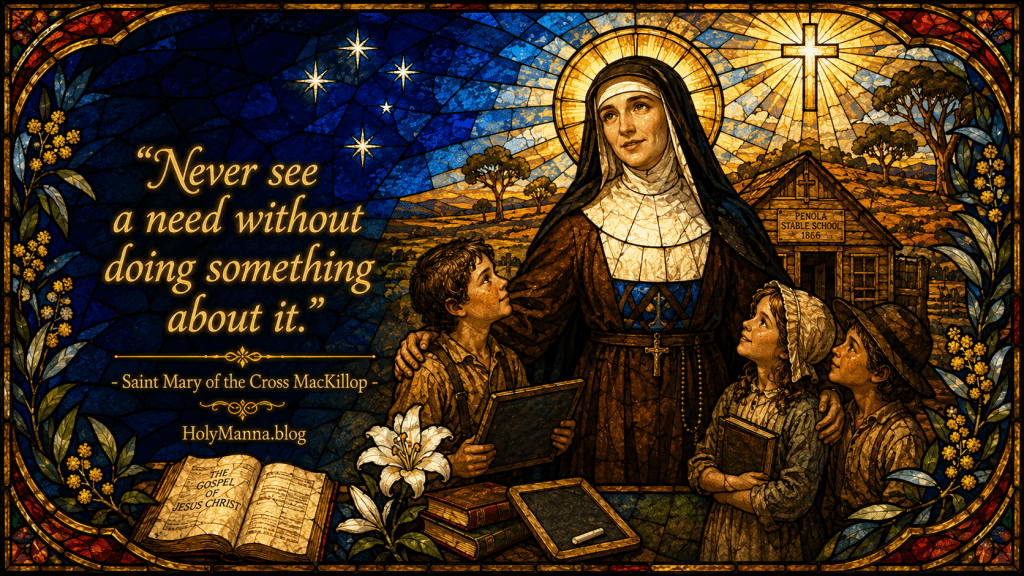
The Unstoppable Faith of Australia’s First Saint
On August 8th, the Church celebrates Saint Mary of the Cross MacKillop, and in her homeland of Australia the day is kept not as a simple memorial but as a solemnity, the highest rank a feast can hold. That tells you something before a single word of her story is spoken. Mary MacKillop is the first Australian ever to be canonized, raised to the altars by Pope Benedict XVI on October 17, 2010, and she has become something close to the spiritual heart of an entire nation. In 2013, by formal decree of the Congregation for Divine Worship, she was named the second patron of Australia, standing alongside Our Lady Help of Christians, who has held that patronage since 1844. She is also the patron of the Archdiocese of Brisbane, the patron of the Diocese of Parramatta, and the patron of the Knights of the Southern Cross, a Catholic men’s order in Australia.
What did she do to earn such love? She co-founded the Sisters of Saint Joseph of the Sacred Heart, the first religious congregation ever established by an Australian, and through it she brought free Catholic education to the poorest children on the continent, the ones nobody else would teach. She opened orphanages, refuges for women leaving prison, and homes for the elderly poor. She crossed the outback by horse and cart to reach families the world had forgotten. And she did all of it while enduring one of the most painful trials a faithful Catholic can suffer: a wrongful excommunication, pronounced by her own bishop, which was later lifted and formally acknowledged as invalid. The Church she loved wounded her deeply, and she never stopped loving the Church. That is why her story matters, and that is why the Church holds her up as a model. As the Catechism teaches, “By canonizing some of the faithful, i.e., by solemnly proclaiming that they practiced heroic virtue and lived in fidelity to God’s grace, the Church recognizes the power of the Spirit of holiness within her and sustains the hope of believers by proposing the saints to them as models and intercessors” (CCC 828).
A Scottish Heart in a New Land
Mary Helen MacKillop was born on January 15, 1842, in Fitzroy, then a district of Melbourne in the colony of Victoria. Some popular retellings misplace her birth in other colonies, but the documented record points to Fitzroy, and it matters, because her beginnings were as humble as the children she would one day serve. Her parents, Alexander MacKillop and Flora MacDonald, were Catholic immigrants from the Scottish Highlands who had arrived in the Australian colonies in the late 1830s. Mary was the eldest of their eight children.
Her father is one of the great bittersweet figures in her story. Alexander had studied for the priesthood in Rome before discerning that it was not his path, so the MacKillop home was rich in faith and learning. Mary received from him a solid grounding in the truths of the faith that most colonial children never had. But Alexander was hopeless with money. He failed at farming, failed at business, and moved the family from house to house, often depending on relatives for shelter. Poverty was not something Mary read about. It was the air she breathed as a child.
From her earliest years, Mary sensed God quietly calling her to a life of poverty consecrated to the service of the poor. But the call had to wait, because her family needed her first. At fourteen she went to work as a clerk in a Melbourne stationery shop, and her small wages helped keep her parents and siblings fed. There was no dramatic thunderbolt conversion in Mary’s life. There was something rarer and, in its own way, more demanding: a steady deepening of a faith she had carried since childhood, tested daily by duty and want. In 1860 she moved to the small rural town of Penola in South Australia to serve as governess for her aunt and uncle’s children, and it was there that Providence arranged the meeting that would change Australia. The parish priest of Penola was Father Julian Tenison Woods, a brilliant and restless man with a burning conviction that the children of the bush, scattered across vast distances and desperately poor, deserved a Catholic education. In Mary, he found the soul who could make that conviction real.
The Stable School and the Brown Josephites
Every great work of God seems to begin small, and this one began in a stable. In 1866, Mary moved to Penola with her sisters, and her brother John renovated a cottage and a disused stable into the first Saint Joseph’s school. The MacKillop siblings taught more than fifty local children there, and to the astonishment of the townspeople, they taught even the children whose parents could not afford to pay a single coin. On March 19, 1866, the feast of Saint Joseph, Mary appeared dressed in black, dedicating herself entirely to the work, and the Sisters of Saint Joseph of the Sacred Heart trace their founding to that moment. In 1867 she professed vows, took the religious name Mary of the Cross, and became the first sister and first superior of the new congregation.
The growth that followed was astonishing. Within a year the sisters had opened schools in other cities, along with an orphanage and a refuge for women released from prison. The Josephites, affectionately nicknamed the Brown Joeys for their simple brown habits, lived a way of religious life that was startling for the era. They took no dowries, so any woman with a true vocation could enter, rich or poor. They refused government funding so their schools would remain free and fully Catholic. They declined to run fee-paying academies for wealthy families, and they even refused to teach ornamental subjects like music, so no one could accuse them of serving the comfortable. They lived among the poor as the poor, begging alms door to door, and they went wherever the need was greatest, into mining camps and bush settlements that no other teachers would touch. Money, or rather the lack of it, was a constant worry, yet the sisters were convinced that their struggles were opportunities to grow closer to God.
Here honesty requires a plain statement, because a saint’s story must never be embellished. The Church documents no wonder-working miracles performed by Mary during her lifetime. She healed no lepers with a touch and raised no one from the dead. Those who knew her testified instead to something the Church weighs just as carefully: heroic virtue, and an almost supernatural trust that God would provide when nothing else would. Time and again the congregation had no money, no food, and no earthly reason to survive, and time and again what was needed arrived. Mary wrote to her sisters in 1907, near the end of her life, that “God’s love is too deep for words to express,” and in 1874, in the middle of her worst trials, she urged them, “Let us all have courage.” Her daily bread was the Providence of the Father, and that quiet, unbroken reliance was the miracle of her active years. The saying handed down by her congregation as her motto captures the whole spirit of the work: “Never see a need without doing something about it.” Whether or not those exact words appear in a dated letter, her sisters preserved them as the truest summary of her life, and her life proves them right. This is precisely the love the Lord describes when He says, “Amen, I say to you, whatever you did for one of these least brothers of mine, you did for me” (The Gospel of Matthew, Mt 25:40), and it is the love the Church still commands of every believer today, teaching that “the works of mercy are charitable actions by which we come to the aid of our neighbor in his spiritual and bodily necessities” (CCC 2447).
Excommunicated for Doing What Was Right
Mary MacKillop was never martyred, but she carried a cross that would have broken most souls, and she carried it at the hands of men inside the Church she served. Her congregation’s rule placed the sisters under a central superior drawn from their own ranks rather than under the control of each local bishop. Some priests and bishops resented that independence. The resentment turned poisonous after the Josephites became involved in exposing a priest who had been abusing children. The sisters reported what they learned, the offending priest was sent away, and his friends among the clergy never forgave the congregation. Chief among them was Father Charles Horan, who gained the ear of Bishop Laurence Sheil of Adelaide, the same bishop who had originally approved the congregation’s rule. Horan and his allies pressed the aging and ailing bishop to bring the sisters under diocesan control and to change the rule they lived by.
Mary wrote respectfully to Bishop Sheil that she desired to continue operating the community according to the rule he himself had approved. On September 22, 1871, in response, the bishop excommunicated her for alleged insubordination and turned the sisters out of their convent. Picture the scene honestly. A twenty-nine year old religious sister, kneeling before her bishop, hearing the most terrifying sentence the Church can pronounce, cast out from the sacraments she loved more than life. And here is where the saint shines through, because her own written account of that moment survives, and it is one of the most remarkable passages in the literature of the saints. She wrote, “I do not know how to describe the feeling, but I was intensely happy and felt nearer to God than I had ever felt before. The sensation of the calm beautiful presence of God I shall never forget.” There was no bitterness in her words and no rage; in the very moment of injustice, she rested in God.
She refused to allow her sisters or friends to speak against the bishop. She waited, homeless and publicly disgraced, sheltered by friends including, in one of the most beloved details of her story, the Jewish businessman Emanuel Solomon, who gave the scattered sisters lodging when many Catholics were afraid to. In February 1872, as he lay dying, Bishop Sheil acknowledged that he had been misled and ordered the excommunication rescinded. An apostolic commission subsequently investigated the whole affair and completely exonerated Mary, though Father Woods was removed as the congregation’s director. Many years later, in 2009, Bishop Sheil’s successor, Archbishop Philip Wilson, publicly apologized to the Sisters of Saint Joseph for what he called Mary’s wrongful and invalid excommunication.
The trials did not end there, and it is important to see how long her road truly was. In 1873 she sailed to Rome to place her congregation directly under the protection of the Holy See, meeting Blessed Pope Pius IX and securing approval for the rule of central government, with final papal approval of the congregation coming from Pope Leo XIII in 1888. Bishops in Bathurst and Brisbane later fought to seize control of the sisters in their dioceses, and rather than surrender the rule, the Josephites withdrew. In 1883 the Bishop of Adelaide effectively banished her from the very city where she had built the congregation, and she relocated to Sydney. In 1885 she was removed as superior general, and she served humbly under her successor for fourteen years until the sisters re-elected her in 1899. Through those same years she endured a slander that wounded her deeply: whispers that she was a drunkard, because doctors had prescribed brandy for her chronic and painful illness. The accusation was investigated and disproven, but the humiliation was real. Then in 1902, while visiting her sisters in New Zealand, she suffered a stroke that paralyzed her right side. She governed the congregation from a wheelchair for her final seven years, her mind clear and her spirit unbowed. Through every one of these trials, her counsel to her sisters never changed. In 1871, the very year of her excommunication, she wrote, “Forgiveness is love,” and in 1890 she urged them, “Keep your mind in peace whatever happens.” She died at the convent on Mount Street in North Sydney on August 8, 1909. Cardinal Patrick Moran of Sydney, who had visited her at the end, declared, “I consider this day to have assisted at the deathbed of a saint.”
Two Cancers, Two Cures, One Canonization
The Australian people did not wait for Rome to tell them what they had witnessed. Mary’s grave at the Gore Hill cemetery immediately became a place of pilgrimage, with the faithful carrying away soil from the plot, and in 1914 her remains were transferred to a vault in the Memorial Chapel on Mount Street in North Sydney, a resting place given by her devoted friend Joanna Barr Smith, who was, beautifully, a lifelong Presbyterian. In 1925 the Archbishop of Sydney opened the official cause for her canonization.
The Church requires verified miracles for beatification and canonization, and Mary’s two approved miracles are among the most thoroughly documented of the modern era, both involving Australian women cured of cancer. The first concerned Veronica Hopson, a young woman of the Diocese of Parramatta who was diagnosed in 1961, at the age of twenty-four, with acute myeloblastic leukaemia and given only months to live. Her family and friends prayed persistently through the intercession of Mary MacKillop, and Veronica recovered completely, going on to marry, raise a family, and welcome grandchildren. For decades the Church protected her privacy, and she was known in the cause simply as patient X. Before the beatification, Pope John Paul II met her in secret, and she later recalled him telling her that she was a very special person. Her cure was officially recognized as miraculous, and Pope John Paul II beatified Mary MacKillop on January 19, 1995, before a vast crowd at Randwick Racecourse in Sydney.
The second miracle concerned Kathleen Evans, a wife, mother of five, and grandmother from the Lake Macquarie region of New South Wales. In 1993, at the age of forty-nine, she was diagnosed with an inoperable large cell carcinoma of the lung, and doctors then discovered a secondary tumor in her brain. She was given roughly two months to live and was beyond the help of chemotherapy. She declined radiotherapy, which could have added only weeks. A friend gave her a picture of Mary MacKillop with a small relic of Mary’s clothing attached to the back, and Kathleen wore it pinned to her nightgown while her family and friends prayed through Mary’s intercession. Against every medical expectation, the cancer disappeared entirely. After exhaustive investigation, Pope Benedict XVI formally recognized the cure as a miracle on December 19, 2009, and on October 17, 2010, before tens of thousands of jubilant Australians in Saint Peter’s Square, he canonized Saint Mary of the Cross MacKillop. Both women, Veronica and Kathleen, were present in the square that day. Beyond these two approved cures, countless Australians have attributed graces, healings, and answered prayers to her intercession in the century since her death; these personal accounts are treasured stories of devotion, and they cannot be verified.
In asking her prayers, the faithful are simply doing what the Church has always taught. The Catechism explains that the saints “do not cease to intercede with the Father for us, as they proffer the merits which they acquired on earth through the one mediator between God and men, Christ Jesus” (CCC 956). Today her tomb at Mary MacKillop Place in North Sydney draws pilgrims from around the world, as do the Mary MacKillop Penola Centre near the site of the stable school and the Heritage Centre in East Melbourne near her birthplace. Her face has appeared on Australian postage stamps, a rose has been bred and named in her honor, a pilgrim cross made from timber of her original stable school toured the nation before her canonization, and schools, colleges, hospitals, and family service agencies across Australia and New Zealand bear her name. Her sisters continue her mission today in Australia, New Zealand, and beyond, including among the poor of East Timor.
What Mary Teaches a Weary Modern Heart
It would be easy to file Saint Mary of the Cross MacKillop away as a heroine from a distant colonial world, but her life speaks with almost uncomfortable directness to this generation. Consider what she actually faced: financial insecurity from childhood, the burden of supporting a family before she was old enough to vote, institutional betrayal by leaders she trusted, a public shaming campaign built on lies, chronic illness, and disability at the end of her life. There is hardly a wound of the modern age she did not carry. And she answered every one of them with the same three weapons: trust in Providence, tireless work for the person in front of her, and forgiveness without exception.
Her trust was not a vague optimism. It was a theological conviction that the Father sees and provides, lived out one empty cupboard at a time. Her work was not activism unmoored from prayer; it flowed from the sacraments and from her vows, and she counseled her sisters in 1907 that “prayer is our great weapon.” And her forgiveness was not weakness. She forgave the men who excommunicated her while refusing to abandon the rule God had given her, proving that meekness and courage are not opposites but partners. The Church teaches that “charity is the theological virtue by which we love God above all things for his own sake, and our neighbor as ourselves for the love of God” (CCC 1822), and Mary’s life is that definition written in flesh and dust and chalk.
So bring her into your ordinary week. When a need appears in front of you, a lonely coworker, a struggling parent at your child’s school, a sibling drowning in debt, remember the motto her sisters handed down and do something about it, however small. When you are slandered or overlooked, ask for her intercession before you reach for your own defense, and try her way first: “Keep your mind in peace whatever happens.” When the failures of people inside the Church tempt you toward bitterness or toward the exit, remember the woman who was excommunicated unjustly and who never once stopped loving the Church, because she knew the Church belongs to Christ and not to the men who wound it. Where in your own life has God allowed an injustice that He is inviting you to answer with forgiveness rather than fury? Who is the person nearest to you right now whose need you have seen but not yet acted upon? And what would change in your daily anxieties if you truly believed, as Mary did, that the Father sees every empty cupboard?
Engage With Us!
The story of Saint Mary of the Cross MacKillop belongs to every believer who has ever been wounded by the very people who should have protected them, and to everyone who has looked at a need and wondered whether one person can really make a difference. Share your thoughts and reflections in the comments below; this community grows stronger every time someone speaks honestly about the faith. To guide your reflection, consider these questions.
- Saint Mary was excommunicated unjustly and responded with peace and forgiveness rather than bitterness. How do you respond when you are treated unfairly, especially by people within the Church or your own family?
- The Josephites refused wealth, dowries, and government funding so they could serve the poorest children freely. What comfort or security might God be asking you to loosen your grip on in order to serve others more generously?
- Mary’s motto, handed down by her sisters, was to never see a need without doing something about it. What need have you seen this week, and what one concrete step could you take toward it before Sunday?
- Kathleen Evans and Veronica Hopson were ordinary Catholics whose lives became part of a saint’s story through prayer. Do you truly ask for the intercession of the saints, and if not, what holds you back?
Saint Mary of the Cross MacKillop shows that holiness does not require a dramatic stage, only a willing heart, a trusting spirit, and hands ready to work. This week, let her courage steady you, let her forgiveness challenge you, and let her trust in Providence quiet your fears. Live your faith boldly, love the Church even when her members fail, and do everything, from the greatest sacrifice to the smallest chore, with the love and mercy that Jesus taught us. Saint Mary of the Cross MacKillop, pray for us!
Saint Mary of the Cross MacKillop, pray for us!
Follow us on YouTube, TikTok, Instagram and Facebook for more insights and reflections on living a faith-filled life.


Leave a comment