Memorial of Saint Dominic, Priest – Lectionary: 412
When Heaven Seems Quiet
Every believer eventually stands where Habakkuk stood, looking at a world that seems upside down and asking God why He is silent. Today, on the Memorial of Saint Dominic, the Church places that raw, honest question at the very center of the liturgy and then answers it with one of the most important sentences in all of Scripture: “the just man, because of his faith, shall live” (Habakkuk 2:4). This is the verse St. Paul would later place at the foundation of his Gospel in Romans 1:17, and it unites everything the Church proclaims today. Habakkuk, writing in the late seventh century before Christ as the brutal Babylonian empire rose to power, dares to ask how a holy God can watch the wicked devour the just. God’s answer is not an explanation but a promise: the vision presses on to fulfillment, and those who trust will live. The Psalmist takes up that promise and sings it back as a confession, declaring that God “has not forgotten the cry of the poor” (Psalm 9). Then Jesus Himself, fresh from the glory of the Transfiguration, shows what that trust can do, telling His disciples that faith the size of a mustard seed can move mountains. It is fitting that this all falls on the feast of St. Dominic, who died in 1221 after founding the Order of Preachers, a man who took God’s command to Habakkuk literally: write the vision down clearly, so that everyone can read it. The readings ask one question of every reader today. When God seems slow, will faith keep watch?
First Reading — Habakkuk 1:12—2:4
The Prophet Who Argued with God and Won an Answer
Habakkuk is unlike any other prophet in the Old Testament. Instead of carrying God’s word to the people, he carries the people’s anguish to God. Judah in his day was caught between empires. Nineveh had fallen, Babylon was rising, and the violence Habakkuk saw in his own nation was about to be punished by a nation even more violent. The prophet’s scandal is not that God judges sin but that God seems to use a wickeder instrument to do it, and then says nothing. This reading holds the whole drama of the day’s central theme: honest complaint, patient watching, and the divine promise that faith is the way the just will live.
Habakkuk 1:12—2:4
Are you not from eternity, O LORD,
my holy God, immortal?
O LORD, you have marked him for judgment,
O Rock, you have readied him punishment!
Too pure are your eyes to look upon evil,
and the sight of misery you cannot endure.
Why, then, do you gaze on the faithless in silence
while the wicked man devours
one more just than himself?
You have made man like the fish of the sea,
like creeping things without a ruler.
He brings them all up with his hook,
he hauls them away with his net,
He gathers them in his seine;
and so he rejoices and exults.
Therefore he sacrifices to his net,
and burns incense to his seine;
for thanks to them his portion is generous,
and his repast sumptuous.
Shall he, then, keep on brandishing his sword
to slay peoples without mercy?I will stand at my guard post,
and station myself upon the rampart,
And keep watch to see what he will say to me,
and what answer he will give to my complaint.Then the LORD answered me and said:
Write down the vision
Clearly upon the tablets,
so that one can read it readily.
For the vision still has its time,
presses on to fulfillment, and will not disappoint;
If it delays, wait for it,
it will surely come, it will not be late.
The rash man has no integrity;
but the just man, because of his faith, shall live.
Detailed Exegesis
Verse 12: “Are you not from eternity, O LORD, my holy God, immortal? O LORD, you have marked him for judgment, O Rock, you have readied him punishment!” Habakkuk begins his complaint not with doubt but with doctrine. He anchors himself in what he knows is true: God is eternal, holy, and unchanging, the Rock of Israel. Even Babylon exists under God’s sentence. Faith that questions God must first confess who God is, and the prophet models exactly that order.
Verse 13: “Too pure are your eyes to look upon evil, and the sight of misery you cannot endure. Why, then, do you gaze on the faithless in silence while the wicked man devours one more just than himself?” Here is the ache at the heart of the book. If God cannot tolerate evil, why does He appear to tolerate it? Judah was sinful, but Babylon was worse, and the prophet cannot square divine purity with divine patience. Scripture itself gives voice to the question every suffering believer has asked.
Verse 14: “You have made man like the fish of the sea, like creeping things without a ruler.” Habakkuk describes how the world looks when God’s governance is hidden. Humanity appears leaderless, as vulnerable as fish before a net, and nations seem to be prey for whoever is strongest.
Verse 15: “He brings them all up with his hook, he hauls them away with his net, He gathers them in his seine; and so he rejoices and exults.” The fisherman is Babylon. Ancient conquerors literally led captives away with hooks, and the empire gloried in dragging whole peoples into exile. Evil not only succeeds here; it celebrates.
Verse 16: “Therefore he sacrifices to his net, and burns incense to his seine; for thanks to them his portion is generous, and his repast sumptuous.” Babylon worships its own weapons. This is the essence of idolatry in every age: crediting created power, whether armies, wealth, or self, for what only God gives. The empire’s liturgy is offered to its own military machine.
Verse 17: “Shall he, then, keep on brandishing his sword to slay peoples without mercy?” The complaint ends with a question that demands an answer. Will this go on forever? The prophet refuses both despair and easy answers, and instead does something remarkable.
Chapter 2, Verse 1: “I will stand at my guard post, and station myself upon the rampart, And keep watch to see what he will say to me, and what answer he will give to my complaint.” Habakkuk becomes a watchman. He does not walk away from God in his confusion; he plants himself in God’s presence and waits. This is the posture of biblical faith under trial, prayer that refuses to leave until God speaks.
Verse 2: “Write down the vision Clearly upon the tablets, so that one can read it readily.” God answers. The vision must be written plainly and publicly, so that anyone can read it and run with it. Divine truth is not a private consolation; it is meant to be proclaimed.
Verse 3: “For the vision still has its time, presses on to fulfillment, and will not disappoint; If it delays, wait for it, it will surely come, it will not be late.” God’s timetable is not our timetable, but it is never wrong. What feels like delay to the prophet is precision to God. The promise presses forward even when nothing visible moves.
Verse 4: “The rash man has no integrity; but the just man, because of his faith, shall live.” This single verse became a pillar of the New Testament. The proud collapse under their own weight, but the one who clings to God in trusting fidelity possesses life itself.
Teachings
The Catechism speaks directly to Habakkuk’s experience. CCC 164 teaches, “Even though enlightened by him in whom it believes, faith is often lived in darkness and can be put to the test. The world we live in often seems very far from the one promised us by faith. Our experiences of evil and suffering, injustice and death, seem to contradict the Good News; they can shake faith and become a temptation against it.” The Church does not pretend the prophet’s question is illegitimate; she canonizes it. St. Paul places God’s answer at the foundation of the Gospel itself, writing in Romans 1:17, “For in it is revealed the righteousness of God from faith to faith; as it is written, ‘The one who is righteous by faith will live.’” St. Augustine, in Sermons 43, gives faith its classic definition: “Faith is to believe what you do not see; the reward of this faith is to see what you believe.” And the Catechism, in CCC 227, offers the prayer of St. Teresa of Jesus as the mature fruit of Habakkuk’s watchtower: “Let nothing trouble you / Let nothing frighten you / Everything passes / God never changes / Patience / Obtains all / Whoever has God / Wants for nothing / God alone is enough.”
Reflection
Habakkuk gives permission to pray honestly. Bringing anger, confusion, and grief to God is not a failure of faith; it is faith, so long as the complaint is planted on the watchtower and not in the exit lane. A practical way to live this reading is to take one situation that seems like proof of God’s silence, write it down plainly as God told the prophet to do, and beside it write the promise of Habakkuk 2:3, then return to that page in prayer each day this week. What complaint has gone unspoken in prayer because it felt too raw to say to God? Where is the invitation to stop pacing and stand watch instead, trusting that the vision will not be late?
Responsorial Psalm — Psalm 9:8-13
The Song That Answers the Prophet’s Question
The Church places Psalm 9 on the lips of the faithful today as the direct answer to Habakkuk’s complaint. In the Hebrew tradition this psalm of David originally formed one long alphabetical poem together with Psalm 10, a thanksgiving for God’s just judgment sung by someone who had seen deliverance with his own eyes. Where the prophet asks whether God sees, the psalmist answers that God is already seated on the bench. The refrain chosen by the liturgy carries the whole message of the day: “You forsake not those who seek you, O Lord.”
Psalm 9:8-13
R. (11b) You forsake not those who seek you, O Lord.
The LORD sits enthroned forever;
he has set up his throne for judgment.
He judges the world with justice;
he governs the peoples with equity.
R. You forsake not those who seek you, O Lord.
The LORD is a stronghold for the oppressed,
a stronghold in times of distress.
They trust in you who cherish your name,
for you forsake not those who seek you, O LORD.
R. You forsake not those who seek you, O Lord.
Sing praise to the LORD enthroned in Zion;
proclaim among the nations his deeds;
For the avenger of blood has remembered;
he has not forgotten the cry of the poor.
R. You forsake not those who seek you, O Lord.
Detailed Exegesis
Verse 8: “The LORD sits enthroned forever; he has set up his throne for judgment.” Empires rise and fall, but the throne that matters was never vacant. Babylon’s power in Habakkuk’s day was real but temporary; God’s kingship is eternal, and His courtroom is always in session.
Verse 9: “He judges the world with justice; he governs the peoples with equity.” Human justice is partial, delayed, and often corrupted. Divine justice is perfect and universal. Every nation, including the strongest, stands under this governance whether it acknowledges God or not.
Verse 10: “The LORD is a stronghold for the oppressed, a stronghold in times of distress.” The repetition of “stronghold” is deliberate poetry. God is not merely sympathetic to the oppressed; He is their fortress, the place where the powerless are safe when the nets of the powerful are cast.
Verse 11: “They trust in you who cherish your name, for you forsake not those who seek you, O LORD.” Trust grows from knowing God’s name, which in Scripture means knowing His character. Those who have learned who God is find abandonment impossible, because His fidelity is who He is.
Verse 12: “Sing praise to the LORD enthroned in Zion; proclaim among the nations his deeds;” Gratitude becomes mission. The one who has been rescued cannot stay quiet, and the psalm commands exactly what God commanded Habakkuk: make the message public, so the nations can read it.
Verse 13: “For the avenger of blood has remembered; he has not forgotten the cry of the poor.” This is the verse the refrain rests upon. God’s memory is not like human memory. Nothing suffered by the lowly is lost, and every cry of the poor is held until the day of justice.
Teachings
The psalm’s confidence in God’s care for the lowly runs through the whole of Catholic teaching. The Catechism declares in CCC 2443, “God blesses those who come to the aid of the poor and rebukes those who turn away from them,” showing that God’s remembrance of the poor becomes a command laid upon His people. The psalmist’s posture also teaches the Church how to pray. CCC 2559 concludes, “He who humbles himself will be exalted; humility is the foundation of prayer.” The oppressed man who runs to God as his stronghold is not exercising weakness but the deepest realism, because he prays from the truth of his dependence. St. Dominic, whose memorial the Church keeps today, lived this psalm concretely. As a student in Palencia during a famine, he sold his own precious books, hand copied and irreplaceable in his day, to feed the starving, saying according to his early biographers that he refused to study on dead skins while people died of hunger. His life shows what happens when someone truly believes God has not forgotten the cry of the poor: that person becomes part of God’s answer.
Reflection
This psalm invites a double examination. First, of trust: whether God is treated as a stronghold or as a last resort after every other fortress has failed. Second, of mission: whether His deeds are proclaimed or kept private. A concrete practice for the week is to pray verse 13 slowly each morning and then perform one hidden act of care for someone in distress, becoming an agent of the God who forgets no one. Who in daily life is crying out and being overlooked, and what would it mean to be God’s remembrance for that person? Does prayer flow from the humility of one who needs a stronghold, or from self-sufficiency?
Holy Gospel — Matthew 17:14-20
Down the Mountain and into the Valley of Little Faith
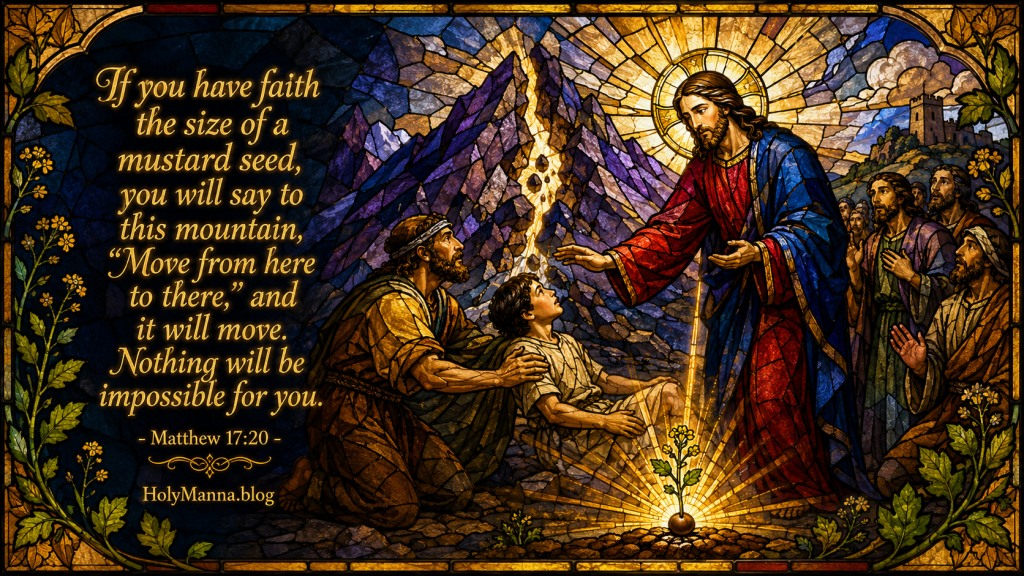
Matthew places this scene immediately after the Transfiguration. Peter, James, and John have just seen the glory of Christ blazing on the mountain, and the very first thing waiting at the bottom is failure: a tormented boy, a heartbroken father, and nine disciples who tried to help and could not. The contrast is the whole point. The Gospel of Matthew shows what happens when the glory of God meets the weakness of human faith, and Jesus’ answer gathers the entire day into one image, the mustard seed.
Matthew 17:14-20
A man came up to Jesus, knelt down before him, and said,
“Lord, have pity on my son, who is a lunatic and suffers severely;
often he falls into fire, and often into water.
I brought him to your disciples, but they could not cure him.”
Jesus said in reply,
“O faithless and perverse generation, how long will I be with you?
How long will I endure you?
Bring the boy here to me.”
Jesus rebuked him and the demon came out of him,
and from that hour the boy was cured.
Then the disciples approached Jesus in private and said,
“Why could we not drive it out?”
He said to them, “Because of your little faith.
Amen, I say to you, if you have faith the size of a mustard seed,
you will say to this mountain,
‘Move from here to there,’ and it will move.
Nothing will be impossible for you.”
Detailed Exegesis
Verse 14: “A man came up to Jesus, knelt down before him, and said,” The father’s first act is worship. Kneeling before Jesus, he takes the posture of the psalmist before the enthroned Lord, bringing his distress to the only stronghold left.
Verse 15: “Lord, have pity on my son, who is a lunatic and suffers severely; often he falls into fire, and often into water.” The word translated “lunatic” is the Greek seleniazetai, literally “moonstruck,” the ancient description for seizures resembling epilepsy. Matthew’s account makes clear this particular affliction was demonic in origin. The detail about fire and water shows a torment aimed at destruction, and a father who has clearly spent years pulling his boy back from the edge.
Verse 16: “I brought him to your disciples, but they could not cure him.” The disciples had already been given authority over unclean spirits in Matthew 10. Something had changed, not in the gift but in the receivers. Their failure sets up the teaching that closes the passage.
Verse 17: “Jesus said in reply, ‘O faithless and perverse generation, how long will I be with you? How long will I endure you? Bring the boy here to me.’” The lament echoes the words of Moses about Israel in Deuteronomy 32, placing Jesus in the position of God’s own long-suffering patience with His people. Yet the rebuke ends in invitation. Whatever the generation’s faithlessness, the command remains: bring the suffering one to Jesus.
Verse 18: “Jesus rebuked him and the demon came out of him, and from that hour the boy was cured.” What the disciples could not do with effort, Jesus does with a word. Matthew records no struggle and no ritual, only authority. The eternal throne of Psalm 9 is standing in the valley in sandals.
Verse 19: “Then the disciples approached Jesus in private and said, ‘Why could we not drive it out?’” The disciples’ question is one of the most hopeful moments in the passage. They do not excuse themselves or blame the boy; they come privately and ask to be taught. Failure brought to Jesus becomes formation.
Verse 20: “He said to them, ‘Because of your little faith. Amen, I say to you, if you have faith the size of a mustard seed, you will say to this mountain, “Move from here to there,” and it will move. Nothing will be impossible for you.’” Jesus diagnoses the problem as “little faith,” a favorite word in Matthew for disciples who believe but waver. Then comes the stunning promise. The measure of faith’s power is not its size but its genuineness, because its power is God’s own.
Teachings
St. John Chrysostom preached on this very passage in his Homily 57 on Matthew, explaining the Lord’s choice of image: “To indicate therefore that even the least degree of genuine faith can do great things, He mentioned the mustard seed.” The Catechism defines what this faith is in CCC 1814: “Faith is the theological virtue by which we believe in God and believe all that he has said and revealed to us, and that Holy Church proposes for our belief, because he is truth itself.” And CCC 2610 draws out the connection between faith and prayer that this Gospel dramatizes: “Such is the power of prayer and of faith that does not doubt: ‘all things are possible to him who believes.’” The same paragraph notes that Jesus is saddened by the “little faith” of His own disciples even as He marvels at the great faith of outsiders like the centurion. The lesson of the valley is the lesson of Habakkuk’s watchtower: the just do not live by the size of their certainty but by the fidelity of their trust in the God for whom nothing is impossible.
Reflection
Everyone has a mountain, a situation so fixed and heavy that prayer about it feels pointless. This Gospel forbids that conclusion. The invitation is not to manufacture bigger feelings of faith but to plant genuine trust, however small, in Jesus and keep bringing the impossible thing to Him, as the father brought his son. A practical step is to name one mountain honestly in prayer this week and to pray about it daily with the simple words of the father in Mark’s parallel account, asking the Lord to strengthen weak belief. What mountain has quietly been declared immovable, and what would it look like to bring it to Jesus again? When effort fails, is the response private discouragement or the disciples’ humble question, asking the Lord why and letting Him teach?
The Vision Will Not Be Late
Today’s readings trace a single golden thread from a watchtower in ancient Judah to a valley in Galilee. Habakkuk dared to ask why God stays silent while the wicked prosper, and God answered with a promise that has carried the Church for over two and a half millennia: the vision presses on to fulfillment, and “the just man, because of his faith, shall live” (Habakkuk 2:4). The psalmist sang the answer into Israel’s worship, proclaiming a God enthroned forever who “has not forgotten the cry of the poor.” Then Jesus came down the mountain and showed the promise in action, healing with a word what human effort could not touch, and teaching that faith the size of a mustard seed is enough to move mountains, because the power belongs to God and not to the seed. St. Dominic, whom the Church celebrates today, gathered all of it into a single life. He stood watch in prayer, he wrote the vision plainly by founding an order of preachers so the whole world could read it, and he sold his books to answer the cry of the poor. His witness makes the invitation of these readings concrete. Faith is not a feeling to be waited on but a trust to be lived, one honest prayer, one act of mercy, one mountain at a time. Whatever seems delayed in life right now, whatever prayer seems to have gone unanswered, the word of the Lord still stands: wait for it, it will surely come, it will not be late. Stand at the watchtower. Bring the impossible to Jesus. The just live by faith, and the God they trust has never once forgotten them.
Engage With Us!
Reflections, questions, and stories of faith are warmly welcome in the comments below, because faith grows when it is shared, and someone reading may need exactly the testimony another reader can give.
- In Habakkuk 1:12—2:4, the prophet brings his complaint to God and then stations himself to wait for an answer. What honest question needs to be brought to God this week, and what would standing at the watchtower look like in daily life?
- In Psalm 9:8-13, the Lord is called a stronghold for the oppressed who has not forgotten the cry of the poor. Whose cry might God be asking His people to remember and answer this week?
- In Matthew 17:14-20, Jesus teaches that faith the size of a mustard seed can move mountains. What mountain in life has quietly been declared immovable, and how can it be brought back to Jesus in prayer?
- Taken together, the readings proclaim that the just live by faith even when God seems silent. Where is God inviting deeper trust right now, and what one concrete step of faith can be taken today?
Living faith is built exactly this way, in small seeds planted daily and watered with trust. May every reader walk through this week doing everything with the love and mercy Jesus taught, confident that the God who answers prophets and heals children forsakes no one who seeks Him.
Sacred Heart of Jesus, we trust in You!
Immaculate Heart of Mary, pray for us!
Saint Michael the Archangel, defend us in battle!
Follow us on YouTube, TikTok, Instagram and Facebook for more insights and reflections on living a faith-filled life.

 Holy Manna!
Leave a comment