The Pope Who Would Not Leave the Altar
Every time a priest prays the Roman Canon, the ancient First Eucharistic Prayer of the Church, a short list of names rises from the altar like incense. Among them, right after Linus, Cletus, Clement, and Cornelius, comes a name most Catholics have heard hundreds of times without ever stopping to ask who he was: Sixtus. On August 7th, the Church stops and asks. She celebrates Pope Saint Sixtus II and his companions, martyrs of the year 258, and in doing so she opens a window onto one of the most dramatic and best documented moments of the early Church.
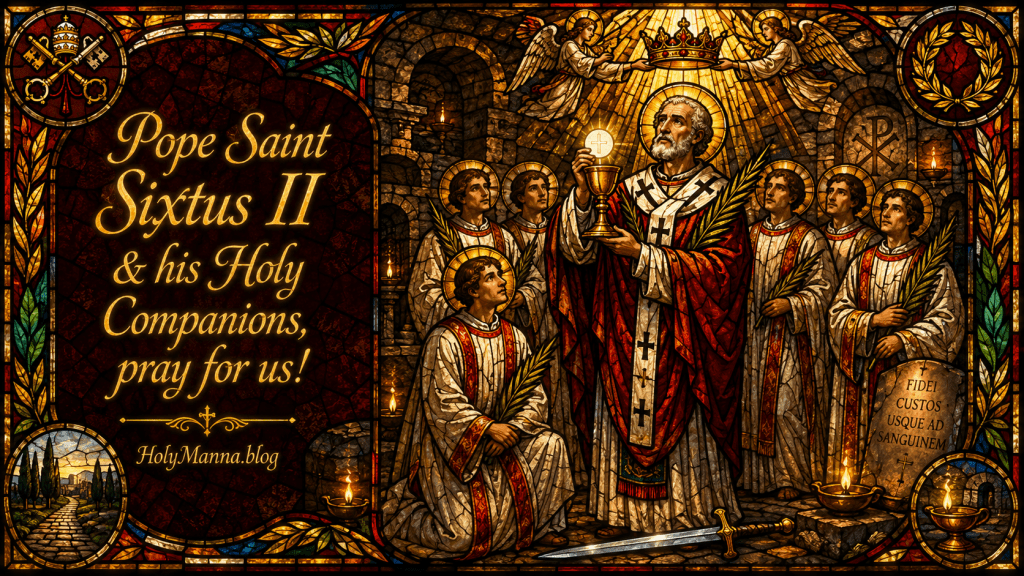
Sixtus II reigned as Bishop of Rome for less than a single year, from August of 257 to August of 258. In human terms, his pontificate was a blink. In the eyes of God and of the Church, it was a masterpiece. In those few months he healed a wound that had threatened to tear apart the communion of the universal Church, he shepherded the Christians of Rome through the opening blows of one of the empire’s cruelest persecutions, and he finished his course exactly where a shepherd belongs, in the middle of his flock, presiding over the sacred assembly, when the soldiers of the Emperor Valerian came for him. He was put to death on August 6, 258, together with four of his deacons, and within days two more of his deacons had followed him, with the most famous of all, Saint Lawrence, following on August 10th.
The Church has always understood what happened in those catacombs as the supreme act of Christian witness. The Catechism teaches, “Martyrdom is the supreme witness given to the truth of the faith: it means bearing witness even unto death” (CCC 2473). Sixtus and his companions gave that witness not in the abstract, but in the very act of gathering the Church for worship. They died, quite literally, for the Mass. That is why their story still matters to anyone who has ever wondered whether Sunday worship is worth an inconvenience, let alone a life.
A Church on Edge
The honest historian must begin with a confession: almost nothing is known about the early life of Sixtus II. His birthplace, his family, and his formation are lost to history. The ancient Liber Pontificalis, the early catalogue of the popes, records that he was a Greek by birth, but scholars have long judged this claim doubtful. It appears to rest on a confusion between the pope and a Greek philosopher of the same name, the author of a collection of moral maxims known as the Sentences of Xystus. The Church can say with confidence only that a man named Sixtus, or Xystus in its Greek form, was elected Bishop of Rome on August 31, 257, succeeding Pope Saint Stephen I.
A later tradition, cherished especially in Spain, tells a warmer story. In this telling, Sixtus was a renowned teacher who encountered a brilliant young student named Lawrence in the city of Caesaraugusta, the modern Zaragoza, and brought him along to Rome, where he would one day ordain him a deacon. It is a beautiful story, and it explains the deep bond between the pope and his most famous deacon, but it appears only in sources written long after the events. This story cannot be verified.
What can be verified is the situation Sixtus inherited, and it was tense on two fronts at once. Inside the Church, a bitter theological dispute had flared during the reign of his predecessor. Saint Cyprian, the great bishop of Carthage, together with many churches of North Africa and Asia Minor, held that baptism administered by heretics was invalid, and that converts coming from heretical sects had to be baptized anew. Pope Stephen I, standing on the tradition of Rome, insisted that baptism validly conferred with water and the Trinitarian formula was true baptism even when the minister was a heretic, and that such converts should be received with the laying on of hands rather than rebaptized. The exchange grew so heated that a real rupture between Rome and the churches of Africa and the East seemed possible. Rome’s position is the one the Church holds to this day, for the Catechism teaches that “Baptism constitutes the foundation of communion among all Christians, including those who are not yet in full communion with the Catholic Church” (CCC 1271), and that the sacrament, once validly received, “cannot be repeated” (CCC 1272).
Outside the Church, the situation was darker still. Shortly before Sixtus took office, the Emperor Valerian had issued his first edict of persecution. It required Christians to take part in the official pagan cult and, crucially, forbade them to assemble in the cemeteries, the underground burial complexes outside the city walls where the faithful gathered to celebrate the Eucharist over the tombs of the martyrs. Disobedience meant exile or death. Into this storm stepped a man whom Pontius, the deacon and biographer of Saint Cyprian, described in words that have echoed for eighteen centuries. He called Sixtus “a good and peaceful priest” (Pontius, Vita Cypriani, 14). It is the only personal description of Sixtus II that survives from his own generation, and his brief reign proved it entirely accurate.
The Peacemaker Pope
The first great work of Sixtus II was peace. Where the dispute over rebaptism had generated heat, Sixtus brought light. Without abandoning the Roman teaching that his predecessor had defended, he reached out to Cyprian and to the churches of the East with a gentleness that lowered the temperature and restored friendly communion. The rupture that had loomed over the whole Church simply never happened, and the credit belongs in large part to this conciliatory pope. It is worth pausing on how remarkable that is. Sixtus did not purchase peace by surrendering truth, and he did not defend truth in a way that destroyed charity. He embodied what the Catechism describes as the vocation of Peter’s successor, for “the Roman Pontiff, as the successor of Peter, is the perpetual and visible source and foundation of the unity both of the bishops and of the whole company of the faithful” (CCC 882). In eleven months, he proved that unity and truth are not rivals.
His second great work was worship. Under the terms of Valerian’s first edict, every Eucharistic assembly in the cemeteries was an act of civil disobedience punishable by death. Sixtus celebrated anyway. For roughly a year, in some way that the sources do not fully explain, he managed to carry out his ministry as chief shepherd of the Roman Christians without being seized, gathering the faithful in the catacombs along the Appian Way and offering the Holy Sacrifice in the half darkness among the tombs of the martyrs. Every one of those liturgies was an act of quiet, staggering courage, and every one of them was also an act of communion with the whole Church, for as the Catechism teaches, “the whole Church is united with the offering and intercession of Christ” in every Eucharist, which is always celebrated in union with the pope and the local bishop (CCC 1369).
Here honesty requires a plain statement. No miracles worked by Sixtus II during his lifetime are recorded in any reliable source. There are no accounts of healings at his hands, no wonders, no prodigies. What the historical record preserves instead is something that the modern world may need even more than wonders: a picture of steady, unspectacular fidelity. A man doing his duty, keeping the Church together, and celebrating the sacraments under the shadow of death. The reader should remember Sixtus II precisely because his heroism looks so much like the heroism actually available to ordinary believers. He kept showing up. He kept the peace. He kept the faith. And when the moment of testing came, all those hidden months of fidelity blossomed into the crown of martyrdom, for as the Lord teaches in The Gospel of Luke, “The one who is faithful in very small matters is also faithful in great ones” (Lk 16:10).
Martyrdom in the Catacombs
In the first days of August 258, the storm broke. Valerian issued a second edict, far crueler than the first, and the Church knows its contents from an extraordinary source: a letter written that very month by Saint Cyprian to his fellow bishop Successus. Cyprian reports that the emperor’s rescript ordered “that bishops and presbyters and deacons should immediately be punished” (Cyprian, Epistle 80), that is, put to death at once, while senators and other high ranking Christians were to be stripped of rank and property, and executed if they persisted in the faith. This was no longer harassment. It was a decapitation strike aimed at the entire leadership of the Church.
Sixtus understood exactly what the edict meant for him, and he made his choice. He would not flee the city, and he would not stop gathering his flock for the Eucharist. On August 6, 258, he was presiding over the liturgical assembly in one of the cemetery complexes on the Appian Way when Roman soldiers burst in. The most ancient testimony is breathtakingly close to the event. Writing to Successus only days later, Cyprian passes along the news from Rome in a single, unadorned sentence: “Know that Sixtus was put to death in the cemetery on the sixth of August, and with him four deacons” (Cyprian, Epistle 80). Four days after that letter’s news, on August 10th, the archdeacon Lawrence followed his bishop into glory, exactly as the Church commemorates each year.
Around that spare, contemporary core, some details remain uncertain, and honesty requires that they be flagged. Sources differ on the precise cemetery. Sixtus was buried in the catacomb of Saint Callixtus, but a number of scholars hold that he was actually seized across the road in the cemetery of Praetextatus, where the Christians may have gathered precisely because the famous Callixtus complex was being watched. The Liber Pontificalis adds that he was “led away to sacrifice to the demons” (Liber Pontificalis), which suggests he may have been taken briefly before the authorities and then brought back to the cemetery for execution, though other reconstructions have him beheaded on the spot, seated in his episcopal chair before his people. What no source doubts is the manner of his death, beheading, and the company he kept, his deacons. Tradition names the four who died beside him as Januarius, Vincentius, Magnus, and Stephanus. On the same day, two more of the seven deacons of Rome, Felicissimus and Agapitus, were martyred and buried in the cemetery of Praetextatus.
One more scene belongs here, and it is among the most beloved in all the lives of the saints, though it must be told as what it is, a story handed down rather than a documented fact. Saint Ambrose of Milan, writing more than a century later in De Officiis, relates that as Sixtus was led to his death, the deacon Lawrence ran after him weeping and cried out, “Where are you going, father, without your son? Where are you hurrying, holy priest, without your deacon? Never before did you offer sacrifice without your minister” (Ambrose, De Officiis, 1.41). And the old pope, according to the same account, turned and consoled him with a prophecy, telling him that greater struggles awaited him and that he would follow in three days. The Church has treasured this exchange for centuries because it captures something true about the bond between the martyred pope and his deacon, and because Lawrence did in fact die three days after the letter Cyprian wrote, four days after his bishop. But it comes to us only through later tradition, and this story cannot be verified.
What can be verified is how the Church of that generation understood these deaths. In the very letter announcing the martyrdom, Cyprian urges that the news be spread so that the whole brotherhood might be strengthened for the combat, so that “every one of us may think less of death than of immortality”, and he closes with the line that has defined this feast ever since, that the soldiers of God and Christ “are not slain, but crowned” (Cyprian, Epistle 80). Cyprian himself would receive that same crown the following month, beheaded at Carthage in September 258. The Catechism echoes his conviction across the centuries when it teaches that the martyr “bears witness to Christ who died and rose, to whom he is united by charity” and “endures death through an act of fortitude” (CCC 2473).
Trophies from the Enemy
Again the record must be stated honestly. No specific accounts of miracles worked through the intercession of Sixtus II after his death survive from the early centuries. There are no preserved narratives of healings at his tomb of the kind that surround some later saints. His cult rested on something the early Church considered even weightier, the witness of his blood, joined to the certainty of the communion of saints, for as the Catechism teaches, “being more closely united to Christ, those who dwell in heaven fix the whole Church more firmly in holiness. They do not cease to intercede with the Father for us” (CCC 956). And his veneration began immediately and has never stopped.
The faithful buried Sixtus in the most honored place they possessed, the Crypt of the Popes in the catacomb of Saint Callixtus, where a whole line of third century popes rests. More than a century later, Pope Saint Damasus I, the great restorer of the Roman martyr shrines, adorned that crypt with a magnificent inscription carved by the calligrapher Filocalus. Part of it still survives on site, and its words about the martyrs of the crypt gleam like a battle report from heaven: “Here lie the companions of Xystus, who bear the trophies won from the enemy” (Damasus, Epigram in the Crypt of the Popes). Damasus also composed an epigram describing a shepherd seized while seated and teaching, who offered his own head first so that the fury of the persecutors might spare his flock. Scholars have long debated whether that poem describes Sixtus II or another pope, and some manuscripts even attach it to Pope Stephen I, so it cannot be claimed with certainty for this feast; it is flagged here as a disputed attribution rather than asserted as fact.
The most extraordinary monument to Sixtus, however, is not carved in stone at all. It is spoken aloud. When the Roman Canon lists the ancient witnesses of the Roman Church, it prays, “in communion with those whose memory we venerate, especially the glorious ever Virgin Mary… Linus, Cletus, Clement, Sixtus, Cornelius, Cyprian, Lawrence” (Eucharistic Prayer I). Sixtus and Cyprian, the two friends who made peace across the sea and died in the same persecution weeks apart, stand side by side in that prayer, with Lawrence right behind them, and they have been named together at the altar for well over a thousand years. The Catechism observes that “the Church has painstakingly collected the records of those who persevered to the end in witnessing to their faith” and calls these records “the acts of the Martyrs”, which “form the archives of truth written in letters of blood” (CCC 2474). In the case of Sixtus, the archive is the Canon of the Mass itself.
Pilgrims can still descend into the catacomb of Saint Callixtus on the Appian Way and stand in the Crypt of the Popes where he was laid. Tradition holds that his relics were later translated into the city, to the ancient Roman church of San Sisto Vecchio, which bears his name to this day, though the details of that translation rest on later accounts rather than contemporary documentation. His companions spread across Europe as well; in the ninth century, Pope Gregory IV sent relics of the deacons Felicissimus and Agapitus north to a Bavarian monastery, and a mosaic he commissioned in the Roman church of San Marco still shows their figures among the saints. Churches dedicated to Saint Sixtus rose across Italy and beyond, and the liturgical calendar carried his memory through the centuries, first on August 6th alongside the feast of the Transfiguration, and since 1969 on August 7th, the day after his death, so that his own celebration would no longer be overshadowed. Perhaps his greatest cultural legacy is indirect: the martyrdom of his deacon Lawrence, forever linked to his own, became one of the most celebrated in Christian history, and every telling of Lawrence’s story begins with Sixtus.
What a One Year Pontificate Teaches a Lifetime of Faith
The life of Sixtus II asks the modern reader a set of uncomfortable and liberating questions, and the first concerns worship. Sixtus and his companions died because they would not stop gathering for the Eucharist. The Catechism reminds the faithful that the Sunday Eucharist is not optional piety but the heart of the Church’s life, teaching that “the Sunday Eucharist is the foundation and confirmation of all Christian practice” (CCC 2181). When attending Mass costs you something, an early alarm, a long drive, the raised eyebrows of friends, do you treat it as a burden to escape or as a treasure worth any price? The Christians in those catacombs risked beheading for what many today are tempted to skip for brunch.
The second lesson concerns peace. Sixtus inherited a Church at war with itself and left it reconciled, without compromising the truth entrusted to him. That combination, conviction without contempt, is desperately rare in an age of online outrage, and it is exactly what the Lord asks when He says in The Gospel of Matthew, “Blessed are the peacemakers, for they will be called children of God” (Mt 5:9). Is there a relationship in your life, a family rift, a parish tension, an old friendship soured by an argument, where God is calling you to be the one who lowers the temperature first? Being a peacemaker did not make Sixtus soft. It made him strong enough to die well.
The third lesson concerns hidden fidelity. Sixtus worked no recorded miracles. He simply did his duty, month after month, until his duty led him to a crown. There is enormous freedom in that. Holiness does not require spectacular gifts; it requires what the Catechism calls the vocation of all the faithful, for “all Christians in any state or walk of life are called to the fullness of Christian life and to the perfection of charity” (CCC 2013). Practically, that might mean committing to one weekday Mass this week in honor of the martyrs of the Roman Canon, and listening for the name of Sixtus when the priest prays Eucharistic Prayer I. It might mean writing the letter of reconciliation that has been sitting unwritten in the heart for years. It might mean simply refusing to abandon a post, a marriage, a caregiving duty, a thankless job done honestly, when abandoning it would be easier. If soldiers came for the leaders of your parish tomorrow, would your own quiet fidelity have prepared you to stand firm?
Engage With Us!
The story of Pope Saint Sixtus II and his companions belongs to the whole family of God, and every reader carries a piece of it. Share your thoughts and reflections in the comments below; hearing how the martyrs of the catacombs speak to different hearts strengthens everyone who reads along. To spark that conversation, here are some questions for prayer and discussion.
- Sixtus celebrated the Eucharist under threat of death. What is one concrete obstacle that keeps you from Mass, and what would it look like to overcome it this month?
- Sixtus made peace with Saint Cyprian without abandoning the truth. Where in your life are you tempted to choose between charity and conviction, and how might you hold both together?
- The deacons of Rome died within days of their bishop rather than scatter. Who are the companions in faith who would stand with you in a trial, and how are you investing in those friendships now?
- No miracles of Sixtus are recorded, only faithfulness. Does that make his holiness feel more reachable to you, and what hidden duty is God asking you to keep with greater love?
- The next time you hear Eucharistic Prayer I, the names Sixtus, Cornelius, Cyprian, and Lawrence will be prayed aloud. How might listening for those names change the way you experience the Mass?
The martyrs of August 258 were not superheroes. They were a good and peaceful priest and a handful of deacons who loved the Mass more than their own lives, and God turned their fidelity into a light that still burns after seventeen centuries. The same grace that carried them through the catacombs is offered to every believer today in the same Eucharist they died for. Go to the altar they would not abandon, make the peace they made, keep the small faithfulness they kept, and do everything with the love and mercy that Jesus taught us.
Pope Saint Sixtus II and his holy companions, pray for us!
Follow us on YouTube, TikTok, Instagram and Facebook for more insights and reflections on living a faith-filled life.


Leave a comment