Friday of the Eighteenth Week in Ordinary Time – Lectionary: 411
The Ledger That Never Lies
Every empire keeps books, and every soul does too. The readings for Friday of the Eighteenth Week in Ordinary Time, August 7, 2026, open the ledgers side by side and let the numbers speak. On one page sits Nineveh, the glittering capital of Assyria, rich beyond imagining, feared from Egypt to Persia, and built on plunder, lies, and heaping corpses. The prophet Nahum announces that its account has come due. On another page, Moses sings his farewell song on the plains of Moab, reminding Israel that the Lord alone deals death and gives life, and that vengeance belongs to him and to no one else. Then the Lord Jesus, fresh from Peter’s confession at Caesarea Philippi, closes the book with the most piercing audit in history: “What profit would there be for one to gain the whole world and forfeit his life?”
The central theme uniting these readings is divine accounting. God alone keeps the true ledger, and his mathematics reverse the world’s. Assyria gained everything and lost everything. The disciple who loses everything for Christ gains the one thing that cannot be seized, taxed, or burned. This was not abstract theology for the original audiences. Judah had watched Assyrian armies devour the Northern Kingdom in 722 BC and camp outside Jerusalem’s walls in 701 BC. The first Christians hearing The Gospel of Matthew knew what a condemned man carrying a crossbeam looked like. These readings were forged in real history, under real empires, and they still ask the same question of every heart today. Whose ledger will matter in the end?
First Reading — Nahum 2:1, 3; 3:1-3, 6-7
The City That Believed Its Own Press
Nahum is easy to skip and impossible to forget once read. His entire book, tucked among the Twelve Minor Prophets, is a single sustained oracle against Nineveh, the capital of the Assyrian Empire and the superpower of the seventh century before Christ. Assyria had erased the Northern Kingdom of Israel in 722 BC, deported its tribes, and terrorized the survivors in Judah. Its own royal inscriptions bragged about flaying enemies and stacking heads. Nahum wrote sometime between 663 BC, since he mentions the fall of Egyptian Thebes as an accomplished fact, and 612 BC, when a coalition of Babylonians and Medes finally broke Nineveh forever. Here is the delicious irony that frames everything: the prophet’s name means comforter, yet his book ends by asking who will console Nineveh, and the answer is no one. There is a second irony as well. Roughly a century earlier, this same city had repented at the preaching of Jonah and been spared. Mercy came first. Nineveh took the pardon, then went back to the whip and the sword. Nahum shows what happens when a soul, or a civilization, treats the patience of God as permission.
Nahum 2:1, 3; 3:1-3, 6-7
See, upon the mountains there advances
the bearer of good news,
announcing peace!
Celebrate your feasts, O Judah,
fulfill your vows!
For nevermore shall you be invaded
by the scoundrel; he is completely destroyed.
The LORD will restore the vine of Jacob,
the pride of Israel,
Though ravagers have ravaged them
and ruined the tendrils. Woe to the bloody city, all lies,
full of plunder, whose looting never stops!
The crack of the whip, the rumbling sounds of wheels;
horses a-gallop, chariots bounding,
Cavalry charging, the flame of the sword, the flash of the spear,
the many slain, the heaping corpses,
the endless bodies to stumble upon!
I will cast filth upon you,
disgrace you and put you to shame;
Till everyone who sees you runs from you, saying,
“Nineveh is destroyed; who can pity her?
Where can one find any to console her?”
Detailed Exegesis
Nahum 2:1: “See, upon the mountains there advances the bearer of good news, announcing peace! Celebrate your feasts, O Judah, fulfill your vows! For nevermore shall you be invaded by the scoundrel; he is completely destroyed.”
This verse deliberately echoes Isaiah 52:7, where beautiful feet upon the mountains bring glad tidings of peace. For Judah, the good news is concrete: the oppressor is finished, so the feasts can resume and the vows made in desperation can now be fulfilled in joy. St. Paul later applies this herald image to the preaching of the Gospel itself in Romans 10:15, and the connection is no accident. The word evangelion, good news, begins here as the announcement that tyranny has fallen.
Nahum 2:3: “The LORD will restore the vine of Jacob, the pride of Israel, Though ravagers have ravaged them and ruined the tendrils.”
The vine is Israel’s oldest self-portrait, planted by God’s own hand in Psalm 80 and Isaiah 5. Assyria had trampled the vineyard, but ravaging is not uprooting. The Lord himself pledges restoration, a promise that reaches its fullness when Christ declares himself the true vine in The Gospel of John.
Nahum 3:1: “Woe to the bloody city, all lies, full of plunder, whose looting never stops!”
The prophetic woe is a funeral cry pronounced over the living. Nineveh’s indictment has three counts, and they always travel together: blood, lies, and plunder. Violence requires propaganda, and both exist to feed greed.
Nahum 3:2: “The crack of the whip, the rumbling sounds of wheels; horses a-gallop, chariots bounding.”
Nahum writes like a war correspondent. The Hebrew is a staccato burst of sounds and images, and the reader is meant to hear the attack before understanding it. The very sounds Nineveh’s victims once heard now close in on Nineveh herself.
Nahum 3:3: “Cavalry charging, the flame of the sword, the flash of the spear, the many slain, the heaping corpses, the endless bodies to stumble upon!”
The camera pans from the charge to the aftermath. The corpses Assyria heaped in other lands now heap in her own streets. This is the biblical law of the measure: the violence a nation sows becomes the harvest it reaps.
Nahum 3:6: “I will cast filth upon you, disgrace you and put you to shame.”
Note the speaker. This is no longer the Babylonian army; it is the Lord in the first person. Behind the human coalition stands divine judgment, and the proud city that shamed nations is publicly shamed in return.
Nahum 3:7: “Till everyone who sees you runs from you, saying, ‘Nineveh is destroyed; who can pity her?’ Where can one find any to console her?”
The book of the comforter ends with a city beyond comfort. History confirmed the oracle with eerie precision. Nineveh fell in 612 BC and was buried so completely that later generations doubted it had existed until archaeologists uncovered it in the nineteenth century.
Teachings
The Church reads Nahum not as ancient score-settling but as a revelation of how divine justice and mercy work together. The Catechism teaches that condemnation is never God’s ambush; it is the fruit of persistent refusal. CCC 1037 states, “God predestines no one to go to hell; for this, a willful turning away from God (a mortal sin) is necessary, and persistence in it until the end.” Nineveh is the historical illustration of that paragraph. Jonah brought mercy, the city repented, and God relented. The relapse, not the first sin, sealed the sentence. St. Jerome, who wrote a full commentary on Nahum among his works on the Twelve Prophets, records in his prologue the tradition that the prophet came from a small Galilean village called Elcesi, a striking detail: the man who announced the fall of the world’s greatest city came from a town history would barely remember. God consistently chooses the small to humble the mighty, a pattern Our Lady herself sings in The Gospel of Luke: “He has thrown down the rulers from their thrones but lifted up the lowly.”
Reflection
Nahum is uncomfortable because everyone secretly builds little Ninevehs. A career fortified with exaggerations, a reputation maintained by flattening others, a comfort funded by ignoring the suffering nearby; these are plunder economies in miniature, and they carry the same expiration date. The reading also consoles anyone living under someone else’s cruelty, because it proves that God sees, God remembers, and God acts, even when the oppressor seems permanent. This week, try a simple audit. Name one place where security rests on something God has already called a lie, and surrender it in Confession or in honest prayer. Then name one person crushed by injustice and do one concrete thing for them, whether prayer, a phone call, or material help. What is the Nineveh in your own life, the fortress built on something other than God? And where might God be sending you as a bearer of good news to someone still waiting for their oppression to end?
Responsorial Psalm — Deuteronomy 32:35cd-36ab, 39abcd, 41
The Song Moses Left as a Witness
Today the Church does something unusual: the responsorial comes not from The Book of Psalms but from The Book of Deuteronomy. These verses belong to the Song of Moses, the farewell canticle the great lawgiver proclaimed on the plains of Moab with the Promised Land in view and his own death days away. God himself commissioned this song in Deuteronomy 31:19, commanding Moses to write it down and teach it to Israel as a witness for the generations, a melody that would outlive the man and testify against future infidelity. Israel sang its own indictment in advance, and hidden inside the indictment, its hope. The liturgy places this canticle between Nahum and the Gospel like a hinge, because it names the principle beneath both: the Lord alone holds life, death, justice, and vengeance in his hands.
Deuteronomy 32:35cd-36ab, 39abcd, 41
R. (39c) It is I who deal death and give life.
Close at hand is the day of their disaster,
and their doom is rushing upon them!
Surely, the LORD shall do justice for his people;
on his servants he shall have pity.
R. It is I who deal death and give life.
“Learn then that I, I alone, am God,
and there is no god besides me.
It is I who bring both death and life,
I who inflict wounds and heal them.”
R. It is I who deal death and give life.
I will sharpen my flashing sword,
and my hand shall lay hold of my quiver,
“With vengeance I will repay my foes
and requite those who hate me.”
R. It is I who deal death and give life.
Detailed Exegesis
Verses 35cd-36ab: “Close at hand is the day of their disaster, and their doom is rushing upon them! Surely, the LORD shall do justice for his people; on his servants he shall have pity.”
Two movements happen in one breath. Doom rushes toward the wicked, and pity rushes toward the servants of God. These are not two gods or two moods but one act seen from two sides. The justice that topples Nineveh is the very mercy that liberates Judah. St. Paul quotes the opening of this verse in Romans 12:19, drawing the practical conclusion for every Christian: “Beloved, do not look for revenge but leave room for the wrath; for it is written, ‘Vengeance is mine, I will repay, says the Lord.’”
Verse 39abcd: “Learn then that I, I alone, am God, and there is no god besides me. It is I who bring both death and life, I who inflict wounds and heal them.”
This is one of the Old Testament’s most thunderous declarations of monotheism. The doubled pronoun, I, I alone, hammers the point against every idol of the ancient world and every modern substitute. Hannah echoes it in 1 Samuel 2:6: “The LORD puts to death and gives life.” For Christian ears, the promise that the one who wounds also heals points forward to the Resurrection, where death itself becomes the doorway God uses to give life.
Verse 41: “I will sharpen my flashing sword, and my hand shall lay hold of my quiver, ‘With vengeance I will repay my foes and requite those who hate me.’”
The imagery is fierce, but its pastoral effect is liberating. Because vengeance belongs to God, it does not belong to anyone else. The sword in God’s hand is the sword removed from ours. The Letter to the Hebrews quotes this same passage in Hebrews 10:30 as a sober warning to believers, proving the early Church heard Moses’ song as addressed to the baptized, not only to ancient enemies.
Teachings
The refrain, “It is I who deal death and give life,” carries the whole Catholic theology of the sovereignty of God over human existence. The Catechism teaches in CCC 2258, “God alone is the Lord of life from its beginning until its end: no one can under any circumstance claim for himself the right directly to destroy an innocent human being.” What Moses sang as doctrine, the Church defends as morality: because life belongs to God, it is not ours to take, whether in the womb, on the battlefield of private revenge, or at the end of life. The same logic transforms the treatment of enemies. Since God reserves vengeance to himself, the disciple is freed for the harder and holier work Jesus commands in The Gospel of Matthew: love of enemies and prayer for persecutors. Surrendering revenge is not weakness; it is an act of faith that the Judge is competent.
Reflection
Everyone carries a mental courtroom where old wounds are retried nightly, and the Song of Moses walks in and dismisses the case, not because the wound was nothing, but because the Judge is someone else. There is real rest in that. This week, identify one grudge that has been quietly sharpening its own flashing sword in the heart, speak the person’s name in prayer, and hand the file to God with the words of the refrain. Consider also the pro-life dimension of this canticle, and ask how to defend the truth that life belongs to God alone, from conception to natural death, in conversation, in voting, in service. Whose case are you still prosecuting that God is asking you to surrender? And do you truly trust that the God who inflicts wounds also heals them, including yours?
Holy Gospel — Matthew 16:24-28
The Most Expensive Question Ever Asked
Context is everything here. Moments earlier at Caesarea Philippi, Peter made the greatest confession in history, “You are the Christ, the Son of the living God,” and received the keys of the Kingdom. Then Jesus revealed that the Christ must suffer, die, and rise, Peter objected, and the newly minted rock heard the most stinging rebuke in the Gospels: “Get behind me, Satan!” Today’s passage is what Jesus says next, to all the disciples, so no one could think the cross was a detail meant only for him. To first-century ears this teaching was shocking beyond modern imagining. Crucifixion was not yet a polished symbol on jewelry; it was the empire’s instrument of degrading public execution, and every listener had seen condemned men carry the crossbeam to their own deaths. Jesus takes the most shameful image in his world and makes it the definition of discipleship, then follows it with a question about profit and loss that has never stopped echoing.
Matthew 16:24-28
Jesus said to his disciples,
“Whoever wishes to come after me must deny himself,
take up his cross, and follow me.
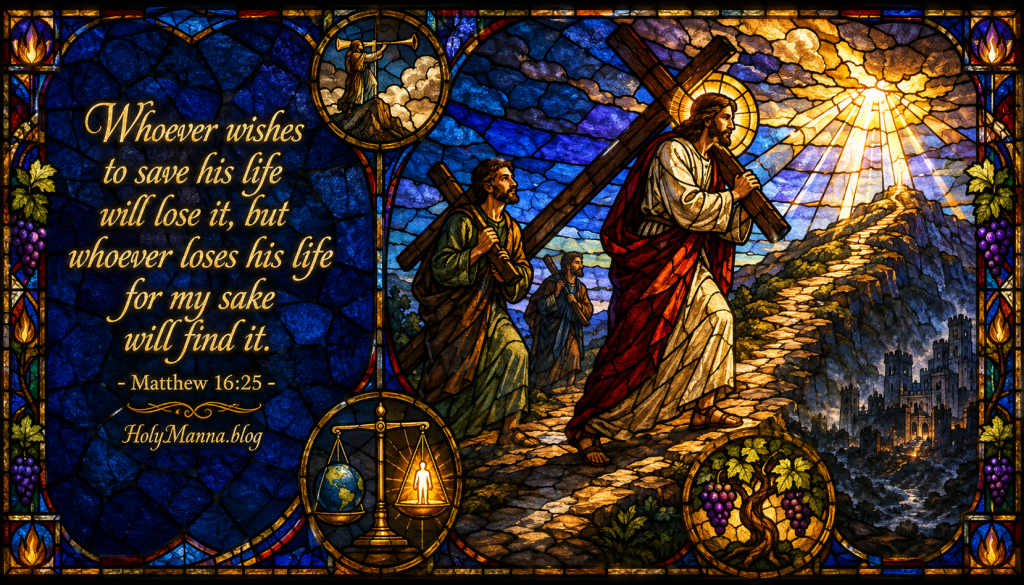
For whoever wishes to save his life will lose it,
but whoever loses his life for my sake will find it.
What profit would there be for one to gain the whole world
and forfeit his life?
Or what can one give in exchange for his life?
For the Son of Man will come with his angels in his Father’s glory,
and then he will repay each according to his conduct.
Amen, I say to you, there are some standing here
who will not taste death
until they see the Son of Man coming in his Kingdom.”
Detailed Exegesis
Verse 24: “Whoever wishes to come after me must deny himself, take up his cross, and follow me.”
Three verbs, one road. St. John Chrysostom, preaching on this verse in Homily 55 on Matthew, notes that Jesus begins with an invitation, whoever wishes, because God draws rather than drags, and explains that to deny oneself means to “have nothing to do with himself, but give himself up to all dangers” for the sake of Christ. Denial here is not skipping dessert; it is dethroning the self as the organizing principle of life.
Verse 25: “For whoever wishes to save his life will lose it, but whoever loses his life for my sake will find it.”
The Greek word psyche means both life and soul, and Jesus exploits the double meaning. Clutching biological life, comfort, and safety as ultimate goods guarantees losing the deeper life they were meant to serve. Every martyr proves the promise from one side; every hoarded, fearful existence proves it from the other.
Verse 26: “What profit would there be for one to gain the whole world and forfeit his life? Or what can one give in exchange for his life?”
Jesus speaks the language of the marketplace: profit, exchange, forfeiture. The arithmetic is merciless. The whole world on one side of the scale, a single soul on the other, and the soul outweighs it, because the world passes and the soul is made for eternity. Nineveh had, in its day, effectively gained the whole known world. Nahum already showed how that investment matured.
Verse 27: “For the Son of Man will come with his angels in his Father’s glory, and then he will repay each according to his conduct.”
The title Son of Man reaches back to the glorious figure of Daniel 7, and the promise of repayment according to conduct grounds the Catholic teaching on judgment. The cross is not the end of the story; the ledger is real, and the Crucified himself will settle it.
Verse 28: “Amen, I say to you, there are some standing here who will not taste death until they see the Son of Man coming in his Kingdom.”
This puzzling promise finds its first fulfillment six days later, when Peter, James, and John behold the Transfiguration, a preview of the Son of Man in glory, which is the reading of many Church Fathers given that Matthew 17:1 follows immediately. The Resurrection and the explosive coming of the Kingdom in the Church at Pentecost complete the picture. The disciples would glimpse the glory before tasting the death.
Teachings
The Catechism gathers this Gospel into a single luminous paragraph. CCC 618 teaches, “The cross is the unique sacrifice of Christ, the one mediator between God and men,” and then adds that Jesus calls his disciples to take up their cross and follow him, because his sacrifice, far from excluding participation, invites it. That same paragraph closes with the words of St. Rose of Lima, the first canonized saint of the Americas: “Apart from the cross there is no other ladder by which we may get to heaven.” On the judgment promised in verse 27, CCC 682 teaches, “When he comes at the end of time to judge the living and the dead, the glorious Christ will reveal the secret disposition of hearts and will render to each man according to his works and according to his acceptance or refusal of grace.” And on the urgency beneath it all, CCC 1021 teaches, “Death puts an end to human life as the time open to either accepting or rejecting the divine grace manifested in Christ.” The exchange Jesus describes is offered now, in time, not later.
Reflection
The cross rarely arrives as martyrdom; it usually arrives as Tuesday. It looks like caring for an aging parent, telling the truth when a lie would be promoted, staying faithful in a marriage during a dry season, or getting up for Mass when the bed argues eloquently. Self-denial can be practiced in training-sized portions: a weekly fast, an anonymous act of generosity, biting back the comeback that would have won the argument and wounded the person. Try one deliberate, hidden act of self-denial each day this week, offered explicitly to Jesus. Then sit honestly with the Lord’s question about exchange. What is the “whole world” you are most tempted to trade your soul for, whether success, approval, comfort, or control? And what would taking up the cross, concretely and daily, look like in your life this very week?
Where the Real Treasure Waits
Set the three readings side by side and a single story emerges. Nineveh gained everything the world could offer and kept none of it, because it was purchased with blood and lies, and the Lord’s ledger never lies. Moses, dying within sight of a Promised Land he would not enter, sang that God alone deals death and gives life, and that both justice and pity flow from the same faithful hands. Then Jesus, walking toward Jerusalem with the shadow of the cross already across his path, named the only transaction that matters: lose everything for him and gain a life that no empire, no economy, and no grave can touch.
This is not gloomy arithmetic; it is the best news imaginable. It means the powers that seem unbeatable are already under judgment. It means the hidden sacrifices no one applauds are being recorded by the only Auditor whose opinion counts. It means the cross carried today, the patience, the honesty, the quiet fidelity, is not loss at all but investment in the Kingdom the disciples glimpsed shining on Tabor. St. Rose of Lima called the cross the only ladder to heaven, and ladders are for climbing, not admiring.
So take the next rung. Go to Mass this Friday and hear these readings proclaimed with new ears. Bring the grudge, the fear, and the little Nineveh to Confession. Choose one act of self-denial and one act of mercy before the weekend ends. The bearer of good news is already on the mountains, announcing peace, and the feast is worth every vow. The soul was never for sale, because it was always meant for God.
Engage With Us!
The comments below are open, and every reflection shared there helps this community carry the cross together, so please add a thought, a struggle, or a story from today’s readings. Here are some questions to pray with before writing:
- In Nahum 2:1, 3 and 3:1-3, 6-7, the city that once repented at Jonah’s preaching falls because it returned to blood, lies, and plunder. Where in life has God’s past mercy been treated as permission, and what would true, lasting repentance look like there?
- In Deuteronomy 32:35-36, 39, and 41, the Lord declares that vengeance belongs to him alone and that he both wounds and heals. What grudge or desire for revenge is God asking to be surrendered into his hands this week?
- In Matthew 16:24-28, Jesus asks what profit there is in gaining the whole world while forfeiting one’s life. What “whole world” holds the strongest temptation right now, and what daily cross is Jesus offering in its place?
- Taken together, these readings reveal that God alone keeps the true ledger of every soul and every nation. How does trusting his justice and his mercy change the way tomorrow will be lived?
Living the faith is not a spectator sport, and no cross is carried alone. Walk this road with honesty, courage, and joy, and do everything with the love and mercy Jesus taught us.
Sacred Heart of Jesus, we trust in You!
Immaculate Heart of Mary, pray for us!
Saint Michael the Archangel, defend us in battle!
Follow us on YouTube, TikTok, Instagram and Facebook for more insights and reflections on living a faith-filled life.


Leave a comment