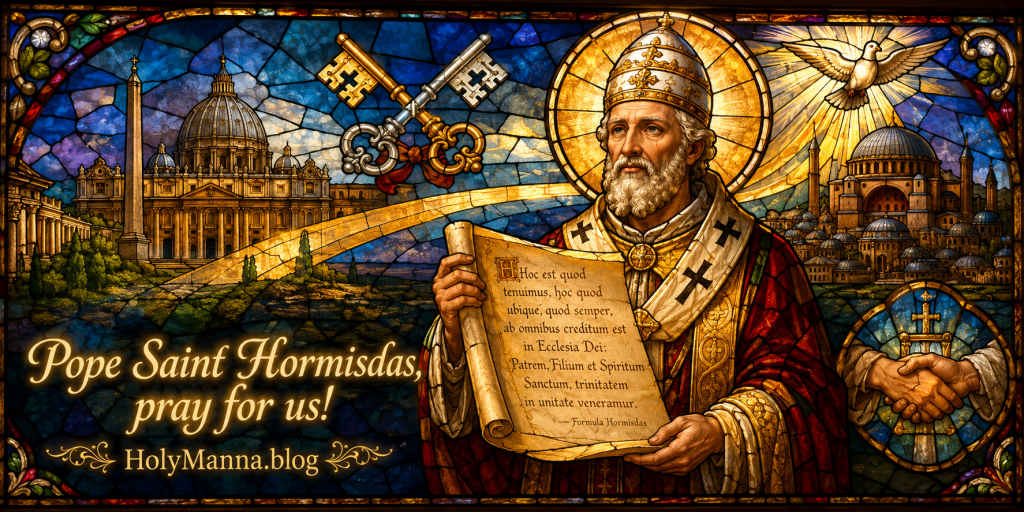
The Pope Who Mended a Broken Church
Some saints are remembered for dramatic visions, for stigmata, or for founding great religious orders. Pope Saint Hormisdas, commemorated on August 6th in the Roman Martyrology, is remembered for something quieter and, in its own way, just as miraculous: he healed a wound in the Body of Christ that had been bleeding for thirty five years. When he was elected to the Chair of Saint Peter in the year 514, the Churches of Rome and Constantinople had been out of communion since 484, torn apart by a dispute known as the Acacian Schism. Emperors had tried to fix it. Previous popes had tried to fix it. Armies had even marched over it. Hormisdas fixed it, not with force, but with nine years of patient, immovable fidelity to the truth, crowned by one of the most consequential documents in Church history, the Formula of Hormisdas.
His commemoration falls on the anniversary of his death, August 6, 523. Because August 6th is also the universal Feast of the Transfiguration of the Lord, his memory is kept quietly in the Martyrologium Romanum rather than celebrated at the altar on the universal calendar. That hiddenness suits him. Hormisdas was never a man who sought the spotlight. He was a widower, a father, a deacon, and then a pope who understood that unity in the Church is not a human achievement to boast about but a gift of Christ to be guarded. The Catechism teaches that “Christ always gives his Church the gift of unity, but the Church must always pray and work to maintain, reinforce, and perfect the unity that Christ wills for her” (CCC 820). Few lives illustrate that teaching as cleanly as his.
One note of honesty before the story begins, because honesty is what Hormisdas himself would demand. He holds no formally documented patronage, no miracles are recorded of him either during his life or after his death, and he was not a martyr. He is also frequently confused online with a different saint, Hormizd the Persian, a martyr commemorated two days later on August 8th. What Pope Hormisdas offers instead of wonders is something the modern world desperately needs: proof that steady faithfulness, exercised without bitterness and without compromise, can repair what anger has broken.
A Persian Name in the Roman Countryside
Hormisdas was born around the year 450 in Frusino, the town known today as Frosinone, in the Latium countryside southeast of Rome. The date is an estimate rather than a documented fact, as is common for figures of this era, but his origins are well attested. He came from a wealthy and prominent family of the Campagna di Roma, the rolling plain surrounding the Eternal City. His name is the striking thing. Hormisdas is not a Latin name at all but a Persian one, derived ultimately from the name of the Zoroastrian deity Ahura Mazda. Historians believe the name was likely given in honor of an exiled Persian noble named Hormizd who was venerated in the West, though the names of his father and his son point to an otherwise thoroughly Italian family. It is a small reminder that the late Roman world was far more interconnected than people often imagine, and that the Church has never belonged to one culture alone.
The most personally remarkable fact about Hormisdas is that before he ever wore clerical vesture, he was a husband and a father. He married as a young man and had at least one son, Silverius. After the death of his wife, he gave himself to the service of the Church and was ordained a deacon in Rome. His son followed him into the Church’s service, and in one of the most extraordinary father and son stories in Catholic history, Silverius himself later ascended to the papacy in 536 and is venerated today as Pope Saint Silverius. A canonized pope who raised a canonized pope: there is nothing quite like it anywhere else in the annals of the Church. It stands as a quiet testimony to what the Catechism says about the vocation of parents, that “the role of parents in education is of such importance that it is almost impossible to provide an adequate substitute” (CCC 2221). Hormisdas formed his son not merely for a career but for holiness, and heaven ratified the work.
As a deacon under Pope Symmachus, Hormisdas lived through one of the ugliest chapters in the history of the Roman Church, the Laurentian schism, in which a rival claimant named Laurentius divided the clergy and aristocracy of Rome against Symmachus for years. Hormisdas remained loyal to the legitimate pope and served him prominently. The historian Jeffrey Richards observed that the schism had lingered largely out of personal hatred toward Symmachus, something with which Hormisdas was apparently not tainted. That detail matters. When Symmachus died in July of 514, Hormisdas was elected and consecrated the very next day, with no recorded disturbance or division. After years of factional poison, Rome chose the one man nobody hated. There is a lesson in that before his pontificate even begins.
The Diplomacy of a Shepherd
The new pope’s first act set the tone for everything that followed. Rather than settling scores from the Laurentian conflict, Hormisdas received back into the Church the remaining adherents of the defeated faction who had not yet been reconciled. He did not gloat, and he did not purge. He gathered. The Catechism describes the bishop’s office in exactly these terms, teaching that each bishop is “the visible principle and foundation of unity” in his particular Church (CCC 886). Hormisdas began by being that principle of unity at home, because he knew a far larger reconciliation was waiting abroad.
The Acacian Schism, which dominated his entire pontificate, requires a little background. In 451 the Council of Chalcedon had definitively taught that Jesus Christ is one divine Person in two natures, true God and true man, a truth the Catechism continues to teach today, affirming that Christ must be acknowledged “in two natures, without confusion, change, division, or separation” (CCC 467). Large portions of the East rejected Chalcedon in favor of Monophysitism, the error that Christ has only one nature. In 482 the Emperor Zeno, hoping to paper over the division, issued a compromise document called the Henoticon, drafted with Patriarch Acacius of Constantinople, which deliberately avoided affirming Chalcedon. Rome could not accept a formula that treated defined truth as negotiable, and in 484 Pope Felix III excommunicated Acacius. Constantinople and Rome fell out of communion, and the breach hardened for decades. Zeno’s successor, the Emperor Anastasius, leaned ever more openly toward Monophysitism and persecuted bishops who refused to repudiate Chalcedon.
This was the situation Hormisdas inherited. The first opening came not from piety but from politics. A general named Vitalian, commander of the imperial cavalry, took up the cause of Chalcedonian orthodoxy, raised the provinces of Thrace, Scythia, and Moesia in revolt, and marched an army to the gates of Constantinople. Under this pressure, Anastasius wrote to Hormisdas in December of 514, inviting him to a synod to discuss reunion. Hormisdas answered with a delight that was genuine and a caution that was well founded. He expressed joy at the prospect of peace while firmly defending the position of his predecessors, and he convened a synod at Rome before sending legates east in 515. Among those legates was the distinguished bishop Ennodius of Pavia. The pope’s terms were clear and unbending: acceptance of the Council of Chalcedon, acceptance of the letters of Pope Saint Leo the Great, and the removal of the names of Acacius and his successors from the diptychs, the official lists of those commemorated in the liturgy.
Anastasius wanted the appearance of peace without the substance of conversion, and once the military pressure from Vitalian eased, his interest cooled. A second embassy in 517 was treated shamefully; the emperor attempted to bribe and then simply dismissed the papal legates, and he closed his correspondence with the pope in a letter whose preserved words are unforgettable. Writing to Hormisdas, Anastasius declared, “We can endure being insulted and set at naught, but we cannot allow ourselves to be commanded.” With that, the door slammed shut. A weaker man would have softened the terms to get a deal. Hormisdas simply waited, prayed, and held the line, trusting the words of the Lord in The Gospel of John, who prayed for His disciples “that they may all be one” (Jn 17:21).
Then, in July of 518, everything changed. Anastasius died suddenly, and the Catholic Encyclopedia, drawing on the chroniclers of the age, records that he died in the midst of a terrible storm. The storm detail comes from those later chroniclers and is best received as their telling rather than as verified fact, but the death itself is certain, and so is what followed. The new emperor, Justin I, was a convinced Chalcedonian, and the people and monks of Constantinople were hungry for reunion with Rome. Negotiations reopened almost immediately, and this time the East accepted the pope’s terms in full.
The Formula That Confessed the Rock
What the Eastern bishops signed has come down through history as the Formula of Hormisdas, and it deserves to be quoted at length, because it is one of the clearest confessions of the role of the Apostolic See ever written, composed more than thirteen centuries before the First Vatican Council. The Formula opens with these words: “The first condition of salvation is to keep the norm of the true faith and in no way to deviate from the established doctrine of the Fathers. For it is impossible that the words of our Lord Jesus Christ, who said, ‘Thou art Peter, and upon this rock I will build my Church,’ should not be verified. And their truth has been proved by the course of history, for in the Apostolic See the Catholic religion has always been kept unsullied.”
The document goes on to condemn the heresies rejected by the ecumenical councils, to condemn the memory of Acacius who had caused the schism, and to endorse the letters of Pope Saint Leo. Its signers pledged themselves in words that still stir the Catholic heart: “Following, as we have said before, the Apostolic See in all things and proclaiming all its decisions, we endorse and approve all the letters which Pope St Leo wrote concerning the Christian religion. And so I hope I may deserve to be associated with you in the one communion which the Apostolic See proclaims, in which the whole, true, and perfect security of the Christian religion resides.”
On March 28, 519, a date some accounts note fell on Holy Thursday of that year, the reunion was ratified in the cathedral of Constantinople before a great crowd. Patriarch John II of Constantinople signed the Formula, together with about 250 Eastern bishops. Some later accounts claim that as the document circulated through the East in the following years its signatures eventually numbered as many as 2,500; that larger figure reflects later claims of cumulative accessions and cannot be verified with the same confidence as the initial ratification. Either way, the schism of thirty five years was over. The Church breathed with both lungs again.
Why does the reader today need to remember this? Because the Formula of Hormisdas is not a museum piece. It is living evidence that the early Church, East as well as West, recognized the See of Peter as the touchstone of orthodox faith. The Catechism teaches that “the Roman Pontiff, as the successor of Peter, is the perpetual and visible source and foundation of the unity both of the bishops and of the whole company of the faithful” (CCC 882), and that the pope “has full, supreme, and universal power over the whole Church, a power which he can always exercise unhindered” (CCC 882). When the First Vatican Council solemnly defined papal primacy and infallibility in 1870 in the constitution Pastor Aeternus, it reached back and cited the Formula of Hormisdas as witness. A pope from a small town in Latium, writing in the sixth century, supplied words that the Church would still be leaning on in the nineteenth, and leans on now.
It must be said plainly, because integrity demands it: no miracles are recorded of Hormisdas during his lifetime in the historical sources. His wonders were of another kind. He reconciled schismatics without humiliating them. He negotiated with an Arian king, Theodoric the Great, who ruled Italy, maintaining a respectful working relationship without ever compromising Catholic doctrine. The Liber Pontificalis, the ancient book of papal biographies, reports that he confronted the Manichaean sect in Rome and had their books burned before the doors of the Lateran basilica; that account rests on the Liber Pontificalis and is best read as its report of his zeal for pure doctrine. He guided the Church through the delicate Theopaschite controversy raised by a group of Scythian monks with prudence and restraint, and the great scholar Dionysius Exiguus, the monk whose calculations gave the world the Anno Domini dating system, dedicated a collection of Church canons to him. Everywhere the pattern is the same: clarity in doctrine, gentleness with persons.
Insulted and Set at Naught, but Never Moved
Hormisdas was not a martyr, and no persecution took his life; he died peacefully. But it would be a mistake to imagine his path was smooth. Consider what he actually endured. He came to the papacy in the immediate aftermath of the Laurentian schism, inheriting a city whose clergy and nobility had spent years at one another’s throats. He then spent four years, from 514 to 518, in negotiations with an emperor who was never truly negotiating. His legates traveled enormous distances at real personal risk, only to be strung along, pressured, and finally dismissed with contempt. The emperor’s parting words, that he could endure insult but not command, were a slap delivered across a continent. Hormisdas absorbed it without retaliation and without surrender.
That combination is rarer than it sounds. Most people, when insulted, either strike back or cave in. Hormisdas did neither. He understood that the terms he was defending were not his personal preferences but the deposit of faith, which no pope has the authority to trade away. The Catechism captures this exactly when it teaches that the Magisterium “is not superior to the Word of God, but is its servant. It teaches only what has been handed on to it” (CCC 86). Hormisdas could be endlessly patient about process precisely because he was completely inflexible about truth. He also had to bear the ordinary griefs of his age: the slow crumbling of Roman civilization around him, the rule of a heretical king over Italy, famine and instability in the countryside of his birth, and the personal sorrow, carried from his earlier life, of burying his wife. He knew loss from the inside, which may be why he was so unwilling to let the Church remain divided. A man who has grieved understands what separation costs.
There were also hardships after the triumph. Reunion on paper is one thing; reunion in hearts is another. In the years after 519, Hormisdas had to manage lingering resistance in parts of the East, disputes over how strictly the Formula’s condemnations should be applied to bishops who had merely gone along with the schism, and pressure from zealous parties who wanted maximum severity. Here again his pastoral instinct showed. Having won the essential point, he showed measured flexibility toward persons while conceding nothing on principle, working to make the peace stick rather than to make it sting.
A Legacy Written in Stone and in Councils
Pope Saint Hormisdas died on August 6, 523, roughly four years after his greatest achievement, and was buried in Saint Peter’s Basilica, where his mortal remains rest among the successors of the Apostle he served. It must again be stated honestly that the historical sources record no miracles attributed to his intercession after death, no healings at his tomb, and no tradition of wonder working relics. His veneration arose instead from the Church’s grateful memory of what God accomplished through him, and he has been honored as a saint from antiquity, recognized in both the Catholic Church and the Eastern Orthodox Church. There is no major pilgrimage tradition attached to him specifically; those who wish to honor him do so where he lies, within the greatest pilgrimage church in Christendom, Saint Peter’s in Rome, and in his home city of Frosinone, which remembers him as its most illustrious son.
His true relics are textual. The Formula of Hormisdas outlived empires. It was invoked through the medieval controversies over papal authority, cited by theologians defending the primacy of Rome, and quoted at the First Vatican Council in Pastor Aeternus when the Church solemnly defined the dogmas of papal primacy and infallibility. The Catechism’s teaching that the Roman Pontiff enjoys infallibility “when, as supreme pastor and teacher of all the faithful… he proclaims by a definitive act a doctrine pertaining to faith or morals” (CCC 891) stands in a direct line of continuity with the confession those 250 Eastern bishops signed in 519. His legacy also reaches into the story of his family, since his son Silverius governed the same Church, suffered greatly in his own pontificate, and joined his father among the saints.
One final clarification protects his memory from a common error. The Roman Martyrology commemorates a different Saint Hormisdas on August 8th, a Persian nobleman who suffered for the faith under the Persian kings. Many websites blend the two men together, sometimes even transferring details of the Persian saint’s story, including a supposed patronage connected with tending animals, onto the pope. No reliable Catholic source documents any patronage for Pope Hormisdas, and the two saints should be kept distinct. The pope of August 6th needs no borrowed stories. His own is enough.
Patience as a Form of Courage
What does a sixth century diplomat pope have to say to a person scrolling through this post today? More than might be expected. Everyone lives with broken communion somewhere. A family fractured by an old argument. A parish divided by factions. A friendship that ended over politics. A Church still wounded by the separations of centuries. Hormisdas teaches that reconciliation is neither achieved by pretending truth does not matter nor by wielding truth as a weapon. He held both charity and doctrine at full strength simultaneously, and he was willing to wait years for hearts to change, without ever poisoning the waiting with resentment.
Where in your own life has a relationship been out of communion for so long that you have stopped even praying for its healing? Hormisdas inherited a schism older than his pontificate and refused to accept it as permanent. The Catechism insists that the desire for unity is not optional for the Christian, teaching that “the desire to recover the unity of all Christians is a gift of Christ and a call of the Holy Spirit” (CCC 820). That desire can be practiced in small, concrete ways: a message sent to an estranged relative, a Rosary offered for Christian unity, a decision to speak charitably about those on the other side of a disagreement, a refusal to gloat when circumstances finally turn in one’s favor.
Hormisdas also models something countercultural about strength. The world tends to equate strength with volume, with the sharp reply and the viral takedown. Hormisdas was strong the way an anchor is strong. When the most powerful man in his world told him he would not be commanded, the pope did not escalate and did not yield; he simply remained what he was, and in the end the empire moved, not the Church. When you are pressured to compromise on something you know to be true, do you respond with anger, with surrender, or with the quiet steadiness of the saints? And there is his fatherhood. Before he shepherded the universal Church, he shepherded one boy in Frosinone, and that boy became a saint and a pope. No hidden faithfulness is wasted. Who has God placed in your care whose holiness may one day be the greatest achievement of your life?
Engage With Us!
HolyManna would love to hear from you. Share your thoughts and reflections on Pope Saint Hormisdas in the comments below, and let this quiet peacemaker spark a conversation about unity, patience, and truth in your own life.
- Pope Saint Hormisdas waited nine years, through insult and failure, to see the Church reunited. What broken relationship or long unanswered prayer in your life is God inviting you to keep bringing to Him with that same patience?
- The Formula of Hormisdas confessed that the true faith must be kept without deviation. Is there an area of your life where you have been tempted to treat a truth of the faith as negotiable for the sake of an easier peace?
- Hormisdas began his papacy by welcoming back his former opponents without humiliation. Is there someone you have “won” against whom you still need to welcome back with mercy?
- Before he was a pope, Hormisdas was a husband and a father who raised a future saint. How are you investing in the holiness of the people entrusted to you at home, at work, or in your parish?
- His commemoration is hidden beneath the great Feast of the Transfiguration. How does his hidden, unglamorous faithfulness challenge the way you measure success in your own spiritual life?
May the example of Pope Saint Hormisdas encourage you to guard the truth without losing tenderness, to seek unity without surrendering conviction, and to trust that God can heal even the oldest wounds. Go into this day determined to be a repairer of what is broken, and do everything with the love and mercy that Jesus taught us.
Pope Saint Hormisdas, pray for us!
Follow us on YouTube, TikTok, Instagram and Facebook for more insights and reflections on living a faith-filled life.

 Holy Manna!
Leave a comment