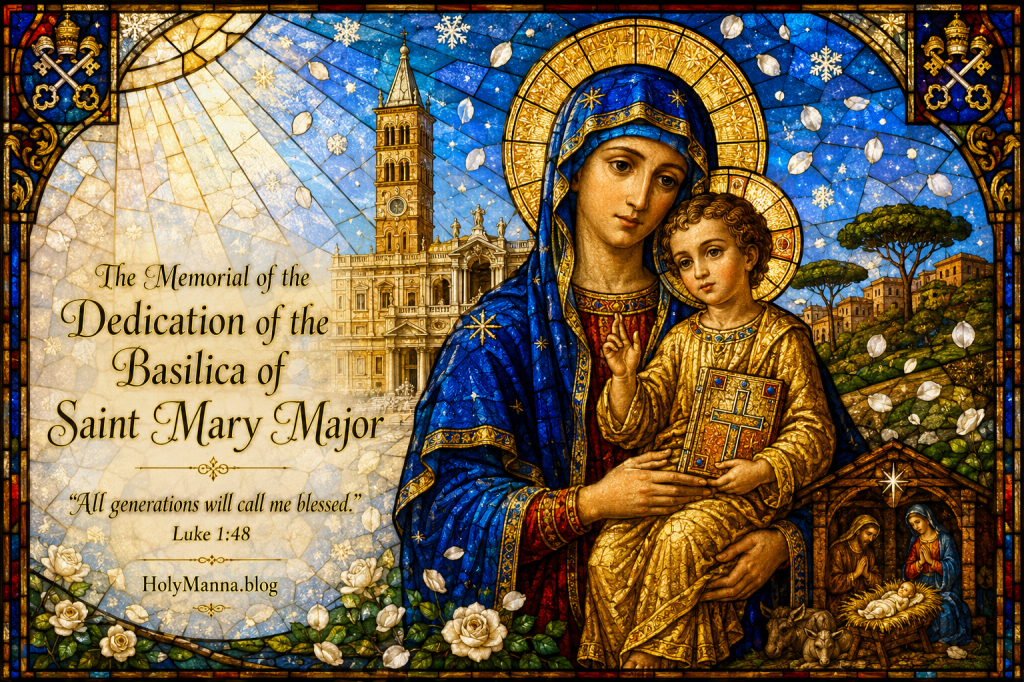
The Church Built on Summer Snow
Every year on August 5th, the universal Church pauses to celebrate something that might seem unusual at first glance: the dedication of a building. The Optional Memorial of the Dedication of the Basilica of Saint Mary Major invites Catholics everywhere to turn their hearts toward a church on Rome’s Esquiline Hill, the oldest church in the Western world dedicated to the Blessed Virgin Mary and one of the 4 great papal basilicas of Rome, alongside Saint John Lateran, Saint Peter’s, and Saint Paul Outside the Walls. While every diocese and parish keeps the anniversary of its own dedication, the whole Church commemorates the consecration of these mother churches of Christendom, binding all the faithful to the See of Peter.
Why does a building deserve a place on the liturgical calendar? Because this particular building is a confession of faith carved in marble and shimmering in mosaic. Saint Mary Major rose in the years immediately following the Council of Ephesus in 431, the council that solemnly proclaimed Mary to be Theotokos, the Mother of God. The basilica is, quite literally, the Church’s oldest standing monument to that dogma. The Catechism of the Catholic Church teaches that visible churches “are not simply gathering places but signify and make visible the Church living in this place, the dwelling of God with men reconciled and united in Christ” (CCC 1180). Saint Mary Major makes visible something more specific still: the Church’s unshakable love for the Mother of her Lord.
For more than 1,600 years, popes have offered Mass beneath its gilded ceiling, saints have knelt before its altars, and pilgrims beyond counting have whispered their needs to the Mother of God within its walls. In April of 2025, the basilica became something even more poignant for this generation: the resting place of Pope Francis, the first pope in over 3 centuries to be buried there. This celebration, then, is anything but a dusty architectural anniversary. It is a family feast, a day to come home to the house of the Mother.
A Patrician, a Pope, and Snow in August
The story of Saint Mary Major begins in the middle of the 4th century, during the pontificate of Pope Liberius, who governed the Church from 352 to 366. The first church on the site was known as the Liberian Basilica in his honor. Rome in that era was a city in transition; Christianity had been legalized by Constantine only decades earlier, and the faithful were building churches over the bones of martyrs and in the heart of the old imperial capital, claiming the city for Christ.
A beloved tradition, and it must be honestly labeled a tradition rather than established history, tells how the site was chosen. According to the story, a wealthy Roman patrician named John and his wife, who had no children, desired to give their fortune to the Blessed Virgin. On the night of August 4th, Mary appeared in a dream to the couple and, separately, to Pope Liberius, asking that a church be built in her honor on the spot where snow would fall. The following morning, in the blazing heat of a Roman August, snow blanketed the summit of the Esquiline Hill. Pope Liberius processed to the site with clergy and people and traced the outline of the future church in the snow. Honesty requires noting what historians observe: the dedicatory inscription of Pope Sixtus III makes no mention of any miracle, and written accounts of the snowfall do not appear in surviving records until centuries later. The Church herself acknowledged this uncertainty when the 1969 revision of the General Roman Calendar changed the celebration’s title from the Dedication of Saint Mary of the Snows to the Dedication of the Basilica of Saint Mary Major. The snow remains a cherished story; the basilica remains a certain fact.
That certain fact took its present form under Pope Sixtus III, who reigned from 432 to 440. In 431, the Council of Ephesus had confronted the error of Nestorius, who hesitated to call Mary the Mother of God. The council’s answer was thunderous and joyful: because Jesus Christ is one divine Person, the woman who bore Him truly bore God in the flesh. Sixtus III rebuilt and enlarged the Liberian Basilica and dedicated it to the Mother of God, adorning it with mosaics of the life of Christ and His Mother that still glow above the nave today. The basilica became, and remains, the great architectural amen to Ephesus.
The Icon That Watches Over Rome
Because this celebration commemorates a dedication rather than an apparition, no formal Church judgment of approval or non-approval applies to it in the way it would to events like Lourdes or Fatima. The dream of Pope Liberius and the summer snowfall belong to the realm of pious tradition, and the Church proposes them to no one as matters of faith. The Catechism reminds the faithful that private revelations, even approved ones, “do not belong, however, to the deposit of faith” (CCC 67), and unverified traditions hold a humbler place still. Yet within the basilica’s walls lives a treasure around which centuries of trust in Mary’s intercession have gathered: the icon known as Salus Populi Romani, Protectress of the Roman People.
Tradition attributes the icon to Saint Luke the Evangelist, painting the Mother of God from life. That attribution, too, is tradition rather than verified history, but the icon’s antiquity and its hold on the Roman heart are beyond dispute. The image shows Mary as a regal, tender mother, holding the Child Jesus who clutches a book of the Gospels. A treasured story recounts that during a devastating plague around the year 593, Pope Saint Gregory the Great carried the icon in penitential procession through Rome, and that as the procession neared Hadrian’s Mausoleum, a vision of Saint Michael the Archangel sheathing his sword signaled the end of the pestilence, while the people sang the Regina Caeli. Again, this account is handed down as sacred story rather than documented event, but it reveals how completely Rome has entrusted itself to Mary under this image.
Documented history offers its own testimonies. Pope Gregory XVI granted the icon a canonical coronation on August 15th, 1838. In the spring of 1944, with Nazi forces occupying Rome and Allied armies approaching, Pope Pius XII made a solemn vow to the Blessed Virgin for the salvation of the city; on June 4th, 1944, Allied troops entered Rome without resistance, and the city was spared destruction. In gratitude, Pius XII crowned the icon anew on November 1st, 1954, during the first Marian Year in the Church’s history, after a great procession from Saint Mary Major to Saint Peter’s. In 2018 the icon was carefully restored and honored with a Pontifical Mass. Through plague, war, and every anxiety of the centuries, Romans have looked to this image and found a mother looking back.
Theotokos
The deepest meaning of August 5th is not snow, and not even the icon; it is the dogma the basilica was built to proclaim. When the Council of Ephesus confessed Mary as Theotokos in 431, it was defending the identity of Jesus Christ Himself. The Catechism explains that the One whom Mary conceived by the Holy Spirit “was none other than the Father’s eternal Son, the second person of the Holy Trinity. Hence the Church confesses that Mary is truly ‘Mother of God’” (CCC 495). The council taught this against Nestorius precisely because Christ’s humanity “has no other subject than the divine person of the Son of God” (CCC 466). To honor Mary as Mother of God is to guard the truth that God truly became man for the salvation of the world.
The basilica also embodies Mary’s motherhood of the Church. The Catechism, drawing on Saint Augustine, calls Mary “clearly the mother of the members of Christ” because she cooperated by her charity in the birth of believers (CCC 963). The Second Vatican Council devoted the entire 8th chapter of Lumen Gentium to Mary’s place in the mystery of Christ and the Church, teaching that she is honored as the Church’s most beloved mother and model. Saint Paul VI, in his apostolic exhortation Marialis Cultus of 1974, taught that authentic Marian devotion flows from and leads back to the worship of Christ. Saint John Paul II, in his encyclical Redemptoris Mater of 1987, meditated on Mary’s pilgrimage of faith and her maternal presence in the life of every believer. All of it stands on the foundation the Catechism states plainly: “The Church’s devotion to the Blessed Virgin is intrinsic to Christian worship” (CCC 971).
The basilica preaches this theology in image as well as in stone. The 5th century mosaics commissioned under Pope Sixtus III still crown the nave and the great triumphal arch, depicting scenes from the life of Christ and the story of salvation with a splendor meant to catechize a city. In an age when most of the faithful could not read, these shimmering panels proclaimed the Incarnation to every worshiper who lifted his eyes: the Child enthroned, the Magi adoring, the promises of God fulfilled in the Son born of the Virgin. Later centuries added the glorious apse mosaic of the Coronation of the Virgin, showing Christ crowning His Mother amid the court of heaven, a visual echo of the truth the Church would continue to unfold about Mary’s Assumption and Queenship. Art, here, is not decoration; it is doctrine made radiant.
Even the act of dedicating a church carries theological weight. The Catechism teaches that entering a church building symbolizes crossing from the world wounded by sin into the world of new life to which all are called (CCC 1186). A basilica dedicated to the Mother of God says something more: that the surest doorway to the Son has always been the Mother who gave Him to the world. Every stone of Saint Mary Major preaches the words of Mary herself in The Gospel of Luke: “From this day all generations will call me blessed” (Luke 1:48).
Bethlehem of the West
Pilgrims who cross the threshold of Saint Mary Major discover that the basilica gathers the whole mystery of the Incarnation under one roof. Beneath the high altar rests the Crypt of the Nativity, which enshrines relics venerated for centuries as wood from the Holy Crib of Bethlehem. Because of this treasure, the basilica came to be called the Bethlehem of the West, and tradition holds that Christmas Mass was celebrated there in imitation of the cave of Bethlehem from early times. Saint Jerome, the great translator of the Scriptures who spent his last decades in Bethlehem itself, is honored in the basilica, where tradition places his relics.
The saints have loved this place with particular tenderness. On Christmas of 1538, Saint Ignatius of Loyola, founder of the Society of Jesus, celebrated his first Mass at the altar of the Crib, choosing the nearest thing to Bethlehem that Rome could offer. Saint Pius V, the pope of the Rosary and of Lepanto, is buried within the basilica. Pilgrims through the centuries have come to venerate the Crib, to pray before the Salus Populi Romani in the magnificent Pauline Chapel built by Pope Paul V, and, during Jubilee years, to pass through the basilica’s Holy Door. As one of the 4 major basilicas of Rome, Saint Mary Major holds one of the Holy Doors opened for each Jubilee, and the recent Jubilee of 2025 drew immense crowds of pilgrims of hope through its threshold. Crossing a Holy Door is itself a lived catechesis: a bodily confession that Christ is the door of the sheepfold, and that conversion means passing from one way of living into another. Countless pilgrims who entered through that door then walked a few steps further to kneel at a plain marble slab and pray for the pope who had opened it.
Since April 26th, 2025, pilgrims have come for a new reason as well. Pope Francis, who visited the Salus Populi Romani 126 times during his pontificate, beginning the very day after his election on March 14th, 2013, and who entrusted every apostolic journey to her protection, asked in his testament to be buried near the icon he loved. His tomb lies in the left aisle between the Pauline and Sforza chapels: a simple slab of white Ligurian marble bearing a single word, Franciscus. He became the 8th pope buried in the basilica and the first since Clement IX in 1669. The sight of that plain stone beneath the gaze of the Mother of God may be the most eloquent homily on Marian devotion this generation will ever receive.
White Petals Falling Like Snow
The celebration of August 5th has taken on beautiful flesh in Rome and far beyond it. In the basilica itself, the days leading up to the memorial are kept with a triduum of prayer from August 1st to 3rd, followed by 2 days of celebration on August 4th and 5th. At the pontifical Mass and again at second vespers on the memorial itself comes the moment every pilgrim waits for: a shower of white flower petals released from the ceiling of the basilica, drifting down through shafts of summer light in memory of the snowfall of tradition. In some years, Rome has even arranged artificial snowfalls in the piazza outside on the evening of August 5th, delighting children and pilgrims alike.
The devotion has traveled across the world under the older and much loved title of Our Lady of the Snows. Parishes, missions, and shrines bearing that name can be found across Europe, the Americas, Asia, and beyond, a quiet testimony to how deeply the story of the summer snow captured the Catholic imagination. In the United States, the National Shrine of Our Lady of the Snows in Belleville, Illinois, founded by the Missionary Oblates of Mary Immaculate, stands among the largest outdoor shrines in North America and draws pilgrims throughout the year. Wherever the title has traveled, it carries the same message the petals carry in Rome: that the Mother of God marks out holy ground in the middle of ordinary life, and that her care arrives as gently and as unexpectedly as snow in August.
The memorial also shapes the Church’s public prayer far from Rome. In parishes across the world that keep the Optional Memorial, the Collect of the day asks God, who dwells in the hearts of the faithful, to grant through the intercession of the Blessed Virgin Mary the health of mind and body needed to serve Him, a prayer that quietly gathers up the whole history of a people who called this icon their Salus, their health and salvation. Priests vest in white, the color of Marian celebrations, and homilists from Manila to Mexico City retell the story of the snow, always with the honest label of tradition, and always with the sturdy fact of Ephesus beneath it.
The basilica has also shaped the Church’s music and memory. The Regina Caeli, sung by tradition during Pope Saint Gregory’s procession, still rises in Eastertide. The Sub Tuum Praesidium, the most ancient known prayer to the Mother of God, gives words to what the Salus Populi Romani shows in color: a people flying to the protection of the holy Mother of God in every danger and need.
Where Your Own Snow Falls
Now comes the question that matters most: what does a 1,600 year old basilica in Rome have to do with your life this August? More than you might think. Start with what the basilica is: a house built for the Mother because a childless couple, according to the treasured story, wanted to give everything they had to God. Whatever the historical details, the spiritual pattern is solid ground. Generosity toward God is never wasted, and what is offered to Mary is always handed on to her Son. What do you have, this season of your life, that you could place completely in God’s hands?
Consider also what the basilica protects: the truth that Mary is the Mother of God, and therefore your mother too. From the Cross, Jesus said to the beloved disciple, “Behold, your mother” (John 19:27), and the Church has always heard those words addressed to every disciple. The Catechism teaches that Mary’s motherhood in the order of grace continues uninterrupted until the eternal fulfillment of all the elect (CCC 969). You do not have to travel to the Esquiline Hill to live under her mantle. A Rosary prayed on a commute, a Memorare whispered in a hard moment, a Saturday morning Mass offered in her honor: these build a Saint Mary Major in the interior of your own soul.
Finally, learn from the pope who chose to be buried there. Pope Francis went to the Salus Populi Romani before and after every journey, in sickness and in health, for 12 years. That kind of steady, humble returning is something anyone can imitate. Choose your own icon, your own parish image of Mary, your own corner with a candle, and return to it. Before the job interview and after it. Before the diagnosis and after it. Mary is not honored by grand gestures nearly so much as by faithful ones, and the mother who watched over Rome through plague and war is entirely capable of watching over your ordinary week.
Engage With Us!
The story of Saint Mary Major belongs to the whole family of God, and that includes this community. Share your thoughts, memories, and reflections in the comments below; every voice enriches the conversation and encourages a fellow pilgrim.
- The tradition of the snowfall tells of a couple who wanted to give their whole fortune to Mary. What is one concrete gift of time, treasure, or talent you feel invited to offer God this month?
- The Council of Ephesus defended the title Mother of God in order to defend the truth about Jesus. How does honoring Mary strengthen, rather than compete with, your relationship with Christ?
- Romans have turned to the Salus Populi Romani in plague, war, and personal need for centuries. Where in your life right now do you most need to fly to the protection of the Mother of God?
- Pope Francis returned to the same icon 126 times over 12 years. What small, repeatable habit of Marian devotion could you begin this week and actually sustain?
- A dedicated church is a sign of God dwelling among His people. How could you treat your own parish church, and your own baptized soul, more intentionally as holy ground?
May the celebration of the Dedication of the Basilica of Saint Mary Major remind every heart that the Mother of God has been marking out holy ground for her children since the earliest centuries of the Church, and that she is doing so still. Keep close to her, keep close to the sacraments, and keep walking; under the guidance of our Blessed Mother, this community will grow together in faith, one feast, one prayer, and one small act of love at a time.
Most Blessed Virgin Mary, Mother of God, pray for us!
Follow us on YouTube, TikTok, Instagram and Facebook for more insights and reflections on living a faith-filled life.

 Holy Manna!
Leave a comment