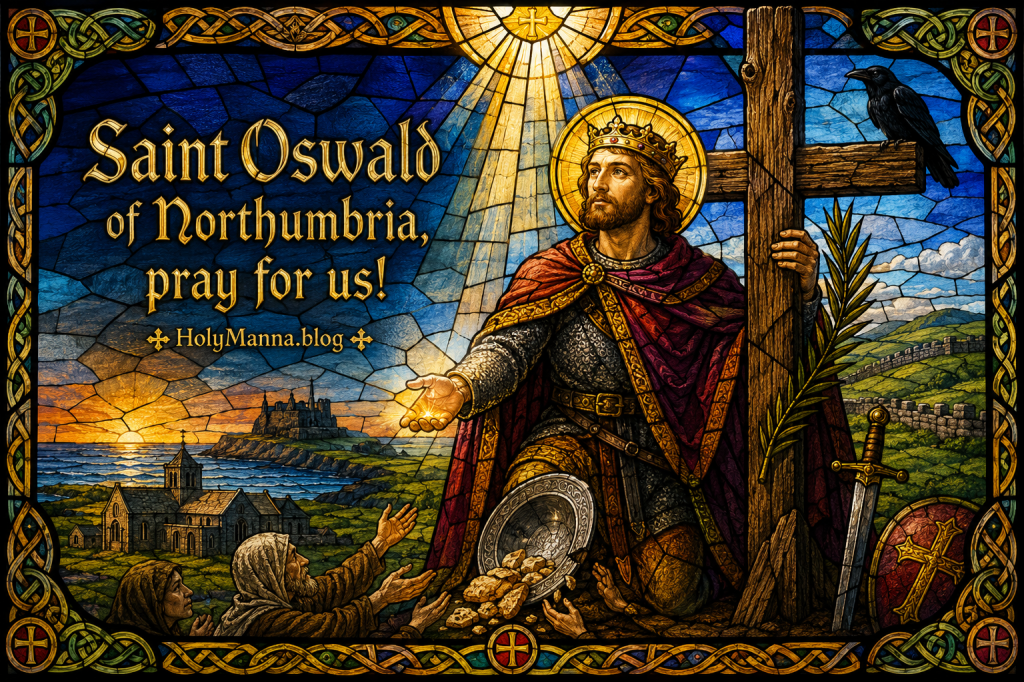
The King Who Knelt Before He Fought
Some saints teach the Church how to pray in a cloister, and some teach her how to preach in a pulpit. Saint Oswald of Northumbria teaches something rarer; he shows what it looks like when a man holds real earthly power and refuses to let that power own him. Oswald was an Anglo-Saxon king of the seventh century, ruling the northern English kingdom of Northumbria from 634 until his death on August 5th in 642. In eight short years of rule he reunited a fractured kingdom, restored the Catholic faith to a land that had slid back into paganism, personally translated the preaching of a missionary bishop for his own people, gave away his royal banquet and the silver it was served on to the poor at his gate, and died on a battlefield at the age of thirty-eight with a prayer for his soldiers on his lips. The Church celebrates him on August 5th, the day of his death, and the Roman Martyrology commemorates him on that date as a king who fell at the hands of pagans while laboring to spread the faith. In England his feast is kept on local calendars, since the universal calendar for August 5th belongs to the Dedication of the Basilica of Saint Mary Major.
Oswald is venerated as both king and martyr, and by long tradition he is honored as a patron of soldiers. The patronage fits: he was a fighting man in a brutal age, yet everything the early sources remember about him points away from the sword and toward the Cross he planted with his own hands before his first great battle. The Catechism teaches that “by canonizing some of the faithful, i.e., by solemnly proclaiming that they practiced heroic virtue and lived in fidelity to God’s grace, the Church recognizes the power of the Spirit of holiness within her” (CCC 828). Oswald’s veneration stretches back to within a generation of his death, one of the earliest royal cults in all of Christian Europe, and the Spirit’s fingerprints are all over his story.
An Exile Shaped by Monks
Oswald was born around the year 604, though some sources give 605, into the violent world of early Anglo-Saxon England. His father was Æthelfrith, a pagan warrior king who had forged the northern kingdoms of Bernicia and Deira into a single realm called Northumbria. His mother was Acha, a princess of the royal house of Deira. That double bloodline mattered enormously, because Oswald carried in his own person the claim of both halves of a divided kingdom. He was one of seven brothers, and his sister Ebbe would herself one day be venerated as a saint.
The comfortable years of childhood ended abruptly. In 616, when Oswald was around twelve years old, his father was killed in battle, and his uncle Edwin seized the Northumbrian throne. The children of a fallen king were not safe in the house of the man who replaced him, so Acha fled north with her sons into the lands of the Irish-speaking kingdom of Dál Riata, in what is now western Scotland. It was the kind of catastrophe that could have hardened a boy into a bitter man. Instead, God used the exile to save him.
The refugee princes came under the care of the monks of Iona, the great island monastery founded by Saint Columba around 563. There, on a windswept rock in the Hebrides, the pagan-born son of a warlord encountered the Gospel of Jesus Christ. Oswald was instructed in the faith, baptized, and formed by the rhythms of monastic prayer during his most impressionable years. He grew into a capable soldier in the service of the kings of Dál Riata, fighting at the Battle of Fid Eoin in Ireland in 628, and Irish sources gave him the epithet Lamnguin, meaning White Blade. Yet the deeper formation was happening on his knees. Saint Bede the Venerable, the monk-historian who wrote his Ecclesiastical History of the English People less than a century after these events and who is the principal source for everything known about Oswald, later recorded that as king Oswald would often pray alone from the early morning hours with his arms outstretched in the shape of a cross. A man does not improvise that habit in a palace. He learns it from monks.
Here is the first great lesson of Oswald’s life. The worst thing that ever happened to him, the loss of his father, his home, and his inheritance, became the doorway through which grace entered. The Catechism teaches that God “in his almighty providence” can “bring a good from the consequences of an evil” (CCC 312). Has there been an exile in your own life, a loss or a displacement, that God quietly used to bring you closer to Himself?
The Cross at Heavenfield and the Bishop from Iona
In 633 the political world that had exiled Oswald collapsed. His uncle Edwin, who had himself become a Christian, was killed in battle against an alliance of Penda, the pagan king of Mercia, and Cadwallon, a British king. Northumbria descended into a year of horror. Cadwallon ravaged the land, and Oswald’s own brother Eanfrid, who had returned to claim part of the kingdom, was treacherously killed while trying to negotiate peace. With Christianity’s brief foothold in Northumbria collapsing and the kingdom bleeding, Oswald came down from the north in 634, some sources say 635, with a small army to face Cadwallon’s much larger force.
What happened next is the scene for which Oswald is most remembered. Near the old Roman Wall, about seven miles north of Hexham, at a place afterwards called Heavenfield, Oswald raised a wooden cross as his battle standard. Bede tells that it was the first Christian symbol ever erected in that part of the kingdom. Tradition adds the beautiful detail that the king knelt and held the cross upright with his own hands while his men packed the earth around its base to make it stand firm. Then, before any weapon was drawn, Oswald turned to his little army and called them to their knees. Bede records his words: “Let us all kneel, and jointly beseech the true and living God Almighty, in his mercy, to defend us from the haughty and fierce enemy; for He knows that we have undertaken a just war for the safety of our nation.” An early tradition, recorded by Adamnan of Iona within decades of the events, holds that Saint Columba appeared to Oswald in a vision the night before the battle and promised him victory; it is told here as the early sources tell it.
The next morning Oswald’s outnumbered force routed Cadwallon completely, and the British king was killed. Northumbria was reunited under a Christian king who was descended from the royal lines of both its halves. The wooden cross remained standing at Heavenfield, and Bede reports that for generations afterward people cut splinters from it, placed them in water, and used that water for the healing of the sick, both people and animals. The Catechism affirms that such practices of popular piety, including the veneration of relics and sacred objects, are expressions of “the religious sense of the Christian people” (CCC 1674), always ordered toward Christ, from whom every healing flows.
Victory in battle would have satisfied most kings of that age. For Oswald it was only the beginning of the real work. His kingdom had lapsed back into paganism, and he wanted his people to know the God who had saved him. So he sent, not south to the missionaries of Canterbury, but back to the monastery of his own conversion, asking Iona for a bishop. The first monk sent proved too harsh and returned home complaining that the English were stubborn. The community then chose a gentler man, a monk named Aidan, who suggested that the problem had been the method rather than the audience. Aidan came to Northumbria around 635, and Oswald gave him the tidal island of Lindisfarne, within sight of the royal fortress at Bamburgh, as his episcopal see. From that island monastery the faith would spread across northern England, and Lindisfarne became one of the great centers of prayer and learning of the early medieval world.
Then comes the detail that reveals the whole man. Aidan spoke Irish, and at first his command of the English tongue was poor. Oswald had grown up speaking Irish in exile. So the king of Northumbria stood beside the missionary bishop as he preached and personally translated the Word of God for his own thegns and people. Picture it honestly. The most powerful ruler in Britain, acknowledged in Bede’s telling as overlord of all the nations and provinces of the island, standing as an assistant, a servant of the Word, so that shepherds and warriors could hear the Gospel in their own language. The Catechism teaches that lay people, and a king is a layman, have “the right and duty, individually or grouped in associations, to work so that the divine message of salvation may be known and accepted by all men throughout the earth” (CCC 900). Thirteen centuries before that paragraph was written, Oswald was living it.
The Easter Feast Given Away
Bede preserves one story above all others to show what kind of soul wore the Northumbrian crown, the story behind Oswald’s most famous relic. One Easter day, the king sat down to dinner with Bishop Aidan. A silver dish piled with rich food was set before them, and the two men were about to say the blessing when a servant, the officer Oswald had appointed specifically to care for the poor, came in with news. A great crowd of needy people from all over the country was sitting in the streets outside, begging alms from the king. Oswald did not send out leftovers. He ordered the entire feast carried out to the poor at once, and then he commanded that the silver dish itself be broken into pieces and distributed among them. In a kingdom where minted coin barely circulated, that broken silver was real wealth, given without hesitation on the holiest day of the year.
Aidan, sitting beside him, was so moved that he seized the king’s right hand and prayed: “May this hand never perish.” Bede reports that the prayer was answered literally. After Oswald’s death in battle, his right hand and arm, severed from his body, were found to remain incorrupt, and they were preserved in a silver casket at the church of Saint Peter in Bamburgh, where Bede says they remained whole and uncorrupted in his own day, decades later, venerated by all.
This is why Oswald matters, and why he deserves to be remembered and imitated. His generosity was not a public relations gesture; it was the overflow of a heart converted at Iona. Bede describes him as humble, kind, and generous to the poor and to strangers, a king who never let power calcify into pride. The Catechism teaches that “the works of mercy are charitable actions by which we come to the aid of our neighbor in his spiritual and bodily necessities” and that “giving alms to the poor is one of the chief witnesses to fraternal charity” (CCC 2447). Oswald shows that no one is too important or too busy for that witness. If a king juggling war, diplomacy, and the re-evangelization of a nation could keep a personal officer for the poor and hand over his own Easter dinner, the excuses of the modern calendar begin to look thin. When the needs of others interrupt your plans at the most inconvenient moment, do you respond like Oswald, or do you send out leftovers?
Oswald’s influence rippled beyond his borders. He married Cyneburga, daughter of Cynegils, king of Wessex, stood as godfather at Cynegils’ baptism, and encouraged the mission of Saint Birinus in that southern kingdom.
Maserfield and the Last Prayer
Peace, in that age, never lasted. Penda of Mercia, the fierce pagan king who had helped destroy Edwin, remained the great enemy of Christian Northumbria. In 642, some early sources say 641, the two kings met in battle at a place Bede calls Maserfelth, identified by long-standing tradition, though not with absolute certainty, with Oswestry in Shropshire. Oswald’s army was defeated, and the king himself was cut down on August 5th, thirty-eight years old, having reigned only eight years.
Bede records that Oswald’s final act was not a curse against his enemies or a cry for rescue, but intercession. Seeing his men falling around him and knowing his own death was upon him, he prayed for the souls of his soldiers. The prayer became so well known that it passed into a common English proverb, which Bede preserves: “Lord, have mercy on their souls, said Oswald, as he fell to the ground.” A man’s dying words are the truest summary of his life, and Oswald’s were a prayer for others. The Catechism teaches that in intercession, the one who prays looks “not only to his own interests, but also to the interests of others, even to the point of praying for those who do him harm” (CCC 2635). Oswald died mid-intercession, a king performing the priestly work of every baptized soul to his last breath.
Penda was not content with victory. He had Oswald’s body dismembered, and the king’s head and arms were mounted on stakes, an act the sources connect with pagan sacrifice. It was meant as the ultimate desecration. God turned it into the beginning of one of the most widespread cults of veneration in medieval Europe. A word of honesty is owed here. Bede himself, interestingly, never applies the formal word martyr to Oswald, locating his sanctity chiefly in his personal holiness and his love for the poor. Yet the Church’s tradition, reflected in the Roman Martyrology and in the ancient liturgical titles given to him, has consistently honored him as king and martyr, since he fell at the hands of a determined enemy of the faith while laboring for its spread. The Catechism teaches that “martyrdom is the supreme witness given to the truth of the faith: it means bearing witness even unto death” (CCC 2473), and the Church has long recognized in Oswald’s death at pagan hands a true share in that witness. Both truths can be held together: he died a martyr’s death, and he had already lived a saint’s life.
Healing Earth, a Pillar of Light, and Relics Across Europe
What happened after Maserfield reads like a catalogue of God’s insistence on having the last word. Bede reports that miracles began almost immediately at the place where Oswald fell. The sick were healed there, and people began carrying away the very soil where his blood had soaked the ground, mixing it with water for the healing of the sick, until, Bede says, a hole was gradually dug as deep as a man’s height. Travelers noticed that the grass at that spot grew greener and more beautiful than anywhere else in the field. Bede tells of a horse that was cured of sudden agony after rolling on the spot, and of a paralyzed girl who was healed after being brought to the same place. Bede wrote within living memory of these events and named his sources with a historian’s care; his accounts are early testimony rather than late embellishment.
One story attached to Oswestry itself must be told differently, because it comes from later tradition rather than from Bede. The story goes that a great bird, a raven, took up Oswald’s severed arm and carried it to an ash tree, and that the tree gained miraculous healing power from the relic; where the arm fell to the ground, a holy well sprang up, and the tree gave the town its name, Oswald’s Tree, Oswestry. It is a striking story, woven deep into the identity of that Shropshire town, but it cannot be verified.
The documented journey of Oswald’s relics is remarkable enough on its own. His brother and successor Oswiu recovered the head and arms from the stakes at Maserfield. The incorrupt right arm, the very hand Aidan had blessed, was enshrined in silver at Saint Peter’s church in Bamburgh. The head went to the monastery of Lindisfarne, and centuries later, when the monks fled Viking raids carrying the coffin of Saint Cuthbert, Oswald’s head traveled with them inside that coffin. It rests to this day in Durham Cathedral, buried with Saint Cuthbert, which is why medieval art so often shows Cuthbert holding a crowned head in his hands. Several churches in continental Europe have also claimed to possess the head of Saint Oswald; the claims cannot all be true, and the Durham tradition is by far the strongest.
The fate of his body produced one of the loveliest miracle stories in Bede. Oswald’s niece Osthryth, queen of Mercia, brought his bones to the monastery of Bardney in Lincolnshire. But Bardney lay in Mercia, the very kingdom that had killed him, and the monks, still nursing old enmities, refused to receive the relics of a former enemy king. The wagon bearing the bones stood outside all night under a tent. During that night, a great pillar of light appeared, reaching from the wagon up to heaven, visible across the countryside. In the morning the chastened monks begged to receive the relics they had spurned, washed the bones with honor, and enshrined them in the church. Bede adds the touching detail that from that day the monastery’s doors were never barred again, so that all could enter freely. When Bardney was threatened by Danish invasions, the bones were translated in 909 to Gloucester, to the church now known as Saint Oswald’s Priory.
Devotion to Oswald spread astonishingly far for an English king. Saint Willibrord, the Northumbrian apostle of the Frisians, carried relics of Oswald to the continent, and veneration of the soldier-king took root across Europe. Some seventy ancient churches were dedicated to him in England alone, with more than twenty in Germany, and churches honoring him in France, northern Italy, Ireland, Scotland, Portugal, Austria, Switzerland, the Netherlands, the Czech Republic, and Slovenia. Place names like Kirkoswald in Cumbria and Oswaldtwistle in Lancashire still carry his memory, and pilgrims continue to walk to the little church of Saint Oswald at Heavenfield, where an annual pilgrimage keeps alive the memory of the king who knelt before he fought. The Catechism explains why such devotion endures: the saints in heaven “do not cease to intercede with the Father for us”, and “by their fraternal concern is our weakness greatly helped” (CCC 956).
A Rule of Life from a Warrior King
What does a seventh-century Anglo-Saxon king have to say to a person navigating commutes, group chats, and quarterly deadlines? More than might be expected, because Oswald’s sanctity was forged precisely in the middle of responsibility, conflict, and power, the same raw materials that fill ordinary adult life.
First, Oswald planted the cross before the battle, not after it. He did not fight first and thank God later; he knelt with his whole company before a single sword was drawn. The invitation is to do the same with the day’s battles, the difficult meeting, the strained marriage conversation, the medical appointment. Begin on your knees. The Catechism calls prayer “a vital and personal relationship with the living and true God” (CCC 2558), and Oswald treated it as exactly that, a relationship consulted before decisions rather than a formality appended to them. What battle are you currently fighting that you have never actually knelt down and handed to God first?
Second, Oswald used his position to serve, not to be served. He translated for Aidan. He kept an officer whose entire job was the poor. He broke his own silver for beggars. Whatever platform a person holds, a classroom, a cubicle, a kitchen table, can become an instrument of the Gospel the moment it is held with open hands. Where has God given you influence, and who is standing outside your gate?
Third, Oswald forgave the exile and prayed for enemies. The boy who lost everything to political violence died praying for mercy on souls, in the spirit of the Lord who taught, as recorded in The Gospel of Matthew, “Love your enemies and pray for those who persecute you” (Mt 5:44). Practical steps flow naturally from his example. A person could choose one recurring interruption this week and treat it as Oswald treated the servant’s news at Easter dinner, as a summons rather than a nuisance. A person could set aside a fixed early hour, even fifteen minutes, for prayer with open hands, imitating the king’s outstretched arms. A person could name one enemy and pray nightly for that soul by name. Compassion, resilience, and faith were not abstractions for Oswald; they were habits, and habits can be borrowed.
Engage With Us!
Saint Oswald’s story has crossed thirteen centuries to reach this page, and now the conversation belongs to the readers. Share your thoughts and reflections in the comments below; the HolyManna community grows richer with every voice that joins it. To help the discussion along, here are some questions to ponder and answer.
- Oswald’s exile became the setting of his conversion. Can you name a painful season of your own life that God later revealed to be a preparation?
- Before Heavenfield, Oswald called his entire company to kneel and pray together. Who are the people you could invite to pray with you before your next great challenge?
- Oswald gave away his Easter feast and the silver dish it sat on. What is the silver dish in your life, the possession or comfort you would find hardest to break apart for the poor?
- The king served as translator so his people could hear the Gospel. What talent or skill do you have that could help someone else encounter the Word of God?
- Oswald died praying for the souls of others. If your final words were a summary of your life, what would you want them to be?
Saint Oswald did not wait until life was calm to become holy; he became holy in the storm, with a crown on his head, a sword in his hand, and the poor at his gate. The same grace that reached a refugee prince on the island of Iona reaches every reader of these words today. Go into this week resolved to kneel before you fight, to give before you are asked, and to intercede even for those who wound you, doing everything with the love and mercy that Jesus taught us.
Saint Oswald of Northumbria, pray for us!
Follow us on YouTube, TikTok, Instagram and Facebook for more insights and reflections on living a faith-filled life.

 Holy Manna!
Leave a comment