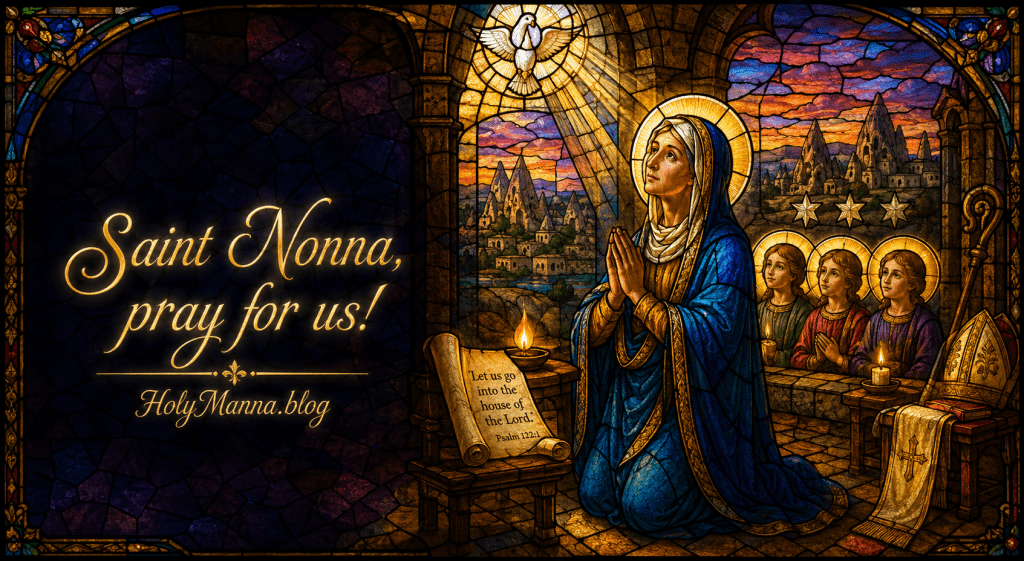
The Woman Who Prayed Her Whole House into Heaven
Some saints convert empires. Some write volumes of theology that the Church still studies seventeen centuries later. Saint Nonna of Nazianzus did something that, in the eyes of heaven, may be just as remarkable. She prayed, patiently and persistently, until her pagan husband became a Christian, then a bishop, then a saint. She raised three children, and every single one of them is now canonized, including a Doctor of the Church. Then, having buried two of her children and her husband within the span of a few years, she died in the one place that had become her true home: kneeling at prayer inside the church of Nazianzus, on August 5th in the year 374.
The Church celebrates her feast on August 5th, and the Roman Martyrology commemorates her with beautiful simplicity: “In Nazianzus in Cappadocia, in today’s Turkey, Saint Nonna, who was the wife of the holy Bishop Gregory the Elder and mother of the Saints Gregory, Cesario and Gorgonia.” One sentence, and yet inside that sentence stands an entire family of saints, and at its center stands the woman whose prayer held them all together.
Nonna matters because she sanctified the most ordinary vocation there is. She was a wife and a mother. She never founded an order, never preached a sermon, never left behind a single written word. Everything the Church knows about her comes through the pen of her son, Saint Gregory Nazianzen, who loved her so deeply that he wove her memory into his greatest orations. Through him, the Church received a portrait of what the Catechism calls the domestic church, the family as “a community of grace and prayer, a school of human virtues and of Christian charity” (CCC 1666). Nonna’s home was exactly that, and it is why the Church still speaks her name every August.
A Christian Daughter Given to a Pagan Husband
Nonna was born around the year 305 in the region of Nazianzus in Cappadocia, a rugged province of the Roman Empire in what is now central Turkey. The hagiographic tradition, preserved especially in the Eastern synaxaria, names her parents as Philotatos and Gorgonia, Christians who raised their daughter in genuine piety during the very years when the last great Roman persecutions were burning themselves out. That same tradition remembers her as the aunt of Saint Amphilochius, who would become Bishop of Iconium and a friend of the great Cappadocian Fathers. The names of her parents survive only through later tradition rather than contemporary documents, so they are received as the Church has handed them down rather than as verified history.
What is firmly documented is what happened next, because her son recorded it. Nonna was given in marriage to Gregory of Arianzus, a wealthy landowner with estates in the districts around Nazianzus. By every earthly measure the match was advantageous. By the measure of Nonna’s soul, it was a sorrow. Her husband was not a Christian. He belonged to a sect called the Hypsistarians, an unusual religious movement that blended Jewish observances with pagan practices in the worship of Hypsistos, the “Most High” God, while also venerating fire. He was a decent and moral man, but he did not know Christ.
Nonna refused to accept that division at the heart of her marriage. Her son Gregory later described her anguish in words that still pierce: “She could not bear this, being half united to God, because he who was part of her remained apart from God.” Half united to God. That phrase captures the ache of every believer who has ever loved someone standing outside the faith. Nonna did not respond with arguments or ultimatums. She responded with prayer, daily, relentless, confident prayer, joined to the quiet witness of her own life.
Scripture had already promised that such a witness carries real power. Saint Paul teaches in 1 Corinthians 7:14 that “the unbelieving husband is consecrated through his wife.” The Catechism takes up this very verse when it speaks of the believing spouse as an instrument of grace, noting the joy that comes “if this leads to the free conversion of the other spouse to the Christian faith” (CCC 1637). Nonna lived that paragraph three centuries before Saint Monica did and sixteen centuries before it was written down.
God answered her. Around the year 325, her husband Gregory had a dream in which he found himself singing a verse from the psalms of David: “I was glad when they said to me, let us go into the house of the Lord” (Psalm 122:1). The words were new to him, but they were not new to Nonna, who recognized the hand of God and seized the moment. Providence supplied the rest. Saint Leontius, the bishop of Caesarea in Cappadocia, passed through Nazianzus on his journey to the Council of Nicaea, that great gathering of 325 where the Church confessed the divinity of Christ against the Arians. Nonna brought her husband to the bishop, and Gregory was baptized by his hands. The timing is almost poetic; in the same season the Church was defining who Christ is, one Cappadocian household was discovering Him for the first time.
Gregory the Elder did not become a lukewarm convert. Within a few years, around 328, he was chosen as bishop of Nazianzus, an office he held for nearly half a century until his death. He even financed the construction of a church for the region from his own wealth. The man who once bowed toward fire ended his life as a shepherd of the Catholic faith, and the Church venerates him today as Saint Gregory the Elder. Behind that transformation stands one praying wife.
The Mother of a Household of Saints
If Nonna’s story ended with her husband’s conversion, she would already deserve her feast day. But God was not finished with her home. Nonna bore three children, and the Church has raised every one of them to the altars.
Her firstborn son, Gregory, arrived around the year 329. Tradition holds that Nonna, longing for a son, had consecrated him to God even before his birth, just as Hannah consecrated Samuel in 1 Samuel 1:11, and Gregory himself testifies in his writings that his mother offered him to the Lord from the beginning. That boy grew into Saint Gregory Nazianzen, called “the Theologian,” Archbishop of Constantinople, defender of the Trinity, Doctor of the Church, and one of the most brilliant minds Christianity has ever produced. Her second son, Caesarius, became a distinguished physician who served at the imperial court and is venerated as Saint Caesarius of Nazianzus. Her daughter Gorgonia married and raised a family of her own, living such a luminous Christian life that her brother eulogized her as the model of a holy wife; the Church honors her as Saint Gorgonia.
Stop and take that in. Husband, son, son, daughter, and Nonna herself: five saints under one roof, with a canonized nephew besides. The Catechism teaches that “the Christian family constitutes a specific revelation and realization of ecclesial communion, and for this reason it can and should be called a domestic church” (CCC 2204). It also teaches that parents are “the first heralds” of the faith for their children (CCC 1656). History offers few clearer illustrations of those paragraphs than the house of Nonna. Her children did not learn the faith primarily from books or schools. They learned it from watching their mother pray.
Gregory left no doubt about who formed him. He wrote of her, “My mother was a worthy companion for such a man, and her qualities were as great as his.” Elsewhere in his orations he presents her as the very pattern of Christian womanhood, a woman whose piety governed her household, whose generosity fed the poor, and whose reverence in church was so complete that she never turned her back to the altar. Because Gregory was an eyewitness writing within living memory, these details carry a weight that later hagiography often lacks. This is a son’s testimony about the mother he watched his whole life.
Two episodes from her life have the character of the miraculous, and both come from Gregory’s own pen. The first occurred in the year 351, when Nonna fell gravely ill and seemed to be at the point of death. Gregory, traveling at the time, changed his plans and hurried to her side, only to find that she had begun to recover. She then told of a vision she had received during her illness, in which her son Gregory appeared to her and gave her cakes marked with the sign of the cross and blessed by him; after eating them in the vision, she was strengthened and restored. The story comes from Gregory himself, and the Church presents it as his testimony to God’s tenderness toward his mother.
The second episode concerns Gregory’s famous voyage to Athens as a young man, when a violent storm overtook his ship and the young student, not yet baptized, feared he would die outside the covenant of grace. Gregory records that he cried out to God, and tradition adds that at the same hour his mother, far away in Cappadocia, was shown the danger and stormed heaven on his behalf; the sea grew calm and the future Theologian reached Athens safely. Gregory attributed his rescue to God’s mercy and to the prayers offered for him, and the tradition has always credited Nonna’s intercession as part of that rescue. The core of the event rests on Gregory’s account; the details of Nonna’s simultaneous knowledge of the storm belong to the tradition that grew around it.
Why should you remember Nonna? Because she proves that the Catechism is describing something real when it says that intercession, “asking on behalf of another, has been characteristic of a heart attuned to God’s mercy” since Abraham (CCC 2635). Nonna’s entire biography is a single sustained act of intercession. She interceded for her husband and won him. She interceded for her children and formed them. She interceded for her son on the sea and, as the tradition holds, helped save him. Emulating her does not require leaving home. It requires praying inside it.
The Long Griefs of Her Final Years
Nonna was not a martyr, and the Church has never claimed otherwise. Her crown was of a different kind, the slow martyrdom of a heart that outlived almost everyone it loved. The final decade of her life brought a procession of griefs that would have broken a lesser faith.
In 368 her younger son Caesarius died, still a relatively young man. The following year brought the death of her daughter Gorgonia. A mother burying one child is a sorrow beyond words; Nonna buried two in the space of about a year, and the sources record that she bore these losses by submitting herself to the will of God. Most accounts place both deaths before her own, though at least one source dates Gorgonia’s death slightly later; the weight of the tradition, and the witness of Gregory’s own funeral orations for his siblings, supports the reading that Nonna outlived both of her younger children.
Then, early in the year 374, her husband died. Saint Gregory the Elder was by then reckoned to be about one hundred years old, and he had served as bishop of Nazianzus for some forty-five years, with his wife beside him through all of it. They had been married for the better part of six decades. The sources record what Nonna did after his funeral, and it may be the most moving detail of her whole story: she almost never left the church again. The building her husband’s generosity had helped give to Nazianzus became her dwelling. She had spent her life turning her home into a church, and at the end, the church became her home.
Her endurance in those years is its own catechesis. The Catechism teaches that the theological virtue of hope “keeps man from discouragement” and “sustains him during times of abandonment” (CCC 1818). Nonna in her widowhood, praying daily in the church at Nazianzus, surrounded by the graves of her family, is what that paragraph looks like when it is lived. She did not grow bitter. She did not despair. She waited on the Lord, and she did her waiting on her knees.
On August 5, 374, only months after her husband’s death, God called her. She died where everyone in Nazianzus knew she would be found, at prayer inside the church. The Eastern tradition adds that she had served the Church in her final years as a deaconess, a detail preserved in the synaxaria of the East, and it records that she reposed in peace during the prayers. There was no drama, no persecution, no executioner. There was simply a faithful woman finishing her prayers and opening her eyes in the presence of the God she had talked to all her life. For a soul like Nonna’s, death was not an interruption of prayer. It was the answer to it.
Her Legacy After Death and the Family She Sent Ahead
Nonna left behind no relics enshrined in a great basilica, no pilgrimage route, no religious order bearing her name. Nazianzus itself faded from history, and its location near the modern Turkish village of Nenizi is today a matter for archaeologists rather than pilgrims. No specific miracles of healing at her tomb have come down in the historical record, and it would be dishonest to invent any. Her legacy took a different and arguably greater form: it walked out of her house on two feet and changed the universal Church.
Her son Gregory went on from her burial to the defining work of his life. Within a few years of her death he was in Constantinople, preaching the five Theological Orations that earned him the title “the Theologian,” defending the divinity of the Son and the Holy Spirit against the Arians, and presiding for a time over the Second Ecumenical Council in 381. Every Sunday, when Catholics profess the Nicene Creed and confess the Holy Spirit as “the Lord, the giver of life,” they are praying words whose defense owes an incalculable debt to Gregory Nazianzen, and therefore to the mother who consecrated him before birth and formed him in the faith. The Catechism itself quotes Saint Gregory Nazianzen repeatedly on the Trinity, including his luminous teaching that “no sooner do I conceive of the One than I am illumined by the Splendor of the Three” (CCC 256). In a real sense, Nonna’s fingerprints are on the Catechism.
Her memory was also enshrined in the Church’s prayer. Gregory embedded his mother in his funeral orations, above all Oration 18, delivered for his father, in which Nonna appears as the spiritual engine of the whole family. Because those orations became classics of Christian literature, Nonna became one of the best documented laywomen of the fourth century. The East honors her on August 5th with hymns that call her a mother of fervent prayer like the mother of the prophet Samuel, and the Roman Church commemorates her on the same day in the Roman Martyrology. Devotional writers across the centuries have paired her with Saint Monica as the two great mothers of the patristic age, each of whom prayed a family member into sanctity, and she is frequently proposed to Catholic parents as a heavenly friend and example.
This, ultimately, is her impact after death: not wonders at a shrine, but an unbroken stream of Christian husbands, wives, and parents who have looked at her and found courage. The Catechism teaches that the witnesses who have preceded us into the kingdom, “especially those whom the Church recognizes as saints, share in the living tradition of prayer” and “contemplate God, praise him and constantly care for those whom they have left on earth” (CCC 2683). Nonna cared for her family on earth with her prayers for seventy years. The Church invites you to believe that she has not stopped.
Bringing Nonna’s Fire Into Your Own Home
It is easy to read the lives of the great missionary saints and feel that holiness happens somewhere else, on some other continent, in some other vocation. Nonna closes that escape route. Her entire field of mission was a marriage, a kitchen, three children, and a parish church in a small Cappadocian town. If sanctity was possible there, it is possible in your home too.
Start where she started, with intercession for the people under your own roof. Nonna prayed for her husband every single day for years before God gave her that dream about the house of the Lord. Who in your life is “half united” to you because they do not yet share your faith, and have you truly committed to praying for them daily rather than merely worrying about them? The Church asks believers to entrust exactly these intentions to God, for “the prayer of the Church is sustained by the prayer of Christ” and nothing offered in His name is wasted (CCC 2606). Persistence was Nonna’s genius. Make it yours.
Second, let your conduct do the preaching. The sources agree that Nonna won her husband not by lecturing him but by the eloquence of her life, exactly as Saint Peter counseled wives whose husbands did not obey the word, that they “may be won without a word by the behavior of their wives” (1 Peter 3:1). If the people closest to you could reconstruct your beliefs only from your behavior this past week, what would they conclude you worship?
Third, treat your family as your first apostolate. The Catechism calls parents the first heralds of the Gospel to their children (CCC 1656) and describes the home as the place where “one learns endurance and the joy of work, fraternal love, generous and even repeated forgiveness” (CCC 1657). Nonna built that school in Nazianzus, and it graduated three saints. Family prayer, grace at meals, honest conversations about God, and visible love for the poor are the bricks of the same school today.
Finally, learn from her grief. Nonna lost two children and her husband in six years, and her response was to move closer to the altar, not further from it. When suffering comes to you, does it drive you toward the church or away from it? Resilience, for the Christian, is not stoicism. It is hope, the virtue by which “we desire the kingdom of heaven and eternal life as our happiness, placing our trust in Christ’s promises” (CCC 1817). Nonna trusted those promises all the way to her last prayer.
Engage With Us!
Saint Nonna’s story belongs in every Catholic home, and your reflections on it belong in this community. Share your thoughts in the comments below; your experience of praying for a loved one may be exactly the encouragement another reader needs today. To guide the conversation, consider these questions:
- Is there someone in your family you have quietly given up on spiritually, and what would it look like to take up Nonna’s daily, patient intercession for them starting today?
- Nonna evangelized her husband through her conduct more than her words. What is one concrete habit you could change this week so that your life preaches more clearly than your arguments?
- Nonna consecrated her son Gregory to God before he was born. In what specific ways are you entrusting the people you love to God’s plans rather than your own?
- After losing her husband and two children, Nonna made the church her home. Where do you run when grief finds you, and how might you make the sacraments your refuge?
- All five members of Nonna’s household became saints. What is one step your family could take together this month toward becoming a true domestic church?
Sainthood did not begin for Nonna in a cathedral or a desert. It began at her own dinner table, in prayers whispered over a husband who did not yet believe and children who did not yet understand. Your home is holy ground too. Pray with Nonna’s persistence, love with her patience, and endure with her hope, and then carry that same love out your front door, doing everything with the love and mercy that Jesus taught us.
Saint Nonna, pray for us!
Follow us on YouTube, TikTok, Instagram and Facebook for more insights and reflections on living a faith-filled life.

 Holy Manna!
Leave a comment