Wednesday of the Eighteenth Week in Ordinary Time – Lectionary: 409
The Love That Refuses to Let Go
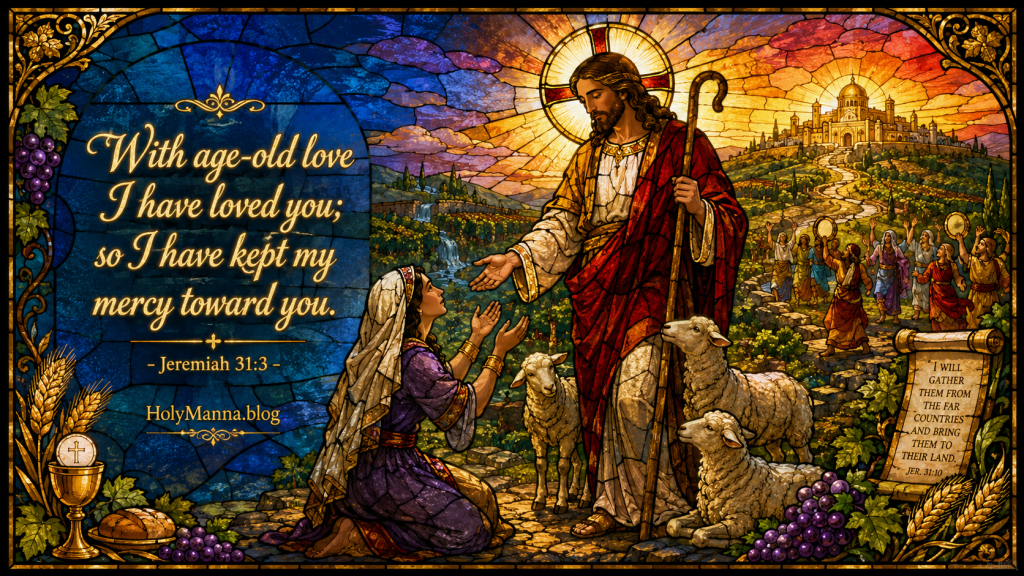
Everyone knows what it feels like to wonder whether a season of loss can ever be undone. The readings for Wednesday of the Eighteenth Week in Ordinary Time answer that ache with one of the most tender promises in all of Scripture. Through the prophet Jeremiah, God speaks to a people shattered by war and scattered by exile, and He does not scold them first. He tells them why He is bringing them home: “With age-old love I have loved you; so I have kept my mercy toward you.”
The central theme uniting today’s readings is God’s everlasting love, a love that gathers what has been scattered, turns mourning into joy, and overflows every border that human beings draw around it. Jeremiah delivered these words during the darkest stretch of Judah’s history, in the decades surrounding the destruction of Jerusalem in 587 BC. The section of his book containing today’s passages is often called the Book of Consolation, because in the middle of national catastrophe the prophet suddenly sings of homecoming, vineyards, and dancing. The Responsorial Psalm, drawn from that same consoling chapter of Jeremiah 31, announces the good news to the nations themselves: the God who scattered Israel now gathers His flock like a shepherd.
Then the Holy Gospel shows what happens when one of those nations talks back. A Canaanite mother, a daughter of Israel’s oldest enemies, steps into the path of Jesus and refuses to leave without mercy. Her persistence meets His age-old love, and heaven applauds. Today invites every reader to stand exactly where she stood.
First Reading — Jeremiah 31:1-7
A Love Older Than the Ruins
Jeremiah prophesied in Judah from around 627 BC until after Jerusalem fell to Babylon, and most of his book aches with warning and grief. That is what makes Jeremiah 30-31 so startling. In these chapters, known as the Book of Consolation, God promises restoration before the worst has even finished happening. Today’s oracle reaches back further still, to the ten northern tribes deported by Assyria in 722 BC, more than a century before Jeremiah spoke. Those tribes had been separated from Judah since the kingdom split around 930 BC, worshiping at rival shrines and finally vanishing into exile. Humanly speaking, they were gone. Yet God speaks of them as a father speaks of children he has never stopped expecting home, and He grounds the entire promise not in Israel’s merits but in His own eternal love. This is the foundation of the day’s central theme: restoration begins in the heart of God.
Detailed Exegesis
Verse 1: “At that time, says the LORD, I will be the God of all the tribes of Israel, and they shall be my people.”
This is the ancient covenant formula, the marriage vow between God and Israel first heard in Exodus 6:7. The word “all” carries the weight here. After two centuries of schism and exile, God promises to reunite every tribe, north and south, into one people. What history broke, God intends to mend.
Verse 2: “Thus says the LORD: The people that escaped the sword have found favor in the desert.”
Jeremiah deliberately echoes the Exodus. Just as the generation that escaped Pharaoh’s sword found grace in the wilderness of Sinai, so the survivors of Assyria’s sword will experience a new Exodus. The desert, the place of loss, becomes once again the place where God’s favor is discovered.
Verse 3: “As Israel comes forward to be given his rest, the LORD appears to him from afar: With age-old love I have loved you; so I have kept my mercy toward you.”
Here beats the heart of the entire passage. The Hebrew phrase behind “age-old love” is ahavat olam, an everlasting love, and it is joined to hesed, the covenant mercy that never quits. God’s love is not a response to Israel’s goodness; it precedes Israel’s existence and survives Israel’s failures.
Verse 4: “Again I will restore you, and you shall be rebuilt, O virgin Israel; Carrying your festive tambourines, you shall go forth dancing with the merrymakers.”
Calling the unfaithful nation “virgin Israel” is an act of sheer grace, for God speaks of His people as if their infidelity had never stained them. The tambourines and dancing recall Miriam leading the women in triumph at the sea in Exodus 15:20. Restoration will not be grudging survival; it will look like a wedding feast.
Verse 5: “Again you shall plant vineyards on the mountains of Samaria; those who plant them shall enjoy the fruits.”
Samaria was the heartland of the fallen northern kingdom. Among the covenant curses of Deuteronomy 28 was the horror of planting a vineyard and never tasting its wine. God now reverses the curse explicitly. Ordinary life, with its patient labor and its harvest joy, will return to the very hills that saw the catastrophe.
Verse 6: “Yes, a day will come when the watchmen will call out on Mount Ephraim: ‘Rise up, let us go to Zion, to the LORD, our God.’”
Watchmen once scanned those ridges for invading armies. Now they will summon pilgrims. Even more remarkably, watchmen in Ephraim, the north that had rejected Jerusalem’s Temple for rival shrines, will call the people to Zion. Reunion with God means reunion with one another in shared worship.
Verse 7: “For thus says the LORD: Shout with joy for Jacob, exult at the head of the nations; proclaim your praise and say: The LORD has delivered his people, the remnant of Israel.”
The passage closes with a command to celebrate before the deliverance is even visible, and to do so publicly, at the head of the nations. The “remnant” is a treasured biblical theme: however small the surviving portion of God’s people appears, it carries the whole promise forward.
Teachings
The Catechism reads this very chapter as a revelation of who God is. CCC 218 teaches: “In the course of its history, Israel was able to discover that God had only one reason to reveal himself to them, a single motive for choosing them from among all peoples as his special possession: his sheer gratuitous love.” The following paragraph, CCC 220, quotes today’s reading directly: “God’s love is ‘everlasting’: ‘For the mountains may depart and the hills be removed, but my steadfast love shall not depart from you.’ Through Jeremiah, God declares to his people, ‘I have loved you with an everlasting love; therefore I have continued my faithfulness to you.’ The Church also hears in this chapter the first announcement of something greater, for Jeremiah 31 culminates in the promise of the New Covenant. As CCC 64 teaches: “Through the prophets, God forms his people in the hope of salvation, in the expectation of a new and everlasting Covenant intended for all, to be written on their hearts.” The love announced to exiles in 587 BC was already reaching toward the Upper Room.
Reflection
Every life contains a ruined Samaria, some region of the heart flattened by sin, grief, or years of distance from God. Today’s reading insists that God looks at precisely that place and says “again.” Consider one concrete step this week: return to a devotion that was abandoned long ago, whether the Rosary, daily Scripture, or Confession, and let God rebuild on the old foundation. Which area of life feels too far gone for restoration, and what would change if God’s “again” were spoken over it? When was the last time God’s love was received as a gift rather than a wage to be earned?
Responsorial Psalm — Jeremiah 31:10, 11-12ab, 13
The Shepherd Who Turns Mourning into Joy
Today the Church does something unusual. Instead of drawing the Responsorial Psalm from the Psalter, the liturgy continues directly in Jeremiah 31, setting the prophet’s own poetry on the congregation’s lips with the refrain, “The Lord will guard us as a shepherd guards his flock.” The choice is significant. The promises proclaimed in the First Reading are not merely announced to the assembly; they are sung by the assembly, as if the Church were already standing among the returning exiles. Strikingly, these verses are addressed outward, to the nations and the distant coastlands, which quietly prepares the ground for the Gentile woman who will dominate today’s Gospel. The mercy shown to Israel was always meant to be overheard by the whole world.
Detailed Exegesis
Verse 10: “Hear the word of the LORD, O nations, proclaim it on distant isles, and say: He who scattered Israel, now gathers them together, he guards them as a shepherd his flock.”
God summons the Gentiles as witnesses and even as heralds of Israel’s homecoming. The verse makes a bold theological claim: the same Lord who permitted the scattering is the One now gathering. Exile was never abandonment. The shepherd image places this promise in the great stream that flows from Psalm 23 through Ezekiel 34 to the lips of Christ.
Verse 11: “The LORD shall ransom Jacob, he shall redeem him from the hand of his conqueror.”
The words “ransom” and “redeem” come from Israel’s family law, where the go’el, the kinsman redeemer, paid the price to buy a relative out of slavery or debt. God claims that role personally. For the Christian reader, the verse points forward to the true price of redemption, paid not in silver but in the Blood of Christ.
Verse 12ab: “Shouting, they shall mount the heights of Zion, they shall come streaming to the LORD’s blessings.”
The exiles do not trudge home; they stream like a river running uphill, shouting as they climb toward the Temple mount. The picture is pilgrimage transformed into celebration, and it hints at the great procession of all peoples toward God’s holy mountain that the prophets loved to describe.
Verse 13: “Then the virgins shall make merry and dance, and young men and old as well. I will turn their mourning into joy. I will console and gladden them after their sorrows.”
Every generation joins the dance, from young women with tambourines to the very old. God does not merely end sorrow; He transforms it, echoing the cry of Psalm 30:12 that the Lord changes mourning into dancing. Consolation is not a distraction from grief but its healing.
Teachings
The shepherd promise finds its face in Jesus, who declares in The Gospel of John: “I am the good shepherd. A good shepherd lays down his life for the sheep.” (John 10:11) The Church understands herself as the flock this psalm foretells. CCC 754 teaches: “The Church is, accordingly, a sheepfold, the sole and necessary gateway to which is Christ. It is also the flock of which God himself foretold that he would be the shepherd, and whose sheep, even though governed by human shepherds, are unfailingly nourished and led by Christ himself, the Good Shepherd and Prince of Shepherds, who gave his life for his sheep.” What Jeremiah sang to scattered exiles, the Church now sings to every soul scattered by sin, confident that the Shepherd still leaves no sheep unclaimed.
Reflection
Scattered things rarely gather themselves; someone must go out and collect them. That is the quiet comfort of this psalm, because the work of regathering belongs to God, not to sheer willpower. A practical way to live this today is to name one scattered piece of life, perhaps a fractured friendship, a neglected prayer routine, or a family member far from the Church, and entrust it to the Good Shepherd by name in prayer, then take one small step toward reconciliation. What part of life feels scattered beyond recovery, and has it truly been handed to the Shepherd? Whose mourning nearby could be met this week with genuine consolation?
Holy Gospel — Matthew 15:21-28
The Mother Who Would Not Be Turned Away
For the only time in His adult ministry as The Gospel of Matthew records it, Jesus leaves the territory of Israel, withdrawing north into the pagan coastal region of Tyre and Sidon after a bruising dispute with the Pharisees over ritual purity in Matthew 15:1-20. There a local woman approaches, and Matthew introduces her with a word chosen for maximum shock: Canaanite. By the first century that term was ancient, deliberately evoking the idolatrous nations Israel had displaced a thousand years earlier. She is, in other words, the last person anyone expected to become a hero of the faith. Yet this outsider addresses Jesus with the messianic title “Son of David” and simply refuses to stop asking. Her encounter with Christ, wrestling mercy from apparent refusal, shows the readings’ central theme in action: God’s age-old love overflowing its banks toward the nations.
Detailed Exegesis
Verse 21: “At that time Jesus withdrew to the region of Tyre and Sidon.”
The geography preaches. Having just taught that purity comes from the heart rather than from external observance, Jesus walks straight into unclean Gentile territory. St. John Chrysostom saw in this journey the door quietly opening to the Gentiles, a preview of the mission that Peter would later inaugurate with Cornelius.
Verse 22: “And behold, a Canaanite woman of that district came and called out, ‘Have pity on me, Lord, Son of David! My daughter is tormented by a demon.’”
A pagan woman confesses Israel’s Messiah using Israel’s own royal title. Chrysostom also noticed her wording, for she does not ask pity for the daughter alone but cries “Have pity on me,” because a mother carries her child’s suffering as her own. Her prayer is short, honest, and drenched in love.
Verse 23: “But he did not say a word in answer to her. His disciples came and asked him, ‘Send her away, for she keeps calling out after us.’”
The silence of Jesus is the hardest verse in the passage, and the Fathers refused to read it as coldness. St. Augustine explained: “He made as though He heard her not, not to the end that mercy might be refused her, but that her desire might be enkindled.” Even the disciples’ irritation testifies that she never stopped crying out.
Verse 24: “He said in reply, ‘I was sent only to the lost sheep of the house of Israel.’”
Jesus states the divine order of salvation history: the Messiah’s earthly mission was to Israel first, so that the promises, including those heard in today’s First Reading, would be fulfilled among the covenant people before flowing outward through the Church. Augustine taught that she “was not refused, but only put off,” her hour standing just ahead.
Verse 25: “But the woman came and did him homage, saying, ‘Lord, help me.’”
Rebuffed, she comes closer. The word for homage describes worship, the posture of adoration, and her prayer shrinks to three perfect words. When arguments fail, she simply kneels. It is one of the purest acts of faith in the Gospels.
Verse 26: “He said in reply, ‘It is not right to take the food of the children and throw it to the dogs.’”
The saying uses a diminutive word meaning the little dogs of the household rather than street scavengers, yet it remains a stinging test. Chrysostom insisted on reading it as invitation rather than dismissal: “Not in insult then were His words spoken, but calling her forth, and revealing the treasure laid up in her.”
Verse 27: “She said, ‘Please, Lord, for even the dogs eat the scraps that fall from the table of their masters.’”
This is one of the most brilliant replies in Scripture. She accepts the humbling image and turns it into her claim, for household dogs belong to the household. Chrysostom marveled at her humility: “He called them ‘children,’ but she ‘masters;’ He used the name of a dog, but she added also the dog’s act.” Augustine added that “by knocking she was made of a dog one of human kind.”
Verse 28: “Then Jesus said to her in reply, ‘O woman, great is your faith! Let it be done for you as you wish.’ And her daughter was healed from that hour.”
Only twice in The Gospel of Matthew does Jesus praise someone’s faith as great, here and with the centurion in Matthew 8:10, and both are Gentiles. Chrysostom concluded that Jesus delayed for one purpose: “Yea, therefore did He put her off, that He might proclaim aloud this saying, that He might crown the woman.” The healing is instant, complete, and accomplished at a distance, by faith alone laying hold of mercy.
Teachings
The Catechism holds this woman up as a permanent teacher of prayer. CCC 2610 teaches: “Jesus is as saddened by the ‘lack of faith’ of his own neighbors and the ‘little faith’ of his own disciples as he is struck with admiration at the great faith of the Roman centurion and the Canaanite woman.” Her story also reveals the destiny of the kingdom itself, as CCC 543 teaches: “Everyone is called to enter the kingdom. First announced to the children of Israel, this messianic kingdom is intended to accept men of all nations.” Finally, CCC 2616 lists her among those whose petitions Christ answered during His earthly ministry: “Jesus hears the prayer of faith, expressed in words (the leper, Jairus, the Canaanite woman, the good thief) or in silence.” The woman who begged for scraps became, in the Fathers’ eyes, a figure of the whole Gentile Church now seated at the table of the Eucharist.
Reflection
Almost every believer eventually prays into what feels like silence, and this Gospel was given for exactly those seasons. The Canaanite woman shows that divine silence can be an invitation to draw nearer rather than a verdict to walk away. Three concrete practices flow from her example: keep praying for loved ones by name even when nothing seems to change, answer discouragement by moving closer to Jesus through the sacraments rather than drifting from Him, and let humility do the talking, since God cannot resist an honest heart. Whose healing deserves the same stubborn intercession this mother gave her daughter? When prayer meets silence, is the response to knock louder or to quietly give up?
Coming Home to the Table
Taken together, today’s readings tell one seamless story. In the First Reading, God explains why the exiles will come home, and the reason is not their repentance, their strategy, or their strength, but His own age-old love that never once let go of them. In the Responsorial Psalm, that love takes the shape of a shepherd who gathers His scattered flock and turns mourning into dancing, while the nations lean in to listen. And in the Holy Gospel, one daughter of those nations stops listening from a distance and steps forward to claim the mercy she overheard, teaching Israel and the Church forever what great faith looks like.
The message lands close to home. The love that rebuilt Samaria’s vineyards and healed a Canaanite girl is the same love poured out at every Mass, where former outsiders no longer gather scraps beneath the table but receive the Bread of Life upon it. No exile is too long, no distance too far, and no silence too heavy for the God who says, “With age-old love I have loved you.”
So take the Canaanite woman as a companion this week. Bring the most hopeless intention forward one more time. Kneel when arguing fails. Trust that the Shepherd is already out looking for whatever has been scattered. Then watch for the moment when mourning quietly begins its turn toward joy, because the promise spoken through Jeremiah has never expired, and the Lord still crowns persistent, humble faith with the words every heart longs to hear. He has been waiting at the table all along, and there is a place set with your name.
Engage With Us!
Your reflections matter here, and this community grows stronger every time someone shares honestly. Please add your thoughts, questions, and experiences in the comments below, because another reader may need exactly the testimony you carry.
- In Jeremiah 31:1-7, God promises to rebuild “virgin Israel” and replant vineyards on the ruined hills of Samaria. What broken area of your life is God inviting you to let Him rebuild with His “again”?
- The Responsorial Psalm from Jeremiah 31:10-13 proclaims that the Lord who scattered Israel now gathers His people like a shepherd and turns mourning into joy. Where have you seen God gather something scattered in your own story?
- In Matthew 15:21-28, the Canaanite woman keeps praying through silence, refusal, and testing until Jesus declares her faith great. How do you respond when your prayers seem to meet silence, and what would her persistence look like in your life this week?
- All three readings reveal a love that is ancient, gathering, and open to every nation. How will you extend that boundary-crossing mercy to someone who feels like an outsider this week?
Living faith is built one small, stubborn act of trust at a time, just like the steps of a mother who would not turn back. Keep praying, keep returning, and keep the door of your heart open wide, doing everything with the love and mercy Jesus taught us.

 Holy Manna!
Leave a comment