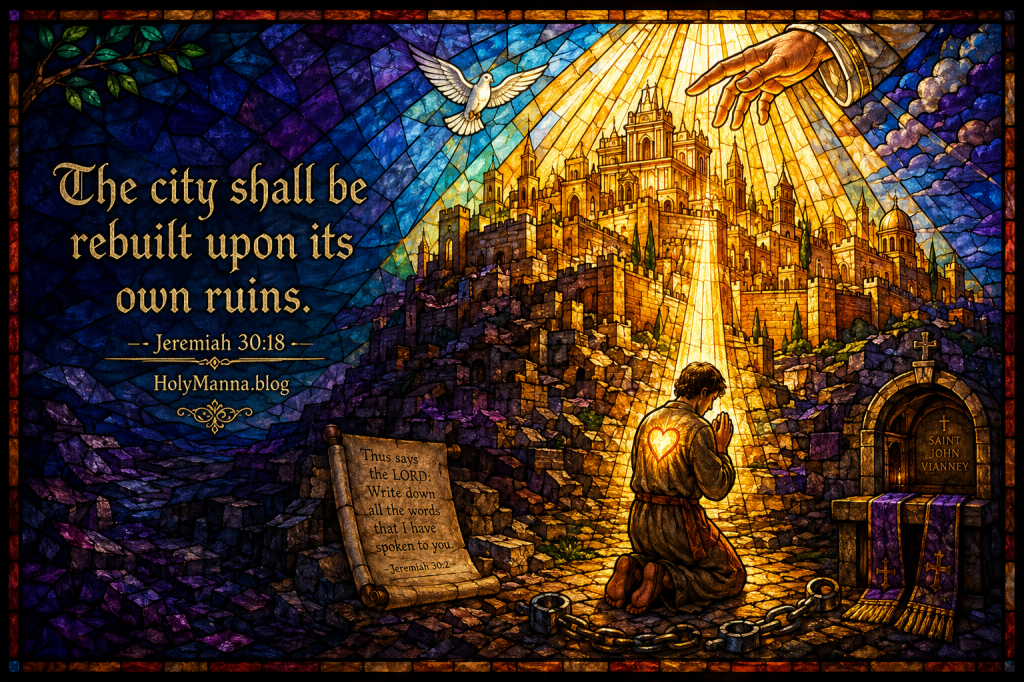
Memorial of Saint John Vianney, Priest — Lectionary: 408
When God Picks Up the Trowel
Some ruins look final. A doctor closes the chart, a marriage collapses, a habit hardens into an identity, and everyone quietly agrees that nothing can be rebuilt here. The readings for this Memorial of Saint John Vianney walk straight into that kind of ruin and refuse to accept the verdict. Through Jeremiah, God looks at His people and says the unthinkable twice over: the wound is incurable, and He will heal it anyway. The psalmist picks up the same song, promising a generation not yet born that the LORD rebuilds Zion and bends down to hear the prayer of the destitute. Then, in the Holy Gospel, Jesus reveals where the real ruin lies and where the real rebuilding must begin, not in washed hands or polished observance, but in the human heart.
The central theme uniting these readings is that God alone rebuilds what sin has ruined, and He begins that rebuilding from the inside out. It is no accident that the Church proclaims these texts on the feast of the Curé of Ars. John Vianney arrived in 1818 at a tiny French village spiritually flattened by the aftermath of the Revolution, and he spent four decades letting God rebuild it soul by soul, hour after hour, in the confessional. Ars became living proof that no wound is beyond the Divine Physician. These readings extend that same proof to every reader carrying something that feels past repair. What looks like rubble to human eyes looks like a foundation to God.
First Reading — Jeremiah 30:1-2, 12-15, 18-22
When the Diagnosis Says Incurable and Heaven Says Otherwise
Jeremiah spent most of his ministry announcing a judgment nobody wanted to hear as Babylon rose in the east. Chapters 30 and 31 of The Book of Jeremiah form a startling interruption often called the Book of Consolation, hope spoken to a people staring at catastrophe. The northern tribes had already been scattered by Assyria in 722 BC, and Judah stood on the edge of the destruction of 587 BC. Into that darkness, God commands His prophet to write down promises of restoration for a generation not yet born. The passage moves in two panels, first the brutal diagnosis of a wound no human remedy can touch, then a restoration so complete that only God could accomplish it.
Jeremiah 30:1-2, 12-15, 18-22
The following message came to Jeremiah from the LORD:
For thus says the LORD, the God of Israel:
Write all the words I have spoken to you in a book.For thus says the LORD:
Incurable is your wound,
grievous your bruise;
There is none to plead your cause,
no remedy for your running sore,
no healing for you.
All your lovers have forgotten you,
they do not seek you.
I struck you as an enemy would strike,
punished you cruelly;
Why cry out over your wound?
your pain is without relief.
Because of your great guilt,
your numerous sins,
I have done this to you.Thus says the LORD:
See! I will restore the tents of Jacob,
his dwellings I will pity;
City shall be rebuilt upon hill,
and palace restored as it was.
From them will resound songs of praise,
the laughter of happy men.
I will make them not few, but many;
they will not be tiny, for I will glorify them.
His sons shall be as of old,
his assembly before me shall stand firm;
I will punish all his oppressors.
His leader shall be one of his own,
and his rulers shall come from his kin.
When I summon him, he shall approach me;
how else should one take the deadly risk
of approaching me? says the LORD.
You shall be my people,
and I will be your God.
Detailed Exegesis
Verse 1: The word that came to Jeremiah from the LORD: The formula reminds readers that what follows is not the prophet’s optimism but divine speech, and the promises ahead will need that authority.
Verse 2: Thus says the LORD, the God of Israel: Write all the words I have spoken to you in a book. Hope is to be preserved in writing so it can outlive the disaster. Scripture itself is born from this command, a permanent record of promises meant for generations who would read them in exile.
Verse 12: For thus says the LORD: Incurable is your wound, grievous your injury. God does not minimize sin’s damage. The covenant people’s condition is described in medical terms as a case no physician would accept, an honesty that clears away every illusion of self-rescue.
Verse 13: There is no one to plead your cause, no remedy for your sore, no healing for you. Judah has no advocate and no medicine. Every earthly court and cure has failed, leaving the nation without recourse apart from God Himself.
Verse 14: All your lovers have forgotten you, they do not seek you out. I struck you as an enemy would strike, punished you cruelly, because of your great guilt, your numerous sins. The “lovers” are the foreign alliances and idols Judah courted instead of trusting the LORD. In the moment of crisis those partners vanished, and God allowed His people to feel the full weight of their choices.
Verse 15: Why cry out over your wound? Your pain is without relief. Because of your great guilt, your numerous sins, I have done this to you. The verse forbids self-pity divorced from repentance. Complaint without conversion misses the point, because the wound has a moral cause that must be named before it can be healed.
Verse 18: Thus says the LORD: See! I will restore the fortunes of the tents of Jacob, on his dwellings I will have compassion; the city shall be rebuilt upon its own mound, and the citadel restored as it deserves. Here the reversal begins, and nothing in the text explains it except God’s own compassion. The Hebrew word for mound is tel, the heap of ruins itself, which means God builds the new city directly on top of the wreckage rather than pretending the wreckage never happened.
Verse 19: From them will come praise, and the sound of people rejoicing. I will increase them, they will not decrease; I will glorify them, they will not be insignificant. Restoration produces liturgy, since the first fruit of the rebuilt city is thanksgiving, and the people once decimated will multiply under God’s blessing.
Verse 20: His children shall be as of old, his assembly shall stand firm in my presence, and I will punish all his oppressors. The word translated assembly is the Hebrew qahal, which the ancient Greek translation renders with the same root that gives the New Testament its word for Church, ekklesia. The promise of a congregation standing firm before God quietly points toward the Church that Christ would gather.
Verse 21: His leader shall be one of his own, and his ruler shall emerge from his ranks. I will allow him to draw near me, and he shall approach me. For who would otherwise dare to approach me, says the LORD. No foreign king will govern restored Israel, but the astonishing detail is priestly, since drawing near to God was the privilege of consecrated priests alone. The tradition of the Church reads here a foreshadowing of Christ, the ruler from among His people who alone dares to approach the Father on behalf of all, as The Letter to the Hebrews teaches of the one eternal Mediator.
Verse 22: You shall be my people, and I will be your God. The covenant formula closes the oracle, the sentence that beats like a heart through the whole of Scripture from Sinai to Revelation. The goal of all the rebuilding is not real estate but relationship.
Teachings
The Catechism places this prophetic hope at the foundation of salvation history. CCC 64 teaches, Through the prophets, God forms his people in the hope of salvation, in the expectation of a new and everlasting Covenant intended for all, to be written on their hearts. That final phrase looks directly at this section of Jeremiah, because only a chapter after today’s reading God promises the New Covenant of Jeremiah 31:31-34, fulfilled at the Last Supper and in the sacrifice of Christ. The incurable wound of chapter 30 finds its cure in the New Covenant of chapter 31, and the Church proclaims both as one continuous act of divine mercy.
Verse 21 deserves special attention on this memorial. The ruler who is allowed to draw near to God prefigures Christ the High Priest, and every Catholic priest shares in that one priesthood, drawn from among the people and permitted to approach God for their sake. Saint John Vianney understood this vocation with piercing clarity. In his catechetical instructions, quoted by Pope Benedict XVI in the Letter Proclaiming a Year for Priests, he taught, The priesthood is the love of the Heart of Jesus. The humble priest of Ars became a living answer to Jeremiah’s question of who would dare approach God, because Christ drew Vianney near and, through him, drew thousands of wounded souls back to the Father.
Reflection
Every life contains a verse 12, some wound that feels incurable, whether a sin repeated so often it seems permanent, a relationship shattered beyond apology, or a grief that time refuses to soften. Jeremiah insists that God sees the wound exactly as it is and still promises to rebuild on the very mound of the ruins. The practical path begins where Judah’s healing began, with honest confession rather than complaint. A concrete step this week is to bring the most incurable-feeling wound to the Sacrament of Reconciliation, where Saint John Vianney spent his life proving that God restores fortunes. Another step is to write down, as Jeremiah was commanded, one promise of God worth preserving for harder days ahead. Which ruin in life has quietly been labeled beyond repair? What would change if God were invited to rebuild directly on top of it?
Responsorial Psalm — Psalm 102:16-23, 29
The Prayer of the Destitute Reaches Heaven
Psalm 102 carries one of the most poignant titles in the entire Psalter, introducing itself as the prayer of an afflicted person who is wasting away and pours out anguish before the LORD. The Church counts it as the fifth of the seven Penitential Psalms, prayed for centuries by sinners seeking mercy. Its early verses describe sleepless nights, ashes eaten like bread, and days vanishing like smoke, which makes the section chosen for this Mass all the more striking, because the lectionary lifts out the psalm’s great hinge of hope. The afflicted one looks up from personal misery to the promise that the LORD rebuilds Zion, answering Jeremiah’s oracle almost line for line and carrying the day’s theme of divine restoration into sung prayer.
Psalm 102:16-23, 29
R. (17) The Lord will build up Zion again, and appear in all his glory.
The nations shall revere your name, O LORD,
and all the kings of the earth your glory,
When the LORD has rebuilt Zion
and appeared in his glory;
When he has regarded the prayer of the destitute,
and not despised their prayer.
R. The Lord will build up Zion again, and appear in all his glory.
Let this be written for the generation to come,
and let his future creatures praise the LORD:
“The LORD looked down from his holy height,
from heaven he beheld the earth,
To hear the groaning of the prisoners,
to release those doomed to die.”
R. The Lord will build up Zion again, and appear in all his glory.
The children of your servants shall abide,
and their posterity shall continue in your presence,
That the name of the LORD may be declared on Zion;
and his praise, in Jerusalem,
When the peoples gather together
and the kingdoms, to serve the LORD.
R. The Lord will build up Zion again, and appear in all his glory.
Detailed Exegesis
Verse 16: The nations shall fear your name, O LORD, and all the kings of the earth your glory. The psalmist’s horizon suddenly widens from private suffering to the whole world. Zion’s restoration will be so unmistakable that pagan nations and their kings will recognize the glory of Israel’s God.
Verse 17: For the LORD has rebuilt Zion and appeared in his glory. The verse is sung with such confidence that the future reads as already accomplished. What Jeremiah promised in oracle, the psalmist proclaims in worship, that the rebuilding of the holy city is God’s own self-revelation.
Verse 18: He has regarded the prayer of the destitute, and not despised their prayer. The Hebrew word for the destitute describes someone stripped bare of everything. Heaven’s attention is drawn precisely to the prayer that possesses nothing, which overturns every human instinct about whose voice matters.
Verse 19: Let this be written for the generation to come, and let his future creatures praise the LORD. Just as God commanded Jeremiah to write in a book, the psalmist orders this mercy recorded for a people not yet created. Every reader of this psalm today is that future generation, praising God exactly as the verse foretold.
Verse 20: The LORD looked down from his holy height, from heaven he beheld the earth. The transcendent God is not distant from suffering. The verse pictures Him leaning over the rampart of heaven, deliberately turning His gaze toward the world’s pain.
Verse 21: To hear the groaning of the prisoners, to release those doomed to die. For the exiles in Babylon this was a promise of literal liberation. For the Church it describes the deeper captivity of sin and the sentence of death that Christ came to commute, a release enacted every time absolution is spoken in the confessional.
Verse 22: That the name of the LORD may be declared in Zion, and his praise in Jerusalem. Liberation has a destination, and that destination is worship. God frees prisoners so that praise may rise again in the rebuilt city, echoing the thanksgiving Jeremiah promised.
Verse 23: When the peoples gather together, and the kingdoms, to serve the LORD. The rebuilt Zion becomes a magnet for the nations, a worldwide assembly serving the one true God, a hope the Church sees fulfilled in her own gathering of every people and tongue.
Verse 29: The children of your servants shall abide, and their posterity shall continue in your presence. The psalm’s final selected verse plants the restoration in permanence. God’s rebuilding is not a temporary patch but an enduring dwelling, generation after generation living securely in His presence.
Teachings
The Catechism teaches that the Psalms are the masterwork of prayer in the Old Testament precisely because they unite the community’s worship with the individual’s cry. CCC 2588 states, The Psalter’s many forms of prayer take shape both in the liturgy of the Temple and in the human heart. Psalm 102 displays that union perfectly, one afflicted heart praying alone, yet handing its words to the entire praying Church for all generations. The gathering of the nations in verse 23 also echoes what CCC 762 teaches about salvation history: The remote preparation for this gathering together of the People of God begins when he calls Abraham and promises that he will become the father of a great people. The rebuilt Zion of the psalm is, in the fullest sense, the Church.
Saint Augustine, preaching on this psalm in his Expositions on the Psalms, hears in the afflicted one a voice greater than any single sufferer. He teaches that the poor man praying here is ultimately Christ, who made the anguish of His Body the Church His own, so that when the destitute pray this psalm, Christ prays in them and with them, Head and members groaning together toward the final rebuilding of the heavenly Jerusalem.
Reflection
The psalm offers a quiet test of faith: whether anyone actually believes that God does not despise the prayer of the destitute. Modern life whispers that seasons of spiritual poverty disqualify a person from being heard, yet verse 18 says the opposite, that destitution is precisely what draws God’s regard. A concrete practice is to pray Psalm 102 slowly during a week of dryness, claiming verse 19’s promise that these words were written for the generation reading them now. Another practice is intercession for prisoners, both those behind physical bars and those locked inside addiction or despair, since verse 21 reveals how much their groaning matters to heaven. When prayer feels bankrupt, is it treated as worthless or as the very prayer God has promised to regard? Who in daily life is groaning like a prisoner and waiting for someone to carry that groan to God?
Holy Gospel — Matthew 15:1-2, 10-14
Clean Hands Cannot Substitute for a Clean Heart
By chapter 15 of The Gospel of Matthew, the ministry of Jesus in Galilee has grown impossible to ignore, with crowds at Gennesaret pressing simply to touch His tassel and be healed. So Jerusalem sends a delegation of Pharisees and scribes, an official inquiry into this untrained rabbi. Their charge concerns the tradition of the elders, the oral rulings that extended the ritual washings God commanded of priests in Exodus 30:17-21 to every layperson at every meal, something the written Law never required of ordinary Israelites. The lectionary omits verses 3 through 9, where Jesus confronts their Corban practice and cites Isaiah 29:13 about lips that honor God while hearts stay far away, and moves directly to His public teaching, where the day’s theme reaches its sharpest edge: the ruin that matters is inside, and so is the rebuilding.
Matthew 15:1-2, 10-14
Some Pharisees and scribes came to Jesus from Jerusalem and said,
“Why do your disciples break the tradition of the elders?
They do not wash their hands when they eat a meal.”
He summoned the crowd and said to them, “Hear and understand.
It is not what enters one’s mouth that defiles the man;
but what comes out of the mouth is what defiles one.”
Then his disciples approached and said to him,
“Do you know that the Pharisees took offense
when they heard what you said?”
He said in reply, “Every plant that my heavenly Father has not planted
will be uprooted.
Let them alone; they are blind guides of the blind.
If a blind man leads a blind man,
both will fall into a pit.”
Detailed Exegesis
Verse 1: Then Pharisees and scribes came to Jesus from Jerusalem and said, The detail of origin matters, since a delegation from the capital carries the weight of official religious scrutiny. Galilee’s popular movement has drawn the attention of the establishment, and the encounter that follows is not casual curiosity but formal challenge.
Verse 2: “Why do your disciples break the tradition of the elders? They do not wash their hands when they eat a meal.” The accusation is aimed at Jesus through His disciples, a rabbi being responsible for his students’ practice. Notably, the charge concerns not the Law of Moses but a human expansion of it, treated by the questioners as though it carried divine authority.
Verse 10: He summoned the crowd and said to them, “Hear and understand.” Jesus deliberately widens the audience from the experts to the ordinary people. The double command to hear and understand signals a teaching of unusual weight, spoken with the sovereign authority of the Lawgiver Himself.
Verse 11: “It is not what enters one’s mouth that defiles the person; but what comes out of the mouth is what defiles one.” In one sentence, Jesus relocates the entire geography of purity from the hands to the heart. Later in the chapter He specifies that what comes from the mouth proceeds from the heart, where evil thoughts, malice, and falsehood are born, so defilement is a moral reality flowing outward rather than a ritual contamination flowing inward.
Verse 12: Then his disciples approached and said to him, “Do you know that the Pharisees took offense when they heard what you said?” The disciples are nervous about scandalizing the powerful, exposing a perennial temptation in religious life, the instinct to soften the truth whenever it offends the influential.
Verse 13: He said in reply, “Every plant that my heavenly Father has not planted will be uprooted.” Jesus answers with an image of divine gardening. Teachings that God did not plant, however venerable they appear, carry no permanence, and the Father Himself will uproot them in His own time.
Verse 14: “Let them alone; they are blind guides. And if a blind person leads a blind person, both will fall into a pit.” The saying is a sober warning about spiritual leadership rather than a license for contempt. Guides who cannot see the true location of holiness lead their followers into ruin with them, which makes the gift of a clear-sighted shepherd, like the saint honored this day, a mercy beyond price.
Teachings
This Gospel demands a careful Catholic distinction, because Jesus condemns human traditions while the Church lives by sacred Tradition. CCC 83 teaches, Tradition is to be distinguished from the various theological, disciplinary, liturgical or devotional traditions, born in the local churches over time. These are the particular forms, adapted to different places and times, in which the great Tradition is expressed. In their light, tradition may be retained, modified or even abandoned under the guidance of the Church’s Magisterium. What Jesus uproots in this passage is the human tradition that had grown to rival God’s own commandment, never the living transmission of divine revelation that He Himself entrusted to the Apostles.
On the heart as the true battlefield, CCC 2517 teaches, The heart is the seat of moral personality: “Out of the heart come evil thoughts, murder, adultery, fornication.” The struggle against carnal covetousness entails purifying the heart and practicing temperance. The Catechism there quotes this very chapter of Matthew, confirming that the Lord’s teaching remains the Church’s permanent moral compass. Saint John Chrysostom, preaching on this passage in his Homilies on the Gospel of Matthew, teaches that Christ was not despising reverence but exposing its counterfeit, since zeal for washing the hands had become a way of avoiding the harder washing of the soul. That insight lands squarely on the Curé of Ars, who spent forty years, often ten or more hours a day in the confessional, leading souls to the interior cleansing Christ demands. Against the blind guides of verse 14 stands this nearly unschooled priest whom God made one of the most clear-sighted guides of souls in the history of the Church.
Reflection
The examination this Gospel invites is uncomfortable because it bypasses the checklist. Mass attendance and visible observance are goods, yet Jesus insists they can coexist with a heart manufacturing resentment, gossip, lust, or pride, and that the heart’s output is what actually defiles. A concrete practice is a nightly examen focused on what came out of the mouth that day, since speech is the heart’s most honest export. Another is choosing one interior habit, perhaps a recurring judgment or a private bitterness, and bringing it deliberately to confession rather than polishing the exterior one more time. The memorial adds a final challenge about guidance, since everyone follows somebody. Does daily religion stop at clean hands, or has Christ been given access to the heart itself? Which voices are trusted as guides, and do those guides actually see?
The City God Is Still Rebuilding
Taken together, the readings tell a single story in three movements. Jeremiah delivers the diagnosis and the promise, an incurable wound that God Himself vows to heal, a city rebuilt on its own ruins, a people restored to covenant. The psalmist turns that promise into song, certain that the LORD rebuilds Zion, regards the destitute, and frees the prisoners doomed to die. Then Jesus reveals the true address of the ruined city. It was never merely Jerusalem’s walls. It is the human heart, where defilement is manufactured and where, by grace, restoration begins.
Saint John Vianney stands over this feast like a signature proving the document authentic. A village written off as spiritually dead became a place of pilgrimage for all of France, not through programs or brilliance, but through one priest who believed that God still rebuilds on ruins and who sat in a confessional until the rubble of countless souls became foundations. The same God is at work now, in every parish, in every honest confession, in every heart that stops polishing the outside and hands the inside over to Him.
The invitation of this memorial is simple and urgent. Bring the incurable wound to the Divine Physician. Pray the prayer of the destitute with full confidence that heaven regards it. Ask Christ to uproot whatever the Father never planted and to begin construction on the mound of whatever has collapsed. The city God is most determined to rebuild is not made of stone, and the work can begin this very day, in the quiet of a confessional line, exactly where the Curé of Ars always said it would.
Engage With Us!
Your reflections are a gift to this community, so please share them in the comments below and let today’s readings become a real conversation.
- In Jeremiah 30:12-15, God names the wound as incurable before promising in Jeremiah 30:18-22 to rebuild everything. What wound needs to be named honestly before God this week, and what would trusting His promise of rebuilding look like in practice?
- Psalm 102:18 declares that the LORD does not despise the prayer of the destitute. When prayer feels poorest and driest, what would it mean to believe that this is exactly the prayer God has promised to regard?
- In Matthew 15:10-11, Jesus teaches that defilement comes from within rather than from unwashed hands. Which exterior religious habit is easiest to maintain, and which interior habit most needs to be surrendered to Christ?
- All three readings proclaim that God alone rebuilds what sin has ruined, beginning inside the heart. Where is God asking for permission to start rebuilding right now, and what is one concrete step, perhaps confession this week, that would hand Him the trowel?
Living faith is built one honest day at a time, and Saint John Vianney showed that no soul is too ruined for God’s patient reconstruction. Keep praying, keep returning to the sacraments, and keep doing everything with the love and mercy Jesus taught us.
Sacred Heart of Jesus, we trust in You!
Immaculate Heart of Mary, pray for us!
Saint Michael the Archangel, defend us in battle!
Follow us on YouTube, TikTok, Instagram and Facebook for more insights and reflections on living a faith-filled life.

 Holy Manna!
Leave a comment