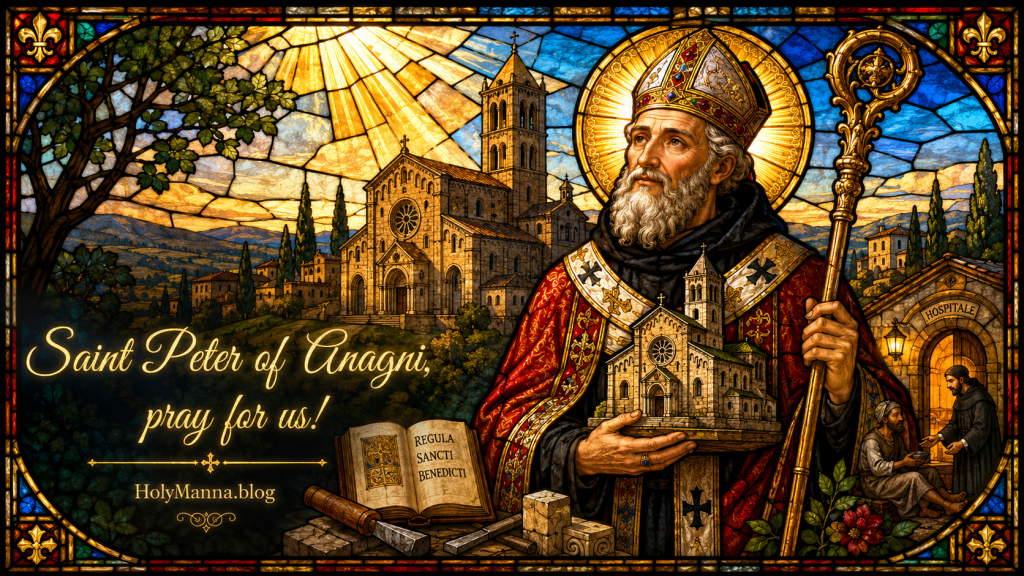
The Orphan Monk Who Raised a Cathedral
Some saints blaze across history like comets, and others build slowly, stone by stone, until something stands that outlasts every critic. Saint Peter of Anagni belongs to the second kind. Born in Salerno in the early eleventh century and celebrated by the Church on August 3rd, he was a Benedictine monk who became a reforming bishop and the man who raised the great cathedral of Anagni that still crowns its hilltop city in central Italy. He governed his diocese for forty-three years, endured relentless opposition from clerics who hated his reforms, opened a hospital that served the sick and travelers free of charge, and died on August 3, 1105, with his life’s work complete. Only about four years later, Pope Paschal II canonized him, one of the fastest canonizations of the entire medieval Church.
The Roman Martyrology remembers him with a single, beautiful line for August 3rd: “At Anagni, St. Peter, bishop, who rested in the Lord after gaining great renown for monastical observance and for pastoral vigilance.” Monastic observance and pastoral vigilance; those two phrases hold his whole life. He never stopped being a monk, and he never stopped watching over his flock.
Saint Peter of Anagni is the patron saint of the city and diocese of Anagni, a patronage he shares with the ancient martyr Saint Magnus, whose relics he enshrined in the cathedral he built. When the Church canonizes a man like Peter, she acts deliberately. The Catechism of the Catholic Church teaches that “by canonizing some of the faithful, i.e., by solemnly proclaiming that they practiced heroic virtue and lived in fidelity to God’s grace, the Church recognizes the power of the Spirit of holiness within her and sustains the hope of believers by proposing the saints to them as models and intercessors” (CCC 828). Peter is proposed to the faithful as a model of something the world badly needs and rarely celebrates: patient, faithful endurance in the work God assigns, even when that work takes an entire lifetime.
An Orphan in the House of Saint Benedict
Peter was born in Salerno, on the southwestern coast of Italy, sometime in the early eleventh century. The New Catholic Encyclopedia places his birth around 1030 or 1035. His family was no ordinary one; it was related to the Lombard princely dynasty that ruled Salerno. He was born adjacent to power, wealth, and worldly expectation. Then, while he was still a boy, the bottom fell out of his world, and Peter was left an orphan.
What happens next is the hinge of his whole story. The orphaned boy was placed in the Monastery of San Benedetto in Salerno, a house living under the Rule of Saint Benedict. There, in the rhythm of prayer, study, and work, the child who had lost his earthly father discovered the Father who never abandons His children. He spent his youth in that monastery, receiving a solid formation in canon law and the affairs of the Church while giving himself to the practice of the monastic virtues. He so distinguished himself in monastic observance that his reputation traveled well beyond the cloister walls.
Later tradition made him abbot of San Benedetto, but modern scholars reject that claim as resting on nothing more than a vague reference in a letter of Saint Peter Damian. What is certain is that his holiness and competence drew the attention of the most consequential churchman of the age. Hildebrand of Soana, the fiery reforming archdeacon who would one day be elected Pope Saint Gregory VII, met Peter during a legation to Salerno and was impressed. At Hildebrand’s request, sometime between 1049 and 1062, Peter moved to Rome and devoted himself to the business of the papal court.
Rome in those years was the epicenter of a great reform movement in Church history. The Gregorian Reform, named for Hildebrand’s later papacy, was a battle to free the Church from simony, clerical corruption, and the control of secular princes who treated bishoprics as family property. Peter arrived in Rome as that battle was gathering force, and he was formed in its furnace. In 1062, Pope Alexander II appointed him bishop of Anagni, a see that had stood vacant for a long time, very likely at Hildebrand’s urging. Some popular accounts say Gregory VII himself made the appointment, but Gregory was not elected pope until 1073; the documented record points to Alexander II in 1062, with the future Gregory VII working behind the scenes. The reform papacy chose this Benedictine monk to be its man in Anagni, and he would hold that office until the day he died.
How often does God prepare a soul in hidden places for a public mission it never asked for? Peter did not campaign for a bishop’s chair. He was a monk who wanted to pray, and obedience carried him to a broken diocese that needed everything rebuilt.
A Bishop Who Built with Stone and Soul
When Peter arrived in Anagni, he inherited a diocese in disrepair, materially and spiritually. Church properties had been usurped during the years of weak governance under his predecessors. Discipline among the clergy had frayed. The cathedral itself was inadequate to the dignity of the see. A lesser man might have managed the decline. Peter chose to rebuild all of it.
The historical record shows him methodically recovering the rights, privileges, and lands stolen from the Church of Anagni, bringing the devastated territory of Vico Moricino back under episcopal control, and fortifying several churches in the diocese. He labored to restore discipline and community life among his clerics, forming a generation of priests who would be worthy to carry the work forward after him. This was slow, unglamorous, contested work, and he did it for decades.
His most visible achievement was the cathedral. Peter undertook the complete rebuilding of the cathedral of Anagni, the great Romanesque church of Santa Maria that still dominates the city today, with its construction spanning roughly the years 1072 to 1104. Into its crypt he solemnly translated the relics of Saint Magnus and of Saints Secondina, Aurelia, and Neomisia, giving the martyrs of the local Church a shrine worthy of their witness. He understood something the Church has always known: that honoring the saints of earlier generations strengthens the faith of the generations still to come. As The Catechism teaches, “being more closely united to Christ, those who dwell in heaven fix the whole Church more firmly in holiness. They do not cease to intercede with the Father for us, as they proffer the merits which they acquired on earth through the one mediator between God and men, Christ Jesus” (CCC 956).
And here is the detail that should make every modern reader stop and think. Attached to his new cathedral, Peter established a hospital where accommodation and care were provided completely free of charge, and not only to the sick. Travelers and pilgrims were welcomed too. In an age when illness ruined families and travel was dangerous, the bishop of Anagni built a house where the suffering stranger paid nothing. This was the Gospel in masonry. Our Lord said, “For I was hungry and you gave me food, I was thirsty and you gave me drink, a stranger and you welcomed me” (The Gospel of Matthew, Mt 25:35). The Church has never treated care for the sick as optional charity work; she treats it as a commission from Christ Himself. The Catechism puts it plainly: “Heal the sick! The Church has received this charge from the Lord and strives to carry it out by taking care of the sick as well as by accompanying them with her prayer of intercession” (CCC 1509).
The most famous story attached to Peter’s episcopate reaches all the way to Constantinople. According to his Vita, Peter was sent around 1071 as the pope’s representative to the Byzantine Emperor Michael VII Ducas, in the delicate diplomacy that followed the schism of 1054. The story goes that the emperor fell gravely ill at court, and Peter cured him. The grateful emperor rewarded him lavishly, providing funds and skilled craftsmen for the building of the cathedral back in Anagni. It is a magnificent account of God’s power working through His servant. Honesty requires a caveat, though. Modern scholars judge the Constantinople legation historically doubtful; the surviving account contains anachronisms, and some historians suspect the episode may have migrated to Peter from another churchman of the same name. This story of the emperor’s healing comes from the medieval Vita and cannot be verified.
Why should the reader remember Peter and want to imitate him? Because he shows what a shepherd actually is. The Catechism teaches that “the bishops have by divine institution taken the place of the apostles as pastors of the Church” (CCC 862), and Peter lived that succession not as a title but as a total gift of self. He fed his people with the sacraments, defended their patrimony, healed their sick, honored their martyrs, and gave them a mother church built to last a thousand years. Scripture describes his job description perfectly: “Tend the flock of God that is your charge, not by constraint but willingly, not for shameful gain but eagerly, not as domineering over those in your charge but being examples to the flock” (The First Letter of Peter, 1 Pet 5:2 to 3).
Forty-Three Years Under Fire
It would be a mistake to imagine Peter’s long episcopate as a peaceful building project. It was closer to a siege. Saint Peter of Anagni was not a martyr, but he suffered a slow martyrdom of opposition that lasted most of his adult life, and the way he endured it is the heart of his sanctity.
The sources are candid that Peter suffered greatly at the hands of clerics within his own diocese who were enemies of his reforms. The fiercest resistance to this holy bishop came not from pagans or foreign armies but from priests, men of the Church who preferred the comfortable corruption of the old ways to the discipline of the Gospel. The enormous cost of the cathedral project drew sharp criticism from the local establishment. Historians identify his enemies with the anti-Gregorian party, clerics aligned with the antipope Clement III against the legitimate reforming popes, at a moment when much of the surrounding region, clergy and laity alike, stood with the imperial faction against Rome. Anagni under Peter was a fortress of fidelity in hostile country, and Pope Urban II chose to reside there more than once during Peter’s episcopate. The medieval account of his life refers repeatedly to the persecutions he endured in the exercise of his office, and the hostility was so durable that it outlived him; after his death, one cleric went so far as to profane a relic of his body and publicly cast doubt on his sanctity, an episode recounted in the Vita that cannot be independently verified.
Peter’s response to decades of hostility was neither retreat nor retaliation; it was perseverance. He simply kept going: reforming, rebuilding, celebrating the sacred mysteries, training the clerics who would succeed him. Our Lord had promised exactly this kind of suffering to His faithful ones: “Blessed are you when men revile you and persecute you and utter all kinds of evil against you falsely on my account. Rejoice and be glad, for your reward is great in heaven” (The Gospel of Matthew, Mt 5:11 to 12). The Catechism confirms that this endurance is not incidental to Christian life but essential to it: “The disciple of Christ must not only keep the faith and live on it, but also profess it, confidently bear witness to it, and spread it” (CCC 1816). The Church likewise teaches that “the duty of Christians to take part in the life of the Church impels them to act as witnesses of the Gospel and of the obligations that flow from it. This witness is a transmission of the faith in words and deeds” (CCC 2472).
Tradition adds one last astonishing chapter to his years of hardship. In 1096, when Peter was already an old man by any measure of that era, he is said to have joined the forces of Bohemond of Taranto setting out on the First Crusade toward the Holy Land, returning afterward by way of Constantinople, Palermo, and his native Salerno, where donations gathered along the route helped complete the cathedral. Scholars caution that the only source for this journey is the late Vita, that its details contain chronological impossibilities, and that the episode is extremely uncertain as history; this story is a tradition of the Anagni Church and cannot be verified. What is certain is the picture the sources agree on at the end: when Peter died on August 3, 1105, after forty-three years as bishop, the arduous work was accomplished. The cathedral stood complete. Discipline had been restored to clergy and faithful. The men he had formed were ready to govern the Church of Anagni worthily after him. He had outlasted every enemy, not by crushing them, but by outloving and outworking them. The Psalmist could have been describing his life: “Unless the LORD builds the house, those who build it labor in vain” (Psalm 127, Ps 127:1). Peter built with the Lord, and the house still stands.
Santo Subito
What happened after Peter’s death is nearly as remarkable as his life. His great friend and collaborator, Saint Bruno, the bishop of Segni and one of the most learned churchmen of the age, celebrated his funeral and then set about recording the story of his virtues and miracles. On June 4 of 1109, or 1110 according to some scholars, Pope Paschal II issued a solemn diploma of canonization addressed to the bishops of Anagni and the surrounding Campagna. In it the pope recalled Peter’s virtues and the miracles attributed to him, noted that these had been faithfully recorded by Bruno of Segni, and fixed his memorial on August 3rd. Roughly four years passed from deathbed to sainthood, making Peter a true santo subito, a saint at once.
Regarding the miracles attributed to Peter’s intercession after death, the record presents a poignant situation that deserves honest telling. The papal diploma explicitly affirms that miracles occurred and were documented by Bruno of Segni. But Bruno’s original text has been lost to history; the account of Peter’s life that survives is a later reworking, with the surviving version dating from around 1325, and scholars cannot determine how much of Bruno’s text it preserves. Some scholars have even raised questions about the authenticity of the canonization diploma itself. So the Church’s ancient testimony is that God confirmed Peter’s sanctity with miracles, while the individual stories of those healings and interventions can no longer be read or verified in their original form. The faithful can hold both truths together with serenity: the Church proclaimed his holiness within living memory of the man himself, and time has simply been unkind to the documents.
The veneration of his relics, by contrast, has a long and continuous history. Tradition holds that Peter’s second successor, a bishop named Pietro II, oversaw the translation of the saint’s body from the upper basilica down into the crypt; this account of the translation comes from later tradition and cannot be verified in contemporary documents. What stands on firmer ground is the later devotion. In 1324, the Anagni canon Jacopo de Guerra restored the altar erected in Peter’s honor, and it was solemnly consecrated on February 11 of that year. In a large niche carved into the wall behind it, the holy bishop was painted nobly seated between the standing figures of Saints Aurelia and Neomisia, the very martyrs whose relics he had enshrined. In 1541, the city commissioned a silver-plated copper bust of the saint containing one of his relics, and to this day that bust is displayed beside the matching bust of Saint Magnus during Anagni’s patronal celebrations in August. Nearly a thousand years after his death, the people of Anagni still process with their bishop.
The cultural impact of Peter’s work is difficult to overstate. The cathedral he built became one of the great stages of medieval history. Anagni gave the Church four popes, including Innocent III and Boniface VIII, and Peter’s cathedral witnessed moments that shaped Christendom. The crypt beneath it, whose reconstruction Peter set in motion, was later covered with a fresco cycle so magnificent that it is sometimes called the Sistine Chapel of the Middle Ages. Pilgrims and art lovers who stand in that crypt today are standing inside the answered prayer of an orphan monk from Salerno. This is what The Catechism means when it teaches that “the witnesses who have preceded us into the kingdom, especially those whom the Church recognizes as saints, share in the living tradition of prayer by the example of their lives” and that “their intercession is their most exalted service to God’s plan. We can and should ask them to intercede for us and for the whole world” (CCC 2683).
Building What You May Never See Finished
So what does an eleventh-century bishop builder have to say to a person scrolling through this post today? More than might be expected.
Start with the wound at the beginning of his story. Peter was orphaned as a child, and God did not waste that wound. The boy who lost his family was given a monastery, a Rule, and eventually a diocese full of spiritual children. Many readers carry losses that seem to disqualify them from a fruitful life. Peter’s story insists on the opposite: in God’s providence, the very place where life breaks open can become the place where grace pours in. “We know that in everything God works for good with those who love him, who are called according to his purpose” (The Letter to the Romans, Rom 8:28).
Consider next the length of his labor. Peter did not reform Anagni in a fiscal quarter. He gave it forty-three years, most of them under attack, and the cathedral alone took more than three decades. Modern culture runs on immediate results and quick exits from anything difficult. Peter’s canonization is the Church holding up the opposite pattern: fidelity measured in decades, fruit that ripens slowly, work finished just in time to die. The Church teaches that all the faithful, in every state of life, are called to exactly this kind of persevering holiness, for “all Christians in any state or walk of life are called to the fullness of Christian life and to the perfection of charity” (CCC 2013). Holiness is not an event; it is endurance in love.
Consider also whom his opposition came from. The hardest part of Peter’s cross was that fellow clergymen carried the hammer. Anyone who has been wounded inside the Church, by the sins or coldness of the very people who should have shown Christ, has a friend in Peter of Anagni. He neither abandoned the Church nor grew bitter within it. He stayed, he reformed what he could reach, and he let God vindicate him. His vindication came four years after his death, from the Chair of Peter itself.
And consider, finally, the hospital. In the middle of a building project that consumed his budget and his reputation, Peter made room for a house where the sick and the stranger paid nothing. Charity was not an amenity of his cathedral; it was part of the foundation. The Catechism teaches that “the works of mercy are charitable actions by which we come to the aid of our neighbor in his spiritual and bodily necessities” (CCC 2447), and Peter built the works of mercy in stone.
There are practical ways to weave his lessons into daily life. Choose one long-term commitment, a marriage, a friendship, a parish ministry, a work of service, and quietly recommit to it for the long haul, without demanding quick results. Visit or call someone who is sick this week, honoring the hospital builder by becoming a small hospital yourself. When criticism comes for doing what is right, answer it the way Peter did, with continued faithful work rather than with retaliation. And spend a few minutes praying for bishops and priests, especially the ones laboring under opposition, that they might have Peter’s endurance.
What is the cathedral in your own life, the long, slow, worthy thing God is asking you to keep building even though you cannot yet see it finished? When resistance comes from the people closest to you, do you respond with Peter’s patient perseverance or with discouragement? Sit with those questions honestly. They are the kind of questions that build saints.
Engage With Us!
The story of Saint Peter of Anagni deserves a conversation, and the comments below are open for exactly that. Readers are warmly invited to share their thoughts, their reactions, and their own experiences of long, patient faithfulness. Here are some questions to spark reflection and discussion:
- Saint Peter was orphaned as a child, and God turned that loss into the doorway of his vocation. Where has God brought unexpected grace out of a painful loss in your own life?
- Peter spent forty-three years reforming and rebuilding, mostly without applause. What long, slow work is God asking you to persevere in right now, and what would it look like to recommit to it this week?
- The fiercest opposition Peter faced came from within the Church. How do you keep your faith anchored in Christ when fellow Christians disappoint or wound you?
- Peter attached a free hospital to his cathedral because charity belonged to the foundation of his work. What concrete work of mercy could you build into your regular routine this month?
- Peter was canonized only about four years after his death because his holiness was so evident to those who knew him. What would the people closest to you say your life is a witness to?
Every reader who has made it this far is carrying some unfinished cathedral: a family being held together, a faith being rebuilt, a work of love that will take years. Take heart from the orphan of Salerno and keep laying stones. Keep tending the flock God has given you, however small. Do the work in front of you with monastic faithfulness and pastoral vigilance, and let God worry about the vindication. And in all of it, in the building and the enduring and the serving, do everything with the love and mercy that Jesus taught us.
Saint Peter of Anagni, pray for us!
Follow us on YouTube, TikTok, Instagram and Facebook for more insights and reflections on living a faith-filled life.

 Holy Manna!
Leave a comment