Monday of the Eighteenth Week in Ordinary Time – Lectionary: 407/408
When Every Voice Promises Peace
Some lies are easy to spot, and some sound exactly like hope. On this Monday of the Eighteenth Week in Ordinary Time, the Church places two dramatic scenes side by side, a showdown in the temple of Jerusalem and a storm on the Sea of Galilee, and lets them ask the same question: when the comfortable voice and the true voice disagree, which one deserves trust?
In the first reading, the prophet Hananiah stands in the house of the LORD around the year 594 before Christ and announces that the Babylonian crisis will be over within two years. The crowd loves it. Jeremiah, wearing a wooden yoke at God’s command as a sign that Judah must submit to Babylon’s discipline, answers with a harder word, and history will prove which prophet God actually sent. The responsorial psalm, drawn from the great acrostic Psalm 119, becomes the prayer of anyone caught between those voices, begging God to remove the way of falsehood and to keep the word of truth close. Then the Holy Gospel moves from words to waves. In the fourth watch of the night, Jesus comes to his disciples walking on the sea, and Peter stakes his life on a single syllable from the Lord’s mouth. He walks while he trusts the word, and he sinks the moment the wind sounds louder than it.
The uniting theme of the day is that the word of the Lord holds when everything else gives way. False confidence breaks like a wooden yoke, but the true word, even when it demands more, carries the weight of a human life on open water.
First Reading — Jeremiah 28:1-17
A Wooden Yoke and an Iron Truth
The year is 594 before Christ, the fourth year of King Zedekiah, three years after Nebuchadnezzar deported young King Jeconiah, the leading citizens, and the temple vessels to Babylon. In Jeremiah 27, God commanded Jeremiah to wear a wooden yoke as a living sign that Judah must bow to Babylon for a season, because the exile was God’s own instrument of purification. With foreign envoys whispering revolt in Jerusalem, Hananiah arrives with the message everyone wants to hear.
Jeremiah 28 – New American Bible (Revised Edition)
The Two Yokes. 1 That same year, in the beginning of the reign of Zedekiah, king of Judah, in the fifth month of the fourth year, Hananiah the prophet, son of Azzur, from Gibeon, said to me in the house of the Lord in the sight of the priests and all the people: 2 “Thus says the Lord of hosts, the God of Israel: I have broken the yoke of the king of Babylon. 3 Within two years I will restore to this place all the vessels of the house of the Lord which Nebuchadnezzar, king of Babylon, took from this place and carried away to Babylon. 4 And Jeconiah, son of Jehoiakim, king of Judah, and all the exiles of Judah who went to Babylon, I will bring back to this place—oracle of the Lord—for I will break the yoke of the king of Babylon.”
5 Jeremiah the prophet answered the prophet Hananiah in the sight of the priests and all the people standing in the house of the Lord, 6 and said: Amen! thus may the Lord do! May the Lord fulfill your words that you have prophesied, by bringing back the vessels of the house of the Lord and all the exiles from Babylon to this place! 7 But now, listen to the word I am about to speak in your hearing and the hearing of all the people. 8 In the past, the prophets who came before you and me prophesied war, disaster, and pestilence against many lands and mighty kingdoms. 9 But the prophet who prophesies peace is recognized as the prophet whom the Lord has truly sent only when his word comes to pass.
10 Thereupon Hananiah the prophet took the yoke bar from the neck of Jeremiah the prophet and broke it. 11 He said in the sight of all the people: “Thus says the Lord: Like this, within two years I will break the yoke of Nebuchadnezzar, king of Babylon, from the neck of all the nations.” At that, the prophet Jeremiah went on his way.
12 After Hananiah the prophet had broken the yoke bar off the neck of the prophet Jeremiah, the word of the Lord came to Jeremiah: 13 Go tell Hananiah this: Thus says the Lord: By breaking a wooden yoke bar, you make an iron yoke! 14 For thus says the Lord of hosts, the God of Israel: A yoke of iron I have placed on the necks of all these nations serving Nebuchadnezzar, king of Babylon, and they shall serve him; even the wild animals I have given him. 15 And Jeremiah the prophet said to Hananiah the prophet: Listen to this, Hananiah! The Lord has not sent you, and you have led this people to rely on deception. 16 For this, says the Lord, I am sending you from the face of the earth; this very year you shall die, because you have preached rebellion against the Lord. 17 Hananiah the prophet died in that year, in the seventh month.
Detailed Exegesis
Verse 1. That same year, in the beginning of the reign of Zedekiah, king of Judah, in the fifth month of the fourth year, Hananiah the prophet, son of Azzur, from Gibeon, said to me in the house of the Lord in the sight of the priests and all the people: The setting is named with legal precision as Hananiah of Gibeon, a priestly town, challenges Jeremiah publicly in the temple itself.
Verse 2. “Thus says the Lord of hosts, the God of Israel: I have broken the yoke of the king of Babylon. Hananiah opens with the authentic prophetic formula, claiming the LORD of hosts as his source; false prophecy borrows the vocabulary of true faith.
Verse 3. Within two years I will restore to this place all the vessels of the house of the Lord which Nebuchadnezzar, king of Babylon, took from this place and carried away to Babylon. The two-year deadline directly contradicts Jeremiah 27:16-22, where God declared the vessels would remain in Babylon until he himself visited his people.
Verse 4. And Jeconiah, son of Jehoiakim, king of Judah, and all the exiles of Judah who went to Babylon, I will bring back to this place—oracle of the Lord—for I will break the yoke of the king of Babylon.” Promising Jeconiah’s return was politically electric, yet Jeremiah 22:24-27 records that the exiled king would never return to the throne.
Verse 5. Jeremiah the prophet answered the prophet Hananiah in the sight of the priests and all the people standing in the house of the Lord, Jeremiah answers before the same witnesses, making this a public test of the word of God in his own house.
Verse 6. and said: Amen! thus may the Lord do! May the Lord fulfill your words that you have prophesied, by bringing back the vessels of the house of the Lord and all the exiles from Babylon to this place! Jeremiah’s Amen is sincere; he longs for the exiles’ return yet refuses to pretend an easier word is true.
Verse 7. But now, listen to the word I am about to speak in your hearing and the hearing of all the people. Jeremiah pivots courteously from what he wishes to what he must say, weighing the new oracle against something sturdier than the moment’s mood.
Verse 8. In the past, the prophets who came before you and me prophesied war, disaster, and pestilence against many lands and mighty kingdoms. The prophets before them, from Amos to Micah, warned of war and pestilence when the covenant was broken; a word flattering national pride stands outside that inheritance.
Verse 9. But the prophet who prophesies peace is recognized as the prophet whom the Lord has truly sent only when his word comes to pass. Jeremiah invokes the test of Deuteronomy 18:21-22, that a prophecy of peace is proven only when the peace arrives. Time, not applause, judges prophecy.
Verse 10. Thereupon Hananiah the prophet took the yoke bar from the neck of Jeremiah the prophet and broke it. Unable to win by argument, Hananiah reaches for theater, snapping the yoke from Jeremiah’s neck and turning God’s commanded sign into a stage prop.
Verse 11. He said in the sight of all the people: “Thus says the Lord: Like this, within two years I will break the yoke of Nebuchadnezzar, king of Babylon, from the neck of all the nations.” At that, the prophet Jeremiah went on his way. Hananiah repeats his two-year promise over the wreckage, and Jeremiah simply walks away, waiting until God gives him a word.
Verse 12. After Hananiah the prophet had broken the yoke bar off the neck of the prophet Jeremiah, the word of the Lord came to Jeremiah: The word of the LORD comes only afterward; the true prophet speaks when sent and is content to look defeated in the meantime.
Verse 13. Go tell Hananiah this: Thus says the Lord: By breaking a wooden yoke bar, you make an iron yoke! The answer is devastating: breaking the wooden yoke did not cancel God’s discipline but hardened it into iron, for resisting God’s correction makes the cross heavier.
Verse 14. For thus says the Lord of hosts, the God of Israel: A yoke of iron I have placed on the necks of all these nations serving Nebuchadnezzar, king of Babylon, and they shall serve him; even the wild animals I have given him. God confirms that Nebuchadnezzar’s dominion, even over the beasts of the field, is granted from above for a season by the God who governs history.
Verse 15. And Jeremiah the prophet said to Hananiah the prophet: Listen to this, Hananiah! The Lord has not sent you, and you have led this people to rely on deception. The verdict is one sentence: the LORD has not sent Hananiah, and a lie that soothes God’s people disarms the very repentance that could save them.
Verse 16. For this, says the Lord, I am sending you from the face of the earth; this very year you shall die, because you have preached rebellion against the Lord. The death sentence echoes Deuteronomy 13, where preaching rebellion against the LORD is a capital offense committed here in the LORD’s own name.
Verse 17. Hananiah the prophet died in that year, in the seventh month. Hananiah spoke in the fifth month and dies in the seventh. The short, unadorned notice is the whole argument: the word of the LORD stood.
Teachings
The Catechism grounds this reading in the very character of God: CCC 215 teaches that “God is Truth itself, whose words cannot deceive”, so God’s word can be trusted even when it wounds before it heals. Against the craving for guarantees that Hananiah exploited, CCC 2115 teaches that “a sound Christian attitude consists in putting oneself confidently into the hands of Providence” concerning the future. St. Thomas More embodied that choice, declaring at his execution in 1535, according to the earliest report, that he died “the King’s good servant, but God’s first”.
Reflection
Every age has its Hananiahs, voices promising that discipline is unnecessary and consequences will evaporate. The reading invites an honest audit of the voices given authority in daily life, from media feeds to quiet rationalizations. A practical step is to test every appealing message the way Jeremiah did, against the whole tradition of God’s revealed word. Another is to imitate Jeremiah’s restraint, waiting in prayer for clarity instead of firing back in anger. Which comfortable message is hardest to question right now? Where might resisting God’s correction be quietly turning a wooden yoke into an iron one?
Responsorial Psalm — Psalm 119:29, 43, 79, 80, 95, 102
A Prayer for an Honest Heart
Psalm 119 is the longest psalm in the Bible, an alphabetic acrostic in which every stanza celebrates the law, the statutes, and the ordinances of God. The Church selects six of its verses today and sets them to the refrain drawn from verse 68, “Lord, teach me your statutes”, turning the entire psalm into the perfect response to the showdown in the temple. Where Hananiah spread falsehood in God’s name, the psalmist begs to be kept on the path of truth.
Psalm 119:29, 43, 79, 80, 95, 102 – New American Bible (Revised Edition)
29 Lead me from the way of deceit;
favor me with your law.43 Do not take the word of truth from my mouth,
for in your judgments is my hope.79 Let those who fear you turn to me,
those who acknowledge your testimonies.80 May I be wholehearted toward your statutes,
that I may not be put to shame.95 The wicked hope to destroy me,
but I seek to understand your testimonies.102 From your judgments I do not turn,
for you have instructed me.
Detailed Exegesis
Verse 29. Lead me from the way of deceit; favor me with your law. The psalmist asks God to remove the way of falsehood, admitting that deception cannot be escaped by willpower alone. Truthfulness begins as a grace requested, not an achievement claimed, and God’s law is the favor that replaces the lie.
Verse 43. Do not take the word of truth from my mouth, for in your judgments is my hope. The prayer that the word of truth never leave the mouth is Jeremiah’s own situation in miniature. Hope is anchored in God’s ordinances, so losing the truth would mean losing hope itself.
Verse 79. Let those who fear you turn to me, those who acknowledge your testimonies. The psalmist longs for the companionship of those who fear the LORD. Fidelity to truth is not a solo project; it is sustained inside a community that acknowledges God’s decrees together, which the Church calls communion.
Verse 80. May I be wholehearted toward your statutes, that I may not be put to shame. A heart blameless in the statutes is the opposite of Hananiah’s divided heart, which used holy words for popular ends. Integrity, the unity of what is believed, said, and done, is the only lasting protection from shame.
Verse 95. The wicked hope to destroy me, but I seek to understand your testimonies. Even with enemies lying in wait, the psalmist’s attention stays fixed on God’s decrees rather than on the threat. This is precisely the posture Peter will lose on the water when he studies the wind instead of the Word.
Verse 102. From your judgments I do not turn, for you have instructed me. The reason for such steadiness is disarmingly simple: God himself has been the teacher. A soul personally instructed by God does not wander from his ordinances, because it has tasted their goodness firsthand.
Teachings
St. Jerome, the great translator of the Scriptures, left the Church a principle so central that the Catechism enshrines it in CCC 133: “Ignorance of the Scriptures is ignorance of Christ.” The psalmist’s plea to be taught God’s statutes finds its answer in the Church’s constant exhortation, echoed in CCC 2653, that the faithful should read the Sacred Scriptures frequently and accompany that reading with prayer, so that reading becomes a dialogue between God and the soul. This is the ancient practice of lectio divina, in which the word of God is read slowly, pondered, prayed, and finally rested in.
Reflection
The refrain of this psalm makes a superb daily prayer for anyone drowning in competing voices. A concrete practice is to open the day’s Mass readings each morning before opening any feed, letting God’s statutes set the tone before the world does. Another is to keep one verse from this psalm on a note card or a lock screen for the week, returning to it whenever a persuasive falsehood applies pressure. What currently gets the first word of the morning, the word of truth or the noise of the world? Which of these six verses feels most like a personal prayer right now?
Holy Gospel — Matthew 14:22-36
The Fourth Watch and the Outstretched Hand
This scene follows directly on the feeding of the five thousand. Jesus compels the disciples into the boat, likely to pull them away from a crowd ready to make him an earthly king, as John 6:15 suggests, and climbs the mountain alone to pray. The Sea of Galilee sits low between hills that funnel sudden violent winds, and the fourth watch of the night runs from three to six in the morning. The early Church treasured what unfolds in that darkness as a portrait of herself.
Matthew 14:22-36 – New American Bible (Revised Edition)
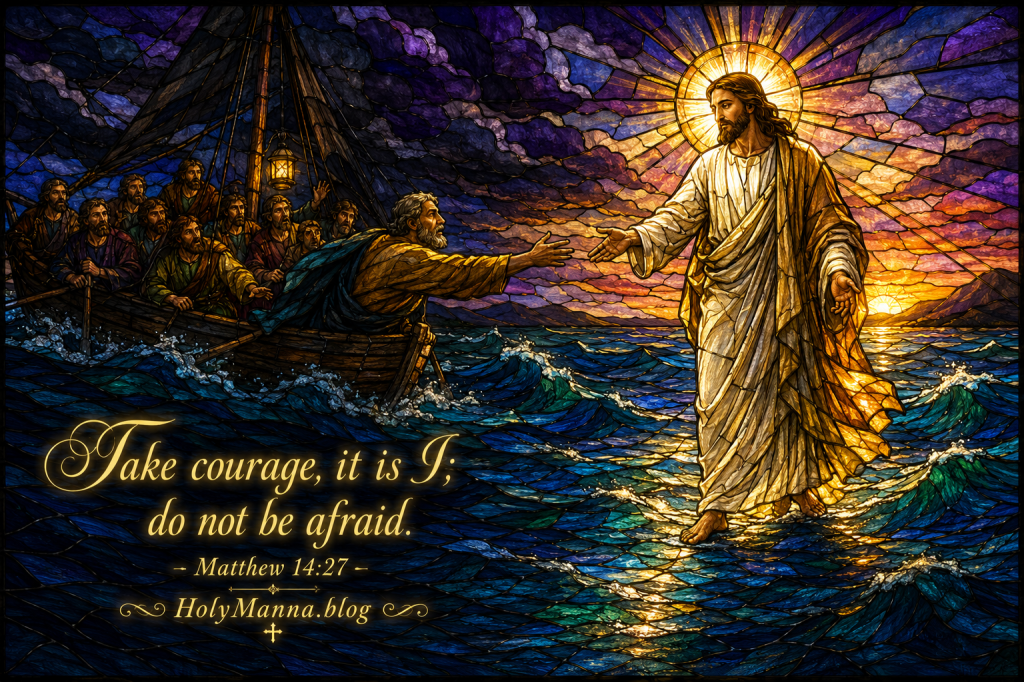
22 Then he made the disciples get into the boat and precede him to the other side, while he dismissed the crowds. 23 After doing so, he went up on the mountain by himself to pray. When it was evening he was there alone. 24 Meanwhile the boat, already a few miles offshore, was being tossed about by the waves, for the wind was against it. 25 During the fourth watch of the night, he came toward them, walking on the sea. 26 When the disciples saw him walking on the sea they were terrified. “It is a ghost,” they said, and they cried out in fear. 27 At once [Jesus] spoke to them, “Take courage, it is I; do not be afraid.” 28 Peter said to him in reply, “Lord, if it is you, command me to come to you on the water.” 29 He said, “Come.” Peter got out of the boat and began to walk on the water toward Jesus. 30 But when he saw how [strong] the wind was he became frightened; and, beginning to sink, he cried out, “Lord, save me!” 31 Immediately Jesus stretched out his hand and caught him, and said to him, “O you of little faith, why did you doubt?” 32 After they got into the boat, the wind died down. 33 Those who were in the boat did him homage, saying, “Truly, you are the Son of God.”
The Healings at Gennesaret. 34 After making the crossing, they came to land at Gennesaret. 35 When the men of that place recognized him, they sent word to all the surrounding country. People brought to him all those who were sick 36 and begged him that they might touch only the tassel on his cloak, and as many as touched it were healed.
Detailed Exegesis
Verse 22. Then he made the disciples get into the boat and precede him to the other side, while he dismissed the crowds. The disciples enter the storm through obedience, not error, for Jesus sends them ahead. Rough water is not proof of being off course; sometimes it proves instructions were followed.
Verse 23. After doing so, he went up on the mountain by himself to pray. When it was evening he was there alone. After a day of miracles, Jesus chooses solitary prayer with the Father, the hidden engine of all that follows and the model for disciples tempted to serve without praying.
Verse 24. Meanwhile the boat, already a few miles offshore, was being tossed about by the waves, for the wind was against it. The boat labors far from land with the wind against it; the Church has long seen her own image here, a small vessel tossed on the sea of the world.
Verse 25. During the fourth watch of the night, he came toward them, walking on the sea. Jesus comes walking on the sea at the darkest hour before dawn. In Job 9:8, it is God alone who treads upon the waves, so Matthew is quietly declaring that the Lord of creation is doing what only God can do.
Verse 26. When the disciples saw him walking on the sea they were terrified. “It is a ghost,” they said, and they cried out in fear. The disciples mistake their Savior for a ghost, because fear distorts perception, and exhausted hearts misread even approaching rescue as a threat.
Verse 27. At once [Jesus] spoke to them, “Take courage, it is I; do not be afraid.” Jesus answers with words that carry the weight of the divine name, for the Greek behind “it is I” is ego eimi, echoing God’s self-revelation to Moses in Exodus 3:14. Courage is commanded because of who is present.
Verse 28. Peter said to him in reply, “Lord, if it is you, command me to come to you on the water.” Peter’s request, found only in Matthew, asks for a command before he moves. This is faith in its proper order, seeking a word from the Lord and then acting on that word alone.
Verse 29. He said, “Come.” Peter got out of the boat and began to walk on the water toward Jesus. One syllable, “Come”, is enough to hold a fisherman’s full weight on open water. The verse is the day’s theme in miniature: the true word of God carries those who stand on it.
Verse 30. But when he saw how [strong] the wind was he became frightened; and, beginning to sink, he cried out, “Lord, save me!” Peter sinks not when the wind rises but when he starts watching it. His cry, “Lord, save me!”, is among the shortest and most perfect prayers in Scripture, and it has never gone unanswered.
Verse 31. Immediately Jesus stretched out his hand and caught him, and said to him, “O you of little faith, why did you doubt?” Jesus catches Peter immediately, and only then asks why he doubted. The rescue comes before the correction, which arrives inside the grip of a hand that never lets go.
Verse 32. After they got into the boat, the wind died down. The wind dies the moment Jesus enters the boat. Storms that rage all night fall silent in his presence, a truth the Church experiences in every age.
Verse 33. Those who were in the boat did him homage, saying, “Truly, you are the Son of God.” The disciples respond with worship and the first corporate confession of Jesus as Son of God in this Gospel, anticipating Peter’s great confession in Matthew 16:16.
Verse 34. After making the crossing, they came to land at Gennesaret. The crossing ends at Gennesaret, where the night of terror gives way to an ordinary morning of arrival, as nights of trial so often do.
Verse 35. When the men of that place recognized him, they sent word to all the surrounding country. People brought to him all those who were sick The locals recognize Jesus and immediately think of their sick neighbors, because genuine encounter with Christ always turns outward.
Verse 36. and begged him that they might touch only the tassel on his cloak, and as many as touched it were healed. The sick beg to touch only the tassel of his cloak, the tzitzit commanded in Numbers 15:38-39, recalling the healed woman of Matthew 9:20-22. Grace flows through humble, physical contact with the Lord, a logic the sacraments extend to every age.
Teachings
St. Augustine, preaching on this passage in Sermon 76 according to the traditional numbering, taught that Peter walking on the water is a figure of the one Church, strong while she stands upon the word of Christ and sinking whenever she measures the winds of opinion instead, so that her constant prayer remains Peter’s cry to be saved. The Catechism speaks soberly about nights like this one in CCC 164, teaching that “faith is often lived in darkness and can be put to the test”. And at the inauguration of his pontificate on October 22, 1978, St. John Paul II took up this very Gospel scene, proclaiming to a frightened world, “Be not afraid!”, and urging every nation to open wide the doors to Christ.
Reflection
Every believer eventually meets the fourth watch of the night, the hour when the wind is contrary, prayer feels unanswered, and even the approaching Lord looks like something to fear. The Gospel offers a precise spiritual method for that hour. First, listen for the word of Christ rather than the volume of the storm, especially in Scripture and the sacraments. Second, act on his word even when the footing looks impossible. Third, when sinking begins, and it will, pray Peter’s prayer without embarrassment or delay. A concrete practice is to bring one current storm before the Blessed Sacrament this week and repeat slowly, “Lord, save me!” Where is Jesus saying “Come” right now, and what makes stepping out of the boat frightening? When fear last took over, was the gaze fixed on the wind or on the Lord?
The Hand That Reaches Through the Storm
Two months after Hananiah snapped a wooden yoke in the temple, he was in his grave, and every hopeful headline he preached had died with him. Centuries later, in the fourth watch of the night, a fisherman stood on the surface of a storm-tossed sea for one reason only: the Lord had spoken a single true word, and Peter had trusted it. The readings of this Monday belong together like a question and its answer. The question is whose voice can bear the weight of a human life, and the answer is written across a broken yoke, a psalmist’s prayer, and a set of wet footprints on the Sea of Galilee.
God’s word does not always promise the easy timeline. Sometimes it lays a yoke on the shoulders and asks for patient trust through a long exile. But it never deceives, never abandons, and never fails to reach out the moment its people begin to sink. The same Jesus who caught Peter by the hand waits in the Scriptures, in the confessional, and above all in the Holy Eucharist, where his word still accomplishes exactly what it says. The invitation of this day is beautifully simple. Turn down the voices that promise everything and demand nothing. Open the word of God daily and let it speak before the world does. And when the wind grows loud, remember that the shortest prayer in the Gospel is still the strongest, and pray it with Peter’s whole heart: “Lord, save me!” The hand that answered him has never once been withdrawn, and it is stretched out still.
Engage With Us!
Please share reflections in the comments below; hearing how God’s word lands in real lives is a gift to this whole community of readers.
- In Jeremiah 28:1-17, Hananiah’s comforting message drew the crowd while Jeremiah’s hard word proved true. What helps distinguish God’s authentic voice from appealing counterfeits in daily life today?
- In Psalm 119:29, 43, 79, 80, 95, 102, the psalmist prays for falsehood to be removed and for the word of truth to remain close. What daily habit could give God’s word the first and final say each day?
- In Matthew 14:22-36, Peter walks on water while trusting the word of Jesus and sinks when he watches the wind. What storm is currently competing with the voice of Christ, and what would stepping out of the boat look like this week?
- Taken together, the readings proclaim that the word of the Lord holds when every other voice fails. Where is God inviting deeper trust in his true word, even though an easier promise is on offer?
Living a life of faith does not mean the wind never blows; it means knowing whose hand is already reaching out when the waves rise. Walk in the truth, pray without embarrassment, and do everything with the love and mercy Jesus taught us.
Sacred Heart of Jesus, we trust in You!
Immaculate Heart of Mary, pray for us!
Saint Michael the Archangel, defend us in battle!
Follow us on YouTube, TikTok, Instagram and Facebook for more insights and reflections on living a faith-filled life.

 Holy Manna!
Leave a comment