A Chapel Small Enough to Hold the Whole Church
On August 2nd, the Franciscan family celebrates the Feast of Our Lady of the Angels of the Portiuncula, and though this observance belongs formally to the Franciscan calendar rather than the General Roman Calendar, its reach extends to every parish church on earth. That is not an exaggeration. It is canon law. On this day, any Catholic who walks into a parish church under the right conditions can receive one of the most generous spiritual gifts the Church has ever offered: the plenary indulgence known as the Pardon of Assisi.
At the center of it all stands a chapel so small that a modern living room would dwarf it. The Portiuncula, Italian for “little portion,” measures roughly 22 feet by 13 feet and sits today beneath the soaring dome of the Basilica of Saint Mary of the Angels on the plain below Assisi. St. Francis rebuilt this chapel with his own hands, discovered his vocation within its walls, founded his order in its shadow, welcomed St. Clare into religious life there, and died beside it on October 3rd, 1226. If the Franciscan movement has a birthplace, this is it.
The feast is central to Marian devotion because everything that happened at the Portiuncula happened under Mary’s roof. The chapel was dedicated to Our Lady of the Angels long before Francis arrived, and he understood his entire mission as unfolding beneath her protection. The Catechism of the Catholic Church teaches that Mary’s motherhood in the order of grace continues uninterrupted from the Annunciation until the eternal fulfillment of all the elect, which is why the Church invokes her as “Advocate, Helper, Benefactress, and Mediatrix” (CCC 969, citing Lumen Gentium 62). The Portiuncula is one of the places in history where that maternal advocacy became almost tangible, where a poor man asked heaven for an ocean of mercy and, according to the constant tradition of the Church, received it.
This is the story of that little portion of land, the mercy that flowed from it, and the reason it still matters for every Catholic alive today.
The Ruin Saint Francis Could Not Stop Loving
To understand the feast, the story begins centuries before Francis was born. According to a tradition whose written record can be traced back with certainty only to 1645, the tiny chapel was erected in the 4th century, during the pontificate of Pope Liberius, by hermits who had come from the Valley of Josaphat in the Holy Land, carrying with them relics associated with the Blessed Virgin. That account is a tradition, not an established historical fact, and honesty requires saying so plainly. What history does establish is that by around the year 1200 the chapel belonged to the Benedictine monks of the Cluny Congregation, who had withdrawn to the fortified monastery on Mount Subasio and left the little church on the plain to crumble among the woods.
The name is itself a small mystery wrapped in beauty. “Portiuncula” refers to the little portion of land on which the chapel stood. The title “Saint Mary of the Angels” is explained by 2 traditions: one holds that it comes from the ancient image of the Assumption of the Blessed Virgin surrounded by angels venerated above the altar, and another holds that the songs of angels were often heard at the site. Both explanations are traditions handed down by the faithful, and either way the name proclaims the same truth, that this ground belonged to the Queen of Angels.
Into this neglected corner of Umbria walked a young man from Assisi who had heard Christ tell him to rebuild His church. After restoring San Damiano and San Pietro, Francis turned to the ruined chapel of Saint Mary of the Angels around 1207 and repaired it stone by stone. Then, on February 24th, 1208, the feast of St. Matthias, he heard the Gospel proclaimed within its walls: the Lord sending out His disciples without gold, without staff, without sandals, to preach the kingdom. Francis recognized in that moment the shape of his entire vocation. The Catholic Encyclopedia records that it was here, in this chapel, that his call crystallized into a way of life.
When the small community at Rivo Torto grew too large, the Benedictines gave Francis the use of the Portiuncula around 1210 or 1211, and the sources record the charming custom by which the friars sent the monks a basket of fish each year in acknowledgment. Francis would accept the chapel only on loan, never as property, because he wished his brothers to own nothing at all. Here the friars built their huts of mud and branches. Here, on a Palm Sunday night dated by some sources to 1211 and by others to 1212, the young noblewoman Clare of Assisi knelt before the altar of Our Lady of the Angels and received the habit from Francis, beginning the Second Order. Here the general chapters of the growing brotherhood gathered, including the famous assembly remembered as the Chapter of Mats, when thousands of friars camped on the plain. And here, in a cell a few steps from the chapel, Francis asked to be carried as he lay dying, so that he could surrender his soul in the place where he had received everything. He died there on Saturday, October 3rd, 1226.
His early biographers record that Francis loved this spot above every other place in the world, and he begged his brothers never to abandon it. They never have.
The Night Francis Asked for Souls Instead of Gold
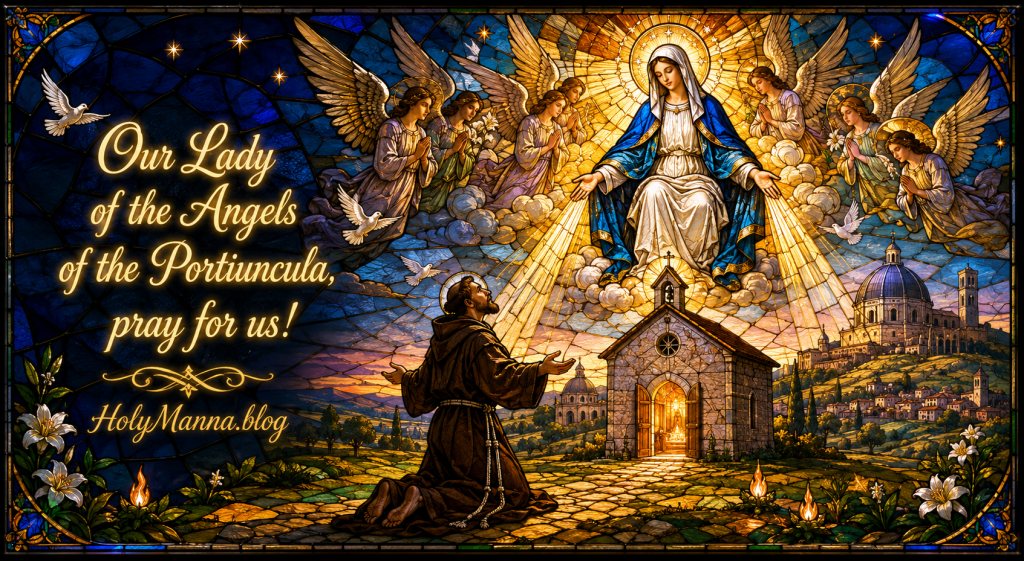
The heart of the feast is the event tradition places in July of 1216. The account, handed down within the Franciscan family, relates that Francis was praying in the Portiuncula one night when the chapel filled with light, and he beheld Christ, His Mother, and a multitude of angels. Asked what he desired for the salvation of souls, Francis made a request that startled even heaven by its boldness: a plenary indulgence for every person who would enter that chapel, confessed and repentant. The account continues that the Lord granted the request on the condition that Francis obtain the approval of His vicar, and that the very next day Francis traveled to Perugia and stood before Pope Honorius III. When the pope asked what privilege document he wished to carry home, tradition preserves his answer that the Word of the pope sufficed, for if this indulgence was the work of God, then God Himself would make it known. Honorius granted the indulgence orally, limiting it to the anniversary of the chapel’s dedication, August 2nd.
Careful honesty is owed here, because the Church demands it. The vision of Christ and Our Lady at the Portiuncula is a pious tradition, not a formally approved apparition; the Church has issued no formal judgment on the vision itself. No document from 1216 records the grant, and the earliest written testimonies emerge from the later 13th century: the theologian Peter John Olivi composed a scholastic defense of the indulgence around 1279, other testimonies reach back to 1268, and the letters of Bishop Theobald of Assisi, who governed the diocese from 1296 to 1329, gave the account its definitive early form. These witnesses were later gathered by Fr. Francesco Bartholi in his Tractatus de Indulgentia S. Mariae de Portiuncula. The Catechism teaches that private revelations, even approved ones, do not belong to the deposit of faith and are never binding on the faithful (CCC 67), and this tradition stands well within that category.
Yet what matters most is beyond dispute. Whatever the precise origin, the Church herself, through pope after pope across 8 centuries, has ratified, defended, confirmed, and extended the Portiuncula Indulgence. Sixtus IV extended it to the churches of the Franciscan First and Second Orders in 1480 or 1481. Gregory XV opened it to all the faithful visiting those churches in 1622. Urban VIII extended it to the churches of the Third Order Regular in 1643, Clement X to the Conventual churches in 1670, and Blessed Pius IX confirmed these grants by decree on July 12th, 1849. Finally, in the era of St. Paul VI’s reform of indulgences through Indulgentiarum Doctrina in 1967, the privilege was extended to every parish church in the world. A favor that began in a chapel the size of a garden shed now stands open in every parish on the planet. If the tradition tells of a gift asked in secret, the history tells of a gift confirmed in the full light of the Church’s supreme authority, and that confirmation is no tradition. It is fact.
Mercy With a Definition: What the Pardon Actually Gives
The Pardon of Assisi makes little sense without understanding what an indulgence actually is, and few doctrines are more misunderstood. The Catechism of the Catholic Church defines it with precision: “An indulgence is a remission before God of the temporal punishment due to sins whose guilt has already been forgiven, which the faithful Christian who is duly disposed gains under certain prescribed conditions through the action of the Church which, as the minister of redemption, dispenses and applies with authority the treasury of the satisfactions of Christ and the saints” (CCC 1471).
Notice what an indulgence is not. It is not forgiveness of sin, which comes only through repentance and, for grave sin, sacramental confession. It is not permission to sin, and it has never been such. Sin leaves 2 wounds: the guilt, which absolution removes, and the disordered attachment and temporal consequences that remain even after forgiveness, the way a nail pulled from wood still leaves a hole. An indulgence is the Church applying the infinite merits of Christ and the prayers and penances of Our Lady and all the saints, what the Catechism calls the Church’s treasury (CCC 1476 and 1477), to heal that remaining wound. A plenary indulgence heals it completely. The Church can do this because the faithful are truly united in the communion of saints, one body in which the holiness of one member benefits all (CCC 1475), and she can apply this gift not only to the living but to the faithful departed in purgatory by way of prayer (CCC 1479).
Seen in this light, the request of Francis reveals its genius. In his day, a plenary indulgence generally required a great pilgrimage to Jerusalem, Rome, or Santiago de Compostela, journeys of enormous cost and danger that the poor could rarely undertake. Francis, the poor man, asked that the poorest peasant of Umbria be given what crusaders and wealthy pilgrims received. The Pardon of Assisi was, from its beginning, mercy democratized.
The Marian dimension runs through all of it. The indulgence is granted to those who visit a church with the intention of honoring Our Lady of the Angels, because the gift was asked and received in her house. The Catechism teaches that Mary, taken up to heaven, “did not lay aside this saving office but by her manifold intercession continues to bring us the gifts of eternal salvation” (CCC 969), and that her motherhood of the Church flows directly from her union with her Son (CCC 963 and 967). Lumen Gentium chapter VIII presents her as the mother who cooperates with maternal love in the birth and formation of the faithful, and St. John Paul II developed the same teaching in Redemptoris Mater on her maternal mediation. In a 1999 letter, St. John Paul II taught that the message of the Portiuncula Indulgence is one of “pardon and reconciliation, that is, of grace, which divine goodness pours out on us if we are well disposed because God is truly rich in mercy”, an echo of Ephesians 2:4. And Pope Francis, praying in the chapel on August 4th, 2016 for the 800th anniversary of the Pardon during the Jubilee of Mercy, recalled the words that ancient tradition places on the lips of the saint before the people and bishops gathered at the Portiuncula: “I want to send you all to heaven!” In that same meditation on the parable of the unforgiving servant, the pope taught: “Yet God never tires of offering us his forgiveness each time we ask for it.” The little chapel, he said that day, speaks of nothing but pardon.
The Pilgrim’s Path: How the Pardon Is Received Today
The devotion surrounding the feast remains wonderfully concrete, because the Church has spelled out exactly how the faithful may receive this grace. According to the Enchiridion of Indulgences, a plenary indulgence is granted to the faithful who devoutly visit the parish church on August 2nd and there recite at least the Our Father and the Creed. The visit may be made from noon on August 1st until midnight at the close of August 2nd. To the visit and prayers are joined the Church’s ordinary conditions for any plenary indulgence: sacramental confession within about 20 days before or after, reception of Holy Communion, prayer for the intentions of the Holy Father, and complete detachment from every sin, even venial. The indulgence may be gained once, either for oneself or applied to a soul in purgatory. The visit may be made to one’s parish church, to any Franciscan church, or to the Portiuncula itself.
That last option remains the summit of the devotion. Pilgrims who travel to Assisi find the Portiuncula standing exactly where Francis left it, though now enclosed like a jewel in its reliquary. To accommodate the immense crowds arriving each August for Il Perdono, Pope St. Pius V decreed the construction of a great basilica over the chapel; work began in 1569 and reached completion in 1684, with sources also giving 1679 for the close of construction. An earthquake on the night of March 15th, 1832 brought down the arches of the naves, and the basilica was rebuilt in the following decade. It has ranked as a papal basilica since 1909, and its facade and portico were completed between 1926 and 1930. Inside, the pilgrim walks up the long nave toward the tiny stone chapel beneath the dome, steps through a door Francis himself passed through, and kneels a few feet from the Transito, the cell where he died. Each year on the evening of August 1st, the shrine and the whole Franciscan world open the celebration of the Pardon with solemn vespers, processions, and long lines of penitents waiting for confession, which has always been the true heart of the feast. Confraternities of the Franciscan Third Order, now the Secular Franciscan Order, have spread the devotion for centuries, and Franciscan parishes around the globe keep the day with special Masses, adoration, and extended confession schedules.
One liturgical note belongs here for precision’s sake. On the General Roman Calendar, August 2nd carries the Optional Memorials of St. Eusebius of Vercelli and St. Peter Julian Eymard, and in years when the date falls on a Sunday, as it does in 2026, the Sunday liturgy takes precedence in parishes. The indulgence, however, does not depend on the liturgy celebrated that day. The treasury of mercy stands open regardless.
From Umbria’s Plain to the City of Angels
Few Marian titles have traveled as far as this one. The most famous example hides in plain sight on the map of the United States. In 1769, Spanish Franciscan missionaries accompanying the Portolá expedition through California reached a river on August 2nd and, in honor of the feast, named it after Our Lady of the Angels of the Porciúncula. The pueblo founded nearby in 1781 inherited the name, and today the second largest city in the United States, Los Angeles, carries the memory of the little chapel of Assisi in its very name. The City of Angels is, quite literally, the city of Our Lady of the Angels of the Portiuncula.
In Costa Rica the feast reaches its most spectacular expression. Our Lady of the Angels, affectionately called La Negrita after the small dark statue venerated in Cartago, is the patroness of the nation, and each year around August 2nd millions of Costa Ricans undertake the Romería, walking the roughly 14 miles from San José to her basilica in Cartago, many covering the final stretch on their knees. Entire families walk together through the night, and the pilgrimage stands among the largest annual religious events in Central America. Formally documented patronages of the title also include the Italian towns of Bisenti and Cassano delle Murge and the Diocese of Getafe in Spain, where the title is honored with its own local celebrations.
In Assisi itself, the feast transforms the town. The Perdono di Assisi draws pilgrims from every continent, and the Franciscan families, friars, Poor Clares, and Secular Franciscans, keep the day as a Feast on their proper calendar, celebrated with the rank of a Solemnity at the basilica itself. Hymns to Our Lady of the Angels, candlelight processions across the plain, and the ancient rhythm of confession and Communion mark the days from the evening of August 1st onward. Wherever Franciscans have preached, from the missions of the Americas to the parishes of Asia and Africa, the devotion has followed, carrying with it the conviction that gave it birth: that God’s mercy is not a luxury for the few but bread for the many, offered in the house of the Mother.
Finding Your Own Little Portion
The Portiuncula asks a question of every generation, and it asks it of you: what do you actually believe mercy is for? Francis did not ask for a cathedral, an endowment, or influence. Standing in the presence of Christ and His Mother, with heaven offering him anything, he asked that ordinary sinners be able to go home clean. That request tells you everything about what a heart looks like after grace has finished remaking it.
Consider beginning with the Pardon itself. This year, from noon on August 1st through August 2nd, you can visit your own parish church, pray the Our Father and the Creed, receive Communion, pray for the Holy Father’s intentions, and bring your sins to confession within the days surrounding the feast. Treat the trickiest condition, detachment from sin, not as a technicality but as an invitation. What is the one attachment you have been negotiating with God about, and what would it cost you to finally hand it over? The indulgence can also be offered for a soul in purgatory, so consider naming someone: a grandparent, a friend, a soul no one else remembers. There may be no greater act of charity available to you this week.
Beyond the feast, the Portiuncula teaches a way of life. Francis loved a small place, stayed faithful to it, and let God make it vast. You have a little portion too: a kitchen table, a cubicle, a hospital room, a parish that could use one more volunteer. Holiness rarely asks you to go somewhere else; it asks you to rebuild the ruin in front of you, stone by stone, until Our Lady is at home in it. And when you fail, return quickly to confession, because the entire message of this feast is that God, as Pope Francis reminded the Church at the Portiuncula, never tires of forgiving. If mercy this complete is truly on offer, what is stopping you from walking through that small door?
Engage With Us!
The story of the Portiuncula belongs to the whole Church, and that includes this community. Share your thoughts and reflections in the comments below; hearing how Our Lady of the Angels is at work in different lives strengthens everyone who reads along.
- Francis asked heaven for mercy for others rather than anything for himself. When you pray, how much of your prayer is intercession for someone else’s soul?
- The Pardon of Assisi requires detachment from all sin, even venial sin. What small, tolerated sin might God be inviting you to release this August?
- Francis rebuilt a ruined chapel before God rebuilt the Church through him. What “ruin” in your own life or parish might be the little portion God is asking you to restore?
- The indulgence can be offered for the faithful departed. Which soul will you carry with you to the church door on August 2nd?
Live this feast boldly. Go to confession, receive the Lord in the Eucharist, and walk into your parish church on August 2nd expecting the generosity of God to be exactly as vast as St. Francis believed it was. Grow together in faith, day by day, under the mantle of our Blessed Mother, Our Lady of the Angels, who still keeps the door of the little portion open wide.

 Holy Manna!
Leave a comment