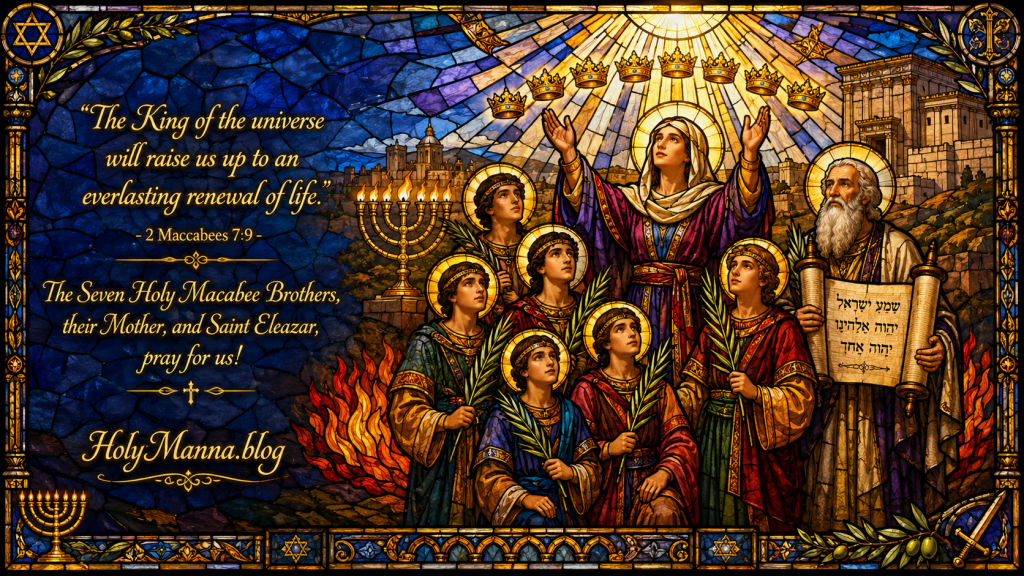
Martyrs Before There Was a Church to Bury Them
Every saint on the calendar points to Christ, but the martyrs celebrated on August 1st did something almost no one else can claim. They died for Him before He was born. The Seven Holy Maccabee Brothers, their mother, and the elderly scribe Saint Eleazar were put to death around 167 to 166 BC, roughly a century and a half before the Nativity, under the Seleucid king Antiochus IV Epiphanes. Their crime was refusing to abandon the Law of God when a pagan empire demanded it. Their story is not preserved in some fragile later account that historians argue over. It is recorded in inspired Scripture itself, in 2 Maccabees 6 and 7, in two of the books of the Old Testament that the Catholic Church has always held as canonical. That makes these martyrs unique in the whole company of the saints. For many centuries they were the only Old Testament figures with a universal feast on the Roman calendar, kept on August 1st. When the calendar was reformed in 1969 and August 1st became the memorial of Saint Alphonsus Liguori, their commemoration remained where it has always been in the Roman Martyrology, on this same day, and the Eastern churches continue to celebrate them on August 1st as well. The Church has never let go of them, and for good reason. The Catechism itself reaches back to their words twice, quoting the brothers to teach the resurrection of the dead in CCC 992 and quoting their mother to teach that God created all things from nothing in CCC 297. When the Church wants to show where faith in the resurrection first found its full voice, she points to a tortured family in the second century before Christ and says, listen to them.
A Faithful Family Under a Faithless King
Scripture tells us almost nothing about the origins of this family, and honesty demands admitting that up front. We do not know their town, their tribe beyond their Jewish identity, or their father. What we know is the world that formed them. After the death of Alexander the Great, the land of Israel fell under the rule of Greek successor kingdoms, and by the second century BC it was governed by the Seleucid dynasty of Syria. Antiochus IV, who took the title Epiphanes, meaning “god manifest,” decided that his empire would be unified by force under Greek religion and culture. He plundered the Temple in Jerusalem, set up an altar to Zeus within it, and made fidelity to the Law of Moses a capital offense. 2 Maccabees 6:6 describes the terror plainly: “A man could neither keep the sabbath, nor observe the feasts of his fathers, nor so much as confess himself to be a Jew.” Keeping kosher, circumcising sons, and honoring the sabbath became acts punishable by death.
Into this fire stepped Eleazar, a scribe advanced in age, ninety years old, whom Scripture describes as a man of noble presence and one of the foremost teachers of the Law. Eastern tradition remembers him as the teacher of the seven brothers themselves, which would make this the story of a catechist and his students dying together for what he taught them, though Scripture does not state that relationship and it cannot be verified. The names by which tradition knows the family come from later centuries rather than from the Bible. The Eastern churches name the brothers Abim, Antonius, Gurias, Eleazar, Eusebonus, Alimus, and Marcellus, and call their mother Solomonia, while Jewish tradition has called her Hannah or Miriam. Scripture itself leaves all of them unnamed except Eleazar, and that anonymity is strangely fitting. They stand in for every believer who will ever be told to deny God or die.
There was no dramatic conversion in their story, because their whole formation was the conversion. This mother raised seven sons in a household where the Law of God was not a cultural leftover but the living covenant with the Creator. When the test came, none of them had to improvise. The answer had been formed in them for years around an ordinary family table.
The Faith That Named the Resurrection
The Maccabean martyrs matter because at the moment of their deaths, the faith of Israel spoke with a clarity it had never reached before. The Catechism teaches that “God revealed the resurrection of the dead to his people progressively” in CCC 992, and it holds up these martyrs as the ones in whom that hope finally rang out in full. When the second brother was at the point of death, he turned to the king and declared, “You accursed wretch, you dismiss us from this present life, but the King of the universe will raise us up to an everlasting renewal of life, because we have died for his laws” as recorded in 2 Macc 7:9. The third brother stretched out his hands to the torturers and said of them, “I got these from Heaven, and because of his laws I disdain them, and from him I hope to get them back again” in 2 Macc 7:11. The fourth went further still in 2 Macc 7:14: “One cannot but choose to die at the hands of men and to cherish the hope that God gives of being raised again by him. But for you there will be no resurrection to life!” These are not vague hopes of a shadowy afterlife. This is bodily resurrection, professed under torture, more than a century before the empty tomb.
Their mother reached even deeper. Encouraging her youngest son, she gave one of the most important theological statements in the entire Old Testament, quoted by the Church in CCC 297 as the scriptural witness to creation out of nothing: “I beseech you, my child, to look at the heaven and the earth and see everything that is in them, and recognize that God did not make them out of things that existed. Thus also mankind comes into being” from 2 Macc 7:28. Her logic is breathtaking. The God who made your body from nothing can certainly give it back to you. She said as much directly: “Therefore the Creator of the world, who shaped the beginning of man and devised the origin of all things, will in his mercy give life and breath back to you again, since you now forget yourselves for the sake of his laws” in 2 Macc 7:23. A grieving mother, standing over the bodies of her sons, articulated the doctrine of creation ex nihilo and tied it to the hope of resurrection in a single breath. The Letter to the Hebrews looks back on her family when it praises the heroes of faith: “Women received their dead by resurrection. Some were tortured, refusing to accept release, that they might rise again to a better life” as Hebrews 11:35 declares. And the very book that records their deaths also gives the Church her scriptural foundation for praying for the dead, when Judas Maccabeus offers sacrifice for his fallen soldiers in 2 Macc 12:46, a passage the Catechism draws on in CCC 1032. One family, one book, and three pillars of Catholic faith: creation from nothing, the resurrection of the body, and prayer for the dead.
The Church attributes no wonder-working miracles to them during their lives, and none should be invented. Their miracle was themselves. The Catechism defines fortitude in CCC 1808 as “the moral virtue that ensures firmness in difficulties and constancy in the pursuit of the good,” and adds that it “enables one to conquer fear, even fear of death, and to face trials and persecutions.” Nine people in one day gave the world a living definition of that virtue.
One Day, Nine Crowns
The persecution reached Eleazar first, as 2 Maccabees 6 recounts. He was seized and ordered to eat pork in violation of the Law. When he refused, officials who had known him for years took him aside and offered him an escape. He could bring his own lawful meat and simply pretend it was the sacrificial pork. No one would know. Eleazar’s answer has echoed for over two thousand years. “Such pretense is not worthy of our time of life,” he said in 2 Macc 6:24, “lest many of the young should suppose that Eleazar in his ninetieth year has gone over to an alien religion.” He understood something our age desperately needs to relearn: that scandal is real, that the compromises of the old teach the young what faith is actually worth, and that a private deal with the world is never really private. He went to the instrument of torture of his own accord, and with his last breath he prayed, “It is clear to the Lord in his holy knowledge that, though I might have been saved from death, I am enduring terrible sufferings in my body under this beating, but in my soul I am glad to suffer these things because I fear him” as 2 Macc 6:30 records. Scripture pronounces his epitaph in 2 Macc 6:31: “So in this way he died, leaving in his death an example of nobility and a memorial of courage, not only to the young but to the great body of his nation.”
Then came the family. Seven brothers and their mother were arrested and brought before the king himself, who commanded them under torture to eat the forbidden flesh. The eldest answered for them all in 2 Macc 7:2: “What do you intend to ask and learn from us? For we are ready to die rather than transgress the laws of our fathers.” Enraged, Antiochus ordered tortures of horrifying cruelty, and Scripture does not look away from them. One by one, from the eldest to the youngest, the brothers were mutilated and burned alive while their mother and remaining brothers were forced to watch. One by one, each professed his faith with his dying words. And their mother did not wail for them to save themselves. Scripture pauses in the middle of the carnage to honor her in 2 Macc 7:20: “The mother was especially admirable and worthy of honorable memory. Though she saw her seven sons perish within a single day, she bore it with good courage because of her hope in the Lord.” She encouraged each of them in the language of their fathers, filled, as the sacred author says, with a noble spirit.
When only the youngest remained, Antiochus changed tactics. He promised the boy wealth, honor, and friendship if he would comply, and when the child refused, the king appealed to the mother to persuade her last surviving son to save himself. She leaned close to the boy, and in words the king could not understand, she urged him toward heaven: “Do not fear this butcher, but prove worthy of your brothers. Accept death, so that in God’s mercy I may get you back again with your brothers” as 2 Macc 7:29 records. The boy died professing that his brothers were now under God’s covenant of everlasting life. 2 Macc 7:41 closes the account with a single devastating line: “Last of all, the mother died, after her sons.” Scripture does not tell us how she died. A later account in 4 Maccabees holds that she threw herself into the flames rather than be touched by the executioners, and Eastern tradition tells that she stood over the bodies of her children, raised her hands in prayer, and gave up her spirit. Both of these are traditions rather than the testimony of the canonical text, and neither detail can be verified.
Where did all this happen? Scripture does not say. Ancient Christian tradition placed the martyrdom at Antioch, where their tomb was venerated, while other traditions place it at Jerusalem, and the sources genuinely conflict. What no source disputes is what their deaths unleashed. Their witness helped inspire Judas Maccabeus and his brothers to rise against Antiochus, a revolt that ended with the purification of the Temple, the event Jewish families still celebrate every winter as Hanukkah. Jesus Himself walked the Temple courts during that very feast, as John 10:22 to 23 records. The courage of one mother and her sons echoes in the Gospels.
A Veneration Older Than Almost Any Other
The veneration of these martyrs is astonishingly ancient, older than the veneration of nearly any Christian saint, because it began among the Jewish people and passed directly into the Church. By the fourth century their feast was firmly established. Saint Gregory of Nazianzus preached a famous homily in their praise around the year 362, defending their place on the Christian calendar and holding them up as martyrs whose endurance shamed the comfortable. Saint John Chrysostom preached on them at Antioch, where their tomb was a center of devotion. Saint Cyprian, Saint Ambrose, and Saint Augustine all celebrated them, and Augustine, in his preaching on their feast, taught the Church how to understand these pre-Christian martyrs: they truly belong to Christ, because the Law and the covenant they refused to betray pointed to Him and found their fulfillment in Him. They died for the Christ who was hidden in the Law they loved. The Catechism echoes that same principle when it teaches in CCC 129 that “Christians therefore read the Old Testament in the light of Christ crucified and risen.”
Their relics were venerated at Antioch in the time of Saint Jerome, and in the sixth century, under Pope Pelagius I, they were translated to Rome and enshrined in the Basilica of San Pietro in Vincoli, Saint Peter in Chains, on the Esquiline Hill. There is something almost too perfect about that placement. In the very church that guards the chains of the first Pope, beneath the same roof where Michelangelo’s great statue of Moses now sits, the Church laid the martyrs who died for the Law of Moses. The Law-giver, the Law’s martyrs, and the fisherman who received the keys of the New Covenant all gathered under one roof. In 1876, during work in the basilica, the ancient fourth-century sarcophagus associated with their relics was rediscovered beneath the church, carved with scenes of Christ’s miracles. Honesty requires adding a sobering note: examinations of the contents reported in the twentieth century raised serious doubts about whether the bones enshrined there are authentic human relics at all, and the question remains unresolved. The faithful can hold that news with peace. The Church’s veneration of these martyrs has never rested on bones in a box. It rests on the inspired Word of God, which no excavation can overturn.
A separate tradition belongs to Cologne in Germany, where the Church of Saint Andrew houses a magnificent medieval shrine of the Maccabees. The story told there is that Archbishop Rainald of Dassel received relics of the Maccabean martyrs along with the famous relics of the Magi and brought them to Cologne in 1164. That translation account is a tradition handed down in Cologne and cannot be verified. Their cultural footprint reaches even into the English language. It has long been claimed that the word “macabre” descends from their name, by way of the medieval “dance macabre” imagery of death, so gruesome was the memory of their martyrdom, though scholars debate that etymology and it should be held loosely. More certain and more beautiful is this: they are commonly described as the only martyrs venerated by Jews and Christians alike, a family whose blood is honored on both sides of the covenant.
What a Family from 167 BC Says to You Today
It would be easy to file this story under ancient history, but the Maccabean martyrs might be the most contemporary saints on the calendar. Nobody today is likely to demand pork at swordpoint, but nearly everyone will eventually face Eleazar’s temptation in some form: the invitation to just pretend. Keep your faith, sure, but hide it. Mouth the words the culture requires, laugh at the joke, sign the statement, stay quiet in the meeting, and no one will ever know. Eleazar’s answer cuts through every rationalization. Someone always knows. The young are always watching, and what the mature do under pressure becomes the next generation’s definition of what faith is worth. The Catechism teaches in CCC 2473 that “Martyrdom is the supreme witness given to the truth of the faith: it means bearing witness even unto death.” Most people will never be asked for that supreme witness, but everyone is asked daily for the smaller ones, and the smaller ones are the training ground. Where in your life have you been offered the “lawful meat,” the comfortable pretense that would cost you nothing but your integrity?
The mother of the seven brothers speaks just as directly, especially to parents. She could not save her sons from suffering, and she did not try to. What she gave them instead was something stronger than safety: a formation so deep that when the worst day of their lives arrived, every one of them knew who God was, what He promised, and why no king on earth outranked Him. Parents today pour enormous energy into protecting children from every discomfort, yet the Maccabean mother suggests the greater gift is preparing them, forming souls who can stand when standing costs something. Her secret was not toughness but hope. She endured, Scripture says, “because of her hope in the Lord” as 2 Macc 7:20 testifies. If your children, or the people who look up to you, learned their theology only from watching how you handle suffering, what would they conclude about God?
And for anyone walking through grief or fear of death, this family offers the oldest and sturdiest consolation in the Bible. Their logic still holds. The God who made you from nothing can raise you from anything. The Church prays for the dead because of their book, hopes in the resurrection because of their witness, and believes in a Creator who owes nothing to pre-existing matter because of their mother’s catechesis delivered at the foot of a torturer’s fire. A practical way to honor them is simple: pray for the dead this week, by name, perhaps at Mass or with a decade of the Rosary, exercising the very hope they died professing. Another is an examination of honesty, asking where pretense has crept into the practice of the faith. A third is at the family table, telling this story out loud, because it was around a table, over the question of a meal, that these nine saints won their crowns. When you imagine your own final hour, is your hope resting on something as unshakable as theirs was?
Engage With Us!
The story of the Seven Holy Maccabee Brothers, their mother, and Saint Eleazar has strengthened believers for over two thousand years, and it still has work to do today. Share your thoughts and reflections in the comments below; this community grows stronger every time someone speaks honestly about walking the path of faith. Here are some questions to pray with and to discuss:
- Eleazar refused a compromise that would have saved his life because of what it would teach the young. Who is watching your example of faith, and what are they learning from it?
- The seven brothers professed the resurrection of the body while facing death. How real is the hope of resurrection in your daily life, and how would your choices change if it were more real?
- The mother encouraged her sons toward heaven rather than begging them to save themselves. Where might God be asking you to encourage someone toward holiness instead of comfort?
- The Maccabean martyrs died rather than pretend. Is there any area of your life where you have been practicing a quiet pretense about what you believe?
- Their book gave the Church her scriptural basis for praying for the dead. Who in your life, living or deceased, most needs your prayers this week?
The witness of this one family proves that no soul is too old, too young, or too ordinary to give God everything. Nine people around one terrible choice changed the history of faith. Take their courage into the week ahead, hold fast to the hope of the resurrection, and do everything, in every trial great and small, with the love and mercy that Jesus taught us.
The Seven Holy Maccabee Brothers, their Mother, and Saint Eleazar, pray for us!
Follow us on YouTube, TikTok, Instagram and Facebook for more insights and reflections on living a faith-filled life.

 Holy Manna!
Leave a comment