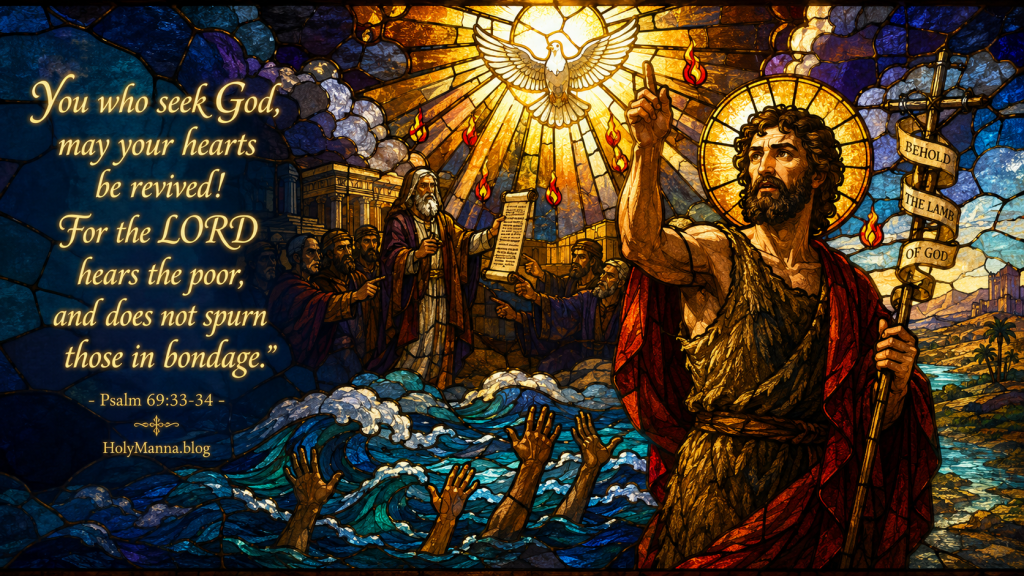
Memorial of Saint Alphonsus Liguori, Bishop and Doctor of the Church – Lectionary: 406
The Word That Refuses to Stay Quiet
There are moments in every life when telling the truth will cost something real, a friendship, a job, a reputation, maybe even more. Today’s readings gather around exactly that moment, and they refuse to sugarcoat it. In the First Reading, the prophet Jeremiah stands trial for his life because he dared to preach repentance inside the Temple itself, and he walks away alive only because a few honest men still had a conscience. In the Gospel, John the Baptist tells a king a truth the king does not want to hear, and it costs him his head. Between those two outcomes stands the Responsorial Psalm, the cry of every faithful soul caught in the flood, begging God for rescue and still choosing to praise Him.
The Church gives these readings on the Memorial of Saint Alphonsus Liguori, Bishop and Doctor of the Church, and the pairing is no accident of the calendar. Alphonsus was a brilliant Naples lawyer who left the courtroom for the confessional, founded the Redemptorists to preach to the most abandoned souls, and wrote moral theology that defended both truth and mercy when powerful voices attacked him for it. He knew what Jeremiah and John knew: the word of God is not ours to edit. The question today is not whether speaking God’s truth will cost something. It will. The question is whether the God who hears the poor can be trusted with the bill. These readings answer with one voice: He can, and He does, even when the rescue looks nothing like what was expected.
First Reading — Jeremiah 26:11-16, 24
A Prophet on Trial for Telling the Truth
The year is around 609 BC. Good King Josiah, the great reformer, has just died in battle, and his son Jehoiakim now sits on the throne of Judah, a king with little patience for prophets. Jeremiah has just delivered what history calls the Temple Sermon, warning that the house of the LORD will end up like Shiloh, the ruined sanctuary of Israel’s past, unless the nation repents. To the religious establishment, this sounds like treason against God Himself. What follows is a trial scene that reads like a preview of Good Friday: priests demanding death, an innocent man appealing to his divine mission, and authorities weighing innocent blood. It fits the day’s theme perfectly, because Jeremiah shows what obedience to God’s word looks like when the audience holds the power of life and death.
Jeremiah 26:11-16 – New American Bible (Revised Edition)
11 The priests and prophets said to the princes and to all the people, “Sentence this man to death! He has prophesied against this city! You heard it with your own ears.” 12 Jeremiah said to the princes and all the people: “It was the Lord who sent me to prophesy against this house and city everything you have heard. 13 Now, therefore, reform your ways and your deeds; listen to the voice of the Lord your God, so that the Lord will have a change of heart regarding the evil he has spoken against you. 14 As for me, I am in your hands; do with me what is good and right in your eyes. 15 But you should certainly know that by putting me to death, you bring innocent blood on yourselves, on this city and its inhabitants. For in truth it was the Lord who sent me to you, to speak all these words for you to hear.”
16 Then the princes and all the people said to the priests and the prophets, “This man does not deserve a death sentence; it is in the name of the Lord, our God, that he speaks to us.”
Detailed Exegesis
Verse 11: “The priests and prophets said to the princes and to all the people, ‘This man deserves death; he has prophesied against this city, as you have heard with your own ears.’”
The accusation comes not from pagans but from the clergy and the professional prophets of the Temple. They frame Jeremiah’s warning as a capital crime against the city and its sanctuary. It is a sobering reminder that religious office is no guarantee of an open heart, and that God’s true messengers are sometimes opposed by the very people charged with guarding His house.
Verse 12: “Then Jeremiah answered the princes and all the people: ‘It was the LORD who sent me to prophesy against this house and city everything you have heard.’”
Jeremiah’s entire defense rests on his commission. He does not soften the message, retract a word, or plead circumstances. He simply testifies that the word was not his own. This is the heart of prophetic vocation: the messenger does not own the message.
Verse 13: “Now, therefore, reform your ways and your deeds, and obey the voice of the LORD your God, so that the LORD will relent of the evil he has spoken against you.”
Astonishingly, while on trial for his life, Jeremiah keeps preaching. The warning was never a curse; it was an invitation. God’s threats in Scripture are always conditional calls to conversion, and Jeremiah wants his judges saved more than he wants himself acquitted.
Verse 14: “As for me, I am in your hands; do with me what seems good and right to you.”
Here is total surrender. Jeremiah hands his fate to the court because he has already handed his life to God. Centuries later, Jesus will stand before Pilate with the same serene freedom of a man who fears God more than death.
Verse 15: “But know for certain that if you put me to death, you bring innocent blood upon yourselves, upon this city and its inhabitants; for in truth the LORD sent me to you to speak all these words for you to hear.”
Jeremiah does not threaten revenge; he states a moral fact. Shedding innocent blood stains a whole community. The phrase echoes forward to Matthew’s Passion narrative, where responsibility for innocent blood again hangs over Jerusalem, marking Jeremiah as a true type of Christ.
Verse 16: “Then the princes and all the people said to the priests and prophets, ‘This man does not deserve a death sentence, for he has spoken to us in the name of the LORD our God.’”
Conscience prevails. The civil officials and the crowd, of all people, recognize the voice of God where the clergy heard only insult. God can raise up defenders of His truth from unexpected places.
Verse 24: “But the hand of Ahikam, son of Shaphan, was with Jeremiah, so that he was not handed over to the people to be put to death.”
One righteous man with influence made the difference. Ahikam belonged to a family that had supported Josiah’s reforms, and his protection saved the prophet from mob violence. God’s providence often works through the quiet courage of laypeople who simply refuse to let injustice happen on their watch.
Teachings
The Catechism grounds this reading’s demand in human nature itself. CCC 2467 teaches, “Man tends by nature toward the truth. He is obliged to honor and bear witness to it.” Jeremiah’s obligation was not a special burden for prophets only; it is the vocation of every baptized person who has received the word of God. Living it out requires the virtue the Church calls fortitude, which CCC 1808 defines: “Fortitude is the moral virtue that ensures firmness in difficulties and constancy in the pursuit of the good.” The same paragraph adds that this virtue can carry a disciple even to the point of renouncing life itself for a just cause.
Saint Alphonsus Liguori, whose memorial the Church keeps today, lived this fortitude in a quieter but very real way. As a moral theologian he was attacked from both sides, by rigorists who accused him of laxity and by others who resented his defense of frequent confession and Communion for ordinary sinners. He endured slander, painful illness, and even a period of anguish near the end of his life, yet he never stopped writing and preaching the truth about God’s mercy. His witness shows that prophetic courage is not only for those facing execution; it belongs to anyone who keeps speaking what is true when it would be easier to stay quiet.
Reflection
Jeremiah’s trial puts a direct question before every believer: when the moment comes, will you say what God has given you to say? Most people will never stand before a literal tribunal, but the smaller courtrooms are everywhere, the family dinner where faith gets mocked, the workplace where honesty is inconvenient, the group chat where cruelty passes for humor.
Consider three concrete steps this week. First, identify one situation where silence has become a habit, and prayerfully prepare one honest, charitable sentence to speak the next time it arises. Second, imitate Ahikam by defending someone else who is speaking truth and paying for it, even if only by standing visibly beside them. Third, before speaking hard truths, pray for the person who needs to hear them, the way Jeremiah kept calling his own judges to conversion.
Where in your life have you been handed a word from God that you are afraid to deliver? Who has been an Ahikam for you, and for whom could you become one?
Responsorial Psalm — Psalm 69:14-16, 30-31, 33-34
The Prayer of the One Sinking in the Flood
Psalm 69 is the prayer Jeremiah could have prayed in that courtroom and the prayer John the Baptist could have prayed in Herod’s dungeon. It is the lament of the just man drowning in persecution, and after Psalm 22 it is the psalm the New Testament applies most often to the Passion of Christ. Zeal for God’s house consuming Him, vinegar offered for His thirst, both come from this psalm. The verses chosen today trace the full arc of faithful suffering: a desperate cry from the mire, and then, before any visible rescue arrives, a decision to praise. That movement, from petition to praise on the strength of trust alone, is the spiritual bridge between today’s two readings, and the refrain gathers it into a single breath: “Lord, in your great love, answer me.”
Psalm 69:14-16, 30-31, 33-34 – New American Bible (Revised Edition)
14 But I will pray to you, Lord,
at a favorable time.
God, in your abundant kindness, answer me
with your sure deliverance.
15 Rescue me from the mire,
and do not let me sink.
Rescue me from those who hate me
and from the watery depths.
16 Do not let the flood waters overwhelm me,
nor the deep swallow me,
nor the pit close its mouth over me.30 But here I am miserable and in pain;
let your saving help protect me, God,
31 That I may praise God’s name in song
and glorify it with thanksgiving.33 “See, you lowly ones, and be glad;
you who seek God, take heart!
34 For the Lord hears the poor,
and does not spurn those in bondage.
Detailed Exegesis
Verse 14: “But I pray to you, LORD, for the time of your favor; in your great mercy, O God, answer me with your faithful help.”
The psalmist does not demand rescue on his own schedule; he appeals to God’s “time of favor.” Prayer here is not a transaction but an act of trust in God’s timing and covenant love, His hesed, that steadfast mercy that never expires.
Verse 15: “Rescue me from the mire; do not let me sink; let me be delivered from my foes and from the watery depths.”
Mire and floodwaters are ancient images of chaos and death. The psalmist feels himself going under, socially, emotionally, perhaps physically. Scripture never pretends that the faithful do not sink; it teaches them where to reach.
Verse 16: “Do not let the floodwaters sweep over me, nor the deep swallow me, nor the pit close its mouth over me.”
The “pit” is the grave itself. This is prayer at the edge of despair, and the Church has always heard in it the voice of Christ in His agony, who “offered prayers and supplications with loud cries and tears” as The Letter to the Hebrews (Hebrews 5:7) describes.
Verse 30: “But I am afflicted and in pain; let your saving help, O God, protect me.”
Notice that nothing external has changed yet. The affliction remains. Yet the psalmist keeps handing his wounds to God rather than nursing them alone, the essential move of biblical hope.
Verse 31: “Then I will praise the name of God in song, and glorify it with thanksgiving.”
Praise erupts before the rescue is visible. This is faith’s boldest act, thanking God in advance because His character is already known. It is the same spirit in which the martyrs sang on the way to their deaths.
Verse 33: “The poor will see it and be glad; you who seek God, may your hearts be revived!”
Personal deliverance becomes communal encouragement. Every answered prayer, every faithful sufferer, revives the hearts of others who are still waiting. Nobody suffers or is rescued alone in the Body of Christ.
Verse 34: “For the LORD hears the poor, and does not spurn those in bondage.”
Here is the psalm’s bedrock claim and the day’s quiet promise. God’s ear is tuned to the anawim, the lowly ones. Jeremiah in the dock and John in the dungeon were both, in this sense, heard, even though one walked free and the other did not.
Teachings
Saint Augustine, in his Expositions on the Psalms, teaches that Psalm 69 is spoken first by Christ the Head in His Passion and then by His Body, the Church, in every age of her suffering, so that when a believer prays it, Christ prays in him and he prays in Christ. The Catechism confirms this way of praying the psalms in CCC 2586, teaching that the Psalter nourishes and expresses the prayer of the People of God, and it defines the deeper posture beneath this psalm in CCC 2559: “Prayer is the raising of one’s mind and heart to God or the requesting of good things from God.”
No saint preached this more insistently than today’s Doctor of the Church. Saint Alphonsus Liguori, in his classic work The Great Means of Salvation and of Perfection, wrote the sentence for which he is perhaps most famous: “He who prays is certainly saved; he who does not pray is certainly damned.” Alphonsus did not mean that prayer earns salvation, but that prayer is the ordinary channel through which God pours the grace of perseverance. The psalmist sinking in the mire and still praying is, for Alphonsus, the picture of a soul that cannot be lost.
Reflection
The psalm offers a practical pattern for seasons of overwhelm. First, name the flood honestly before God; the psalmist hides nothing about mire, foes, and pain. Second, appeal to God’s character rather than personal merit, praying “in your great mercy” instead of “because I deserve it.” Third, choose one act of praise before the answer comes, a hymn on the commute, a Glory Be through gritted teeth, a thank-you for a mercy already received.
Try this concrete practice for the coming week: each night, write down one place where the waters felt high, and beside it one line of praise, then pray both back to God. Over time this trains the heart in the psalm’s own movement from sinking to singing.
What flood are you asking God to hold back right now? When did you last praise God before He answered, and what would it cost you to do it tonight?
Holy Gospel — Matthew 14:1-12
A Guilty Conscience, a Rash Oath, and the Bravest Man in the Room
The Gospel opens in a palace and ends at a graveside. Herod Antipas, tetrarch of Galilee, son of the Herod who slaughtered the innocents of Bethlehem, hears reports about Jesus and cannot shake the thought that John the Baptist has come back from the dead. Matthew then rewinds to tell how John died. The historian Josephus independently confirms the execution, locating it at the desert fortress of Machaerus, which means this grim banquet is not a parable but history. John had told Herod plainly that his union with Herodias, his brother’s wife, violated God’s law. For that one sentence of truth he was imprisoned, and through a dance, a rash oath, and a mother’s hatred, he was beheaded. The reading completes the day’s theme: Jeremiah shows that speaking God’s word can put a man on trial; John shows that it can put a man in the grave, and that even then, God’s word wins.
Matthew 14:1-12 – New American Bible (Revised Edition)
Herod’s Opinion of Jesus. 1 At that time Herod the tetrarch heard of the reputation of Jesus 2 and said to his servants, “This man is John the Baptist. He has been raised from the dead; that is why mighty powers are at work in him.”
The Death of John the Baptist. 3 Now Herod had arrested John, bound [him], and put him in prison on account of Herodias, the wife of his brother Philip, 4 for John had said to him, “It is not lawful for you to have her.” 5 Although he wanted to kill him, he feared the people, for they regarded him as a prophet. 6 But at a birthday celebration for Herod, the daughter of Herodias performed a dance before the guests and delighted Herod 7 so much that he swore to give her whatever she might ask for. 8 Prompted by her mother, she said, “Give me here on a platter the head of John the Baptist.” 9 The king was distressed, but because of his oaths and the guests who were present, he ordered that it be given, 10 and he had John beheaded in the prison. 11 His head was brought in on a platter and given to the girl, who took it to her mother. 12 His disciples came and took away the corpse and buried him; and they went and told Jesus.
Detailed Exegesis
Verse 1: “At that time Herod the tetrarch heard the report about Jesus”
Antipas ruled Galilee under Rome’s shadow, a petty king anxious about his throne. News of Jesus’s miracles penetrates even palace walls; no earthly power is insulated from the Gospel.
Verse 2: “and he said to his servants, ‘This is John the Baptist; he has been raised from the dead, and that is why mighty powers are at work in him.’”
Herod’s guilty conscience has become his theologian. He murdered John, yet cannot bury him in his memory. Sin unconfessed does not disappear; it haunts.
Verse 3: “For Herod had arrested John, bound him, and put him in prison because of Herodias, his brother Philip’s wife,”
The flashback begins. John’s imprisonment was not for sedition but for a moral judgment about a marriage. The world often forgives many things sooner than it forgives being told the truth about its sins.
Verse 4: “because John had said to him, ‘It is not lawful for you to have her.’”
One sentence, rooted in Leviticus 18:16, cost John his freedom and then his life. He did not rage or insult; he simply named the law of God to the man most obligated and least willing to hear it.
Verse 5: “And though he wanted to put him to death, he feared the people, because they regarded John as a prophet.”
Herod is governed entirely by fear, fear of the crowd here, fear of embarrassment later. A man ruled by fear will eventually be ruled by whoever manipulates that fear best.
Verse 6: “But when Herod’s birthday was celebrated, the daughter of Herodias danced before the guests and pleased Herod,”
Tradition, drawing on Josephus, names the girl Salome. A birthday feast, heavy with wine and vanity, becomes the stage for murder. Chrysostom, in his Homilies on Matthew, points to the whole scene as a warning against the excesses of such banquets.
Verse 7: “so that he promised with an oath to give her whatever she might ask.”
A reckless oath, sworn to impress a room. Jesus will later teach against precisely this kind of swearing, because a man who binds himself rashly hands his soul to chance and to worse people than himself.
Verse 8: “Prompted by her mother, she said, ‘Give me here on a platter the head of John the Baptist.’”
Herodias has waited for this moment. Her hatred is patient, deliberate, and total; she does not want John silenced but destroyed, and she is willing to use her own daughter to do it.
Verse 9: “The king was distressed, but because of his oaths and his guests, he commanded that it be given;”
Herod grieves, and then obeys his pride. He knows the act is evil, but the fear of losing face before dinner guests outweighs the fear of God. This is moral cowardice in a single verse.
Verse 10: “and he sent and had John beheaded in the prison.”
The greatest of the prophets, as Jesus Himself called him, dies without trial, without audience, in a dungeon. The world’s verdict and heaven’s verdict on a life rarely match.
Verse 11: “His head was brought in on a platter and given to the girl, and she brought it to her mother.”
The horror is narrated without commentary, and none is needed. Sin, indulged and organized, produces exactly this: the trophy of a silenced conscience.
Verse 12: “Then his disciples came and took the body and buried him; and they went and told Jesus.”
The last movement is quietly beautiful. John’s disciples perform the corporal work of mercy of burying the dead, and then they go to Jesus, the One to whom John had always pointed. Grief brought to Christ is grief already on its way to hope.
Teachings
The Church’s classic commentary on this passage comes from Saint Bede the Venerable, whose homily on the Baptist appears in the Office of Readings. Bede observes of John’s executioner, “His persecutor had demanded not that he should deny Christ, but only that he should keep silent about the truth.” John could have lived by simply saying nothing. His martyrdom teaches that silence about God’s truth, when truth is demanded of us, can itself be a denial.
The Catechism names what John’s death is. CCC 2473 teaches, “Martyrdom is the supreme witness given to the truth of the faith: it means bearing witness even unto death.” And CCC 523 explains why John’s witness matters so much in God’s plan, calling him the Lord’s immediate precursor, “sent to prepare his way,” who precedes Jesus even into death. John’s beheading is not a tragic accident interrupting the Gospel; it is a herald’s final proclamation, announcing in his own blood the Passion that his Lord would soon undergo.
Saint Alphonsus Liguori, preaching and writing in an age of comfortable compromise, constantly warned against the human respect that destroyed Herod, that craven fear of what the guests will think. His whole moral theology aimed to form consciences strong enough to obey God rather than the room.
Reflection
Every person in this Gospel offers a mirror. Herod shows what happens when someone knows the truth, feels its pull, and still lets pride and peer pressure decide. Herodias shows how hatred, nursed over time, becomes capable of anything. John shows that a single faithful voice, even silenced, outlasts every palace.
Concrete steps for living this reading: first, examine where “because of the guests” governs personal choices, the compromises made to avoid awkwardness, and bring one of them to Confession. Second, refuse the rash oath culture of instant promises and hot takes; let words be few and true. Third, imitate John’s disciples by taking grief, outrage, and helplessness directly to Jesus in prayer rather than letting them fester.
Whose approval are you most afraid to lose, and what has that fear already cost you? If speaking one true sentence would cost you comfort this week, would you still say it?
The Word Outlives the Palace
Step back from today’s readings and a single storyline emerges. A prophet stands trial and lives. A prophet sits in a dungeon and dies. And in between, a psalmist up to his neck in floodwater sings that “the LORD hears the poor.” God did not give Jeremiah and John the same ending, but He gave them the same promise: the word entrusted to them was true, and it would outlast every throne that opposed it. Jehoiakim’s kingdom fell. Herod Antipas died in disgrace and exile. Jeremiah’s scroll and John’s witness are still read aloud at Mass twenty-six centuries and twenty centuries later, in every language on earth.
Saint Alphonsus Liguori, whose feast crowns this day, learned the same lesson in his own century. He was mocked, opposed, and eventually pushed aside even within the congregation he founded, yet his books on prayer and the love of Jesus Christ have led more souls to Heaven than his enemies ever imagined. The pattern holds: fidelity now, vindication in God’s time.
The call to action today is simple and searching. Find the one place where God is asking for honest speech, and give it to Him. Pray Psalm 69 in whatever flood is currently rising. Trust that no act of faithfulness, seen or unseen, rewarded or punished, is ever wasted in the economy of grace. The banquet halls of this world are loud, but they empty out by morning. The word of the LORD remains forever, and those who carry it, whether they walk free like Jeremiah or fall like John, are carried by it into eternal life.
Engage With Us!
The conversation does not end with the final paragraph, so please share reflections, questions, and experiences in the comments below. Hearing how God’s word lands in real lives is one of the great joys of this community, and someone else may need exactly the insight another reader has to offer. Here are some questions to spark that sharing:
- In Jeremiah 26:11-16, 24, Jeremiah keeps preaching repentance even while on trial for his life. What truth from God have you hesitated to speak, and what would surrender to His will look like in that situation?
- In Psalm 69:14-16, 30-31, 33-34, the psalmist praises God before any rescue arrives. What would it mean for you to thank God tonight for a deliverance you have not yet seen?
- In Matthew 14:1-12, Herod silences John because of his oaths and his guests. Where does fear of other people’s opinions have the strongest grip on your choices, and how might you loosen it this week?
- Considering the uniting message of all the readings, how is God inviting you to trust that faithful witness is never wasted, whatever it costs?
Living a life of faith does not require a palace platform or a prophet’s mantle. It requires an honest tongue, a praying heart, and the courage to keep pointing to Jesus the way John did, all the way to the end. Speak the truth gently, pray through the floods boldly, and do everything with the love and mercy Jesus taught us, for the Lord truly hears the poor, and He never forgets His own.
Sacred Heart of Jesus, we trust in You!
Immaculate Heart of Mary, pray for us!
Saint Michael the Archangel, defend us in battle!
Follow us on YouTube, TikTok, Instagram and Facebook for more insights and reflections on living a faith-filled life.

 Holy Manna!
Leave a comment