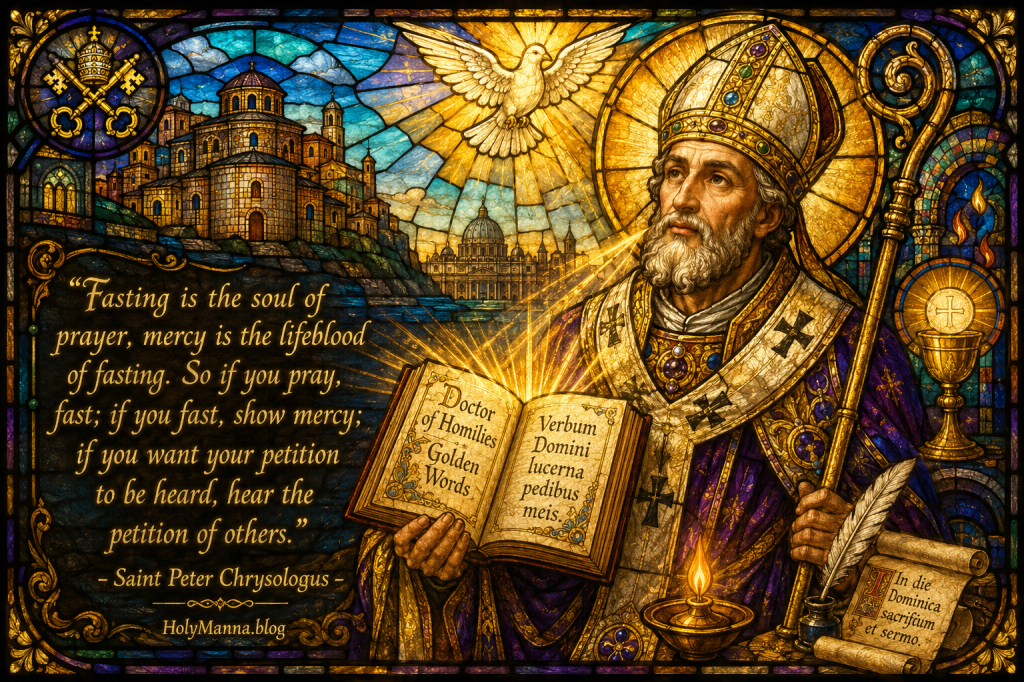
The Man of Golden Words
Some saints thunder. Some saints whisper. Saint Peter Chrysologus, celebrated on July 30th, did something rarer than either; he spoke briefly, beautifully, and truthfully in an age drowning in noise, and the Church has never stopped listening. His very name tells the story. Chrysologus means “golden-worded,” and it was given to him because his short homilies, delivered in the glittering imperial capital of Ravenna in the fifth century, struck his hearers like gold coins dropped into an empty treasury. He is known to this day as the Doctor of Homilies, and in 1729 Pope Benedict XIII declared him a Doctor of the Church, placing this humble bishop from Imola among the greatest teachers Christianity has ever produced.
Why does he matter now, more than fifteen centuries after his death? Because Peter Chrysologus lived through the collapse of a civilization and responded not with panic but with preaching. He watched the Western Roman Empire disintegrate around him, and his answer was to feed his people the Eucharist, teach them the Creed, call them to prayer, fasting, and mercy, and defend the truth that Jesus Christ is fully God and fully man. The Catechism of the Catholic Church still quotes him by name, in CCC 359 and CCC 2837, which means that when Catholics today study the faith, they are still sitting at the feet of the man of golden words. The Church teaches that the Doctors of the Church are given to the faithful precisely so that the deposit of faith can be handed on with clarity, for as CCC 78 explains, “through Tradition, the Church, in her doctrine, life and worship, perpetuates and transmits to every generation all that she herself is, all that she believes.” Peter Chrysologus is one of the shining links in that unbroken chain.
A Boy from Imola in the Hands of a Good Bishop
Peter was born in Imola, a town in northern Italy known in antiquity as Forum Cornelii, around the year 380, though some scholars place his birth as late as the year 400 or 406. The sources honestly disagree on the date, and it is better to admit that openly than to pretend to a precision the historical record does not offer. What the record does offer is something more important than a birthday: the picture of a soul formed slowly and well by the Church.
The bishop of Imola at that time was a holy man named Cornelius, and it was Cornelius who baptized Peter, educated him, and eventually ordained him a deacon. Some later accounts describe Peter as a convert who came to the faith as an adult, while others suggest he was raised within a Christian household; the sources do not agree, and that uncertainty deserves to be stated plainly. What no source disputes is the decisive role of Bishop Cornelius. Peter himself, in his later preaching, spoke of Cornelius with the affection of a spiritual son. Whether Peter came to the font as a child or as a grown man, it was through the ordinary, patient ministry of a local bishop that God prepared an extraordinary instrument.
There is a lesson hiding in that ordinariness. The Church teaches that “the whole Church is apostolic, in that she remains, through the successors of St. Peter and the other apostles, in communion of faith and life with her origin” (CCC 863). Peter Chrysologus did not descend from heaven fully formed. He was catechized, sacramentally nourished, and mentored, the same way any Catholic today is invited to be. In time he rose to the office of archdeacon of Imola, reportedly with the favor of the imperial court of Valentinian III, and there he might have remained, a capable churchman in a modest town, if God had not had other plans.
Around the year 433, the see of Ravenna fell vacant. Ravenna was no ordinary diocese. It was the residence of the Western emperors, a jewel box of a city on the Adriatic, shimmering with mosaics and buzzing with imperial politics. A delegation traveled from Ravenna to Rome to ask Pope Sixtus III to confirm their chosen candidate as the new bishop, and Bishop Cornelius of Imola went along, bringing his archdeacon Peter with him. What happened next comes down to us as a cherished tradition recorded in the Roman Breviary. According to this tradition, Pope Sixtus III had received a vision the night before, in which Saint Peter the Apostle and Saint Apollinaris, the first bishop of Ravenna, showed him a young man and told him that this man was to be Ravenna’s next shepherd. When the delegation entered, the story goes, the Pope recognized the archdeacon from Imola as the man in his vision, set aside the candidate the delegation had brought, and consecrated Peter as Bishop of Ravenna. It is a beautiful account of God choosing the overlooked man, and it has been told in the Church’s liturgical books for centuries, but it must be said honestly that this story is a tradition whose details cannot be verified.
Short Sermons, Golden Words, and a City Won for Christ
What is thoroughly verified is what Peter did once the office was his. For roughly twenty-seven years he shepherded the most politically important city in the Western world, and he did it primarily through one humble instrument: the short sermon. More than 170 of his homilies survive to this day, and they reveal a pastor of remarkable self-awareness. Peter kept his sermons brief because, as the tradition tells us, he was afraid of fatiguing the attention of his hearers. Consider that for a moment. One of the most gifted orators in the history of the Church deliberately restrained his own eloquence out of love for his listeners. In an era when many speakers measured greatness by length, Peter measured it by fruitfulness.
His preaching centered on the Person of Jesus Christ, the mystery of the Incarnation, the Apostles’ Creed, the dignity of the Blessed Virgin Mary, the mission of Saint John the Baptist, and the constant call to repentance and works of penance. Tradition holds that after hearing his first homily as bishop, the Empress Galla Placidia, mother of the Emperor Valentinian III, was so moved that she gave him the surname Chrysologus, “the golden-worded.” That account is a tradition, and some scholars believe the title was actually attached to his name later, perhaps to give the Western Church a counterpart to the great Eastern preacher Saint John Chrysostom, the “golden-mouthed.” Both explanations circulate in the sources, and honesty requires presenting them side by side rather than choosing one with false confidence. What is certain is that Galla Placidia became a devoted patroness of his episcopate, supporting the construction of churches throughout Ravenna while Peter filled them with sound doctrine.
And what doctrine it was. Listen to how he preached on prayer, fasting, and mercy, in the sermon the Church still reads in the Liturgy of the Hours: “There are three things, my brethren, by which faith stands firm, devotion remains constant, and virtue endures. They are prayer, fasting and mercy. Prayer knocks at the door, fasting obtains, mercy receives. Prayer, mercy and fasting: these three are one, and they give life to each other.” He continued with words that could have been written for this generation: “Fasting is the soul of prayer, mercy is the lifeblood of fasting. So if you pray, fast; if you fast, show mercy; if you want your petition to be heard, hear the petition of others. If you do not close your ear to others, you open God’s ear to yourself.” The Church still teaches exactly this. As CCC 1434 states, “the interior penance of the Christian can be expressed in many and various ways. Scripture and the Fathers insist above all on three forms, fasting, prayer, and almsgiving, which express conversion in relation to oneself, to God, and to others.” When Catholics practice these three disciplines every Lent, they are living the very pattern Peter preached to the people of Ravenna.
He was also a fearless voice against the leftover paganism of his day. Fifth-century Ravenna still clung to the raucous celebrations of the old Roman New Year, with their masks, excesses, and superstitions, and Peter confronted these revels directly from the pulpit. From this preaching comes one of his most famous sayings, preserved in his sermons: “Anyone who wishes to frolic with the devil cannot rejoice with Christ.” There is no diplomatic cushioning in that sentence, and there was none intended. Peter loved his people too much to let them split their hearts between Christ and the world, and his blunt clarity anticipates what the Catechism teaches about the first commandment, that superstition and idolatry remain perennial temptations, for “idolatry consists in divinizing what is not God” (CCC 2113).
Perhaps his most tender golden words were reserved for the Blessed Virgin Mary. In one surviving sermon he marveled at the Annunciation with this line: “A gentle maiden having lodged a God in her womb, asks as its price, peace for the world, salvation for those who are lost, and life for the dead.” In a single sentence he captured what the Church would always teach about Mary’s cooperation in salvation, that by her obedience she became, as CCC 494 says, quoting Saint Irenaeus, “the cause of salvation for herself and for the whole human race.”
It must be said plainly, because integrity demands it, that the historical record attributes no miracles to Peter Chrysologus during his lifetime. He healed no lepers that history remembers and raised no dead that any chronicle records. His miracle, if one may speak loosely, was slower and quieter: a pagan-tinged imperial capital gradually converted, catechized, and fed with the Eucharist, one short golden sermon at a time. He urged his people toward the daily reception of Holy Communion, teaching them to receive the Bread of Life not as an occasional luxury but as daily nourishment, a practice the Church continues to commend, for “the Church warmly recommends that the faithful receive Holy Communion each time they participate in the celebration of the Eucharist” (CCC 1417).
Holding the Line When Heresy Came Knocking
Peter Chrysologus was not martyred, and no account claims otherwise. His hardships were of a different kind, the kind that grind a shepherd down slowly: a collapsing empire, a restless imperial court, the stubborn residue of paganism, and above all the storm of heresy that battered the fifth-century Church. Peter labored against the errors of the Manicheans, the Novatians, the Pelagians, and the Nestorians, patiently winning back souls that had wandered into confusion. But his defining trial arrived near the end of his life, and it carried a name: Eutyches.
Eutyches was an aged and influential monk of Constantinople who taught, in his zeal to oppose one heresy, an equal and opposite error. He held that after the Incarnation, Christ possessed only one nature, His humanity effectively absorbed into His divinity. This teaching, later called Monophysitism, struck at the heart of the Gospel, because if Christ is not truly and fully man, then humanity has not truly been redeemed. The Church would eventually define the truth with precision at the Council of Chalcedon in 451, teaching what the Catechism summarizes today: “we confess that one and the same Son, our Lord Jesus Christ, is perfect in divinity and perfect in humanity, truly God and truly man” (CCC 467).
In 448, a synod at Constantinople under Bishop Flavian condemned Eutyches. Refusing the sentence, Eutyches wrote letters seeking allies among the great bishops of the world, including Pope Saint Leo the Great and Peter Chrysologus, hoping the famed preacher of Ravenna would take his side. Peter’s reply, written in 449 and preserved for all time in the Acts of the Council of Chalcedon, is a masterpiece of charity and clarity. He did not flatter Eutyches, and he did not crush him. He grieved with him, and then he pointed him to Rome. His words deserve to be read in full, because they remain one of the most striking early witnesses to the primacy of the successor of Peter: “We exhort you in every respect, honorable brother, to heed obediently what has been written by the most blessed pope of the city of Rome, for blessed Peter, who lives and presides in his own see, provides the truth of faith to those who seek it. For we, by reason of our pursuit of peace and faith, cannot try cases on the faith without the consent of the bishop of Rome.”
Read that again slowly. In the year 449, before Chalcedon, before the great medieval papacy, a bishop of the imperial capital of the West declared that questions of faith cannot be settled apart from the Bishop of Rome, because Peter still lives and presides in his see. This is precisely what the Church confesses today: “the Pope, Bishop of Rome and Peter’s successor, is the perpetual and visible source and foundation of the unity both of the bishops and of the whole company of the faithful” (CCC 882). Peter Chrysologus did not invent papal primacy; he witnessed to it as something already known and lived. In the same letter he added a line that should pierce every heart wounded by Christian division: “If the peace of the Church causes joy in heaven, then divisions must give birth to grief.”
Peter did not live to see the vindication of the truth he defended. He died around the year 450, roughly a year before the Council of Chalcedon condemned the very heresy he had confronted. Feeling his death approaching, he did something profoundly human and profoundly beautiful: he went home. He returned to Imola, the town of his baptism, and there, according to tradition on July 31st, he gave his golden voice back to the God who had lent it to him.
A Doctor Crowned Thirteen Centuries Later
No dramatic miracle stories attach to the tomb of Peter Chrysologus, and it would dishonor a man who prized truth to invent any. The sources record no documented healings at his relics and no posthumous wonders of the kind that fill the pages of other saints’ lives. His veneration took a different and, in its own way, more astonishing shape: his words simply refused to die.
His relics rest principally at Imola, where he died, and tradition holds that an arm of the saint is preserved and venerated in the cathedral at Ravenna, the city he served for nearly three decades. His memory remained alive in both cities across the centuries, and Ravenna itself, with its breathtaking early Christian basilicas and mosaics, many rising during and just after his era, still draws pilgrims and visitors from around the world who walk through the same golden city that once heard his golden words.
The most remarkable event in his afterlife came in 1729, when Pope Benedict XIII declared him a Doctor of the Church. Consider the span of that recognition: roughly thirteen centuries separated the preacher from the proclamation. The Church examined those short sermons, those brief homilies crafted by a man afraid of boring his flock, and judged them so sound, so nourishing, and so enduring that she raised their author to stand alongside Augustine, Jerome, and Gregory as a teacher of the universal Church. In 1969, the reform of the General Roman Calendar moved his feast from December 4th to July 30th, the day nearest his traditional date of death, since July 31st already belonged to Saint Ignatius of Loyola.
And his voice still speaks with the Church’s own authority. When the Catechism of the Catholic Church teaches about the origin of man in CCC 359, it reaches back and quotes his Sermo 117 on Christ as the new Adam. When it teaches about the petition for daily bread in the Our Father, CCC 2837 quotes his Sermo 67, where he preached of Christ in words that shimmer like a Ravenna mosaic: “It is he himself who is the bread who, sown in the Virgin, raised up in the flesh, kneaded in the Passion, baked in the oven of the tomb, reserved in churches, brought to altars, furnishes the faithful each day with food from heaven.” Very few saints are quoted by name in the Catechism. Peter Chrysologus is quoted twice. Sixteen centuries after Ravenna first heard him, every catechism class on earth can still hear him.
Golden Words for an Age of Noise
What does a fifth-century bishop of a vanished empire have to say to someone scrolling through an endless feed in the twenty-first century? Almost everything, as it turns out, because Peter Chrysologus mastered the very things this age struggles with most: attention, brevity, integrity, and hope amid collapse.
Start with his brevity. Peter kept his sermons short out of reverence for his hearers. He understood that communication is an act of charity, not a performance of the self. How often does the modern heart use many words to say little, and how might speaking less, but more truthfully, become an act of love this week? Anyone who has ever sent a message designed to impress rather than to serve knows exactly the temptation Peter resisted. The Catechism teaches that “the disciple of Christ consents to live in the truth, that is, in the simplicity of a life in conformity with the Lord’s example” (CCC 2470). Golden words are not ornate words. They are true words, offered in love, at the right length.
Consider next his threefold remedy of prayer, fasting, and mercy. Peter insisted that these three give life to each other, that prayer without mercy is a knock on a door one refuses to open for others. This is not advice for Lent alone; it is a blueprint for an integrated Catholic life. A practical way to begin is to choose one small daily prayer commitment, one small weekly act of self-denial, and one concrete monthly work of mercy, and to hold all three together deliberately, letting each feed the others exactly as Peter taught. The Church confirms this pattern when she teaches that “the works of mercy are charitable actions by which we come to the aid of our neighbor in his spiritual and bodily necessities” (CCC 2447). Which of the three, prayer, fasting, or mercy, has been most neglected lately, and what would it cost to restore it?
Consider also his loyalty. When the brilliant and persuasive Eutyches came looking for an ally, Peter did not calculate the politics. He pointed to Rome, to the successor of Peter, and to the peace of the Church. In an age when every believer is tempted to curate a private Christianity, choosing doctrines the way one chooses subscriptions, Peter’s example cuts deep. Faith is received, not assembled, for “the task of giving an authentic interpretation of the Word of God, whether in its written form or in the form of Tradition, has been entrusted to the living teaching office of the Church alone” (CCC 85). Is there any teaching of the Church that has been quietly set aside because it is inconvenient, and what would it look like to bring it honestly before God this week?
Finally, consider his hope. Peter watched Rome’s world crack apart, and he responded by building churches, feeding his people the Eucharist daily, and preaching Christ crucified and risen. He did not waste his short sermons on despair. Anyone anxious about the state of the world today can take up his strategy without changing a single element: stay close to the sacraments, speak the truth briefly and kindly, care for the poor, and trust that the Church outlives empires. She has done it before. Peter Chrysologus watched her do it.
Engage With Us!
The story of Saint Peter Chrysologus proves that a faithful voice, even a brief one, can echo for sixteen centuries. Now it is your turn to add your voice. Share your thoughts, your questions, and your own reflections on the man of golden words in the comments below; this community grows stronger every time someone speaks honestly about the faith.
To help you get started, here are some questions to ponder and discuss:
- Saint Peter Chrysologus kept his sermons short out of love for his listeners. In what ways can you make your own words, spoken or typed, more charitable and more intentional this week?
- Peter taught that prayer, fasting, and mercy are three that give life to each other. Which of the three is strongest in your life right now, which is weakest, and what one concrete step could you take to bring them into balance?
- When Eutyches sought his support, Peter pointed him to the Bishop of Rome and the unity of the Church. Where in your own life are you tempted to prefer your private judgment over the teaching of the Church, and how might you bring that struggle to God in prayer?
- Peter served faithfully while the world around him collapsed. What fears about the state of the world weigh on you today, and how does his example of quiet, sacramental faithfulness speak to those fears?
- The Catechism still quotes Peter’s description of Christ as the Bread sown in the Virgin and set upon the altars. How might his love for the daily Eucharist challenge you to approach Holy Communion with fresh reverence and greater frequency?
May the example of Saint Peter Chrysologus remind you that you do not need many words, great fame, or a comfortable era to serve God; you need only a heart surrendered to Christ and a willingness to speak the truth in love. Live this day, and every day, with the compassion, the courage, and the mercy that Jesus taught us, and let every word you offer the world be, in its own small way, golden. Saint Peter Chrysologus, pray for us!

 Holy Manna!
Leave a comment