A Small Door Into the Ocean of God’s Mercy
Some saints conquer the world with sermons that shake cathedrals. Some write theology that universities study for centuries. Saint Leopold Mandić did neither. He could not preach; his stutter would not allow it. He wrote no books. He founded no great institutions. He stood four feet five inches tall, walked with a limp from crippling arthritis, and spent nearly his entire priesthood inside a confessional cell only a few square meters wide in Padua, Italy. And yet, when Pope John Paul II raised him to the altars in 1983, the Church held him up before the whole world as a model of what the priesthood, and the Christian life, are really for.
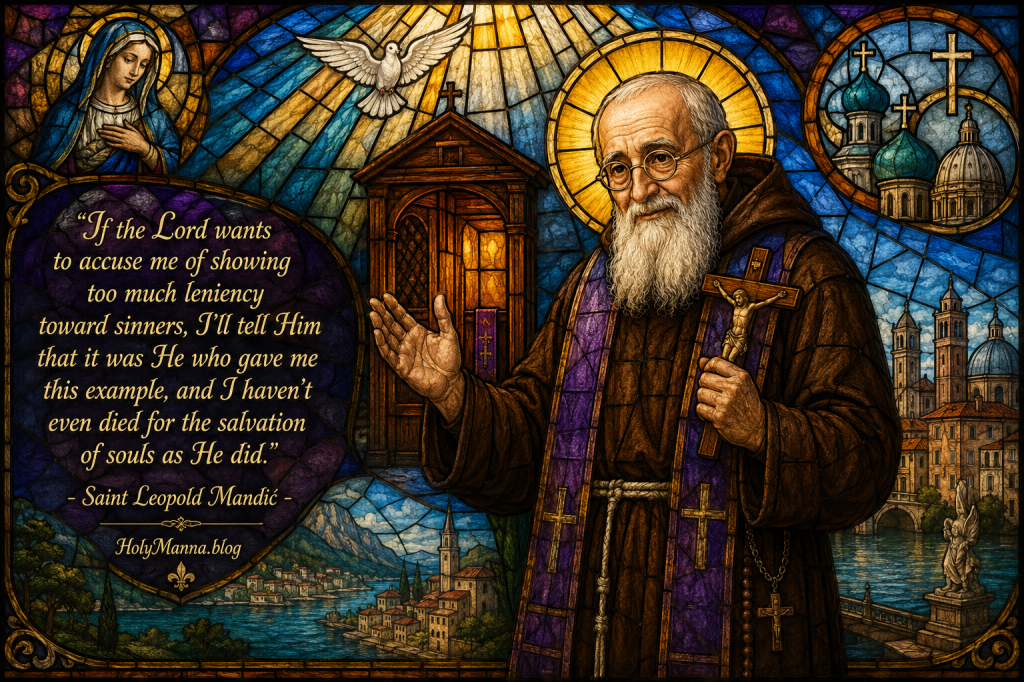
Leopold heard confessions ten to fifteen hours a day, nearly every day, for decades. He absolved sinners with a tenderness so extravagant that his own confreres accused him of being too easy on people. His answer has become one of the most beloved sayings in modern Catholic memory: “If the Lord wants to accuse me of showing too much leniency toward sinners, I’ll tell him that it was he who gave me this example, and I haven’t even died for the salvation of souls as he did.”
The Church teaches that the confessor “is not the master of God’s forgiveness, but its servant” and that he “should unite himself to the intention and charity of Christ” (CCC 1466). Few priests in history have embodied that paragraph the way Leopold did. He is celebrated in the Roman Martyrology on July 30th, the day he entered eternal life, and he holds a documented patronage that flows directly from his own suffering: he is the patron saint of those who suffer from cancer, the disease that took his life. If you have ever hesitated outside a confessional, or wondered whether God could really forgive what you have done, this little Croatian friar is the saint you need to meet.
A Fisherman’s Son from the Bay of Kotor
Bogdan Ivan Mandić was born on May 12, 1866, in Herceg Novi, then called Castelnuovo, a coastal town on the beautiful Bay of Kotor. At the time it belonged to the Kingdom of Dalmatia within the Austro-Hungarian Empire; today it sits in Montenegro. He was a Croatian Catholic, born into a large family; most accounts describe him as the twelfth child, though sources differ on the total number of children, with some describing him as the youngest of twelve and others placing him in a still larger family. What is certain is that he came from a full and faithful Catholic household on the Dalmatian coast, a region where Catholic and Orthodox Christians lived side by side. That mixed religious world would shape the deepest desire of his heart for the rest of his life.
His father, Petar, was a fisherman whose fleet and fortunes collapsed, and the family fell into real poverty. Bogdan grew up knowing what it meant to need everything, and those who knew him later testified that he never forgot it; his lifelong compassion for the poor and the struggling was rooted in his own childhood want.
Italian Capuchin friars had served a church in his hometown since the seventeenth century, back when the Venetian Republic ruled the coast. Young Bogdan watched these sons of Saint Francis up close, and something in their poverty, humility, and closeness to ordinary people captured him. In November 1882, at just sixteen years old, he left his family and his homeland and crossed the Adriatic to enter the Capuchin minor seminary in Udine, Italy. Two years later he was admitted to the novitiate at Bassano del Grappa, where he received the Capuchin habit and a new name: Brother Leopold. He made his first profession of vows on May 3, 1885, and his perpetual vows in 1888.
There was a serious question about whether this frail young man could be ordained at all. He was tiny, his health was poor, his eyesight was weak, his hands and posture were bent by chronic arthritis, and above all he had a stutter and a voice too weak to preach. In the Capuchin tradition, preaching was central to the life of a priest friar. But his superiors saw what God saw: a soul of unusual depth and a will of iron hidden inside a fragile body. On September 20, 1890, at the Basilica of Santa Maria della Salute in Venice, Bogdan Mandić became Father Leopold, a priest of Jesus Christ, at twenty-four years old.
From his youth, Leopold carried a dream that never left him. He longed to return east as a missionary and to labor for the reunion of the Orthodox Christians of his homeland with the Catholic Church. He begged his superiors, repeatedly, to send him. The answer, because of his health and his speech, was always no. What looked like the death of a vocation became, in God’s providence, the birth of a greater one. The Catechism teaches that “Christ always gives his Church the gift of unity, but the Church must always pray and work to maintain, reinforce, and perfect the unity that Christ wills for her” (CCC 820). Leopold decided that if he could not work for that unity with his feet, he would work for it with his heart. He privately vowed to offer every act of his ministry for the return of his separated Eastern brothers and sisters to full communion with Rome. Every confession he would ever hear, tens of thousands upon tens of thousands of them, was silently offered for the East. This is why the Church remembers him not only as the Apostle of Confession but also as the Apostle of Unity.
The Confessional Becomes a Throne of Grace
After ordination, Leopold moved through various Capuchin friaries in the Veneto region and in Croatia, teaching seminarians for a time and taking on humble duties like that of porter. One assignment followed him everywhere: hearing confessions. Since he could not preach, the confessional became his pulpit. He embraced it completely, saying, “Since God has not given me the gift of preaching, I want to consecrate myself to drawing souls back to Him through the Sacrament of Penance.”
In 1906 he was assigned to the friary of Santa Croce in Padua, and apart from brief interruptions, he never left. For roughly the next four decades, his life fit inside a cell a few square meters wide. He rose early, prayed for hours, celebrated Mass, and then sat in that little room from morning until night, ten, twelve, sometimes fifteen hours a day, as an unending line of penitents came to him. Students and professors from the University of Padua, laborers, mothers, priests, bishops, hardened sinners who had not confessed in decades; they all found their way to the tiny friar. Every Wednesday he also went to the Basilica of Saint Anthony to hear the confessions of the friars there, stopping first to pray at the tomb of Saint Anthony, and he would often speak in the local dialect to put people at ease.
What did they find in that cell? Not a judge, but a father. The Church teaches that when a priest hears confessions, he “is fulfilling the ministry of the Good Shepherd who seeks the lost sheep” and is “the sign and the instrument of God’s merciful love for the sinner” (CCC 1465). Leopold’s penitents experienced exactly that. He welcomed each person like a long-awaited friend. He never scolded, never pried, never crushed. To the anxious he would say, “Be at peace; place everything on my shoulders. I will take care of it.” And he meant it literally. He explained, “I give my penitents only small penances because I do the rest myself.” At night, after those endless hours in the confessional, he would spend more hours in prayer and penance, saying simply, “I must do penance for my penitents.” His whole body of suffering, his arthritis, his stomach pain, his weak eyes, was quietly offered for the souls he absolved.
One story from a penitent, preserved in Catholic accounts of his life, captures the man perfectly. A man who had stayed away from confession for years finally worked up the courage to visit Father Leopold. Nervous and distracted, he walked into the cell and sat down in the priest’s own armchair by mistake. Leopold said nothing. He simply knelt down on the floor in front of the man and heard his confession from his knees. Only afterward did the penitent realize what had happened, and when he tried to apologize, Leopold smiled and said, “It’s nothing, it’s nothing. Go in peace.” The man later said that this act of goodness won him over entirely. This account comes from the testimony of the penitent himself as handed down in accounts of the saint’s life, and while it is widely repeated in reliable Catholic sources, it rests on personal testimony rather than official documentation, so it is presented here as testimony rather than as formally verified fact.
Some of his brother friars grumbled that he was an ignorant absolution machine, too soft to be a real confessor. Leopold answered with a logic that is really just the Gospel: “Some people say that I am too kind. But if you come and kneel before me, isn’t this a sufficient proof that you want to have God’s pardon? God’s mercy is beyond all expectation.” He was not lax about sin; he was serious about mercy. The Catechism teaches that the sacrament requires “contrition, confession, and satisfaction” on the part of the penitent, together with God’s action through the Church (CCC 1448), and Leopold worked gently to awaken true contrition in every soul. He simply refused to make the door of mercy narrower than Christ made it.
His interior life was hidden behind a fierce humility. He deflected every compliment, hid every grace, and said of himself, “I am truly a man of nothing, indeed ridiculous.” The official biography of his life preserves his rule for himself and his brothers: “We hide everything, even what may appear to be a gift of God, so as not to make it an instrument of profit. To God alone be honour and glory! If it were possible, we should pass over the earth like a shadow that leaves no trace.” He had a tender devotion to Our Lady, whom he affectionately called his holy boss, praying the Rosary constantly and celebrating Mass at her altar. He was especially gentle with expectant mothers and children and helped establish care for orphans. Many penitents testified that he seemed to read their souls, gently supplying sins they had forgotten or were afraid to say, and numerous favors and healings were attributed to his prayers already during his lifetime. These accounts of reading souls and of healings during life come from the testimony of his penitents; they are widely reported in Catholic sources but are individually unverifiable, so they are told here as testimony and tradition rather than as established fact.
Exile, Mockery, and a Body That Never Stopped Hurting
Leopold’s hardships did not come from a tyrant’s sword. They came in smaller, longer, more grinding forms, and that is exactly why his endurance matters for us.
First, there was his body. He lived his entire life in pain. The arthritis that bent his spine and deformed his hands never relented. His stomach tormented him for years, and the ailment eventually revealed itself as cancer of the esophagus. His eyesight failed as he aged. Children on the streets of Padua sometimes mocked the tiny, limping friar, and accounts from his confreres record that boys would laugh at him and even drop rocks into his hood. It wounded him, and he bore it in silence, uniting it to the Cross. The Catechism teaches that by grace, suffering can become “a participation in the saving work of Jesus” (CCC 1521), and Leopold lived that participation daily for seventy-six years.
Second, there was the death of his dream. Year after year he asked to be sent east, and year after year the answer was no. He obeyed. He did not grow bitter, he did not campaign against his superiors, and he did not nurse his disappointment in public. He transformed it into intercession, offering every confession for the unity of Christians. Obedience, for Leopold, was not defeat; it was the shape his mission took when God redrew it.
Third, there was war and exile. When the First World War came, Leopold, a subject of the Austro-Hungarian Empire living in Italy, was pressed to take Italian citizenship. He refused; he would not renounce his Croatian identity, which was bound up with his hope of one day serving his people in the East. Because of that refusal, he was sent away from Padua in 1917 and made to spend about a year in southern Italy, moving among friaries under the eye of wartime authorities as a citizen of an enemy empire. Some accounts describe this period bluntly as imprisonment, while Capuchin sources describe it more precisely as a supervised exile; either way, he was punished for fidelity to his homeland and accepted it peacefully, hearing confessions wherever he was sent. He returned to Padua when the war ended, and in 1923 he was briefly transferred to Zadar on the Dalmatian coast, a move that thrilled him, only to be recalled to Padua within months because his penitents there simply would not let him go. Their appeals reached the bishop himself. Leopold obeyed again, and Padua kept its confessor.
Finally, there was the long dying. Through the winter of 1941 his stomach pain sharpened into agony, and the diagnosis was grim. He kept hearing confessions anyway. Witnesses recalled that on the very evening before his death, wracked by his illness, he was still in the confessional welcoming penitents. On the morning of July 30, 1942, he rose early as always and prayed for an hour in the infirmary chapel. At six thirty he was vesting for Mass when he collapsed. The friars carried him to his cell and gave him the Last Rites, and as they sang the Salve Regina around his bed, he reached the words addressing Our Lady, “O clement, O loving, O sweet Virgin Mary,” and with the name of his holy boss on the air, he died. He was seventy-six years old. He was not a martyr of blood, but the Church has always understood his life as a slow martyrdom of the confessional, a daily crucifixion of comfort, health, and self-will for the sake of souls.
The Bombs That Spared a Confessional
Before he died, Leopold made a startling prediction to his brothers about the war that was then engulfing Europe. He said, “The church and the friary will be hit by the bombs, but not this little cell. Here God exercised so much mercy for people, it must remain as a monument to God’s goodness.” On May 14, 1944, less than two years after his death, Allied bombs fell on Padua. The church of Santa Croce and part of the friary were destroyed, exactly as he had said. His tiny confessional cell stood intact amid the rubble. This prophecy and its fulfillment are among the best attested facts of his story, reported consistently in Capuchin and wider Catholic sources, and the cell still stands today, preserved just as he foretold, as a monument to the mercy of God.
Devotion to Father Leopold spread rapidly after his death. Padua, which had barely noticed the little friar for decades, now could not forget him. Favors and healings attributed to his intercession were reported and gathered as his cause advanced. A healing judged medically inexplicable was approved as the miracle for his beatification, and Pope Saint Paul VI beatified him in Rome on May 2, 1976. A further healing attributed to his intercession, involving the cure of a malignant tumor, was approved for his canonization, and Pope Saint John Paul II canonized him on October 16, 1983, during the Synod of Bishops that was then meeting on the very themes of penance and reconciliation. The timing was no accident of scheduling; the Church deliberately held up the Apostle of Confession before the world’s bishops as they deliberated on the sacrament he had lived. In canonizing him, the Church exercised the authority described in the Catechism, by which she “recognizes the power of the Spirit of holiness within her and sustains the hope of believers by proposing the saints to them as models and intercessors” (CCC 828). Because of the cancer that killed him and the tumor healing tied to his cause, he is invoked as the patron saint of those suffering from cancer, a patronage that gives countless patients and families a friend in heaven who knows their fear from the inside.
His body, which the faithful venerate as remarkably preserved, rests in the Sanctuary of Saint Leopold Mandić at Piazzale Santa Croce in Padua, rebuilt after the wartime destruction, with his famous confessional cell at its heart. Pilgrims come year round, and priests in particular come to pray where mercy was poured out for forty years. During the Extraordinary Jubilee of Mercy in 2016, Pope Francis asked that the relics of Saint Leopold and of his Capuchin confrere Saint Pio of Pietrelcina be brought to Rome, where they were venerated in Saint Peter’s Basilica itself; two confessors, side by side, set before the universal Church as living icons of the Father’s mercy. A bronze statue of Leopold stands in Medjugorje as an inspiration to confessors, and he remains beloved among Croatians as one of their own, a son of the Bay of Kotor raised to the altars. Individual healing stories attributed to his intercession beyond the formally approved miracles circulate widely among the faithful; those individual accounts cannot be verified and are received as personal testimony rather than established fact.
What a Stuttering Friar Teaches a Loud World
Leopold’s life asks you a quiet, uncomfortable, liberating question: what if the thing you think disqualifies you is actually your mission? He wanted to be a missionary preacher; God gave him a stutter. He wanted the East; God gave him a box in Padua. By every worldly metric his life was a failure of ambition, and by heaven’s metric it was one of the most fruitful priesthoods of the twentieth century. The Catechism teaches that “the whole concern of doctrine and its teaching must be directed to the love that never ends” (CCC 25), and Leopold is proof that a life poured into love needs no stage, no platform, and no applause.
His story also confronts the way so many of us treat confession. Be honest: is there something that has kept you away from the sacrament, fear, shame, embarrassment, or the suspicion that your sins are too big or too repetitive? Leopold spent forty years answering that suspicion. The Church teaches that in this sacrament the penitent receives “reconciliation with God by which the penitent recovers grace” and “peace and serenity of conscience with strong spiritual consolation” (CCC 1496). That is not a threat; it is an invitation. If a return to confession has been sitting on your heart, let this saint of July 30th be the nudge you finally act on. Find a parish confession time this week and go. You will be walking into the same mercy that flowed through Leopold’s little cell.
There is a lesson here about hidden faithfulness, too. Leopold did the same small thing, over and over, for decades, without recognition and often with ridicule. In a culture that measures worth in visibility, he measured it in fidelity. What is the hidden, repetitive, unglamorous duty in your life right now that God may be asking you to embrace as your sanctity? Perhaps it is caring for a sick parent, showing up for a tedious job with integrity, praying for a family member who has left the faith, or forgiving the same person again. Do it the way Leopold heard confessions: completely, gently, and for God alone.
Finally, Leopold teaches intercession. He could not go east, so he prayed east. Every confession became a silent offering for Christian unity. You can do the same with your own limitations. Offer your commute for a struggling marriage you know. Offer your chronic pain for souls who have no one to pray for them. Offer your disappointments for the unity of Christians, exactly as he did. Whose reunion with God could your quiet suffering be purchasing right now? Nothing offered in love is wasted; Leopold’s entire life is the evidence.
Engage With Us!
Saint Leopold Mandić shows us that no limitation is too great, and no soul too far gone, for the mercy of God. Now HolyManna would love to hear from you. Share your thoughts and reflections in the comments below; your story might be exactly what another reader needs today.
- Saint Leopold turned the stutter that ended his preaching dreams into a forty-year ministry of mercy. What perceived weakness in your own life might God be inviting you to surrender so He can transform it into your mission?
- When was the last time you went to confession, and what has been holding you back from returning to this sacrament of peace?
- Leopold offered every confession he heard for the unity of Christians. What intention could you attach to the ordinary, repeated actions of your daily life?
- He endured mockery, exile, and constant physical pain without bitterness. How do you typically respond to humiliations, and what would it look like to respond as he did?
- As the patron of cancer sufferers, Leopold is a friend to the sick and to those who love them. Who in your life is carrying an illness right now, and how can you bring them comfort and prayer this week?
Saint Leopold reminds us that a life hidden in God is never a life wasted. Whatever cell God has placed you in, whether it is a cubicle, a kitchen, a hospital room, or a season of waiting, mercy can flow through it to the whole world. Go to the sacraments, forgive generously, offer everything, and do it all with the love and mercy that Jesus taught us. Saint Leopold Mandić, Apostle of Confession and Apostle of Unity, pray for us!
Saint Leopold Mandić, pray for us!
Follow us on YouTube, TikTok, Instagram and Facebook for more insights and reflections on living a faith-filled life.


Leave a Reply