Thursday of the Seventeenth Week in Ordinary Time – Lectionary: 404
The Wheel Is Still Turning
There is something almost unbearably tender about watching a craftsman refuse to give up on his material. On this Thursday of the Seventeenth Week in Ordinary Time, the Church hands over three readings that fit together like clay on a wheel. In Jeremiah 18, God sends His prophet down to a potter’s workshop, not to preach but to watch. A vessel collapses in the potter’s hands, and instead of throwing the clay away, the potter simply begins again. Then the oracle lands: Israel is that clay, and God is that potter. Psalm 146 answers with the only sane response to such a God, which is total trust. Princes die and their plans die with them, but the Maker of heaven and earth keeps faith forever. Finally, in Matthew 13, Jesus closes His great day of parables with a dragnet hauling in fish of every kind, good and bad together, with the sorting reserved for the angels at the end of the age.
The uniting theme running through all of it is this: God is patiently at work on unfinished things. He reworks the flawed vessel rather than discarding it. He gathers every kind of fish before any sorting begins. He asks His people to stay soft in His hands and to stop placing their hope in powers that cannot save. Jeremiah preached this during Judah’s final drift toward exile, when the nation trusted foreign alliances instead of the Lord. The message was urgent then, and it has not aged a day. The wheel is still turning, and the Potter is not finished.
First Reading – Jeremiah 18:1-6
The Workshop Where God Explains Himself
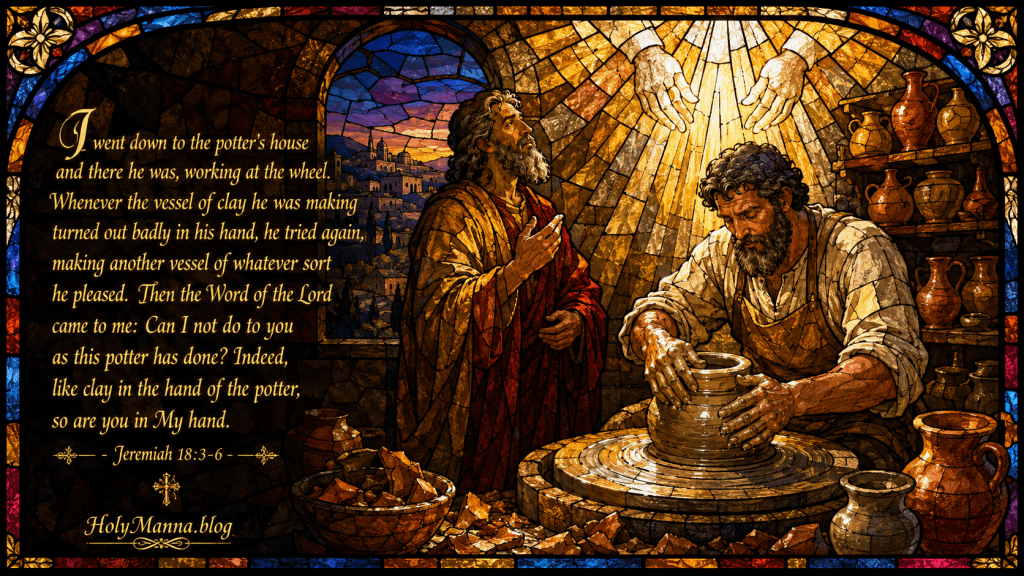
Sometime in the late seventh century before Christ, probably during the reign of King Jehoiakim, God gave Jeremiah one of the strangest homiletic assignments in Scripture: go watch a man work. Pottery workshops in Jerusalem sat in the lower city near water, and the potter’s wheel of that era was a simple machine, two stone wheels joined by an axle, the lower wheel kicked with the foot while the hands worked the clay above. Everyone in Judah had seen one. That is exactly why God chose it. The nation was cracking on the wheel, morally and politically, chasing alliances with Egypt while ignoring the covenant. Rather than sending another thundering oracle, God sent His prophet to an ordinary shop to watch an ordinary craftsman do something extraordinary: refuse to quit on ruined clay. This acted parable sits at the heart of today’s theme, because it reveals the character of the God who holds His people.
Jeremiah 18:1-6New American Bible (Revised Edition)
The Potter’s Vessel. 1 This word came to Jeremiah from the Lord: 2 Arise and go down to the potter’s house; there you will hear my word. 3 I went down to the potter’s house and there he was, working at the wheel. 4 Whenever the vessel of clay he was making turned out badly in his hand, he tried again, making another vessel of whatever sort he pleased. 5 Then the word of the Lord came to me: 6 Can I not do to you, house of Israel, as this potter has done?—oracle of the Lord. Indeed, like clay in the hand of the potter, so are you in my hand, house of Israel.
Detailed Exegesis
Verse 1: “This word came to Jeremiah from the Lord:” The formula signals a formal prophetic oracle. What follows is not Jeremiah’s clever illustration but divine revelation. God initiates; the prophet receives.
Verse 2: “Arise and go down to the potter’s house; there you will hear my word.” Notice that God does not simply speak the word; He stages it. Jeremiah must physically descend to the workshop before the message comes. God often teaches through the concrete and the visible, a pattern that reaches its fullness in the sacraments, where, as the Church teaches, grace comes through material signs. Revelation meets people in workshops, kitchens, and commutes, not only in sanctuaries.
Verse 3: “I went down to the potter’s house and there he was, working at the wheel.” Jeremiah obeys without argument, and the scene he finds is unremarkable: a craftsman at his trade. The Hebrew behind “potter” comes from the same root used in Genesis 2:7, where God “formed” man out of the dust of the ground. The workshop is quietly a window into creation itself.
Verse 4: “Whenever the vessel of clay he was making turned out badly in his hand, he tried again, making another vessel of whatever sort he pleased.” This is the hinge of the entire passage. The vessel fails, but the potter does not discard the clay. He gathers it, presses it down, and begins again. Two truths stand side by side: the potter’s complete sovereignty, since he makes “whatever sort he pleased,” and the potter’s remarkable patience, since he “tried again.” Sovereignty and mercy are not rivals in God; they are the same set of hands.
Verse 5: “Then the word of the Lord came to me:” Only after Jeremiah has watched does the interpreting word arrive. God lets the image do its work first. Contemplation precedes understanding, a rhythm the saints knew well.
Verse 6: “Can I not do to you, house of Israel, as potter has done?—oracle of the Lord. Indeed, like clay in the hand of the potter, so are you in my hand, house of Israel.” The question is rhetorical and the answer is obvious, yet the tone is not menace but invitation. Yes, God holds absolute rights over His people, a point Saint Paul later makes explicitly with this very image in Romans 9:21. But the context defines what those hands intend: this potter has just been seen reworking, not smashing. Judgment remains possible, as the verses following today’s selection make clear, yet the first movement of the divine hands is always toward remaking.
Teachings
The Catechism teaches that creation itself is unfinished business in the hands of God. CCC 302 states, “Creation has its own goodness and proper perfection, but it did not spring forth complete from the hands of the Creator. The universe was created ‘in a state of journeying’ (in statu viae) toward an ultimate perfection yet to be attained, to which God has destined it. We call ‘divine providence’ the dispositions by which God guides his creation toward this perfection.” The collapsed vessel on the wheel is not a failure of the potter; it is a stage of the journey. Providence is God’s ongoing craftsmanship.
No Church Father loved this image more than Saint Irenaeus of Lyons, Doctor of the Church, who wrote in Against Heresies, Book IV, Chapter 39: “For you did not make God, but God you. If, then, you are God’s workmanship, await the hand of your Maker which creates everything in due time; in due time as far as you are concerned, whose creation is being carried out. Offer to Him your heart in a soft and tractable state, and preserve the form in which the Creator has fashioned you, having moisture in yourself, lest, by becoming hardened, you lose the impressions of His fingers.” For Irenaeus, the only thing that can ruin the clay is the clay’s own hardening. Sin dries the soul out; grace keeps it workable. Israel’s own prayer says the same in Isaiah 64:7: “Yet, LORD, you are our father; we are the clay and you our potter: we are all the work of your hand.”
Reflection
The potter’s house is a mirror. Every person has felt like the vessel that “turned out badly,” whether through sin, failure, broken plans, or seasons when life simply collapsed on the wheel. Today’s reading insists that the collapse is not the end of the story, because the clay is still in the hands. Concretely, this looks like returning to the Sacrament of Reconciliation instead of hiding in shame, since confession is the moment of allowing the Potter to press the clay down and begin again. It looks like praying each morning a simple act of surrender, offering God a heart that is, in Irenaeus’s words, soft and tractable. It also looks like patience with the process, since remaking takes time and vessels are not fired in a day.
Where in life does the vessel feel like it has turned out badly, and has that place been surrendered to God or hidden from Him? What habits are hardening the clay, and what one practice this week could keep the heart moist and moldable? Is God being trusted as a potter who remakes, or feared as one who discards?
Responsorial Psalm – Psalm 146:1-6
The Only One Worth Trusting
Psalm 146 opens the grand finale of the entire Psalter, the five Hallelujah psalms that close the book in a rising wave of praise. Jewish tradition wove these psalms into daily morning prayer, which means generations of the faithful, very likely including the Holy Family in Nazareth, began their days with these exact words. The psalm’s placement today is no accident. If Jeremiah has just shown that Israel is clay in the Potter’s hand, the psalmist draws the logical conclusion: stake everything on the Potter and nothing on the pots. In Jeremiah’s era, Judah was doing the opposite, trusting princes, thrones, and Egyptian chariots to save the nation. The psalm names that instinct for what it is, a wager on breath that is about to run out, and redirects all hope to the Maker of heaven and earth.
Psalm 146:1-6 – New American Bible (Revised Edition)
Trust in God the Creator and Redeemer
1 Hallelujah!
2 Praise the Lord, my soul;
I will praise the Lord all my life,
sing praise to my God while I live.3 Put no trust in princes,
in children of Adam powerless to save.
4 Who breathing his last, returns to the earth;
that day all his planning comes to nothing.5 Blessed the one whose help is the God of Jacob,
whose hope is in the Lord, his God,
6 The maker of heaven and earth,
the seas and all that is in them,
Who keeps faith forever,
Detailed Exegesis
Verse 1: “Hallelujah!” One Hebrew word, “praise the Lord,” sets the key signature for everything that follows. Praise is not the conclusion of trust; it is the practice of it.
Verse 2: “Praise the Lord, my soul; I will praise the Lord all my life, sing praise to my God while I live.” The psalmist commands his own soul, which is a striking spiritual move. Praise here is a lifelong resolution rather than a mood, chosen on good days and bad. The saints called this the sacrifice of praise, offered even when feelings lag behind.
Verse 3: “Put no trust in princes, in children of Adam powerless to save.” The phrase “children of Adam” is deliberate. Every ruler, every institution, every impressive human power traces back to the same dust of Genesis 2. The verse does not counsel cynicism toward authority but forbids giving any creature the trust that belongs to the Creator alone.
Verse 4: “Who breathing his last, returns to the earth; that day all his planning comes to nothing.” The Hebrew wordplay is sharp: “Adam” returns to the “adamah,” the ground. The mightiest agenda dies with its author. Placing ultimate hope in mortal saviors means building on a foundation with an expiration date.
Verse 5: “Blessed the one whose help is the God of Jacob, whose hope is in the Lord, his God,” Here is the psalm’s beatitude, the same word Jesus later takes up on the mount. Naming God as “the God of Jacob” recalls a flawed, limping patriarch whom God never abandoned, which is precisely the point. The God of Jacob is the God of unfinished people.
Verse 6: “The maker of heaven and earth, the seas and all that is in them, Who keeps faith forever,” The psalm grounds trust in two facts: God’s power as Creator and God’s fidelity as covenant keeper. The One who made the seas, the very seas into which the Gospel’s net will be thrown, is the One who keeps faith forever. Power without fidelity would be terrifying; fidelity without power would be useless. God alone possesses both.
Teachings
The Catechism draws exactly this conclusion from God’s identity as Creator. CCC 227 teaches that believing in God means “trusting God in every circumstance, even in adversity,” and then offers the prayer of Saint Teresa of Jesus, Doctor of the Church, as the perfect expression of Psalm 146: “Let nothing trouble you / Let nothing frighten you / Everything passes / God never changes / Patience / Obtains all / Whoever has God / Wants for nothing / God alone is enough.” Teresa wrote those lines in an age of political chaos, plague, and upheaval, which makes them less a greeting card and more a battle plan. Judah’s tragedy was refusing this trust; Jeremiah watched his nation mortgage its future to princes who returned to the earth on schedule, exactly as the psalm warned.
Reflection
Modern princes rarely wear crowns. They look like bank accounts, political movements, careers, influencers, and five-year plans, all fine things until they are asked to save. The psalm invites a quiet audit of the heart: whatever produces panic when threatened is probably holding trust that belongs to God. Living this psalm might mean beginning each morning with two minutes of praise before touching a phone, or fasting from news and commentary for a day and giving that time to Scripture, or praying Saint Teresa’s bookmark slowly whenever anxiety about the future rises.
Which “princes” currently hold the heart’s deepest trust, and what would it cost to transfer that trust to God? Does daily life begin with praise or with worry? When was the last time the words “God alone is enough” were prayed and actually meant?
Holy Gospel – Matthew 13:47-53
Every Kind of Fish, One Patient Kingdom
With the parable of the dragnet, Jesus brings the greatest single day of teaching in The Gospel of Matthew to a close. Chapter 13 has piled image upon image, seed and soil, wheat and weeds, mustard seed, leaven, treasure, and pearl, and now the final parable comes straight off the Sea of Galilee. His audience included fishermen who had spent their lives with the seine net He describes, a long net weighted at the bottom and floated at the top, dragged between boats or hauled to shore, gathering absolutely everything in its path. Sorting could only happen afterward on the beach, since the Law of Moses in Leviticus 11 permitted eating only fish with fins and scales. The image completes the day’s theme perfectly: just as the potter works patiently with flawed clay, the Kingdom in its present phase gathers good and bad together, and the separation is not yet, and not ours.
Matthew 13:47-53 – New American Bible (Revised Edition)
47 Again, the kingdom of heaven is like a net thrown into the sea, which collects fish of every kind. 48 When it is full they haul it ashore and sit down to put what is good into buckets. What is bad they throw away. 49 Thus it will be at the end of the age. The angels will go out and separate the wicked from the righteous 50 and throw them into the fiery furnace, where there will be wailing and grinding of teeth.
Treasures New and Old. 51 “Do you understand all these things?” They answered, “Yes.” 52 And he replied, “Then every scribe who has been instructed in the kingdom of heaven is like the head of a household who brings from his storeroom both the new and the old.” 53 When Jesus finished these parables, he went away from there.
Detailed Exegesis
Verse 47: “Again, the kingdom of heaven is like a net thrown into the sea, which collects fish of every kind.” The word “again” links this parable to the whole preceding chain. The sea in Scripture often represents the chaotic mass of the nations, and the net gathers “every kind” without discrimination. The Kingdom’s reach is universal, and its present method is inclusion before evaluation. The Church casts wide.
Verse 48: “When it is full they haul it ashore and sit down to put what is good into buckets. What is bad they throw away.” The sorting is calm, deliberate, and final; the fishermen “sit down,” the posture of judgment in the ancient world. Crucially, no sorting happens in the water. The time of the net is not the time of separation, which restrains every impulse to purge the Kingdom prematurely.
Verse 49: “Thus it will be at the end of the age. The angels will go out and separate the wicked from the righteous” Jesus interprets His own parable and assigns the separating work to angels at the end of the age. The task belongs to no human hands, no matter how zealous. Present duty is fishing, not sorting.
Verse 50: “and throw them into the fiery furnace, where there will be wailing and grinding of teeth.” Jesus repeats the sobering formula from the wheat and weeds parable. The gentle Teacher speaks of hell more directly than anyone else in Scripture, precisely because love warns. Judgment is real, final, and reserved to God.
Verse 51: “‘Do you understand all these things?’ They answered, ‘Yes.’” After seven parables, Jesus checks in on His students, and the disciples answer with perhaps more confidence than they possess, as later chapters reveal. Still, the question shows that Jesus intends His parables to be understood, pondered, and lived, not merely admired.
Verse 52: “And he replied, ‘Then every scribe who has been instructed in the kingdom of heaven is like the head of a household who brings from his storeroom both the new and the old.’” This little saying is the hidden gem of the passage. The disciple formed by the Kingdom becomes a householder with a full storeroom, drawing out the old treasures of the Law and the Prophets alongside the new treasure of Christ, and seeing how the new fulfills the old. Today’s liturgy itself performs this verse, setting Jeremiah’s potter beside Jesus’ net.
Verse 53: “When Jesus finished these parables, he went away from there.” Matthew’s formula closes the discourse. The seed has been sown, the net has been cast, and the Teacher moves on, leaving the words to do their patient work in every listening heart.
Teachings
Saint Augustine, Doctor of the Church, returned to this parable constantly during the Donatist controversy, when a rigorist movement in North Africa demanded a Church purged of sinners immediately. Augustine answered that the Church in history is a mixed body, good and bad fish swimming together in the same net until the shore of eternity, and that demanding purity now usurps the angels’ commission. The Church enshrines this realism in CCC 827, quoting the Second Vatican Council: “Christ, ‘holy, innocent, and undefiled,’ knew nothing of sin, but came only to expiate the sins of the people. The Church, however, clasping sinners to her bosom, at once holy and always in need of purification, follows constantly the path of penance and renewal.” On the judgment itself, CCC 1040 teaches: “The Last Judgment will come when Christ returns in glory. Only the Father knows the day and the hour; only he determines the moment of its coming.” And on the scribe’s treasures, CCC 129 explains the Catholic way of reading Scripture: “Christians therefore read the Old Testament in the light of Christ crucified and risen. Such typological reading discloses the inexhaustible content of the Old Testament; but it must not make us forget that the Old Testament retains its own intrinsic value as Revelation reaffirmed by our Lord himself.”
Reflection
This parable simultaneously humbles and comforts. It humbles because it forbids the favorite modern pastime of sorting people into keepers and throwaways; that job belongs to angels, and the applications are not open. It comforts because the net still holds every struggling, flopping, imperfect fish, and being in the net is grace. Living this Gospel might mean praying for the person in the parish, family, or comment section who seems most like a “bad fish,” rather than writing that person off. It might mean going to confession regularly, taking seriously the reality of judgment without despairing of mercy. And it might mean becoming the scribe of verse 52 by pairing daily Gospel reading with its Old Testament roots, letting the storeroom fill with treasures new and old.
Who has quietly been sorted into the “throw away” pile, and what would praying for that person daily change? Does the reality of the final judgment shape daily choices, or has it faded into background noise? What old treasure of the faith, a psalm, a devotion, a doctrine, is waiting to be brought out of the storeroom?
Still on the Wheel, Still in the Net
Step back and the whole day comes into focus like a finished vessel lifted from the wheel. Jeremiah stood in a dusty workshop and watched a craftsman refuse to give up on collapsed clay, and heard God say, that is how I hold you. The psalmist looked at every impressive human power, watched it return to the earth, and staked his life on the Maker of heaven and earth who keeps faith forever. Then Jesus stood by the sea He had made and described a net gathering every kind of fish, with the sorting reserved for angels at the end of the age, and blessed the disciple who treasures both the old covenant and the new.
Together the readings deliver one liberating message: God is not finished. Not with the world, not with the Church, and not with any single soul reading these words. The vessel that turned out badly is still in His hands. The mixed and messy Church is still His net. The only real danger is the one Saint Irenaeus named, letting the clay dry out, hardening the heart until it no longer takes the impression of His fingers.
So here is the invitation for this Thursday in Ordinary Time. Stay soft. Go back to prayer, go back to confession, go back to the wheel, and let the Potter try again. Transfer trust away from the princes of the age, whatever names they wear, and rest it on the God of Jacob, the God of unfinished people. Praise Him while living, all life long, and leave the sorting to the angels. The wheel is still turning. The net is still in the water. And the hands doing the work have never once dropped the clay.
Engage With Us!
The conversation does not end here, and every reflection shared helps someone else grow. Please share thoughts, questions, and experiences in the comments below, because this community becomes richer every time a reader opens up about how God is working. Here are some questions to spark that reflection:
- In Jeremiah 18:1-6, God compares Israel to clay being reworked on the potter’s wheel. What part of life feels like a vessel that turned out badly, and what would it look like to place it back in the Potter’s hands this week?
- In Psalm 146:1-6, the psalmist warns against trusting princes and blesses the one whose hope is in the Lord. Which modern “princes,” such as money, status, politics, or plans, compete for ultimate trust, and how can praise reorder that trust toward God?
- In Matthew 13:47-53, Jesus describes the Kingdom as a net collecting fish of every kind, with the sorting left to the angels at the end of the age. Is there someone who has been mentally sorted into the “bad fish” pile, and what would change by praying for that person instead?
- Considering all of today’s readings together, where is God still patiently at work on something unfinished in life, and what is one concrete way to stay soft clay in His hands this week?
Living a life of faith does not require being a finished vessel; it requires staying on the wheel. Keep the heart soft, keep hope anchored in the God who keeps faith forever, and go through this day doing everything with the love and mercy Jesus taught us.
Sacred Heart of Jesus, we trust in You!
Immaculate Heart of Mary, pray for us!
Saint Michael the Archangel, defend us in battle!
Follow us on YouTube, TikTok, Instagram and Facebook for more insights and reflections on living a faith-filled life.


Leave a Reply