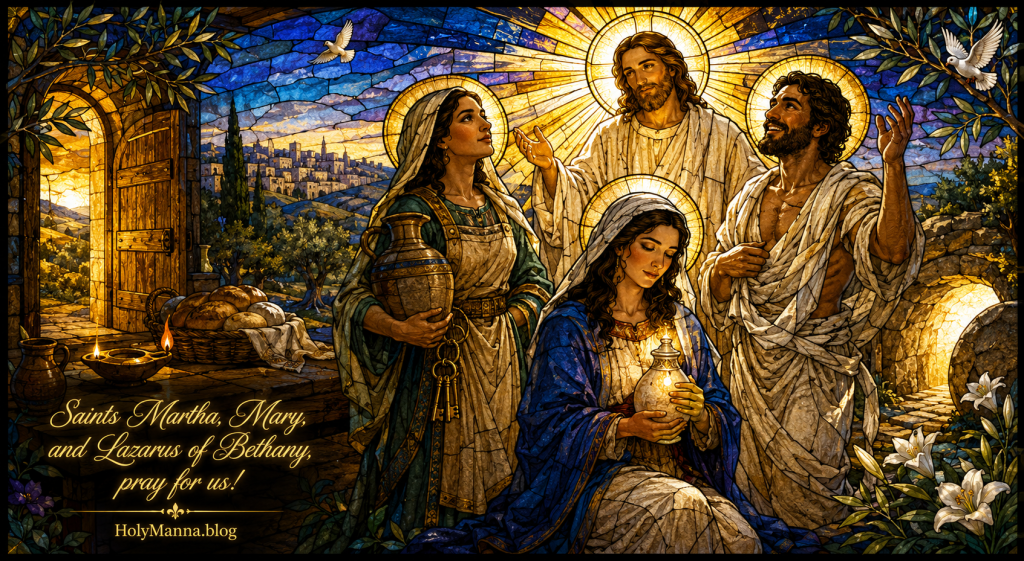
The House Where Jesus Was Always Welcome
Two miles east of Jerusalem, on the far slope of the Mount of Olives, sat a village called Bethany. It was close enough to the holy city to hear its noise and far enough away to escape it. In that village stood a house that holds a singular place in the entire Gospel record, because it is the one house where Jesus of Nazareth was received again and again not as a rabbi to be examined, not as a celebrity to be seen with, but as a friend to be loved. The Gospel of John says it without any hedging: “Now Jesus loved Martha and her sister and Lazarus” (John 11:5). No other household in Scripture receives a sentence like that.
On July 29th the Church celebrates all three of them together: Martha, the sister who served; Mary, the sister who listened; and Lazarus, the brother who walked out of his own tomb. For centuries this date belonged to Martha alone, but in a decree dated January 26, 2021, and published on February 2, 2021, Pope Francis ordered that the memorial be expanded to include her siblings. The Congregation for Divine Worship explained the reason with a lovely economy of words, noting that in the household of Bethany the Lord experienced true family spirit and friendship, and that “Martha generously offered him hospitality, Mary listened attentively to his words”, while Lazarus came forth from death at the command of the Lord of life. The Church honors them together because they belong together; their witness is a household witness, and heaven did not split up the family.
Saint Martha holds a well-documented patronage. She is the patroness of cooks, homemakers, servers and waitstaff, innkeepers and hoteliers, domestic workers, butlers, dietitians, and single laywomen, and she is the patroness of the town of Tarascon in France. Catholic sources also list Saint Lazarus as the patron saint of gravediggers, a patronage with a certain holy humor to it, since no one in history has better reason to trust that a grave is not the end of the story.
A Home in Bethany
Everything historically certain about these three saints comes from the Gospels themselves, and it is worth being honest about that from the start. Scripture gives no birthdates, no parents’ names, and no account of their childhoods. What it gives instead is a portrait of a family, and the portrait is vivid.
They were Jews of Judea, living in Bethany during the public ministry of Jesus. The details of the Gospel accounts suggest a family of some means. Their home was large enough to host Jesus and those traveling with him. In The Gospel of John, a dinner is given in Jesus’ honor with multiple guests reclining at table (Jn 12:2). Mary pours out perfumed oil worth three hundred denarii, roughly a year’s wages for a laborer (Jn 12:5). When Lazarus died, “many of the Jews had come to Martha and Mary to comfort them about their brother” (John 11:19), which hints at a family known and respected well beyond their village. None of this is stated outright as biography; it is reasonable inference from the text, and it should be held as such.
What Scripture does state outright is more important than any genealogy. These three were converted not by a dramatic knockdown moment like Saint Paul’s, but by friendship. At some point Jesus began coming to their house, and they began letting him in. The Gospel of Luke introduces the family this way: “a woman whose name was Martha welcomed him” (Luke 10:38). That verb is the seed of everything that follows. Martha welcomed him. The door opened, the table was set, and a friendship began that would end with a dead man walking out of a tomb and a jar of perfume filling a house on the eve of the Passion.
The Catechism teaches that God “never ceases to draw man to himself” (CCC 27), and the Bethany household shows what that drawing looks like when it happens gently, over shared meals and repeated visits, in the ordinary rhythm of hospitality. Conversion in Bethany was not a lightning strike. It was a door left open.
The Better Part and the Loudest Miracle
Three Gospel scenes carry the whole story, and each sibling gets a turn at the center.
The first scene belongs to Martha and Mary. In Luke 10:38-42, Jesus comes to the house, and the two sisters respond in two different ways. Mary “sat beside the Lord at his feet listening to him speak” (Luke 10:39), taking the posture of a disciple before a rabbi, a posture that in that time and place was rarely offered to women. Martha, meanwhile, is described with a phrase every host recognizes: she was “burdened with much serving” (Luke 10:40). She finally erupts, asking Jesus whether he even cares that her sister has left her to do everything alone, and telling him to order Mary to help. The Lord’s answer is one of the most quoted sentences he ever spoke: “Martha, Martha, you are anxious and worried about many things. There is need of only one thing. Mary has chosen the better part and it will not be taken from her” (Luke 10:41-42).
It is essential to read that answer as affection rather than rebuke. Jesus does not condemn Martha’s service; he names her anxiety. The tradition of the Church has always held the two sisters together rather than against each other. Saint Augustine, preaching on this passage in his Sermon 103 and Sermon 104, taught that Martha’s labor images the Church’s work in this present age, feeding, serving, and tending to Christ in the flesh, while Mary’s stillness anticipates the life of the world to come, where labor ceases and the joy of gazing on the Lord remains forever. Martha’s part is good; Mary’s part is better only because it is the part that never ends. The Catechism describes what Mary was doing at those feet when it defines contemplative prayer, quoting Saint Teresa of Jesus, as “a close sharing between friends” in which the soul takes time frequently to be alone with the God who loves it (CCC 2709). Mary of Bethany is contemplative prayer with a face.
The second scene is the hinge of the whole Gospel of John, and it belongs to all three siblings. In John 11, Lazarus falls gravely ill, and the sisters send Jesus a message of magnificent restraint: “Master, the one you love is ill” (John 11:3). They do not tell him what to do. They simply tell him whom he loves. Jesus, mysteriously, stays where he is for two more days, and by the time he reaches Bethany, Lazarus has been in the tomb four days, past the point where popular Jewish belief held that the soul lingered near the body. Hope, by every human measure, is gone.
Martha goes out to meet him, and what follows is one of the greatest theological exchanges in Scripture. She says, “Lord, if you had been here, my brother would not have died” (John 11:21), a sentence that manages to be both complaint and act of faith at once. Jesus answers her grief with the fifth of his great I AM declarations: “I am the resurrection and the life; whoever believes in me, even if he dies, will live, and everyone who lives and believes in me will never die” (John 11:25-26). Then he asks her directly whether she believes this, and Martha, the busy one, the anxious one, the one remembered for fussing in a kitchen, delivers a confession of faith that stands shoulder to shoulder with Saint Peter’s at Caesarea Philippi: “Yes, Lord. I have come to believe that you are the Messiah, the Son of God, the one who is coming into the world” (John 11:27). The Church’s faith in Jesus as the Christ and Son of the living God is voiced in the Gospels by a fisherman and by a homemaker, and the homemaker said it standing beside an occupied grave.
Mary then comes and falls at his feet, the same feet she loved to sit at, and repeats her sister’s words through tears. And here the Gospel gives its shortest and perhaps most humanly staggering verse: “And Jesus wept” (John 11:35). The Son of God, fully aware of what he is about to do, still weeps at his friend’s tomb, because death is an enemy and grief is real. At the tomb, Jesus prays aloud, “Father, I thank you for having heard me” (John 11:41), and the Catechism holds up this prayer as a model for every believer, because Jesus gives thanks before the gift is given, showing that thanksgiving itself belongs to the confidence of faith (CCC 2604). Then comes the command that echoes through every funeral liturgy the Church has ever prayed: “Lazarus, come out!” (John 11:43). And the dead man came out.
The Catechism is careful and precise about what happened that day. Jesus’ raisings of the dead, including Lazarus, announced and prefigured his own Resurrection, but they were of a different order; Lazarus returned to ordinary earthly life and would die again, whereas Christ’s Resurrection was “not a return to earthly life” but the passage of his humanity into glory (CCC 646; see also CCC 994). Lazarus is not the conqueror of death. He is the living proof of who is.
The third scene, in John 12:1-11, gathers the family one last time, six days before Passover. A dinner is held for Jesus. Martha, true to herself, serves; there is no anxiety mentioned this time, only service. Lazarus reclines at table, a quiet guest whose mere presence is a sermon. And Mary takes a liter of costly aromatic nard, anoints the feet of Jesus, and dries them with her hair, so that “the house was filled with the fragrance of the oil” (John 12:3). When Judas objects to the extravagance, Jesus defends her and links her act to his coming burial. Each sibling, in that one room, shows a complete way of loving Christ: work, witness, and worship.
Grief, Danger, and a Price on a Brother’s Head
None of the three siblings has a verified martyrdom, and this post will not invent one. Their hardships, however, are written plainly in the Gospel, and they are hardships every reader will recognize.
The first hardship was grief. Martha and Mary buried their brother. They sent for the one man who could have prevented it, and he did not come in time. Anyone who has ever prayed hard for a sick loved one and then stood at a graveside knows exactly what those four days felt like. Scripture does not airbrush their pain; both sisters say the same wounded sentence to Jesus’ face, and Jesus does not scold them for it. He weeps with them. The Catechism teaches that in the face of death the Church calls the faithful to hope, because for those who die in Christ’s grace, death is a participation in the death of the Lord that opens onto his Resurrection (CCC 1006, CCC 1010). Bethany is where that teaching was first acted out in real time.
The second hardship was danger, and it fell hardest on Lazarus. His raising was not a private mercy; it was a public event that detonated in Jerusalem. The Gospel of John records that it was precisely this sign that pushed the Sanhedrin into its final resolve against Jesus (Jn 11:45-53). And the danger spilled onto the man who had been raised: “the chief priests plotted to kill Lazarus too, because many of the Jews were turning away and believing in Jesus because of him” (John 12:10-11). Consider the strangeness of Lazarus’ position. He had already died once, and now men were plotting to kill him for the crime of being alive. Simply by existing, by walking through the market and greeting his neighbors, he was unbearable testimony. Lazarus is the patron of every Christian whose life itself, rather than any argument, is what provokes the world.
The third hardship came after the Ascension, and here documented history gives way to tradition, which must be said honestly. Ancient Christian tradition in the East holds that Lazarus was driven out of Judea in the persecution that followed the martyrdom of Saint Stephen, the same persecution described in The Acts of the Apostles (Acts 8:1). According to this tradition he fled to the island of Cyprus, where he was made the first bishop of Kition, the modern city of Larnaca, shepherding the Church there for roughly three decades before dying a second and final death. A related strand of this tradition says that Lazarus rarely smiled for the rest of his earthly life, sobered by what he had seen of death, smiling only once. These accounts are venerable and beloved, but they are traditions rather than documented history, and they cannot be verified.
Whatever the details of their later years, the shape of their hardship is clear from Scripture alone. They loved a Lord who was hunted, they grieved, they were endangered for their association with him, and they kept believing. Martha’s confession was not made in a serene chapel. It was made in the shadow of a tomb, days before her family’s dearest friend would be executed outside Jerusalem. That is what tested faith looks like.
Two Traditions, Many Altars
Scripture does not record how or where any of the three siblings died, and here the Church’s memory divides into two great streams of tradition that cannot both be historically true. Both deserve to be told, and both must be labeled for what they are.
The Eastern tradition, already introduced above, places the end of the story in Cyprus. It holds that Lazarus served as first bishop of Kition and was buried there. In the year 890, a tomb was reportedly discovered in Larnaca bearing the moving inscription “Lazarus, the friend of Christ.” The Byzantine Emperor Leo VI had the relics translated to Constantinople in 898, and in recompense to the island he built the Church of Saint Lazarus over the empty tomb in Larnaca. That church still stands today, one of the oldest on Cyprus, and pilgrims still descend beneath its sanctuary to venerate the marble sarcophagus. Tradition adds that after Crusaders sacked Constantinople in 1204, relics of the saint were carried off toward Marseille and their trail was eventually lost. This entire account rests on tradition and medieval report rather than verifiable history, and it cannot be verified.
The Western tradition, cherished for centuries in Provence in southern France and recorded in a famous thirteenth-century collection of saints’ traditions, tells a very different story. In this account, some years after the Ascension, Martha, Mary, Lazarus, and companions were forced out of Judea by persecutors, placed in a boat without sail, oars, or rudder, and set adrift on the Mediterranean. Guided by God, the boat came ashore at Marseille, and the siblings evangelized the region. Lazarus, in this telling, became the first bishop of Marseille. Martha traveled up the Rhône to the town of Tarascon, where the people were terrorized by a fearsome creature called the Tarasque, part beast and part terror, that lurked in the river and destroyed travelers. The tradition says Martha went out to face it armed with nothing but holy water and a cross, subdued the creature into gentleness, and led it back to town tamed. She then remained in Tarascon, gathering a community of women around her and giving the rest of her life to prayer, fasting, and works of charity until her holy death. It is a story worth loving, not least because it is perfectly in character; the woman who once managed a busy household simply rolled up her sleeves at the town’s biggest problem. But it is a tradition, and it cannot be verified.
What can be verified is the devotion the tradition produced. The Collegiate Church at Tarascon has been dedicated to Saint Martha since at least the ninth century. During a reconstruction in 1187, relics found there were identified as hers and enshrined. In the crypt today stands a late fifteenth-century tomb carved by the sculptor Francesco Laurana at the commission of King René, and the town of Tarascon still celebrates the Fête de la Tarasque every June, a festival so woven into the region’s identity that it has been recognized by UNESCO among the treasures of intangible cultural heritage. Marseille’s ancient churches likewise preserve the memory of Lazarus as their traditional first bishop.
Meanwhile, Bethany itself never forgot its family. The village survives today under the Arabic name al-Eizariya, which means “the place of Lazarus,” and pilgrims have venerated the Tomb of Lazarus there since at least the fourth century. To this day, pilgrims walking the road from Jericho up to Jerusalem can stop where Martha once ran out to meet the Lord and hear John 11 read aloud a few steps from the tomb in question.
Specific miracles attributed to the intercession of these saints after death are not documented in the major sources in the way they are for many later saints; the traditions above, with their discovered tombs and translated relics, form the substance of their posthumous story. Their greatest continuing impact is liturgical and spiritual. The words spoken at Bethany, “I am the resurrection and the life”, are proclaimed at Catholic funerals throughout the world, so that in a real sense every Christian burial passes through Martha’s conversation with Jesus. The Catechism teaches that the saints in heaven “do not cease to intercede with the Father for us” (CCC 956), and generations of cooks, waiters, hotel workers, grieving siblings, and doubting believers have asked this family to do exactly that.
Setting a Place at Your Own Table
The beauty of the Bethany household is that it offers three doors into the same friendship with Christ, and you almost certainly already stand nearer to one of them.
Perhaps you are a Martha. Your love shows up as labor: meals cooked, schedules managed, people cared for, problems handled. The Church needs you desperately, and Jesus never asked Martha to stop serving. He asked her to stop being “anxious and worried about many things” (Luke 10:41). The invitation for you is not less work but more peace within the work, service that flows from time spent with the Lord rather than service that replaces it. Try offering the first five minutes of your workday, before any task, in silence with God. When your serving turns anxious and resentful, what is the one thing you are actually afraid of?
Perhaps you are a Mary. You are drawn to silence, study, Scripture, and the long gaze of prayer. Guard that gift, because the world will call it wasted time just as Judas called the perfumed oil wasted money. But let Bethany also stretch you, because the same Mary who sat in stillness later knelt and served the Lord’s feet with her own hands. Contemplation that never breaks open into generosity has not yet finished its work. The Catechism reminds every soul that contemplative prayer means taking time frequently to be alone with the God who loves us (CCC 2709). Does your prayer ever cost you something, the way Mary’s jar of nard cost her?
And perhaps, in this season, you are Lazarus. Something in you has died: a hope, a marriage, a career, a faith you once had, and you are lying in the dark listening to people grieve for you. The word from Bethany is that Jesus stands outside sealed tombs and calls people by name. He is not repelled by the four days. He is not repelled by the stench the bystanders warned him about. The Church proclaims that Christ has truly conquered death and that whoever believes in him, even if he dies, will live (John 11:25; CCC 994). Bring the dead thing to him honestly, in prayer and above all in the Sacrament of Reconciliation, where his voice still commands life out of tombs. What in your life have you already sealed behind a stone that Jesus is asking you to let him call out?
One practical rule ties all three together: make your home a Bethany. Invite someone to your table this month who needs friendship more than they need impressive hosting. Keep the meal simple so that, unlike that first flustered dinner, the guest gets more attention than the menu. Hospitality was the first thing this family ever gave Jesus, and he counted it as love.
Engage With Us!
The conversation should not end here. Readers are warmly invited to share their thoughts, experiences, and reflections in the comments below; someone else walking the same road may need exactly the words another reader has to offer. The following questions can help start that reflection.
- Are you more naturally a Martha, a Mary, or a Lazarus right now, and what is Jesus saying to the one you are?
- Martha made her great confession of faith standing beside her brother’s tomb. When has your own faith been spoken most clearly in the middle of grief rather than after it?
- Jesus wept at the tomb of a friend he was about to raise. What does that verse teach you about how God regards your sorrow?
- Mary’s gift of perfumed oil looked like waste to Judas and like love to Jesus. What extravagant gift of time, attention, or treasure might God be inviting you to pour out?
- Who could you welcome into your home this month the way the Bethany household welcomed Christ?
However these questions land, take one thing from Bethany today: the Lord is not looking for a perfect host, a perfect contemplative, or a perfect believer. He is looking for an open door. Open it to him in prayer, open it to others at your table, and let every act of service, every quiet moment of listening, and every hope pulled back from the grave be done with the love and mercy that Jesus taught us.
Saint Saints Martha, Mary, and Lazarus, pray for us!
Follow us on YouTube, TikTok, Instagram and Facebook for more insights and reflections on living a faith-filled life.


Leave a comment