The Viking Who Became Norway’s Eternal King
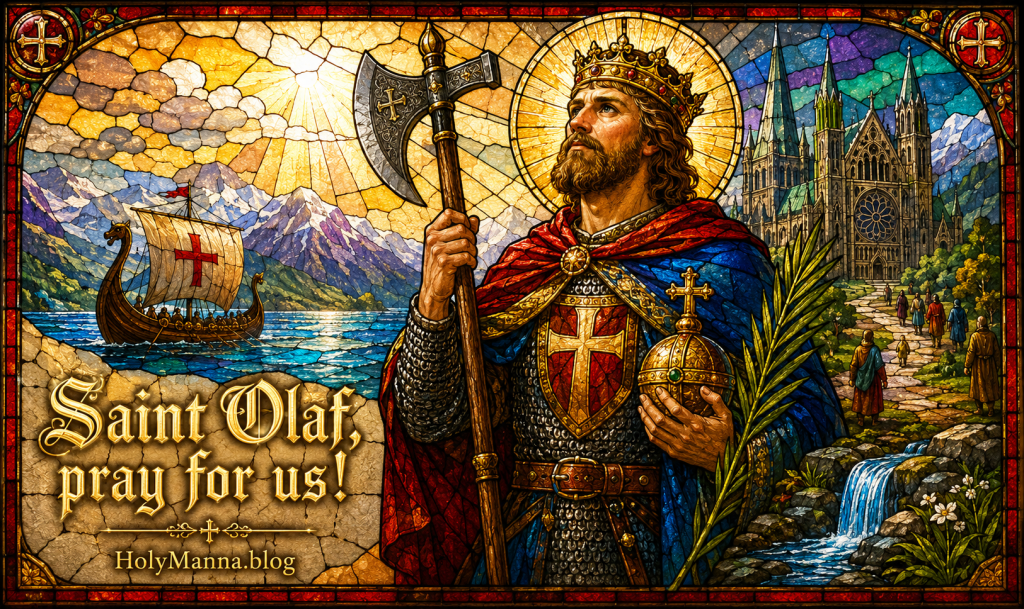
Some saints come to us wrapped in incense and quiet cloisters. Saint Olaf comes to us smelling of salt spray and battle smoke. Olaf II Haraldsson, King of Norway, celebrated on July 29th, was a Viking raider who knelt in the baptismal waters of Rouen and rose to become the man who planted the Catholic faith so deeply in Norwegian soil that a thousand years have not pulled it out. He reigned from 1015 to 1030, died in battle at Stiklestad, and within a single year of his death was being venerated as a martyr, his body found incorrupt, his tomb surrounded by reports of healing. Norway would come to call him Rex Perpetuus Norvegiae, the Eternal King of Norway, and to this day the coat of arms of Norway shows a lion gripping Saint Olaf’s battle axe.
Saint Olaf is the patron saint of Norway and of the Faroe Islands, where his feast, called Ólavsøka, is the national holiday. Catholic reference works also record him as a patron of kings, of carvers, and of those enduring difficult marriages. He is one of that small company of Western saints whose veneration spread before the Great Schism of 1054, so that he is honored in the East as well as in Rome.
Why should a modern reader care about a warrior king who died on a Norwegian hillside a thousand years ago? Because Olaf’s story is the story of every baptized soul writ large: a man of real violence and real ambition who was claimed by Christ, who failed often, who lost everything the world counts as victory, and who won everything heaven counts as glory. The Church teaches that “by canonizing some of the faithful, i.e., by solemnly proclaiming that they practiced heroic virtue and lived in fidelity to God’s grace, the Church recognizes the power of the Spirit of holiness within her and sustains the hope of believers by proposing the saints to them as models and intercessors” (CCC 828). Olaf is proposed to you as exactly that: a model of costly fidelity, and an intercessor who knows what it means to fight, to fall, and to be raised.
From Longship to Living Water
Olaf Haraldsson was born around the year 995, most likely in the Oplandet region of Norway. His father was Harald Grenske, a chieftain and petty king descended from Harald Fairhair, the semi-legendary unifier of Norway. His mother was Åsta Gudbrandsdatter, a woman remembered in the northern accounts as strong-willed and devout in her own way. Olaf never knew his father, who died before or shortly after his birth, and he was raised in the household of his stepfather, Sigurd Syr, a king in Ringerike.
By his early teens, perhaps as young as twelve, Olaf was at sea. The old northern verses, the scaldic poetry composed by court poets during and just after his lifetime, record a youth spent as a Viking: raids along the Baltic, campaigns in Frisia and Spain, and years of fighting in England. Around 1013 he entered the service of the English king Ethelred against the invading Danes. It was in this world, the Christian world of England and Normandy, that the faith began to work on him. The sources tell us that during his years fighting in England he became earnestly interested in Christianity, and the interest ripened into conversion.
Here the historical record requires honesty. The saga tradition, written down by Snorri Sturluson around two centuries later, claims that Olaf was baptized as an infant in Norway in 998, with King Olaf Tryggvason himself standing as sponsor. The older and more careful Catholic scholarship, including the Catholic Encyclopedia, judges it far more probable that Olaf was baptized as a young man at Rouen in Normandy, sometime between about 1010 and 1014, by Archbishop Robert. The two claims cannot both be established, and the Rouen baptism is the better attested. What is beyond dispute is that Olaf entered the Church freely, as a grown warrior who had seen the Christian world and wanted Christ.
Think about what that baptism meant. The Church teaches that “Holy Baptism is the basis of the whole Christian life, the gateway to life in the Spirit, and the door which gives access to the other sacraments” (CCC 1213). A Viking sea king walked through that door. The man who came up out of the water at Rouen was, sacramentally, a new creation, and Olaf seems to have understood it that way. When he sailed home to Norway in 1015 to claim the throne of his ancestors, he did not come merely as a claimant. He came as a missionary with an army.
A Kingdom Built on the Cross
Olaf’s rise was swift. He returned to Norway in 1015, rallied the support of the inland kings, and in 1016 defeated Earl Sweyn at the sea battle of Nesje. For the first time in generations, Norway had a single effective king ruling from the far north to the southern coasts, free of Danish and Swedish overlordship. And Olaf made his purpose unmistakable from the beginning: he sent to England for missionary bishops and priests, chief among them a bishop named Grimkell, and set out to make the Christian religion the foundation of his kingdom.
His greatest and most enduring work was legal and institutional. Around the year 1024, at Moster, Olaf and Bishop Grimkell established a Christian law code for Norway, often counted as the nation’s first national legislation. The Moster Law wove the Church into the fabric of Norwegian life: it protected the observance of Sunday and the feasts, regulated marriage according to Christian norms, outlawed the old pagan practices, and, significantly, forbade the exposure of unwanted infants, a practice the pre-Christian north had tolerated. This law became a model for church law across Scandinavia. Where earlier kings had converted individuals, Olaf converted a legal order. He understood instinctively what the Church teaches, that society itself owes worship to God and that the faith is not a private hobby but a public foundation (CCC 2105).
Honesty also requires saying this plainly: Olaf’s methods were often those of his age and of his upbringing, which is to say they were harsh. The sources do not hide that he could be severe with those who clung to the old gods, that he destroyed pagan shrines, and that the sternness of his rule made him enemies among the chieftains. The Church does not canonize a man because every act of his life was perfect. She canonizes him because grace triumphed in him, because his fundamental orientation was toward Christ, and because his death sealed his witness. Olaf was a sinner being sanctified, exactly like every reader of this post, and the roughness of the raw material only magnifies what God accomplished.
As for miracles during his lifetime, the historical and saga sources center Olaf’s wonders after his death rather than before it. The traditions do describe him during life as a generous almsgiver, a man who kept priests close, prayed before battle, and had a particular devotion to hearing Mass. One tradition tells that on the morning of his final battle he gave money for Masses to be offered for the souls of the very enemies who were marching to kill him, saying that his friends who fell would need no such prayers, for they would be with God. That story comes from the saga tradition written long afterward, and it cannot be verified. But it captures precisely the shape of the man the earliest venerators believed him to be.
Stiklestad: The Defeat That Heaven Counted as Victory
By 1028 the storm broke. King Canute the Great of Denmark and England, the most powerful ruler in the northern world, had spent years buying the loyalty of Norwegian chieftains with silver and promises, and Olaf’s severity had given the bribes fertile ground. When Canute’s fleet arrived, Olaf’s support collapsed. He fled east with his young son Magnus, through Sweden and across the Baltic, to the court of Grand Prince Yaroslav the Wise in Kievan Rus, whose wife was kin to Olaf’s own queen, Astrid of Sweden.
Exile is its own martyrdom of the heart. The saga tradition describes Olaf in Russia wrestling with whether to abandon his crown entirely, perhaps even to enter monastic life or journey to Jerusalem, until a dream vision urged him to return to the kingdom God had given him. That account of the dream comes from the sagas and cannot be verified. What history records with confidence is the decision itself: in 1030, hearing that the Danish regent had died, Olaf marched west with a small army, over the mountains from Sweden into the Trondheim country, knowing full well that a far larger army of Norwegian farmers and chieftains, backed by Canute’s gold, was gathering against him.
The two forces met at the farm of Stiklestad on July 29, 1030. The saga tradition, written by Snorri Sturluson some two centuries later, gives Olaf’s men a battle cry that has echoed through Norwegian memory ever since: “Forward, forward, men of Christ, men of the cross, men of the king!” That cry is saga tradition rather than verified quotation, and it should be received as such, but it faithfully expresses how the earliest generations understood the battle: not merely a contest for a throne, but a collision between the old world and the Kingdom of God. One further historical note belongs here. The sagas describe the sun darkening during the fighting, and astronomers have identified a solar eclipse over that region on August 31, 1030, which leads some modern historians to debate the traditional date. The Church’s liturgical memory holds firmly to July 29th.
Olaf fell in the thick of the fighting, struck down, according to the tradition, by three wounds, the last driven in as he leaned against a great stone. He was about thirty-five years old. By every worldly measure he died a failure: a deposed king, defeated by his own people, his cause apparently extinguished. But the Lord Himself taught, “For whoever would save his life will lose it, and whoever loses his life for my sake will find it” (The Gospel of Matthew, Mt 16:25). The Church has always titled Olaf a martyr, king and martyr, because he was killed in consequence of his fight to establish and defend the Christian faith in Norway. The Catechism teaches that “martyrdom is the supreme witness given to the truth of the faith: it means bearing witness even unto death” (CCC 2473). At Stiklestad, the witness was given.
And then God began to answer.
The Incorrupt King of the North
The first stirrings came almost immediately. The traditions attached to the battlefield tell that a blind man received his sight when Olaf’s blood touched his eyes, and that even Thorir the Hound, one of the men who had dealt the king his death wounds, found a wound of his own healed by the same blood and was so shaken that he later left Norway on pilgrimage to Jerusalem. Tradition also tells of a strange light seen glowing over the place where the king’s body lay hidden. These stories come to us through the sagas and the early accounts of the shrine, and they cannot be independently verified; they are told here as the traditions they are. What can be verified is their effect. Within months, the men who had killed their king began to speak of him as a saint.
Olaf’s body had been smuggled away by friends and buried secretly in a sandbank by the river Nid, at the little trading town of Nidaros, now Trondheim. The year that followed his death turned Norway’s heart. Canute’s promised rewards became punitive taxes, Danish officials took the best positions, harvests failed, and the men who had fought against Olaf at Stiklestad began to remember him differently. Bishop Grimkell, Olaf’s own English bishop, returned to Nidaros.
On August 3, 1031, one year and five days after the battle, Grimkell had the grave opened before witnesses. What they found became the founding fact of the cult of Saint Olaf. Snorri’s Heimskringla, drawing on the earlier tradition, records the scene: there was “a delightful and fresh smell,” and the king’s “cheeks were as red as if he had but just fallen asleep,” while those who had seen him fall remarked that “his hair and nails had grown as much as if he had lived on the earth all the time that had passed since his fall.” The wording is the saga’s, set down long after; the event itself, the exhumation and the finding of the body incorrupt, is attested across the early sources. Grimkell declared Olaf a saint, in the manner of episcopal canonization normal to that age, and the body was enshrined above the high altar of Saint Clement’s church, a church Olaf himself had built only a few years before. The Church would later formalize her processes, but the substance is the same reality the Catechism describes in CCC 828: the recognition of the Spirit’s power in a life of heroic fidelity. In 1164, Pope Alexander III confirmed Olaf’s sainthood for the universal Church.
The miracles multiplied. Tradition tells that a healing spring welled up at the spot on the riverbank where the body had lain hidden, and that its waters cured the sick; the tradition of that spring endured at Nidaros for centuries. An early account of the shrine reports simply, “a multitude of lame and blind and other sick who came to the holy Olaf went back cured.” These healing accounts belong to the medieval miracle collections and cannot be individually verified today, and they are presented here as the traditions the Church of that age received and treasured.
What no one can dispute is the sheer scale of what followed. Over Olaf’s grave rose Nidaros Cathedral, the northernmost of the great medieval cathedrals of Europe and the most important pilgrimage destination in all of Scandinavia. Pilgrims walked to the shrine of the holy king from across the northern world, along routes still walked today as the Saint Olav’s Way. His cult spread through Norway, Denmark, Sweden, Finland, Iceland, and England; London still has a Saint Olave’s Church on Hart Street dedicated to the martyred king of Norway. His son Magnus returned from Russia to a Norway that now rallied around the memory of the father it had killed, and the nation emerged united, independent, and Christian. Olaf was proclaimed Rex Perpetuus Norvegiae, the Eternal King of Norway, the true and permanent sovereign whom every later king merely represented. His axe entered the national coat of arms, where it remains. His feast, Olsok, July 29th, is still marked in Norway, and in the Faroe Islands Ólavsøka is the national holiday itself.
One sorrowful chapter completes the story. At the Reformation, Olaf’s great silver shrine was seized and destroyed, and in 1568 Danish authorities, seeking to end the stubborn Catholic veneration that would not die, buried the saint’s body in an unmarked grave somewhere within Nidaros Cathedral and concealed the spot. The exact location of Saint Olaf’s remains has been lost ever since. The Eternal King of Norway sleeps hidden in his own cathedral, awaiting the resurrection he died believing in. And yet the pilgrims still come. The Catechism reminds us why the saints hold such power over living hearts: “their intercession is their most exalted service to God’s plan. We can and should ask them to intercede for us and for the whole world” (CCC 2683).
What a Viking King Teaches a Modern Believer
It would be easy to file Saint Olaf away as a colorful piece of medieval history, all longships and battle axes, with nothing to say to a person navigating a commute, a mortgage, and a phone full of notifications. That would be a mistake. Olaf’s life presses on the modern soul at three very tender points.
First, conversion is for the unlikely. Olaf was not raised in piety and did not drift gently into faith. He was a professional raider, formed from boyhood in a culture of plunder, and Christ claimed him anyway. If you have ever quietly believed that your past disqualifies you, that you are too compromised, too rough, too far gone for holiness, Olaf stands against that lie with an axe in his hand. The Lord said, “Truly, truly, I say to you, unless a grain of wheat falls into the earth and dies, it remains alone; but if it dies, it bears much fruit” (The Gospel of John, Jn 12:24). The old Olaf had to die in the waters of Rouen for the saint to be born. What in your own life is God asking you to let fall into the earth and die, so that something greater can grow?
Second, conversion is a long road walked daily, not a single moment. Olaf came up from baptism a Christian and remained, for years, a work in progress: impatient, severe, capable of real harshness even in the service of a good cause. The Church teaches that “conversion is accomplished in daily life by gestures of reconciliation, concern for the poor, the exercise and defense of justice and right, by the admission of faults to one’s brethren” (CCC 1435). Sanctity was being forged in Olaf through failure, exile, and loss, right up to the hour of his death. That should be enormous consolation. Your spiritual life is not ruined because it is uneven. Where have you mistaken slow growth for failure, in yourself or in someone you love?
Third, fidelity matters more than success. Olaf lost. He lost his throne, lost his country, lost the battle, lost his life. Every metric his culture used to measure a king declared him finished. And it was precisely that loss, offered in fidelity to Christ, that God transformed into the spiritual foundation of a nation. There is a word here for everyone whose faithfulness has not been rewarded on the world’s schedule: the parent whose prayers for a child seem unanswered, the worker whose integrity costs a promotion, the young Catholic mocked for taking the faith seriously. Saint Paul’s cry fits the king of Norway and fits you: “I have fought the good fight, I have finished the race, I have kept the faith” (The Second Letter to Timothy, 2 Tim 4:7). If you knew that faithfulness would cost you the outcome you want most, would you still choose it?
Practically, let Olaf shape one ordinary week. Guard Sunday the way his law guarded it, as a day genuinely set apart for God and for rest. Choose one habitual harshness, one sharp edge in how you speak to a spouse, a coworker, or a stranger online, and deliberately blunt it, letting grace do in you what it was still doing in Olaf. And pray for your country, by name and without cynicism, as a man once prayed for Norway; the Church has never stopped teaching that nations, and not only individuals, are called to Christ.
Engage With Us!
Saint Olaf’s story has been told for a thousand years around northern fires, in cathedral processions, and along pilgrim roads. Now it is your turn to carry it. Share your thoughts and reflections in the comments below; this community grows stronger every time one reader tells another what God is doing in an ordinary life.
- Saint Olaf was converted as an adult, after years of living far from God. What moment or season in your own life most changed the direction of your faith?
- Olaf’s holiness grew alongside his flaws, and God did not wait for him to be perfect before using him. Where might God be asking to use you exactly as you are right now?
- At Stiklestad, Olaf’s earthly defeat became heaven’s victory. What loss in your life might God be inviting you to surrender so He can transform it?
- Pilgrims still walk hundreds of miles to Nidaros to honor Saint Olaf. What would a small daily pilgrimage toward Christ look like in your ordinary routine this week?
However this post finds you, whether your faith feels like a fortress or a flickering candle, remember that the Eternal King of Norway began as a raider on a longship and ended as a saint at God’s throne, and the same grace that carried him is offered to you. Live this day with courage, hold fast when fidelity costs you something, and do everything, in the home and in the world, with the love and mercy that Jesus taught us.
Saint Olaf, pray for us!
Follow us on YouTube, TikTok, Instagram and Facebook for more insights and reflections on living a faith-filled life.


Leave a Reply