When the Church First Learned to Serve Tables
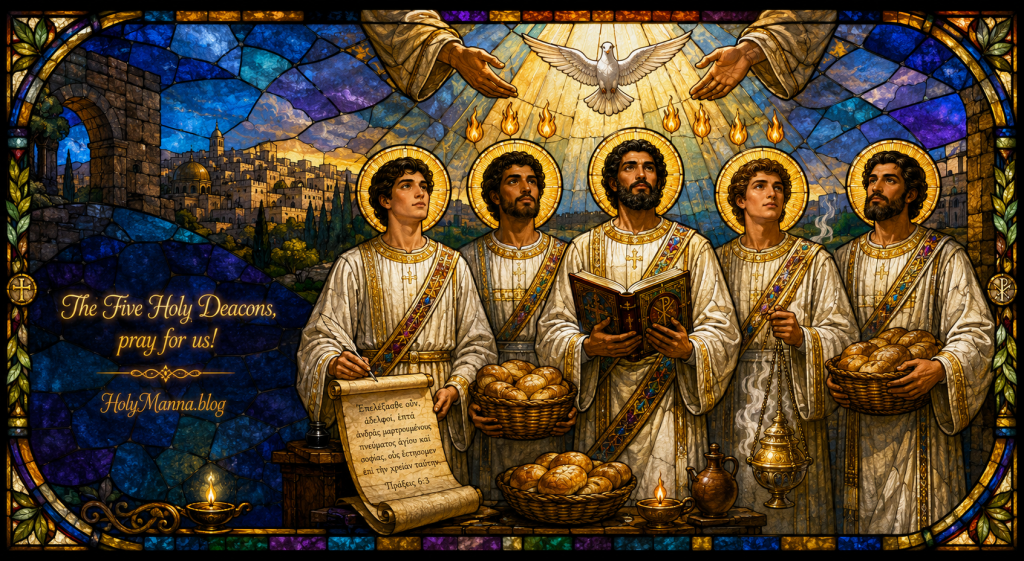
On July 28th, the Church turns her memory toward five men whose names most Catholics have read aloud at Mass without ever pausing on them: Prochorus, Nicanor, Timon, Parmenas, and Nicholas of Antioch. They appear exactly once in Scripture, in a single verse of Acts 6, standing shoulder to shoulder with two far more famous companions, Stephen and Philip. Together these seven men were chosen by the apostles and the whole community of Jerusalem to become the first deacons of the Christian Church. Stephen went on to become the first martyr, and the Church honors him on December 26th. Philip went on to evangelize Samaria and baptize the Ethiopian court official, and he too has his own commemoration. The remaining five received no recorded sermons, no recorded miracles, and no recorded deaths in the pages of the New Testament. They simply served.
That is precisely why they matter. The Church has never believed that holiness requires a spotlight. The Catechism of the Catholic Church teaches that at the lower level of the hierarchy are found deacons, upon whom hands are imposed, in the words of the Second Vatican Council quoted there, “not unto the priesthood, but unto the ministry” (CCC 1569). Every deacon who has ever carried the Book of the Gospels in procession, every deacon who has ever brought Communion to a homebound widow, stands in a line that begins with these seven men, and five of them are remembered together on this day. Their feast is not a celebration of achievement as the world counts achievement. It is a celebration of diakonia, the Greek word for service, which the Church has treasured from her very first days.
Greek Names in a Hebrew City
To understand who these five men were, the story has to begin with a family argument inside the very first Christian community. Acts 6:1 reports that as the number of disciples grew in Jerusalem, a complaint arose from the Hellenists against the Hebrews. The Hellenists were Greek-speaking Jewish Christians, many of them from communities scattered across the Roman world, and their widows were being overlooked in the daily distribution of food. The Hebrews were the Aramaic-speaking believers native to the Holy Land. The infant Church, only a few years old, was already facing the temptation that has threatened every parish since: the temptation to let culture and language divide the one Body of Christ.
The Twelve responded with striking humility. They gathered the community and said, as Acts 6:2 records it, “It is not reason that we should leave the word of God, and serve tables.” This was not disdain for the work of charity; it was an honest recognition that the apostles could not do everything, and that the care of the poor deserved dedicated men rather than distracted ones. So they instructed the community, in the words of Acts 6:3, to “look ye out among you seven men of good reputation, full of the Holy Ghost and wisdom” to be appointed over this task. The proposal pleased everyone, and the community chose Stephen, Philip, Prochorus, Nicanor, Timon, Parmenas, and Nicholas.
Here the text offers a detail that is easy to miss and beautiful to notice. All seven men bear Greek names. The Church has traditionally understood this to mean that the community deliberately chose Hellenists to care for the neglected Hellenist widows. The wounded party was not merely compensated; it was entrusted with leadership. The early Church answered division by giving responsibility to the very group that had been overlooked.
Scripture tells us the origin of only one of the five. Acts 6:5 identifies the last man as “Nicolas, a proselyte of Antioch.” A proselyte was a Gentile who had fully converted to Judaism before coming to faith in Christ. That single phrase makes Nicholas a remarkable figure: a man who crossed from paganism into Judaism, and then from Judaism into the Church, decades before the Council of Jerusalem would settle how Gentiles belonged in the community at all. Of Prochorus, Nicanor, Timon, and Parmenas, Scripture records no birthplace, no family, and no history before that day. Their conversion stories are known to God alone. What is documented is the moment of their ordination: the community presented the seven to the apostles, and, as Acts 6:6 says, “praying, they imposed hands upon them.” This laying on of hands with prayer is the seed of what the Church would come to know as the Sacrament of Holy Orders in its diaconal degree, and the fruit was immediate. Acts 6:7 reports that “the word of the Lord increased; and the number of the disciples was multiplied in Jerusalem exceedingly.”
The Miracle of the Daily Distribution
It is tempting to rush past the actual ministry these men performed, because on the surface it looks so ordinary. They organized food for widows. They kept lists, carried baskets, visited homes, and made sure that no grieving woman went hungry because she prayed in the wrong language. Scripture attributes recorded signs and wonders to Stephen and later to Philip, but it attributes none to the other five. Their recorded miracle, if it can be called that, is that the complaining stopped and the Church grew.
Yet the Church has always insisted that this hidden work is itself a participation in the mission of Christ. The Catechism teaches that deacons share in Christ’s mission and grace in a special way, and that the sacrament of Holy Orders marks them with an imprint, a character, which configures them to Christ who made himself the servant of all; it names their service as the diakonia of the liturgy, of the Gospel, and of works of charity (CCC 1570). The Catechism likewise teaches that the works of mercy, among them feeding the hungry, are charitable actions by which we come to the aid of our neighbor in his bodily and spiritual necessities (CCC 2447). The Five Holy Deacons were doing catechism before the Catechism existed. They were living proof that the Gospel is preached with bread as well as with words.
The generation immediately after the apostles understood this clearly. The Didache, the earliest surviving manual of Church life, instructs the faithful, “Appoint, therefore, for yourselves, bishops and deacons worthy of the Lord.” Saint Ignatius of Antioch, writing around the year 107 while being led to his own martyrdom, insisted in his Letter to the Trallians that deacons are “not the ministers of meat and drink, but servants of the Church of God,” and in the same letter he urged, “let all reverence the deacons as an appointment of Jesus Christ.” When Ignatius wrote those words, some of the original seven may have died within living memory. The reverence he demanded for deacons is the Church’s earliest commentary on the dignity of the men chosen in Acts 6.
Later tradition, preserved chiefly in the Byzantine East, fills in the silence of Scripture with accounts of where the five went after Jerusalem. Tradition holds that Prochorus first accompanied the Apostle Peter, who consecrated him bishop of Nicomedia in Asia Minor, and that he later became the companion and coworker of the Apostle John, sharing John’s exile on the island of Patmos and writing down the Book of Revelation as John dictated it. This account comes from a much later text attributed to Prochorus rather than from any contemporary record, and it cannot be verified. Tradition likewise holds that Timon was appointed bishop of Bostra in Arabia and that God granted him gifts of healing and of driving out evil spirits as he preached the Gospel there. This too rests on later tradition and cannot be verified. Tradition says that Parmenas preached Christ zealously in Asia Minor and Macedonia. This also cannot be verified. These stories are told here as the traditions they are, not as established history, yet even as traditions they testify to something true: the Church of the early centuries could not imagine that men chosen by the apostles and filled with the Holy Spirit simply went home. She assumed they burned themselves out for Christ, because that is what such men do.
Stones, Fire, and a Borrowed Shame
The Five Holy Deacons were ordained into a Church that was about to bleed. Within a short time of their appointment, their brother deacon Stephen was dragged before the Sanhedrin and stoned to death, and Acts 8:1 records that a great persecution broke out against the Church in Jerusalem that very day. Whatever else is uncertain about these five men, this much is certain: they served Christ in an age when doing so could cost everything, and they did not walk away.
Tradition supplies accounts of what that cost looked like for each of them, and honesty requires saying plainly which accounts conflict and that none can be verified. One ancient tradition holds that Nicanor suffered in Jerusalem on the very day Stephen was stoned, and that some two hundred other believers were killed alongside them in the fury that followed. A different tradition places Nicanor’s death many years later, around the year 76, on the island of Cyprus. These two accounts cannot both be true, and neither can be verified. The Church honors him in the Roman Martyrology on January 10th, but she does not pretend to know the details of his end.
For Timon, tradition tells a dramatic story: that pagans in Arabia, enraged by his preaching, threw him into a furnace, and that by the power of God he walked out unharmed. The tradition of the Roman Church then says he was crucified for Christ, while another telling says the fire itself finally took his life. It is a story of divine protection followed by ultimate surrender, and it cannot be verified. The Western Church remembers him on April 19th as a martyr, while acknowledging that nothing further about him is known with certainty.
For Prochorus, tradition holds that after his years of preaching in Nicomedia he was killed by unbelievers in Antioch. This account cannot be verified. For Parmenas, the traditions divide gently rather than violently: one very old account says he died in peace before the eyes of the apostles themselves, who mourned him and buried him, while another says he was martyred at Philippi in Macedonia. Because these accounts conflict and cannot be verified, the Church does not assert his martyrdom as fact; the West remembers him on January 23rd simply as a holy servant of the first generation.
Then there is Nicholas of Antioch, whose hardship was of a different kind altogether, and it deserves to be told carefully. In the Book of Revelation, the risen Christ condemns a sect called the Nicolaitans (Rev 2:6, 2:15), and from the second century onward some Church Fathers connected that sect to the deacon Nicholas. Saint Irenaeus wrote in Against Heresies that the Nicolaitans lead “lives of unrestrained indulgence,” and Hippolytus went further, naming the deacon Nicholas as the author of the heresy. But other Fathers rose to his defense. Clement of Alexandria, in his Stromata, exonerated Nicholas entirely, arguing that the sect had maliciously twisted words of his that were harmless in themselves, and Clement preserved the tradition that Nicholas lived chastely and raised his children in purity. The historian Eusebius agreed, suggesting that the heretics attached the name of an apostolic deacon to their movement precisely to borrow credibility they did not deserve. The Catholic Encyclopedia concludes soberly that there is little certainty about the sect and its supposed connection to the deacon. This is why the Byzantine calendar commemorates only four deacons on July 28th and does not number Nicholas among the saints, while Catholic treatments of this feast have honored all five together. The judgment of history against Nicholas was never unanimous, and the strongest early testimony in his favor comes from Fathers of unquestioned orthodoxy. If Clement and Eusebius are right, then Nicholas endured one of the strangest sufferings a Christian can face: to serve faithfully and have his name stolen by sin. Every believer who has been slandered, misquoted, or blamed for the failures of others has a quiet companion in him.
Four Calendar Dates and a Cave on Patmos
No documented miracles are attributed to the Five Holy Deacons after their deaths in Catholic sources, and no shrine claims their relics with historical confidence. Their afterlife in the Church’s memory has taken a humbler and, in its way, a more durable form: the calendar, the icon, and the diaconate itself.
The Church has never let their names fall out of her official memory. The Roman Martyrology commemorates Nicanor on January 10th, Parmenas on January 23rd, and Timon on April 19th, while the Byzantine tradition, shared by Eastern Catholics, gathers Prochorus, Nicanor, Timon, and Parmenas into a single synaxis on July 28th. For men about whom almost nothing can be proven, this is remarkable. The Church does not require a documented resume to keep a servant’s name alive; she requires only that the apostles once laid hands on him.
Their most vivid legacy in sacred art belongs to Prochorus. Because of the tradition that he wrote down the Book of Revelation at John’s dictation, Eastern iconography for more than a thousand years has painted a scene beloved by pilgrims: the aged Apostle John standing in the cave of Patmos, his eyes lifted toward heaven, while young Prochorus sits at his feet with pen and parchment, catching the words as they fall. Pilgrims who visit the Cave of the Apocalypse on Patmos today still encounter this image, and through it a deacon who left no writings of his own became the Church’s picture of every soul that faithfully receives and transmits the Word. In the West, Blessed Fra Angelico painted the seven deacons in the frescoes of the Niccoline Chapel in the Vatican, kneeling around Stephen at the moment of ordination, so that the popes themselves have prayed for centuries beneath the faces of these five quiet men.
Their deepest impact, though, is neither a painting nor a date. It is the order of deacons itself. The Catechism teaches that since the Second Vatican Council the Latin Church has restored the diaconate as a proper and permanent rank of the hierarchy, so that married men may be ordained to this ministry of the liturgy, the Word, and charity (CCC 1571). Every one of the tens of thousands of permanent deacons serving parishes today, baptizing infants, preaching homilies, feeding the poor, is the living posterity of Acts 6. The Church also teaches that the saints in heaven do not cease to intercede for those on earth, but constantly present to the Father the merits they acquired through Christ (CCC 956), and that our communion with them joins us to Christ himself (CCC 957). The Five Holy Deacons, hidden in life, remain active in that communion still.
The Holiness of Being Overlooked
There is something almost providential in how little is known about these five men, because their obscurity is itself the lesson. Jesus told his disciples plainly, in The Gospel of Mark, that “the Son of man also is not come to be ministered unto, but to minister” (Mark 10:45). The Five Holy Deacons took him at his word so completely that they disappeared into their service. Scripture praises them once, records their ordination, and moves on, and they seem never to have demanded more. Saint Paul would later promise in his first letter to Timothy that “they that have ministered well, shall purchase to themselves a good degree” (1 Tim 3:13), and the Church’s twenty centuries of remembering these men is the down payment on that promise.
Most people will live lives closer to Prochorus than to Stephen. Most acts of Christian love will never be recorded anywhere except in the Book of Life. The parent who packs lunches at six in the morning, the parishioner who quietly stocks the food pantry, the coworker who covers a shift for someone in crisis, all of them are serving tables, and Acts 6 insists that serving tables is worthy of the laying on of apostolic hands. The five deacons also model how a community heals division: not by winning arguments, but by handing responsibility and trust to the overlooked. And Nicholas, if the defense of Clement of Alexandria is believed, models something harder still, the patience of a man whose reputation was taken from him and who has waited on God’s justice for two thousand years.
Where in your own life are you being asked to serve without recognition, and can you accept that hiddenness as a gift rather than an insult? When division appears in your parish, your family, or your workplace, do you respond the way the apostles did, by empowering the wounded party, or do you simply take sides? Is there someone whose reputation you have helped to bury, fairly or unfairly, for whom you could pray tonight?
Practically, this feast invites three small commitments. First, perform one hidden act of service this week and tell no one, letting the Father who sees in secret be the only witness. Second, thank a deacon by name, since the men of Acts 6 have successors in nearly every parish who rarely hear gratitude. Third, examine one grudge or one piece of gossip that lives in the heart, and hand it to God in confession or in prayer, remembering how long a stolen reputation can outlive the theft.
Engage With Us!
HolyManna.blog would love to hear from you. Share your thoughts and reflections on the Five Holy Deacons in the comments below, and consider these questions as a starting point for prayer and discussion.
- Which of the five deacons speaks most to your own season of life right now, and why?
- What is one concrete, hidden act of service you can commit to this week without seeking any credit for it?
- The apostles healed division by entrusting leadership to the overlooked Hellenists. Where could you extend trust to someone who has been overlooked in your own community?
- How does the witness of Nicholas of Antioch, defended by Clement of Alexandria against a borrowed shame, change the way you think about reputation, gossip, and judgment?
- If the Church remembered your name for only one sentence, the way Acts remembers these men, what would you want that sentence to say?
The Five Holy Deacons remind every believer that the Kingdom of God is built mostly in the dark, by people whose names the world forgets and heaven treasures. May you serve this week the way they served, quietly, faithfully, and without counting the cost, and may everything you do be done with the love and mercy that Jesus taught us.
The Five Holy Deacons, pray for us!
Follow us on YouTube, TikTok, Instagram and Facebook for more insights and reflections on living a faith-filled life.


Leave a Reply