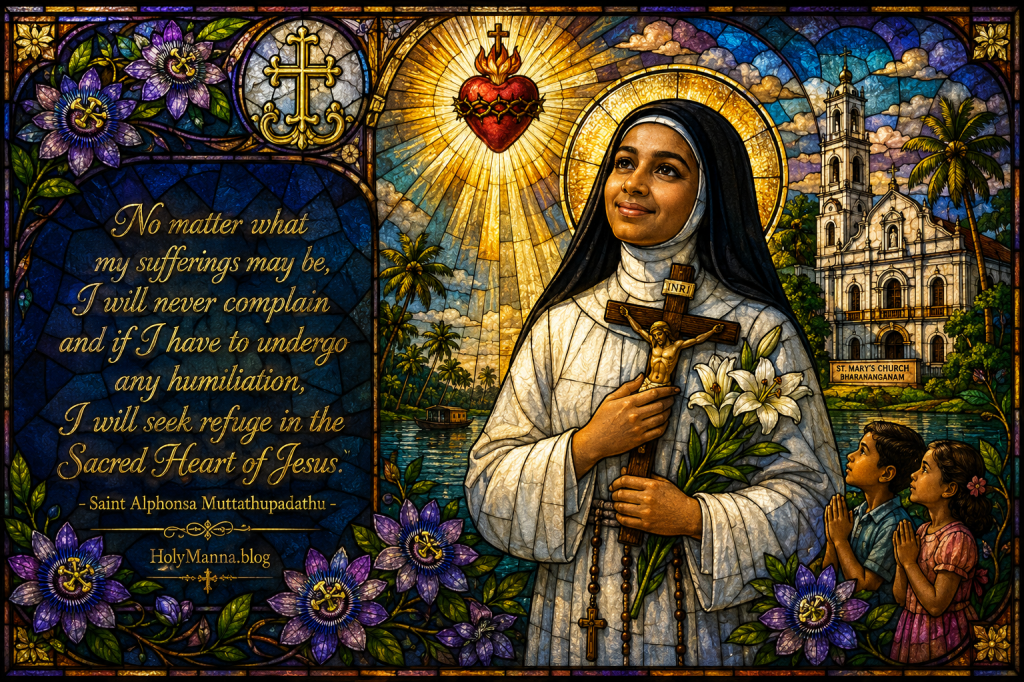
The Passion Flower of India
Some saints conquer the world with cathedrals, crusades, and universities. Saint Alphonsa Muttathupadathu conquered it from a sickbed in a small convent in Kerala, India, and most of the world never heard her name until after she died. She was a Franciscan Clarist nun of the Syro-Malabar Catholic Church, one of the ancient Eastern Catholic Churches in full communion with Rome, tracing its roots to the apostolic preaching of Saint Thomas in India. She lived only thirty-five years, from 1910 to 1946, and nearly all of them were marked by loss, rejection, and relentless physical suffering. Yet on October 12, 2008, Pope Benedict XVI raised her to the altars of the universal Church, making her the first woman of Indian origin ever canonized and the first canonized saint of the Syro-Malabar Church.
At her canonization, the Holy Father opened with the prophet Isaiah and applied the promise directly to her: “He will swallow up death for ever, and the Lord God will wipe away tears from all faces. These words of the prophet Isaiah contain the promise which sustained Alphonsa of the Immaculate Conception through a life of extreme physical and spiritual suffering.” He went on to call her “this exceptional woman, who today is offered to the people of India as their first canonized saint,” and said she “was convinced that her cross was the very means of reaching the heavenly banquet prepared for her by the Father.”
That single sentence is the key to her entire life. The Catechism teaches that suffering, united to the Passion of Christ, is transformed: “Suffering, a consequence of original sin, acquires a new meaning; it becomes a participation in the saving work of Jesus” (CCC 1521). Alphonsa did not merely endure that teaching. She lived it so completely that the Church now points to her as proof that it is true. Her story matters for anyone who has ever asked why God allows pain, and it matters especially for anyone who has ever felt that their own life is too small, too hidden, or too broken to become holy.
A Snake, a Premature Birth, and a Grandmother’s Prayers
Anna Muttathupadathu was born on August 19, 1910, in Kudamalur, in the Arpookara region of what was then the princely state of Travancore, today the state of Kerala in southwest India. She came from the ancient and noble Muttathupadathu family, deeply rooted in the Saint Thomas Christian community. According to the official Vatican biography prepared for her canonization, her very birth was marked by the cross. Her mother, Maria Puthukari, was so frightened when a snake wrapped itself around her waist during sleep that she gave birth prematurely, in the eighth month of pregnancy. Eight days later, on August 28, the fragile infant was baptized in the Syro-Malabar rite by Father Joseph Chackalayil and given the name Annakutty, a diminutive of Anne. Some accounts give the baptism as August 27 at Saint Mary’s Church in Kudamalur; the Vatican biography records August 28, and the small discrepancy in sources is worth noting honestly.
Three months later, her mother died. Annakutty would grow up motherless, the youngest of the children, passed from home to home. Yet God, who “is at work in each person and in the entire cosmos” as The Catechism describes His loving providence (CCC 302 teaches that creation journeys toward an ultimate perfection through God’s guidance), was already writing straight with these crooked lines. Her early infancy was spent with her grandparents in Elumparambil, and the Vatican biography singles out her grandmother as the first great instrument of grace in her life, a pious and charitable woman who communicated to the little girl the joy of the faith, a love of prayer, and generosity toward the poor. By the age of five, Annakutty was already leading the family’s evening prayers in the traditional Syro-Malabar prayer room.
Her First Communion came on November 11, 1917, and the words she spoke to her friends that day have been preserved: “Do you know why I am so particularly happy today? It is because I have Jesus in my heart!” Years later, in a 1943 letter to her spiritual father, she looked back on that season of childhood and revealed just how early her vocation had taken hold: “Already from the age of seven I was no longer mine. I was totally dedicated to my divine Spouse. Your reverence knows it well.” The Catechism reminds readers that “the vocation to eternal life is supernatural” and comes entirely as God’s free gift (CCC 1998 speaks of this call surpassing all human merit), and in this little girl from Kerala the gift arrived astonishingly early. It is also worth noting that at her school in Thonnankuzhy she formed sincere friendships with Hindu children, an early sign of the warmth that would mark her whole life in a religiously diverse land.
In 1920, everything changed. She was sent to Muttuchira to live with her maternal aunt, Anna Murickal, whom her dying mother had chosen as her adoptive guardian. The Vatican biography does not soften the portrait: the aunt was severe and demanding, at times despotic and violent in exacting obedience. She was religiously observant, but she neither shared nor supported her niece’s long hours of prayer or her friendship with the Carmelite sisters of the nearby monastery. Her plan for Annakutty was simple and, by the standards of the time, entirely conventional. The girl was beautiful, the family was noble, and an advantageous marriage would be arranged.
The Fire That Sealed a Vocation
What happened next is the most famous, most difficult, and most misunderstood episode of her life, so it deserves to be told carefully and from the official record. When Annakutty was thirteen, her aunt arranged her marriage. Annakutty had already given her heart entirely to Christ, and she resisted, but a thirteen-year-old girl in 1923 had very little power against a determined guardian. The Vatican biography quotes her own account of that night: “My marriage was arranged when I was thirteen years old. What had I to do to avoid it? I prayed all that night… then an idea came to me. If my body were a little disfigured no one would want me! … O, how I suffered! I offered all for my great intention.” She placed her foot into a heap of burning embers, intending a small disfigurement, and the burn proved far more serious than she expected, injuring her permanently.
Some popular retellings describe this as an accident, saying she fell into a pit of burning chaff. The Vatican’s official biography, resting on her own testimony, records it as a deliberate act, and honesty requires following the official account. The Church does not present this act as a model for imitation; the Church presents the girl’s heart. Behind the drastic decision stood a fierce and total conviction that she belonged to Jesus Christ alone. The Catechism teaches that “from the very beginning of the Church there have been men and women who have renounced the great good of marriage to follow the Lamb wherever he goes” (CCC 1618), and Alphonsa’s whole life makes sense only in the light of that consecrated love. Even the burn did not fully end the marriage attempts. The biography notes that suitors continued to be proposed, and that even during her year of religious probation an attempt was made to give her in marriage with the complicity of her own mistress of formation. Looking back, she wrote with relief and gratitude: “O, the vocation which I received! A gift of my good God!… God saw the pain of my soul in those days. God distanced the difficulties and established me in this religious state.”
Her confessor, Father James Muricken, directed her toward Franciscan spirituality, and on May 24, 1927, she entered the college of the Franciscan Clarist Congregation at Bharananganam in the Diocese of Palai. On August 2, 1928, she began her postulancy and took a new name in honor of the saint whose feast fell on that very day: Alphonsa of the Immaculate Conception, after Saint Alphonsus Liguori. She received the religious habit on May 19, 1930, from Bishop James Kalacherry during his first pastoral visit to Bharananganam. On August 12, 1936, the feast of Saint Clare, she made her perpetual profession, fulfilling the desire she had confided to her sister Elizabeth when she was only twelve years old: “Jesus is my only Spouse, and none other.”
The Classroom, the Sickbed, and a Miracle Through a Future Saint
If holiness were measured by output, Sister Alphonsa’s résumé would look thin. The years from 1930 to 1935 were dominated by grave illness. She was able to teach schoolchildren at Vakakkad for only a single academic year, 1932, before weakness forced her into quieter roles as an assistant teacher, a parish catechist, and a convent secretary, entrusted with official letters because of her beautiful handwriting. The children loved her, and that love would matter enormously after her death.
Yet holiness is not measured by output. The Catechism teaches that “the way of perfection passes by way of the Cross. There is no holiness without renunciation and spiritual battle” (CCC 2015), and Alphonsa’s cell and sickbed became her battlefield. When the canonical novitiate was introduced into her congregation in 1934, she begged to enter but was delayed a full year by her health, finally being admitted on August 12, 1935. About a week later she was struck by a terrifying cascade of symptoms: hemorrhaging from the nose and eyes, profound organic wasting, and purulent wounds on her legs. The community feared for her life.
Then came the miracle within her own story. The sisters made a novena to the Servant of God Father Kuriakose Elias Chavara, a holy Carmelite priest of Kerala who had died in 1871, and the Vatican biography states plainly that Sister Alphonsa was miraculously and instantaneously cured through his intercession. In one of the most beautiful symmetries in modern hagiography, that same Father Chavara would be beatified alongside Alphonsa in 1986 and canonized in 2014. Two saints of Kerala, one interceding for the other across the veil, together illustrate what The Catechism teaches about the communion of saints: “Being more closely united to Christ, those who dwell in heaven fix the whole Church more firmly in holiness… They do not cease to intercede with the Father for us” (CCC 956).
Restored to health, she restarted her novitiate and wrote a set of resolutions in her spiritual diary that read like a miniature rule of life: “I do not wish to act or speak according to my inclinations. Every time I fail, I will do penance… I want to be careful never to reject anyone. I will only speak sweet words to others. I want to control my eyes with rigour. I will ask pardon of the Lord for every little failure and I will atone for it through penance. No matter what my sufferings may be, I will never complain and if I have to undergo any humiliation, I will seek refuge in the Sacred Heart of Jesus.” Anyone looking for the secret engine of her sanctity will find it in those lines. Small fidelities, constant sweetness, refuge in the Sacred Heart. This was her whole method, and it is available to every reader of this post.
Ten Years on the Cross
Two days after her perpetual profession in 1936, Sister Alphonsa returned to Bharananganam, and she understood immediately what her vows would cost. She wrote: “I made my perpetual profession on the 12th of August 1936 and came here to Bharananganam on the following 14th. From that time, it seems, I was entrusted with a part of the cross of Christ. There are abundant occasions of suffering… I have a great desire to suffer with joy. It seems that my Spouse wishes to fulfil this desire.”
That desire was fulfilled beyond anything a healthy person would dare to imagine. Over the following decade she endured typhoid fever and double pneumonia. On the night of October 18, 1940, a thief broke into the convent, and the shock of the encounter triggered a severe nervous collapse. For roughly a year she lived in a state of psychic incapacity, unable even to read or write. For a woman whose service to her community consisted largely of letters, catechesis, and prayer, this was a stripping of nearly everything. Through it all, the Vatican biography records, she maintained great reserve and unfailing charity toward her sisters, suffering in silence rather than burdening others.
Saint Paul wrote to the Colossians, “Now I rejoice in my sufferings for your sake, and in my flesh I complete what is lacking in Christ’s afflictions for the sake of his body, that is, the church” (Colossians 1:24). Few lives in the twentieth century embodied that verse as literally as hers. The Catechism explains the mystery Paul describes: “The cross is the unique sacrifice of Christ, the ‘one mediator between God and men.’ But because in his incarnate divine person he has in some way united himself to every man, ‘the possibility of being made partners, in a way known to God, in the paschal mystery’ is offered to all men” (CCC 618). Alphonsa was not a victim of meaningless misfortune. She was, in the Church’s understanding, a partner in the Paschal Mystery.
In 1945 the final assault began. A tumor spread through her organs. Gastroenteritis and liver disease brought on violent convulsions and vomiting up to forty times a day. Her final year was, in the words of the official biography, a continuous agony, and it was precisely in this period that she gave the Church the sentences by which she is now known across the world: “I feel that the Lord has destined me to be an oblation, a sacrifice of suffering… I consider a day in which I have not suffered as a day lost to me.” At her beatification in Kottayam on February 8, 1986, Pope Saint John Paul II summed up her secret in words attributed to his homily that day: “She came to love suffering because she loved the suffering Christ. She learned to love the Cross through her love of the crucified Lord.”
She was not gloomy about any of it. Witness after witness recalled her smile. The Vatican biography describes her as happy until the final moment, with a smile of innocence always on her lips, when she quietly completed her earthly journey at the convent of the Franciscan Clarists at Bharananganam at half past noon on July 28, 1946. She was thirty-five years old. Her funeral was small and local. The world took no notice. Heaven, it turned out, had other plans.
The Children Spoke First: Miracles at Bharananganam
The first people to insist that Sister Alphonsa was a saint were the schoolchildren of Bharananganam, the same children she had taught and catechized. Claims of her intercession began almost immediately after her death, and many of the earliest reports came from those children praying at her tomb. From that quiet, grassroots devotion grew one of the great pilgrimage movements of modern India.
One story from the very day of her funeral has been handed down in devotional accounts. A sister who had long suffered intense and persistent back pain offered, despite her condition, to help carry the coffin from the convent to the parish church, and during the procession she is said to have been instantly and completely healed. This account comes from devotional literature rather than the official canonization documents, and it cannot be independently verified.
What can be verified is the flood of reported favors that followed. Hundreds of cures have been claimed through her intercession over the decades, chronicled for years in the devotional magazine named for her popular title, the Passion Flower. A remarkable number of the reported healings involve the straightening of children’s clubfeet and other deformities of the feet, a detail pilgrims have long connected to the fact that Alphonsa herself lived with burned and injured feet from the age of thirteen. Two cases were formally submitted to the Congregation for the Causes of Saints. The miracle approved by the Vatican for her canonization was the healing of the clubfoot of an infant boy in 1999, widely reported in Indian Catholic media under the name Jinil Joseph. One source places an approved clubfoot healing in 1985 at Thalassery instead; the 1999 healing is the better attested case for the canonization decree, and the discrepancy in popular sources deserves honest mention.
The formal cause moved steadily. Cardinal Eugène Tisserant inaugurated the diocesan process on December 2, 1953, making her a Servant of God. On November 9, 1984, Pope John Paul II declared that she had practiced the Christian virtues to a heroic degree, giving her the title Venerable. On February 8, 1986, during his apostolic visit to India, the same Pope beatified her at Kottayam alongside Blessed Kuriakose Elias Chavara, the very priest through whose intercession she had been healed a half century before. And on October 12, 2008, in Saint Peter’s Square, Pope Benedict XVI canonized her before an enormous crowd, with her relics presented by the Mother General of the Franciscan Clarist Congregation while pilgrims from Kerala wept openly. In his homily the Pope told the world: “She wrote, ‘I consider a day without suffering as a day lost’. May we imitate her in shouldering our own crosses so as to join her one day in paradise.” In canonizing her, the Church exercised the charism The Catechism describes: “By canonizing some of the faithful, i.e., by solemnly proclaiming that they practiced heroic virtue and lived in fidelity to God’s grace, the Church recognizes the power of the Spirit of holiness within her and sustains the hope of believers by proposing the saints to them as models and intercessors” (CCC 828).
Today her tomb at Saint Mary’s Syro-Malabar Church in Bharananganam, near Palai in the Kottayam district of Kerala, is one of the most beloved pilgrimage sites in India, so associated with quiet, hidden holiness that Bharananganam is popularly called the Lisieux of India, echoing the constant comparison between Alphonsa and Saint Thérèse. Every year around July 28 the town fills with pilgrims of many faiths for her feast, a striking testimony in a land where Christians are a small minority. A museum near the shrine preserves her relics and belongings, and India honored her with a commemorative postage stamp in 1996, a rare civil tribute to a Catholic nun. The girl nobody wanted to marry became the woman a nation of over a billion people came to venerate.
What a Suffering Nun Teaches a Comfortable Age
It would be easy to admire Saint Alphonsa from a safe distance, the way one admires an extreme athlete, while quietly concluding that her path has nothing to do with ordinary life. That would be a mistake. Her canonization does not oblige anyone to seek out suffering, and the Church has never taught that pain is good in itself. What her life proclaims is something far more practical: suffering is coming for every human being regardless, and there are only two ways to meet it, with despair or with love. The Catechism puts it plainly when speaking of the sick who unite themselves to Christ: illness can make a person “more mature, helping him discern in his life what is not essential so that he can turn toward that which is” and “very often illness provokes a search for God and a return to him” (CCC 1501).
Start small, the way she did. Her novitiate resolutions were not heroic in scale; they were heroic in consistency. Speak sweet words to others. Never reject anyone. Take every failure to the Lord and begin again. A commuter stuck in traffic, a parent up all night with a sick child, an employee passed over for a promotion, a patient waiting on test results; each of these moments is raw material that Alphonsa would have recognized instantly as “a part of the cross of Christ.” Offering these moments up is not pious wallpaper. It is participation in the redemption of the world (CCC 1521).
Her life also speaks to vocation. She knew from childhood that she belonged to Jesus, and she paid a staggering price to remain faithful to that call against family pressure and social expectation. How much resistance can your own sense of God’s call withstand before you start negotiating it away? Her friendships with Hindu schoolchildren and the interfaith crowds at her shrine speak to evangelization by warmth rather than argument. And her devotion to the Sacred Heart as her refuge in humiliation offers a concrete practice: when embarrassment or failure strikes, go there first.
When suffering enters your life, is your first instinct to ask God to remove it, or to ask Him what He wishes to accomplish through it? What would change in your daily frustrations if you truly believed that no offered suffering is ever wasted? Is there a small, hidden fidelity, unnoticed by everyone around you, that God may be asking of you right now?
Engage With Us!
Saint Alphonsa’s story has a way of unsettling comfortable assumptions about what a successful life looks like, and hearing how it lands in real lives is exactly what this space is for. Share your thoughts, your questions, and your own experiences of finding God in hardship in the comments below. To help the conversation along, here are some questions to pray with and discuss:
- Saint Alphonsa said that from the age of seven she was no longer her own. When did you first sense that your life belonged to God, and how have you responded to that claim on your heart?
- She resolved to speak only sweet words and never to reject anyone, even while in constant pain. Who in your life is hardest to speak sweetly to, and what would it cost you to try this week?
- Pope Benedict XVI said she saw her cross as the very means of reaching the heavenly banquet. What cross in your own life might God be inviting you to see differently?
- The children of Bharananganam were the first to proclaim her holiness. Whose quiet, hidden goodness in your own community deserves to be noticed and imitated?
- She considered a day without suffering a day lost, because nothing offered to God is wasted. What is one frustration you could deliberately offer to God tomorrow instead of merely enduring it?
Saint Alphonsa waited in hiddenness, sickness, and obscurity, and God made her the first daughter of India raised to the altars. Whatever hidden struggle fills this season of life, it is not wasted, and it is not unseen. Take courage from her smile, take refuge where she took refuge, in the Sacred Heart of Jesus, and go into this week determined to do everything, even the smallest and hardest things, with the love and mercy that Jesus taught us. Saint Alphonsa Muttathupadathu, pray for us!

 Holy Manna!
Leave a comment