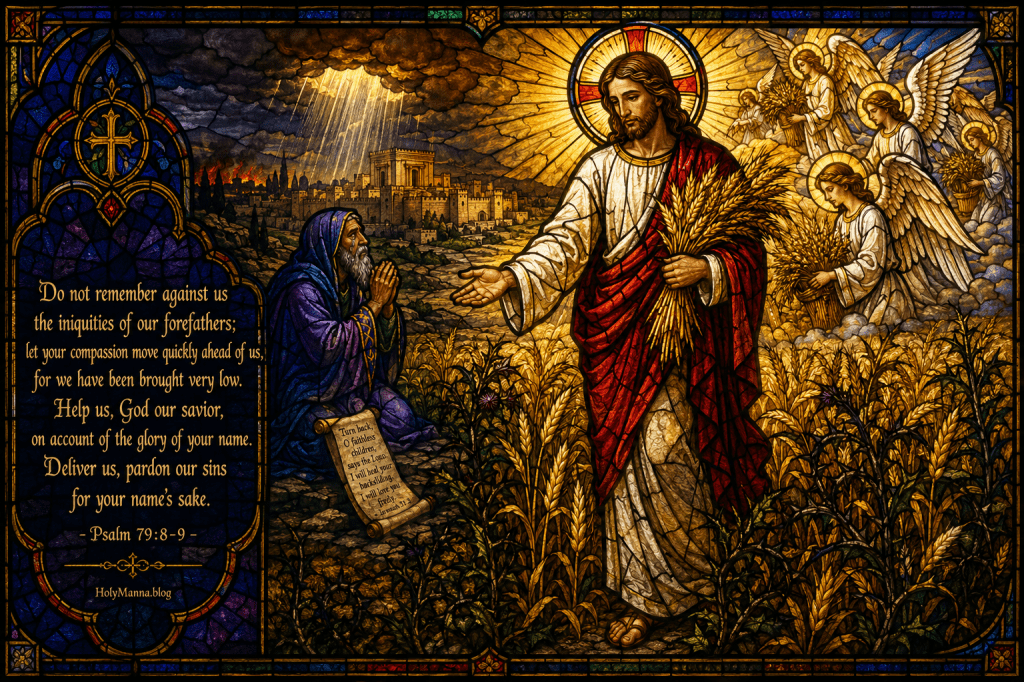
Tuesday of the Seventeenth Week in Ordinary Time – Lectionary: 402
When Honest Tears Meet a Patient God
There is a particular kind of prayer that only shows up when life has fallen apart. It is not polished. It does not pretend. It simply tells God the truth: we are hurting, we are guilty, and we have nowhere else to go. Today’s readings are built around that prayer. In the First Reading, the prophet Jeremiah weeps night and day over the wound of his people and then teaches them to confess honestly: “We recognize our wickedness, Lord… we have sinned against you” (Jeremiah 14:20). The Responsorial Psalm picks up that same confession after the disaster has actually struck, begging God to act “on account of the glory of your name” (Psalm 79:9). Then, in the Gospel, Jesus explains the parable of the weeds and answers the question hiding underneath both laments: if God sees the evil in the world, and even the evil in His own people, why does He not simply pull it all up right now?
The answer is the central theme of this day: honest confession of sin meets the patient mercy of God, who delays the harvest so that sinners have time to become saints. Judah in the late seventh century BC was a nation running out of time, trusting idols that could not send rain and prophets who promised peace that never came. Into that world God sent a weeping prophet, and centuries later He sent His own Son, who revealed that the field stays mixed until the end precisely because the Farmer is merciful. That mercy is not indifference. The harvest is real. But so is the time to change.
First Reading — Jeremiah 14:17-22
The Prophet Who Cried God’s Own Tears
Jeremiah preached in Judah during its final generation, roughly from 627 BC until after Jerusalem fell to Babylon in 587 BC. He is often called the weeping prophet, but today’s passage reveals something startling: the tears begin with God. The Lord commands Jeremiah to speak a word that is itself a flood of grief over the “virgin daughter” of His people, a tender title for Jerusalem that makes the coming devastation feel like a father losing a child. The historical backdrop is a crushing drought (described earlier in Jeremiah 14), layered on top of war, famine, and the false assurances of court prophets who kept promising peace. In this reading, Jeremiah does two things at once. He voices God’s sorrow, and he teaches the people the only prayer that can save them: honest confession joined to an appeal to God’s covenant faithfulness. This is where the day’s theme begins, because mercy cannot heal a wound that no one will admit exists.
Jeremiah 14:17-22 – New American Bible (Revised Edition)
17 Speak to them this word:
Let my eyes stream with tears
night and day, without rest,
Over the great destruction which overwhelms
the virgin daughter of my people,
over her incurable wound.
18 If I walk out into the field,
look! those slain by the sword;
If I enter the city,
look! victims of famine.
Both prophet and priest ply their trade
in a land they do not know.
19 Have you really cast Judah off?
Is Zion loathsome to you?
Why have you struck us a blow
that cannot be healed?
We wait for peace, to no avail;
for a time of healing, but terror comes instead.
20 We recognize our wickedness, Lord,
the guilt of our ancestors:
we have sinned against you.
21 Do not reject us, for your name’s sake,
do not disgrace your glorious throne.
Remember! Do not break your covenant with us.
22 Among the idols of the nations are there any that give rain?
Or can the mere heavens send showers?
Is it not you, Lord,
our God, to whom we look?
You alone do all these things.
Detailed Exegesis
Verse 17: “Speak to them this word: Let my eyes stream with tears night and day, without rest, over the great destruction which overwhelms the virgin daughter of my people, over her incurable wound.” The command “speak to them this word” means the tears themselves are the prophecy. God does not merely announce judgment; He grieves it. Calling Jerusalem the “virgin daughter” underscores both her dignity and her vulnerability, and the phrase “incurable wound” signals that no human remedy, no alliance with Egypt, no ritual shortcut, can fix what sin has broken. Only God can heal what the text calls incurable, which quietly prepares the plea that follows.
Verse 18: “If I walk out into the field, look! those slain by the sword; If I enter the city, look! victims of famine. Both prophet and priest ply their trade in a land they do not know.” Field and city cover the whole landscape; there is nowhere the devastation has not reached. The bitter line about prophet and priest condemns religious professionals who kept performing their roles while spiritually lost, strangers in their own vocation. It is a sobering reminder that religious activity is not the same as fidelity.
Verse 19: “Have you really cast Judah off? Is Zion loathsome to you? Why have you struck us a blow that cannot be healed? We wait for peace, to no avail; for a time of healing, but terror comes instead.” Here the voice shifts to the people’s lament, likely a prayer Jeremiah composes for them. The questions are raw, almost accusing, and Scripture does not censor them. Biblical faith has room for anguished honesty, because the questions are addressed to God rather than spoken about Him behind His back.
Verse 20: “We recognize our wickedness, Lord, the guilt of our ancestors: we have sinned against you.” This is the hinge of the entire reading. The lament becomes confession. The people own both their inherited guilt and their personal sin, refusing the two classic evasions: blaming only the past, or pretending the present is innocent. The Catechism defines sin in exactly these covenantal terms, as an offense against God Himself and not merely a mistake (CCC 1850).
Verse 21: “Do not reject us, for your name’s sake, do not disgrace your glorious throne. Remember! Do not break your covenant with us.” The people appeal not to their own merit, which is spent, but to God’s name, His throne (the Temple, His dwelling among them), and His covenant. This is the same logic Moses used after the golden calf, and it is the deepest logic of biblical prayer: God’s fidelity to Himself is more reliable than anything in the one praying.
Verse 22: “Among the idols of the nations are there any that give rain? Or can the mere heavens send showers? Is it not you, Lord, our God, to whom we look? You alone do all these things.” During a drought, this verse is a direct strike at Baal, the Canaanite storm god Judah kept flirting with. The confession of sin flowers into a confession of faith: the idols are empty, the sky is not a god, and the Lord alone gives life. Repentance always ends in renewed worship.
Teachings
The Church sees in Jeremiah the pattern of intercessory prayer that reaches its fullness in Christ. The Catechism teaches, “Since Abraham, intercession – asking on behalf of another – has been characteristic of a heart attuned to God’s mercy” (CCC 2635). Jeremiah stands between a sinful people and a grieving God, weeping with God’s own tears while pleading the people’s case, and in this he foreshadows Jesus, who wept over Jerusalem (Luke 19:41) and now “always lives to make intercession” for His people (Hebrews 7:25). The Catechism also teaches that this prophetic ministry had a purpose within salvation history: “Through the prophets, God forms his people in the hope of salvation, in the expectation of a new and everlasting Covenant intended for all, to be written on their hearts” (CCC 64). Judah’s appeal to the covenant in verse 21 is answered definitively at the Last Supper, when Jesus announces the new covenant in His blood. Finally, the people’s confession models what the Church calls interior repentance: “Interior repentance is a radical reorientation of our whole life, a return, a conversion to God with all our heart, an end of sin, a turning away from evil, with repugnance toward the evil actions we have committed” (CCC 1431). Judah’s tragedy was not that they sinned; it was that they confessed so late. The reading stands in the Lectionary as an invitation not to repeat that timing.
Reflection
Jeremiah’s world can feel uncomfortably familiar: institutions that keep functioning while losing their soul, voices promising peace that never arrives, and hearts that quietly look to modern idols, money, status, control, to send the rain. The reading offers a concrete path. Begin with honesty before God, naming sin plainly rather than managing it. Bring that honesty to the Sacrament of Reconciliation, where the confession of verse 20 becomes an encounter with absolution. Then anchor every plea in God’s faithfulness rather than personal performance, praying as Judah did, for His name’s sake. Finally, let repentance end where verse 22 ends, in worship, by consciously renouncing one “idol” this week, one thing trusted for security more than God. When life feels wounded beyond repair, is the honest prayer of verse 20 being prayed, or is the wound being hidden? What modern idol is quietly being asked to “send rain,” and what would it look like to look to the Lord alone instead?
Responsorial Psalm — Psalm 79:8-9, 11, 13
The Prayer of a People Sitting in the Ashes
Psalm 79 was born from the very catastrophe Jeremiah announced. In 587 BC the Babylonians breached Jerusalem’s walls, burned the Temple, and dragged the survivors into exile. The psalm is a communal lament, the prayer of a people sitting in the ashes of everything they thought God would never let fall. What makes it remarkable is what it does not do. It does not abandon God, and it does not excuse itself. Instead it takes up exactly the prayer Jeremiah taught in the First Reading: confession of sin, appeal to God’s name, intercession for the suffering, and a promise of praise. The Lectionary places it here as the people’s response, showing that the weeping prophet’s lesson took root. Within the day’s theme, the psalm is the sound of honest confession reaching upward, trusting that God’s mercy is greater than the disaster sin has caused.
Psalm 79:8-9, 11, 13 – New American Bible (Revised Edition)
8 Do not remember against us the iniquities of our forefathers;
let your compassion move quickly ahead of us,
for we have been brought very low.9 Help us, God our savior,
on account of the glory of your name.
Deliver us, pardon our sins
for your name’s sake.11 Let the groaning of the imprisoned come in before you;
in accord with the greatness of your arm
preserve those doomed to die.13 Then we, your people, the sheep of your pasture,
will give thanks to you forever;
from generation to generation
we will recount your praise.
Detailed Exegesis
Verse 8: “Do not remember against us the iniquities of our forefathers; let your compassion move quickly ahead of us, for we have been brought very low.” The people ask God not to hold the accumulated guilt of generations against them, and the image is striking: compassion that runs out ahead, like a rescuer who cannot wait. Being “brought very low” describes both political ruin and spiritual humility, and in the Bible the second is the doorway to mercy.
Verse 9: “Help us, God our savior, on account of the glory of your name. Deliver us, pardon our sins for your name’s sake.” Twice in one verse the plea rests on God’s name, echoing Jeremiah 14:21 almost exactly. The psalmist understands that Israel’s salvation and God’s glory are bound together, because God has attached His reputation to this people. Notice that deliverance and pardon are asked for in the same breath; the exiles know their deepest captivity is sin.
Verse 11: “Let the groaning of the imprisoned come in before you; in accord with the greatness of your arm preserve those doomed to die.” The lament widens into intercession for prisoners and the condemned, the exiles in Babylon and all who suffer with them. The “arm” of God recalls the Exodus, when He redeemed Israel “with outstretched arm” (Exodus 6:6), so the verse is really asking God to be the God He has always been.
Verse 13: “Then we, your people, the sheep of your pasture, will give thanks to you forever; from generation to generation we will recount your praise.” The psalm ends not in despair but in a vow of perpetual thanksgiving. The shepherd image reaffirms the covenant bond even in exile, and the promise to praise “from generation to generation” is being kept every time this psalm is prayed at Mass, twenty-six centuries later.
Teachings
The Church has always heard her own voice in this psalm. The Catechism teaches that the shepherd imagery of verse 13 finds its fulfillment in the Church gathered around Christ: “The Church is, accordingly, a sheepfold, the sole and necessary gateway to which is Christ” (CCC 754). The confession in verses 8 and 9 also anticipates the petition Jesus placed at the heart of the Our Father. The Catechism explains, “But though we are clothed with the baptismal garment, we do not cease to sin, to turn away from God. Now, in this new petition, we return to him like the prodigal son and, like the tax collector, recognize that we are sinners before him” (CCC 2839). What Israel prayed after the Temple fell, the Church prays daily, because the need for mercy never expires this side of heaven. And the intercession of verse 11 for the imprisoned and the condemned remains a living mandate; Jesus counts visiting the imprisoned among the works by which the nations will be judged (Matthew 25:36), a judgment scene that today’s Gospel will place directly before the reader.
Reflection
This psalm gives words for the seasons when consequences have already arrived and prayer feels like praying from the rubble. Pray it slowly on those days, letting verse 8 ask for compassion that runs ahead. Take up verse 11 as a concrete assignment by praying for prisoners this week, or supporting a prison ministry, remembering those the world has written off but God has not. And imitate verse 13 by ending even the hardest prayer with one sentence of thanksgiving, because gratitude spoken in the ashes is one of the purest forms of faith. When consequences of past choices press down, does prayer turn toward God’s mercy or away from His presence? Who are “the imprisoned” and “those doomed to die” that God may be asking to be carried in intercession right now?
Holy Gospel — Matthew 13:36-43
Inside the House, the Master Explains the Field
The scene shifts quietly but significantly. Jesus dismisses the crowds and goes into the house, and there the disciples ask Him to explain the parable of the weeds He had told earlier that day (Matthew 13:24-30). In Matthew’s Gospel, this movement from the crowd to the house is a picture of the Church, the community that does not settle for hearing but asks the Lord for understanding. The parable itself came from the real world of Galilean farming. The weed in question was almost certainly darnel, a poisonous grass so similar to young wheat that pulling it early would tear out the good grain with it; sowing it in an enemy’s field was such a known act of sabotage that Roman law addressed it. Jesus now hands the disciples the key to the whole story, point by point, and in doing so He answers the question aching beneath Jeremiah’s tears and the psalmist’s lament: why does God allow evil to grow so long? The answer reveals both a real judgment and a patient mercy, the very heart of today’s theme.
Matthew 13:36-43 – New American Bible (Revised Edition)
The Explanation of the Parable of the Weeds. 36 Then, dismissing the crowds, he went into the house. His disciples approached him and said, “Explain to us the parable of the weeds in the field.” 37 He said in reply, “He who sows good seed is the Son of Man, 38 the field is the world, the good seed the children of the kingdom. The weeds are the children of the evil one, 39 and the enemy who sows them is the devil. The harvest is the end of the age, and the harvesters are angels. 40 Just as weeds are collected and burned [up] with fire, so will it be at the end of the age. 41 The Son of Man will send his angels, and they will collect out of his kingdom all who cause others to sin and all evildoers. 42 They will throw them into the fiery furnace, where there will be wailing and grinding of teeth. 43 Then the righteous will shine like the sun in the kingdom of their Father. Whoever has ears ought to hear.
Detailed Exegesis
Verse 36: “Then, dismissing the crowds, he went into the house. His disciples approached him and said, ‘Explain to us the parable of the weeds in the field.’” The disciples model the posture of every believer before Scripture: they approach Jesus and ask. Understanding the things of God is not seized; it is requested and received, which is why the Church reads the Bible on her knees, within the living Tradition Jesus established.
Verse 37: “He said in reply, ‘He who sows good seed is the Son of Man,’” Jesus identifies Himself with the mysterious figure from Daniel 7, the Son of Man who receives everlasting dominion. The sowing is His entire mission: His preaching, His grace, His planting of the kingdom in human hearts.
Verse 38: “the field is the world, the good seed the children of the kingdom. The weeds are the children of the evil one,” The field is the world, not merely the Church, which means the mingling of good and evil runs through all of history, and, as the Church teaches, through the Church herself and every human heart. The seeds are people, which raises the stakes of the parable from agriculture to eternity.
Verse 39: “and the enemy who sows them is the devil. The harvest is the end of the age, and the harvesters are angels.” Jesus speaks plainly of the devil as a real enemy actively at work, not a metaphor. Yet the verse is also deeply consoling: the enemy can only sow in a field he does not own. History has an owner, a harvest, and a deadline.
Verse 40: “Just as weeds are collected and burned [up] with fire, so will it be at the end of the age.” The judgment is not an accident of the story but its foretold conclusion. Evil is permitted for a time; it is never permitted forever.
Verse 41: “The Son of Man will send his angels, and they will collect out of his kingdom all who cause others to sin and all evildoers.” Notice who is gathered first: those who cause others to sin. Scandal, leading others into evil, receives particular weight in Jesus’ teaching (Matthew 18:6), a sobering word for anyone with influence over another soul, which is nearly everyone.
Verse 42: “They will throw them into the fiery furnace, where there will be wailing and grinding of teeth.” Jesus does not soften the reality of hell, and neither does His Church. The furnace imagery echoes Daniel 3, and the wailing and grinding of teeth express the grief and rage of a freedom that finally, definitively refused love.
Verse 43: “Then the righteous will shine like the sun in the kingdom of their Father. Whoever has ears ought to hear.” The parable ends in blazing hope, echoing Daniel 12:3, where the wise “shall shine brightly like the splendor of the firmament.” The righteous do not merely survive the harvest; they are transfigured, sharing the radiance of the Father’s own house. The closing summons, “Whoever has ears ought to hear,” turns the explanation into a decision.
Teachings
The Catechism cites this very passage when teaching about the Last Judgment: “On Judgment Day at the end of the world, Christ will come in glory to achieve the definitive triumph of good over evil which, like the wheat and the tares, have grown up together in the course of history” (CCC 681). It cites it again regarding hell: “Jesus solemnly proclaims that he ‘will send his angels, and they will gather . . . all evil doers, and throw them into the furnace of fire’” (CCC 1034). Yet the Church also applies the parable to her own mixed condition in time: “All members of the Church, including her ministers, must acknowledge that they are sinners. In everyone, the weeds of sin will still be mixed with the good wheat of the Gospel until the end of time” (CCC 827). Saint Augustine drew from this parable one of his most pastoral insights. Preaching on it in Sermon 73A, he taught that “those who are weeds today may be wheat tomorrow,” and for this reason the Lord commands patience rather than premature uprooting, since a person still living can still be converted. Saint John Chrysostom, in Homily 47 of his Homilies on Matthew, makes the complementary point: the separation belongs to the angels at the harvest, not to human beings before it, so the disciple’s task in the meantime is vigilance over his own soul rather than the violent purging of others. Together these teachings hold the day’s theme in perfect balance. God’s patience is real, and so is His justice; the delay of the harvest is not weakness but mercy, “not wishing that any should perish but that all should come to repentance” (2 Peter 3:9).
Reflection
This Gospel corrects two opposite temptations. The first is despair over the evil in the world and in the Church, as if the enemy’s sowing meant the Farmer had lost control. The second is the itch to play harvester, sorting neighbors into wheat and weeds with a confidence Jesus reserves for angels at the end of the age. The practical path runs between them. Examine conscience daily, because the line between wheat and weed runs through every heart, and ask honestly where verse 41’s warning about causing others to sin might apply, in speech, in example, in what is shared online. Practice Augustine’s patience with difficult people, praying for one specific “weed” this week with the hope that God intends wheat. And live toward verse 43, letting the promise of shining like the sun shape choices today, since eternity is decided in ordinary time. Where has judging others quietly replaced examining one’s own soul? If the harvest came tonight, what one thing would need to be brought to Confession first, and what is preventing that from happening this week?
The Mercy That Waits for the Harvest
Put the three readings side by side and a single story emerges. A prophet weeps over a wound sin has made incurable, and teaches his people the prayer of honest confession. A shattered nation prays that prayer from the ashes, appealing to nothing but the glory of God’s name. And then the Son of Man Himself, inside the house with His disciples, pulls back the curtain on all of history and explains why the ashes were not the end: the field stays mixed until the harvest because the Farmer is patient, and the Farmer is patient because He wants weeds to become wheat.
That is the Gospel hiding inside this ordinary Tuesday. God’s mercy is not a denial of judgment; it is the time given before judgment. Every day between now and the harvest is a gift with a purpose, and the readings show exactly how to use it. Confess honestly, as Judah finally learned to do. Pray boldly for God’s name’s sake, as the psalmist did, interceding even for the imprisoned and the condemned. And trust the Lord of the harvest enough to stop uprooting neighbors and start weeding one’s own heart.
The invitation is concrete. Go to Confession soon, and bring the honesty of Jeremiah 14:20 into that encounter with mercy. Pray Psalm 79 for someone the world has given up on. And ask daily for the grace to hear the parable’s last line as a personal summons, because the same Jesus who spoke of the fiery furnace also promised that “the righteous will shine like the sun in the kingdom of their Father” (Matthew 13:43). The harvest is coming. Today, mercy is still sowing.
Engage With Us!
The conversation does not end with the final verse, and the comments below are open for exactly that reason. Share what struck the heart in today’s readings, how God has shown patience in a personal season of “weeds,” or what it has meant to pray for His mercy for His name’s sake. These shared reflections encourage the whole community, and every story of grace helps someone else keep going.
Here are some questions to spark that reflection:
- In Jeremiah 14:17-22, the people finally pray, “We recognize our wickedness, Lord… we have sinned against you.” What makes honest confession difficult, and what would it take to pray those words without excuses this week?
- In Psalm 79:8-9, 11, 13, the exiles beg God to act “for your name’s sake” and intercede for the imprisoned. Who needs that kind of intercession right now, and how can that prayer become a concrete act of mercy?
- In Matthew 13:36-43, Jesus explains that the field stays mixed until the harvest. Where is there a temptation to “uproot” others prematurely instead of trusting God’s patience and tending one’s own soul?
- Taking all the readings together, God’s mercy gives time so that weeds may become wheat. How is that gift of time being used today, and what one step toward conversion is God inviting before the harvest?
Keep walking this road of faith with courage and hope. The God who wept through Jeremiah, who heard Israel from the ashes, and who patiently tends the field of this world is tending each soul with the same love. Live this day fully for Him, and do everything with the love and mercy Jesus taught us.
Sacred Heart of Jesus, we trust in You!
Immaculate Heart of Mary, pray for us!
Saint Michael the Archangel, defend us in battle!
Follow us on YouTube, TikTok, Instagram and Facebook for more insights and reflections on living a faith-filled life.

 Holy Manna!
Leave a comment