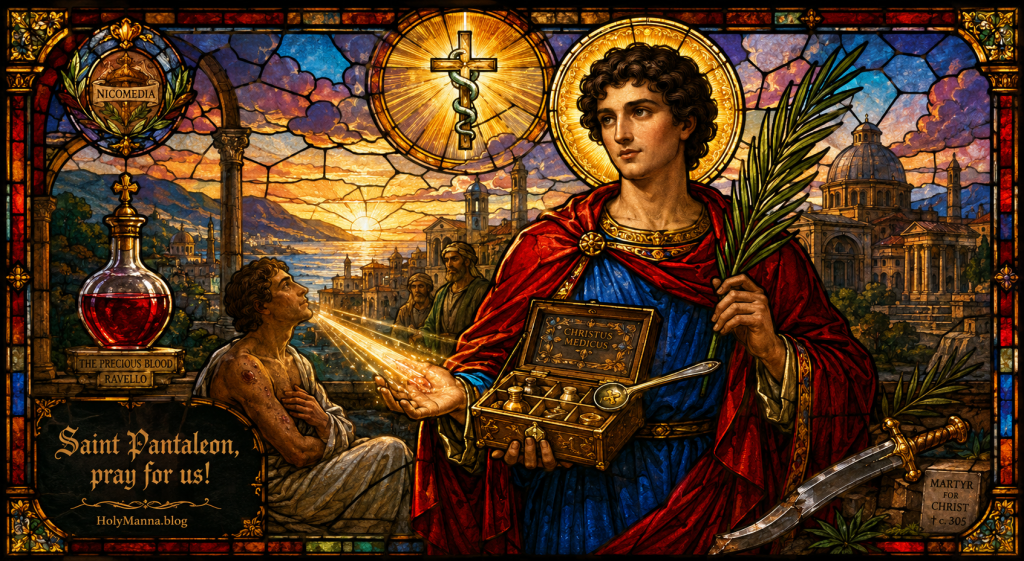
The Doctor Who Met the Greater Physician
Every July 27th, the Church remembers a young doctor from the ancient city of Nicomedia who discovered that medicine, as noble as it is, was never going to be enough. Saint Pantaleon lived at the close of the third century and the opening of the fourth, in the years when the Roman Empire turned its full fury against the followers of Jesus Christ. He was, by every account, a gifted physician, skilled enough to serve at the imperial court itself. Yet the Church does not remember him for his medical brilliance. She remembers him because, when the moment of decision came, he chose Christ over his career, over his fortune, and over his life.
His name in Greek carries a beautiful double meaning. Pantaleon can be read as “in all things a lion,” and the name by which the Christian East knows him, Panteleimon, means “the all-merciful” or “all-compassionate.” Both names fit the man. He needed the courage of a lion to confess Christ before an emperor in the middle of a persecution, and he showed the mercy of Christ by healing the poor without ever asking for payment.
That refusal to charge the poor placed him in a beloved company of saints the Church calls the anargyroi, a Greek word meaning “without silver,” the unmercenary healers who treated the sick for free out of love for Christ. It is why he holds real, documented patronages to this day. Saint Pantaleon is venerated as the patron saint of midwives and, together with Saints Cosmas and Damian, as a co-patron of physicians. After the Black Death devastated Europe in the fourteenth century, he was also counted among the Fourteen Holy Helpers, that group of saints whom the faithful invoked with special confidence in times of plague and desperation. In the Christian East he bears the magnificent title of Great Martyr and Wonderworker.
The Church’s confidence in the intercession of saints like Pantaleon is not sentimentality. It is doctrine. The Catechism teaches, “Being more closely united to Christ, those who dwell in heaven fix the whole Church more firmly in holiness… They do not cease to intercede with the Father for us, as they proffer the merits which they acquired on earth through the one mediator between God and men, Christ Jesus” (CCC 956). When a doctor whispers a prayer to Saint Pantaleon before a difficult surgery, or a midwife asks his help in a hard delivery, they are leaning on a friendship that death could not sever.
One honest note before the story begins. The fact of Pantaleon’s martyrdom is historically solid, attested from the earliest centuries by writers such as Theodoret and Procopius of Caesarea and by the ancient Martyrologium Hieronymianum, a martyrology whose roots reach back to the fifth century. The detailed episodes of his life, however, come from accounts written long after his death, which scholars, including the Catholic Encyclopedia, regard as late and embellished. This post will tell those stories, because they have shaped how the Church has loved this saint for seventeen centuries, but it will always be honest about which parts are documented history and which parts are cherished tradition.
A Mother’s Faith and a Son’s Long Detour
According to the traditional accounts of his life, Pantaleon was born around the year 275 in Nicomedia, a wealthy and important city of Bithynia in Asia Minor, on the ground where the modern Turkish city of İzmit now stands. Nicomedia was no backwater. Under the Emperor Diocletian it functioned as an eastern capital of the empire, which means Pantaleon grew up in the shadow of imperial power, and eventually inside its halls.
His father, Eustorgius, was a rich pagan. His mother, Eubula, was a devout Christian, and she herself is honored as a saint. Tradition says she planted the faith in her son’s heart when he was a boy. She also died while he was still young, and after her death the seed she had planted seemed to wither. Pantaleon drifted. He threw himself into the study of medicine, according to tradition under a renowned physician named Euphrosynus, and he excelled so brilliantly that he was brought to the imperial court as a physician. Sources differ on which emperor he served, with some naming Maximian and others, perhaps more plausibly, Galerius; the ancient records do not allow certainty on this point. What the tradition agrees on is the spiritual cost of that success. Surrounded by pagan luxury, flattery, and ambition, the young doctor let his mother’s faith slip out of his life almost entirely.
Anyone who has ever drifted from the faith of their childhood, not through some dramatic rebellion but through the slow gravity of career and comfort, will recognize this chapter of Pantaleon’s story. And anyone who has drifted should pay close attention to what happened next, because God did not let him go.
Tradition tells that an elderly priest named Hermolaus was living quietly in Nicomedia, hidden from the persecution. He noticed the promising young physician and struck up a friendship with him. Hermolaus did not begin by scolding. He began with Pantaleon’s own vocation. The old priest told him that the famous physicians of the past had possessed the science that heals bodies, but that Jesus Christ is the far greater Physician, able to heal not only bodies but souls. It was an argument aimed straight at a doctor’s heart, and it found its mark. Our Lord had described Himself in exactly these terms in The Gospel of Matthew, saying, “Those who are well have no need of a physician, but those who are sick” (Mt 9:12).
The tradition continues that Pantaleon’s conversion was sealed by a miracle. Walking one day, he encountered a blind man, and in the presence of witnesses he prayed over him, invoking the name of Jesus Christ, and touched his eyes, and the man’s sight was restored. The story holds that this miracle brought not only the blind man but Pantaleon’s own pagan father to baptism. This account of the blind man and the conversion of Eustorgius comes from the later traditional accounts and cannot be verified.
Whatever the precise details of his return, the Church sees in a story like Pantaleon’s the pattern of every conversion. The Catechism teaches, “The human heart is heavy and hardened. God must give man a new heart. Conversion is first of all a work of the grace of God who makes our hearts return to him” (CCC 1432). Pantaleon did not climb back to God by his own cleverness. Grace came looking for him, wearing the face of a persistent old priest.
Medicine Without a Price Tag
Once Pantaleon returned to Christ, the change in his life was total, and it showed up first in his money. Tradition holds that when his father died, Pantaleon inherited a large fortune, and that he responded by freeing his slaves, selling most of his possessions, and pouring the proceeds out on the poor of Nicomedia. Then he did something that scandalized his colleagues and made him famous among the city’s poor. He began practicing medicine for free.
This is the choice that placed him among the anargyroi, the unmercenary healers. It was a direct, almost literal obedience to the instruction Jesus gave when He sent out the Twelve with the power to heal, recorded in The Gospel of Matthew: “You received without paying; give without pay” (Mt 10:8). Pantaleon had received his skill, his education, and above all his rediscovered faith as pure gift, and he decided the only fitting response was to give the way he had been given to.
The Church has never treated this kind of care for the sick as optional decoration on the Gospel. The Catechism teaches, “The works of mercy are charitable actions by which we come to the aid of our neighbor in his spiritual and bodily necessities” (CCC 2447), and it lists caring for the sick among the corporal works of mercy that will be weighed at the judgment. More than that, the Church understands healing itself as part of her mission received directly from the Lord. The Catechism declares, “Heal the sick! The Church has received this charge from the Lord and strives to carry it out by taking care of the sick as well as by accompanying them with her prayer of intercession” (CCC 1509). Every Catholic hospital, every religious nursing order, every doctor who treats a patient who cannot pay stands in a line of witnesses that runs straight back through saints like Pantaleon.
Tradition remembers him healing not only with medicine but with prayer, so that cures multiplied around him and his reputation in Nicomedia grew. These accounts of miraculous healings during his lifetime come from the later traditional sources and cannot be verified, but they capture something the documented history confirms in its own way: this man was loved, and he was loved because he gave himself away.
Why should you remember him, and why should you want to imitate him? Because Pantaleon shows what happens when a person stops treating their talent as a personal possession and starts treating it as a commission. He did not abandon medicine when he found Christ. He converted his medicine along with his heart. That is the pattern for every believer with a skill, a degree, a trade, or a paycheck.
The Sword That Bent
Then came the storm. In the year 303, the Emperor Diocletian unleashed the last and most ferocious of the Roman persecutions, and it began in Nicomedia itself, where the great church of the city was torn down within sight of the palace. Christians in imperial service were among the first targets. A court physician who healed in the name of Jesus Christ could not stay hidden for long.
According to the traditional accounts, it was not the emperor who first moved against Pantaleon but his fellow physicians. Envious of his success and his following among the people, they denounced him as a Christian. The tradition adds a heartbreaking detail: the blind man Pantaleon had healed was questioned, confessed that Christ had cured him through Pantaleon, refused to credit the pagan gods, and was beheaded for it before his healer.
Brought before the emperor, Pantaleon was not immediately condemned. The traditional accounts say the emperor valued him and tried to coax him into a quiet apostasy, a small pinch of incense, a formality, and his career and life would be spared. Pantaleon refused. Instead, the tradition says, he openly confessed his faith and offered proof: a man with paralysis was brought in, the pagan priests prayed over him and failed, and Pantaleon healed him by invoking the name of Jesus, at which many witnesses converted. The emperor, regarding the miracle as sorcery, condemned him to death.
What follows in the traditional accounts is one of the most dramatic martyrdom narratives in the whole calendar of saints. His flesh was burned with torches, and Christ appeared in the form of the old priest Hermolaus to strengthen and heal him. He was thrown to wild beasts, and they fawned on him like pets and would not leave until he blessed them. He was bound to a great wheel, and the ropes snapped and the wheel shattered. Attempts to drown him and to kill him with molten lead failed. Finally the executioners raised the sword to behead him, and the blade bent like soft wax, and the executioners themselves fell at his feet and were converted. Pantaleon prayed aloud that heaven would forgive them, echoing his Lord, who prayed from the Cross, “Father, forgive them, for they know not what they do” (Lk 23:34). Because of that prayer, the tradition says, a voice from heaven gave him his new name, Panteleimon, the all-merciful. Only when Pantaleon himself gave his consent did the sword finally do its work. These dramatic episodes come from accounts written long after the events, and the Church’s own scholars judge them late and unverifiable; they are told here as the treasured stories they are, not as established fact.
Beneath the embroidery, the bedrock remains. A physician named Pantaleon really was martyred at Nicomedia, around the year 305, though some sources place his death in 303, and the ancient records do not settle the question. His veneration exploded across the Christian world within a century or so of his death, which is precisely the footprint a real martyr leaves. The Church teaches why this witness matters so much: “Martyrdom is the supreme witness given to the truth of the faith: it means bearing witness even unto death. The martyr bears witness to Christ who died and rose, to whom he is united by charity” (CCC 2473). Pantaleon spent his career fighting death with medicine, and in the end he defeated it by a better means, by dying united to the One who rose.
Blood That Will Not Stay Still
If Pantaleon’s life story is wrapped in tradition, his afterlife in the devotion of the Church is a matter of remarkable historical record. Within roughly two centuries of his death, his veneration was already so established that the Emperor Justinian rebuilt a church in his honor, a fact recorded by the historian Procopius of Caesarea. From Nicomedia his cult spread east and west, and with it, his relics.
The most astonishing of those relics is his blood. A tradition holds that when Pantaleon was beheaded, blood mingled with milk flowed from his body, and that a devout woman of Nicomedia collected his blood and kept it in her home. That origin story cannot be verified. What can be documented is what happens to the blood that survives today. In the cathedral of Ravello, a hilltop town on Italy’s Amalfi Coast, a sealed vial holds a quantity of dark, solidified blood attributed to Saint Pantaleon. Each year, around his feast on July 27th, the contents are reported to liquefy, turning fluid and brighter red before the eyes of the faithful, a phenomenon that has been observed and documented since 1577 and that still draws crowds to Ravello every summer.
Ravello is not alone. A smaller ampoule of the blood is venerated at the Royal Monastery of the Incarnation in Madrid, where tradition says it arrived shortly after the convent’s founding in 1616 as a gift traced back through the Viceroy of Naples to Pope Paul V, though the documents certifying that route have not survived. What did survive is something a skeptical age should find fascinating: between 1724 and 1730, a commission of thirteen doctors of medicine and theology observed the Madrid ampoule year after year and swore before a notary that its contents turned liquid every July 27th without any human intervention. In earlier centuries still, a phial of his blood was preserved at Constantinople, where it was said to become fluid and bubble on his feast. The reported liquefactions in Ravello and Madrid, occurring in the same season in cities more than a thousand miles apart, remain unexplained; the Church does not oblige any Catholic to believe in such phenomena, but she preserves them with reverence, and the Catechism reminds the faithful that God does give external signs that support faith, teaching that “the miracles of Christ and the saints… are the most certain signs of divine Revelation, adapted to the intelligence of all” (CCC 156).
Other relics scattered across Europe tell the story of how widely he was loved. Relics of the saint are kept at the Basilica of Saint-Denis near Paris, and his head has been venerated at Lyon. In Cologne, a church dedicated to him is mentioned in documents as early as the year 866, and after his relics arrived there in the tenth century, Archbishop Bruno, brother of the Emperor Otto the Great, rebuilt the church magnificently and founded a Benedictine monastery beside it; the Romanesque church of Sankt Pantaleon still stands in Cologne today. On Mount Athos, the great Russian monastery of Saint Panteleimon bears his name, and throughout the Christian East he remains one of the most beloved of all healer saints.
Then there is Porto. Saint Pantaleon is the patron saint of the Portuguese city of Porto, and a beloved story explains how. The story tells that in 1453, as Constantinople fell, a ship of Armenian Christian refugees carried the relics of Saint Pantaleon across the Mediterranean and up the Douro River to safety in Porto. It is a stirring tale, but it cannot be verified; the oldest surviving document mentioning the relics in the area dates from 1492 and says nothing about Armenians, and the story as it is now told first appears in writing in 1623. The patronage itself, however, is real and centuries old, and the city has honored him ever since.
One last impact of this saint is hiding in nearly every wardrobe on earth. Pantaleon was so popular in Venice that his name attached itself to a stock character of the Italian comic theater, Pantalone, an old Venetian merchant famous for his long trousers. From that character’s costume came the word “pantaloons,” which the English language eventually shortened to “pants.” A fourth-century martyr of Nicomedia is, quite literally, woven into the way the modern world gets dressed in the morning.
Prescriptions for Everyday Faith
What does a court physician from ancient Nicomedia have to say to a person navigating faith and work seventeen centuries later? More than almost any saint on the calendar.
Start with the drift. Pantaleon did not storm out of the Church. He simply got busy, got successful, and got surrounded by people who did not share his mother’s faith, and one day the faith was gone. That is the most common conversion story in reverse that exists today, and Pantaleon’s life insists that it is never the end of the story. God sent him a Hermolaus, an unhurried, patient friend who spoke to him in the language of his own profession. Perhaps there is a Hermolaus in your life right now whose voice you have been politely ignoring. Or perhaps you are called to be Hermolaus for someone else, not by lecturing them, but by befriending them and speaking to the hunger they already have. Who first planted the faith in you, and have you ever thanked God for that person by name? Is there someone in your life quietly inviting you back to something you have let slip?
Next, the money and the skill. Pantaleon’s holiness did not require him to stop being a doctor. It required him to stop being a doctor for himself. Whatever sits in the place of medicine in a given life, whether a trade, a degree, a talent, or simply an income, the saint’s question is the same: is it a possession or a commission? The Lord’s words remain the standing order for every baptized professional: “You received without paying; give without pay” (Mt 10:8). In practical terms, that might mean mentoring someone for free, doing honest work for a client who cannot fully pay, giving blood, volunteering professional skills to a parish or a crisis pregnancy center, or simply tithing with the kind of cheerful recklessness Pantaleon showed when he emptied his inheritance into the hands of the poor. What would it look like this month to practice your own profession, whatever it is, without a price tag, even once?
Then, the forgiveness. The most striking detail in the traditional account of his death is not the broken wheel or the bent sword. It is that the Church chose to remember him forever by the name he earned praying for his executioners: Panteleimon, the all-merciful. Mercy toward the people actively harming him is the signature this saint left on history. Most people will never face an executioner, but nearly everyone carries someone they have quietly refused to forgive. Who is the person you find hardest to pray for, and could you offer one sincere prayer for their good before this day ends?
Finally, the sick. Saint Pantaleon’s patronage of physicians and midwives is a standing reminder that the Church regards the care of the sick as sacred ground. Visiting a sick friend, sitting with an aging parent, praying seriously for the healing of someone who suffers, and supporting the medical workers who carry these burdens daily are not small things. They are works of mercy, and the Catechism teaches that such works are among the ways “we come to the aid of our neighbor in his spiritual and bodily necessities” (CCC 2447). Who in your life is sick, weary, or worn down right now, and what is one concrete thing you could do for them this week?
Engage With Us!
The story of Saint Pantaleon has been healing hearts for seventeen hundred years, and it would be a joy to hear what it stirs in yours. Please share your thoughts, your questions, and your own experiences in the comments below. To help the conversation begin, here are a few questions to pray with.
- Saint Pantaleon drifted from the faith during his years of career success before grace called him home. Have you ever experienced a season of drifting, and what, or who, did God use to draw you back?
- As one of the unmercenary healers, Pantaleon treated the poor without charge. What is one skill or resource you could offer freely this month as a gift rather than a transaction?
- Tradition remembers him praying forgiveness over his own executioners. Is there a wound in your life where forgiveness still feels impossible, and what would it mean to hand that wound to the greater Physician?
- The reported liquefaction of his blood in Ravello and Madrid has drawn believers and skeptics alike for centuries. How do signs and wonders function in your own faith, and what does it mean to you that faith does not finally rest on them?
- Pantaleon found that Jesus is the Physician of souls as well as bodies. Where in your soul do you most need His healing right now, and have you asked Him for it plainly?
Whatever brought you to this page today, know that the same grace that chased down a distracted young doctor in ancient Nicomedia is still at work, and it is at work in you. Take one lesson from Saint Pantaleon into this week: give something away that the world says you should sell, forgive someone the world says you should resent, and bring your wounds to the great Physician who never turns a patient away. Live this day with courage, with generosity, and above all with the love and mercy that Jesus taught us. Saint Pantaleon, glorious martyr and all-merciful healer, pray for us.
Saint Pantaleon, pray for us!
Follow us on YouTube, TikTok, Instagram and Facebook for more insights and reflections on living a faith-filled life.


Leave a Reply