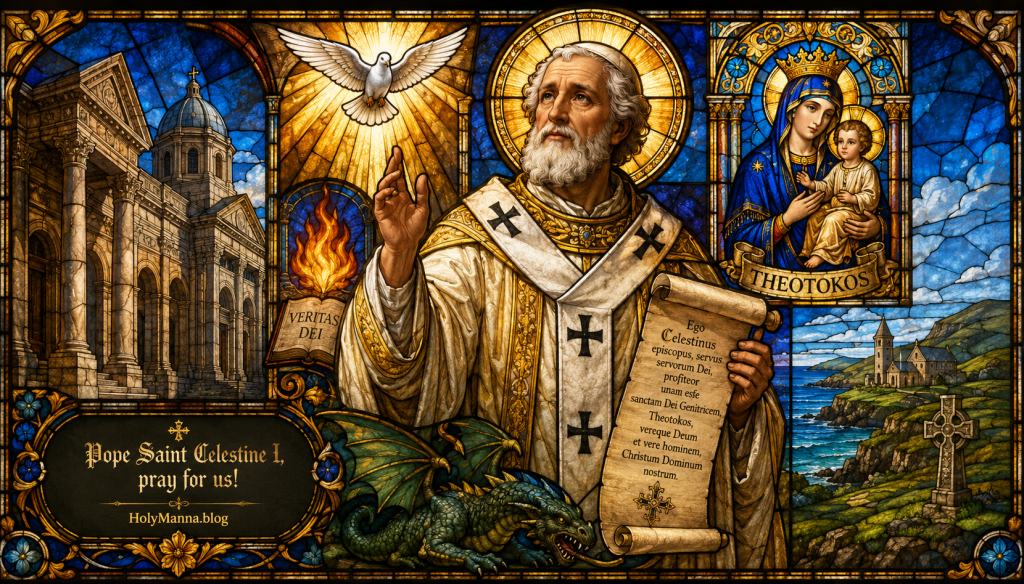
The Pope Who Refused to Stay Silent
Some saints are remembered for what they built, others for what they suffered, and a rare few for what they refused to allow. Pope Saint Celestine I, whose feast the Church keeps on July 27th, belongs to that last company. He governed the Church of Rome from the year 422 to the year 432, a single decade that turned out to be one of the most consequential in the entire history of Christian doctrine. When a powerful patriarch in the imperial capital of Constantinople began teaching that the Blessed Virgin Mary should not be called the Mother of God, it was Celestine who condemned the error, Celestine who set the machinery of a general council in motion, and Celestine whose legates stood at the Council of Ephesus in 431 when the Church solemnly confessed that Mary is truly Theotokos, the God-bearer.
That confession was never really about Mary alone. It was about her Son. The Church teaches that “what the Catholic faith believes about Mary is based on what it believes about Christ” (CCC 487), and the Council of Ephesus, held under Celestine’s authority, confessed “that the Word, uniting to himself in his person the flesh animated by a rational soul, became man” (CCC 466). Celestine understood that if Mary’s title fell, the truth about Jesus Christ would fall with it, and he was not willing to let that happen on his watch.
He was also the pope who sent the first bishop to Ireland, the pope who defended Saint Augustine’s memory when critics circled after the great doctor’s death, and the pope who rebuilt the churches of Rome after barbarian invaders had torn through the city. What he holds is a permanent place in the story of how the Church came to say clearly who Jesus Christ is and who His Mother is.
A Roman Deacon in a Crumbling Empire
The documented facts about Celestine’s early life are few, and honesty demands saying so plainly. He was a Roman, born in the region of Campania in the second half of the fourth century, and the old records preserve only one detail about his family, that his father’s name was Priscus. A tradition holds that in his younger years he lived for a time at Milan in the circle of Saint Ambrose, the bishop who baptized Saint Augustine. It is a beautiful thought, the future pope formed in the shadow of one of the greatest bishops the West ever produced, but it rests on later accounts rather than contemporary evidence, and it cannot be verified.
What is certain is that by the early fifth century Celestine was serving as a deacon of the Roman Church under Pope Innocent I. This was no ceremonial post. The deacons of Rome administered the Church’s charity, managed her material affairs, and stood close to the pope in the daily governance of the diocese. Celestine’s formation was therefore intensely practical. He learned the faith not primarily in a library but in the administration of a Church trying to hold a city together while the Western Roman Empire visibly came apart. Rome had been sacked by Alaric and his Goths in the year 410, a catastrophe that shook the ancient world to its core, and the wounds of that pillage were still visible on the city’s churches when Celestine came to prominence.
On September 10th in the year 422, following the death of Pope Boniface I, Celestine was elected Bishop of Rome. Some older sources, following the Bollandist scholars, place the election in early November instead, and that discrepancy in the records deserves to be noted rather than smoothed over. What the sources agree on is remarkable for the era: he was elected without opposition. The previous papal election had been marred by rival claimants and civil turmoil, so a peaceful, unanimous election was itself a small mercy. One of the first letters he received as pope came from Saint Augustine himself, who wrote asking the new bishop of Rome for help in resolving a painful pastoral situation involving Antonius, the bishop of Fussala in North Africa. A genuine friendship seems to have existed between the two men, and that friendship would bear fruit in ways Augustine never lived to see.
Guarding the Flock From Gaul to Ireland
Celestine’s decade as pope reads like the work of a shepherd who believed that every corner of the flock was his responsibility. The Catechism teaches that “the Roman Pontiff, by reason of his office as Vicar of Christ, and as pastor of the entire Church has full, supreme, and universal power over the whole Church, a power which he can always exercise unhindered” (CCC 882), and Celestine governed as a man who took that charge seriously long before later centuries would articulate it so precisely.
It must be said honestly that no miracles are recorded of Celestine during his lifetime, and this post will not manufacture any. His holiness showed itself in another register entirely, in vigilance, in courage, and in an almost fatherly stubbornness about the truth. In Rome itself he moved against the Novatianist sect, whose rigorist teaching effectively denied that the Church could reconcile serious sinners, a position contrary to the Catholic faith that “there is no offense, however serious, that the Church cannot forgive” (CCC 982). He confiscated their churches and reclaimed the city for the Catholic faith. He restored the church of Santa Maria in Trastevere, which had suffered in the Gothic sack, embellished the church of Saint Sabina on the Aventine, and adorned the catacomb of Priscilla, the ancient burial place of the Roman martyrs.
His letters show the same energy directed outward. He wrote to the bishops of Illyria insisting they keep the ancient canons and their obedience to the papal vicar at Thessalonica. He wrote to the bishops of Apulia and Calabria that clergy must not be ignorant of Church law and that popular enthusiasm, however loud, was never a reason to leapfrog an unformed layman into a bishop’s chair. He insisted that absolution and penance must never be refused to a dying person who sincerely asks for them, a decree of striking tenderness from a man so often remembered as a fighter. And in a letter of 428 to the bishops of Gaul, who had taken to wearing conspicuous garb that set them apart as a spiritual elite, he delivered one of the most quotable rebukes in early papal history: “We should be distinguished from the common people by our learning, not by our clothes; by our conduct, not by our dress; by cleanness of mind, not by the care we spend upon our person.”
The same Gallic correspondence produced his most famous line of all. Confronting clergy who tolerated dangerous novelties in preaching, Celestine wrote words preserved for posterity by Saint Vincent of Lérins: “We are deservedly to blame if we encourage error by silence. Therefore rebuke these people. Restrain their liberty of preaching.” That sentence is the key to his entire pontificate. Celestine believed that silence in the face of error was not neutrality but complicity, and he lived by that conviction at real cost.
His pastoral reach extended even beyond the frontiers of the empire. In 429 he supported the mission that sent Saint Germanus of Auxerre to Britain to confront the Pelagian heresy there. Then, in 431, he did something no pope had done before. The chronicler Prosper of Aquitaine, writing at the time, recorded it in a single sentence that changed the history of a nation: “Palladius, ordained by Pope Celestine, is sent as first bishop to the Scots believing in Christ.” The “Scots” of that era were the Irish. With that act, Celestine gave Ireland its first bishop and formally opened the mission to the Irish people. A cherished tradition, recounted in the Catholic Encyclopedia, adds that when Palladius died soon afterward, Saint Patrick received his own long-desired commission in the final days of Celestine’s life, making the dying pope a sharer in the conversion of Ireland. The Palladius mission is documented history; the story of Celestine personally commissioning Patrick is a tradition that cannot be verified. Either way, the seed planted under Celestine grew into one of the most missionary peoples in the history of the Church, and it is fitting that Ireland long honored him with a feast of his own.
One caution belongs here, because Celestine is often misquoted online. The famous maxim behind the principle lex orandi, lex credendi, that the law of prayer establishes the law of belief, circulates widely under Celestine’s name. It actually comes from the Indiculus, a collection of chapters on grace that was historically appended to his letters but is attributed by scholars, and by the Catechism itself, to Prosper of Aquitaine (CCC 1124). The principle is thoroughly Catholic and thoroughly at home in Celestine’s world, but the words are not his, and honesty about sources honors him more than a borrowed quotation ever could.
The Battle for the Mother of God
Celestine was not martyred, and his sufferings were not those of the arena. His hardships were the slower kind, the grinding battles a shepherd fights when wolves appear inside the sheepfold wearing shepherd’s clothing, and he fought two of them at once.
The first was Pelagianism. Pelagius, a British monk, had taught that human beings could achieve salvation essentially by their own effort, minimizing original sin and the absolute necessity of grace. The Church condemned this because it hollowed out the Gospel itself. As the Catechism teaches, following Saint Augustine’s great insight, Pelagius held “that man could, by the natural power of free will and without the necessary help of God’s grace, lead a morally good life” (CCC 406), whereas the true faith confesses that “grace is favor, the free and undeserved help that God gives us to respond to his call” (CCC 1996). Celestine banished Caelestius, the most aggressive disciple of Pelagius, from Italy, backed the anti-Pelagian mission to Britain, and after Augustine died in 430, wrote to the bishops of Gaul praising the doctor’s sanctity, learning, and zeal, and forbidding the Semipelagian critics gathering around John Cassian to attack his memory. The pope who hated silence in the face of error refused to be silent even in defense of a dead friend.
The second battle defined his life. In 428 a monk named Nestorius became Patriarch of Constantinople, the most politically powerful see in the East, and began preaching that Mary should not be called Theotokos, Mother of God, but at most Mother of Christ. Beneath the slogan lay a wound aimed at the heart of the Incarnation, a way of speaking about Jesus that treated the divine Son and the man Jesus as loosely joined rather than one divine Person. Saint Cyril, the Patriarch of Alexandria, challenged Nestorius, and when the dispute hardened, both men appealed to Rome. Cyril sent Celestine a full dossier of Nestorius’s sermons.
Celestine acted with a decisiveness that still startles historians. In August of 430 he gathered a synod at Rome, examined the teaching, and solemnly condemned it. He then wrote a battery of letters, to Nestorius, to the clergy and faithful of Constantinople, and to the great bishops of the East, announcing his sentence: unless Nestorius retracted his errors in writing within ten days of receiving the notice, he was excommunicated and deposed, and Saint Cyril was commissioned to execute the sentence in the pope’s name. Celestine also restored everyone Nestorius had punished for opposing him. When the emperor Theodosius II summoned a general council to meet at Ephesus in 431, Celestine sent three legates, the bishops Arcadius and Projectus and the priest Philip, instructing them to act “not as disputants but as judges,” because in his mind the doctrinal question had already been settled by Rome.
The council opened in June of 431 in the city where ancient tradition places the last earthly home of the Blessed Virgin. The assembled bishops condemned Nestorius and confessed Mary as Theotokos, and when the papal legates arrived in July they solemnly confirmed what had been done. It was at Ephesus that Celestine’s legate Philip made a declaration that echoes through the centuries, proclaiming that no one has ever doubted that blessed Peter, the prince and head of the Apostles, “lives and exercises judgment in his successors.” The people of Ephesus, for their part, met the council’s decision with torchlight processions through the streets, overjoyed that the Mother of God had been vindicated in her own city.
The Catechism enshrines exactly what Celestine defended: “Called in the Gospels ‘the mother of Jesus,’ Mary is acclaimed by Elizabeth, at the prompting of the Spirit and even before the birth of her son, as ‘the mother of my Lord.’ In fact, the One whom she conceived as man by the Holy Spirit, who truly became her son according to the flesh, was none other than the Father’s eternal Son, the second person of the Holy Trinity. Hence the Church confesses that Mary is truly ‘Mother of God’ (Theotokos)” (CCC 495). Elizabeth’s own words in The Gospel of Luke had already said it: “And why is this granted me, that the mother of my Lord should come to me?” (Lk 1:43). Every time a Catholic prays the second half of the Hail Mary, “Holy Mary, Mother of God,” that prayer stands on ground Celestine held.
He did not enjoy the victory long. Worn by a decade of ceaseless labor, Celestine died in Rome in the summer of 432. Most sources give July 27th as the date of his death, though the Catholic Encyclopedia records July 26th and notes that the precise date is uncertain, another small discrepancy that deserves honest mention. He had reigned not quite ten years, and in that time he had helped secure the Church’s confession of Christ, defended the doctrine of grace, disciplined and encouraged bishops across three continents, and given Ireland its first bishop.
A Quiet Tomb and a Loud Legacy
Celestine was buried in the catacomb of Priscilla on the Via Salaria, among the martyrs of earlier and bloodier generations, and his tomb was adorned with painted scenes of the Council of Ephesus, so that even in death he kept watch over the council that crowned his life’s work. The older Latin feast of April 6th commemorated the day his body was laid in that catacomb. Centuries later his relics were translated into the city, to the Basilica of Santa Prassede, where they rest today among the countless relics Pope Paschal I gathered from the catacombs in the ninth century. In the year 1922 his feast was placed on the General Roman Calendar for July 27th, and although the calendar reform of 1969 confined his celebration to local calendars, he remains inscribed in the Roman Martyrology, and the Eastern Churches venerate him as well, keeping his memory on April 8th. It is a striking fact that a pope so identified with Roman authority is honored as a saint by the Orthodox East, a quiet testimony to the age when the whole Church confessed one faith at Ephesus.
Honesty requires stating plainly that no specific miracles are recorded as attributed to Celestine’s intercession after his death, and none will be invented here. His veneration in both East and West arose from the ancient conviction that he was a holy confessor of the faith, canonized in the era before formal processes, by the acclamation of a Church that knew what it owed him. In sacred art he is depicted in papal vesture with a dove, a flame, and a dragon, the dove and flame signifying the Holy Spirit who guided his judgments, and the dragon signifying the heresies he fought and defeated. His deepest cultural impact is arguably Ireland itself. The mission he launched through Palladius, and which tradition links to Saint Patrick, grew into the conversion of a nation whose monks and missionaries would later carry the faith back across a collapsing Europe. Every Saint Patrick’s Day parade stands, at a distance of many centuries, downstream of a decision made by a dying Roman pope in 431. And every Catholic church where the faithful pray “Holy Mary, Mother of God” is, in a real sense, a site dedicated to what Celestine defended.
What a 5th Century Pope Says to You Today
Celestine’s life presses a question that has lost none of its edge in sixteen centuries: what do you do when staying silent would be easier? His most famous sentence, that we are deservedly to blame if we encourage error by silence, was written to bishops, but its logic reaches every baptized person, because the Catechism teaches that all the faithful share in Christ’s prophetic office and are called to be witnesses, “so that the power of the Gospel may shine forth in daily social and family life” (CCC 2044, drawing on the whole teaching of CCC 904 to 907). Speaking the truth does not mean harshness; Celestine paired his firmness with the decree that no dying sinner may ever be refused mercy. Truth and tenderness were, for him, one act of love. When was the last time you stayed quiet about your faith because speaking felt costly, and what would it look like to speak with both honesty and gentleness next time?
His rebuke about clerical clothing cuts in another direction, straight at a culture obsessed with appearances. Celestine insisted that what sets a Christian apart should be learning, conduct, and cleanness of mind, not costume. In an age of curated profiles and personal branding, that is almost shockingly countercultural. If everything external were stripped away, your clothes, your feed, your titles, would your conduct alone reveal that you belong to Christ?
His Marian legacy offers something warmer. Celestine spent the last years of his life defending a title that belongs, in the end, to a mother. The Church he served teaches that Mary “is truly ‘Mother of God’” (CCC 495) and that she is mother to us as well in the order of grace (CCC 968). A practical way to honor Celestine is simply to pray the Hail Mary slowly, pausing at the words “Mother of God,” and remembering that those three words were purchased with a decade of one man’s vigilance. Praying a daily Rosary, learning what the Council of Ephesus actually taught, defending a friend’s good name the way Celestine defended Augustine’s, or supporting the missions the way he sent Palladius to Ireland, these are all ways of letting his virtues take root in ordinary life. Which of Celestine’s virtues, courage in truth, loyalty in friendship, or devotion to the Mother of God, is God inviting you to grow in this week?
Engage With Us!
The story of Pope Saint Celestine I is a story about the cost of clarity and the love behind it, and readers are warmly invited to share their thoughts and reflections in the comments below. Whether this was a first meeting with this fifth century shepherd or a return visit to an old friend, other readers will be encouraged by hearing how his witness lands in a real life today. Here are some questions to spark that conversation:
- Celestine wrote that we are to blame if we encourage error by silence. Where in your own life is God asking you to speak up with charity rather than stay comfortable?
- The Council of Ephesus confessed Mary as the Mother of God. How has your relationship with Mary shaped, or how could it shape, your relationship with her Son?
- Celestine defended Saint Augustine’s memory after his death. Is there someone whose good name you are being called to defend?
- Celestine taught that Christians should be known by their conduct and purity of mind rather than outward appearance. What is one concrete way you can let your conduct do the talking this week?
- A single decision by Celestine helped bring the faith to Ireland. What small act of faithfulness might God multiply through you in ways you will never see?
May the witness of Pope Saint Celestine I stir up a braver, gentler faith in everyone who reads his story. Go into this week resolved to speak the truth with love, to honor the Mother of God with renewed devotion, and to do everything, the great things and the hidden things alike, with the love and mercy that Jesus taught us.
Pope Saint Celestine I, pray for us!
Follow us on YouTube, TikTok, Instagram and Facebook for more insights and reflections on living a faith-filled life.


Leave a Reply