Monday of the Seventeenth Week in Ordinary Time – Lectionary: 401
The God Who Wants Us Close
There is a moment in today’s First Reading that stops the heart if it is read slowly. God tells Jeremiah why He commanded that strange business with the linen loincloth, and the reason is almost unbearably tender: as a garment clings to the body, so God made His people to cling to Him, to be His people, His fame, His praise, His glory. The God of the universe wanted a people pressed close against Him, and they walked away.
Monday of the Seventeenth Week in Ordinary Time, July 27, 2026, sets that heartbreak beside two of the gentlest parables Jesus ever told. The Church pairs Jeremiah’s ruined loincloth and the Song of Moses, both laments over a people who forgot the God who gave them birth, with the mustard seed and the leaven, images of a Kingdom that grows quietly, invisibly, from almost nothing into something that shelters the world.
The pairing is not an accident. Both halves of today’s liturgy are about hidden things. Jeremiah hides a loincloth in a rock, and it rots, because apart from God even what is chosen and consecrated decays. Jesus hides a seed in a field and yeast in dough, and they flourish, because whatever remains joined to God carries a power out of all proportion to its size. The whole day turns on a single question of attachment. What clings to God grows. What detaches from God rots. Ancient Judah learned this the hard way on the eve of the Babylonian exile, and the Church places these readings before the faithful now so that no one has to learn it the same way.
First Reading — Jeremiah 13:1-11
A Garment Buried, a People Warned
Jeremiah ministered during the last, unraveling decades of the kingdom of Judah, from around 627 BC until after Jerusalem fell to Babylon in 586 BC. He watched a nation that still kept the externals of religion while its heart drifted into idolatry and political self-reliance. To reach a people who had stopped listening, God often commanded His prophets to perform symbolic actions, living parables acted out in public. Today’s reading records one of the most intimate of these signs. The garment involved is not a cloak or a sash but a loincloth, the undergarment worn directly against the skin, and it is made of linen, the fabric of the priests in Leviticus 16:4. Israel had been called to be “a kingdom of priests, a holy nation” in Exodus 19:6, so the sign is precise: a priestly people, made to rest against the very body of their God, now carried off toward the Euphrates, the direction of exile, and left to rot. The passage fits the day’s central theme perfectly, because it shows the first half of the equation. Detachment from God is not neutral. It is decay.
Jeremiah 13:1-11 – New American Bible (Revised Edition)
Judah’s Corruption. 1 The Lord said to me: Go buy yourself a linen loincloth; wear it on your loins, but do not put it in water. 2 I bought the loincloth, as the Lord commanded, and put it on. 3 A second time the word of the Lord came to me thus: 4 Take the loincloth which you bought and are wearing, and go at once to the Perath; hide it there in a cleft of the rock. 5 Obedient to the Lord’s command, I went to the Perath and buried the loincloth. 6 After a long time, the Lord said to me: Go now to the Perath and fetch the loincloth which I told you to hide there. 7 So I went to the Perath, looked for the loincloth and took it from the place I had hidden it. But it was rotted, good for nothing! 8 Then the word came to me from the Lord: 9 Thus says the Lord: So also I will allow the pride of Judah to rot, the great pride of Jerusalem. 10 This wicked people who refuse to obey my words, who walk in the stubbornness of their hearts and follow other gods, serving and worshiping them, will be like this loincloth, good for nothing. 11 For, as the loincloth clings to a man’s loins, so I made the whole house of Israel and the whole house of Judah cling to me—oracle of the Lord—to be my people, my fame, my praise, my glory. But they did not listen.
Detailed Exegesis
Verse 1: “The Lord said to me: Go buy yourself a linen loincloth; wear it on your loins, but do not put it in water.” The command is deliberately personal. Jeremiah must buy the garment, wear it against his own skin, and never wash it. The unwashed garment represents a people who have not been cleansed, who carry their corruption with them even while remaining outwardly close to God.
Verse 2: “I bought the loincloth, as the Lord commanded, and put it on.” Jeremiah obeys immediately and without question. His prompt obedience stands in silent contrast to the nation’s stubborn refusal, which God will name explicitly in verse 10. The prophet’s own body becomes the stage on which God’s message is performed.
Verse 3: “A second time the word of the Lord came to me thus:” The word comes in stages, and Jeremiah must wait between commands. God’s pedagogy unfolds over time, and the prophet’s task is to remain attentive through the silence, a discipline every believer recognizes from the life of prayer.
Verse 4: “Take the loincloth which you bought and are wearing, and go at once to the Perath; hide it there in a cleft of the rock.” The Hebrew “Perath” normally means the Euphrates, several hundred miles away, though many scholars note the wordplay with the Wadi Farah near Anathoth. Either way, the meaning lands: the garment travels toward Babylon, the very direction the people will soon be dragged into exile.
Verse 5: “Obedient to the Lord’s command, I went to the Perath and buried the loincloth.” Again the text underlines obedience. Jeremiah does something costly and apparently absurd simply because God said so. Prophetic signs work precisely because the prophet surrenders his dignity and his logic to the word of the Lord.
Verse 6: “After a long time, the Lord said to me: Go now to the Perath and fetch the loincloth which I told you to hide there.” The long delay matters. Judah’s decay was not sudden but gradual, generations of small compromises accumulating in hiddenness, unseen until God chose to expose it.
Verse 7: “So I went to the Perath, looked for the loincloth and took it from the place I had hidden it. But it was rotted, good for nothing!” Here is the terrible reveal. The garment made for intimacy is now fit only to be discarded. Separated from the body it was meant to cling to, it had no purpose left, and neither does a people separated from its God.
Verse 8: “Then the word came to me from the Lord:” God Himself now interprets the sign. Prophetic actions in Scripture are never left to guesswork; the Lord who commands the sign also supplies its meaning, a pattern the Church continues in her authoritative interpretation of the word of God.
Verse 9: “Thus says the Lord: So also I will allow the pride of Judah to rot, the great pride of Jerusalem.” Notice that God does not say He will destroy their pride by force. He will allow it to rot, permitting the natural consequence of detachment to run its course. Pride, cut off from grace, decomposes on its own.
Verse 10: “This wicked people who refuse to obey my words, who walk in the stubbornness of their hearts and follow other gods, serving and worshiping them, will be like this loincloth, good for nothing.” The indictment names three movements: refusing God’s word, following the stubborn heart, and serving other gods. That progression, from disobedience to self-will to idolatry, is the anatomy of every soul’s drift away from the Lord.
Verse 11: “For, as the loincloth clings to a man’s loins, so I made the whole house of Israel and the whole house of Judah cling to me, oracle of the Lord, to be my people, my fame, my praise, my glory. But they did not listen.” This is the most tender verse in the passage, and its wound. God’s original design was closeness, a people pressed against Him like a garment against skin, existing for His praise and glory. The final four words, but they did not listen, carry all the sorrow of the covenant.
Teachings
The Catechism illuminates the astonishing intimacy behind this sign. CCC 218 teaches: “In the course of its history, Israel was able to discover that God had only one reason to reveal himself to them, a single motive for choosing them from among all peoples as his special possession: his sheer gratuitous love.” The loincloth was never about usefulness; a loincloth does nothing except stay close. Israel’s whole vocation was nearness to God, received as pure gift. The rot sets in through idolatry, which the Catechism defines with bracing relevance in CCC 2113: “Idolatry not only refers to false pagan worship. It remains a constant temptation to faith. Idolatry consists in divinizing what is not God. Man commits idolatry whenever he honors and reveres a creature in place of God, whether this be gods or demons (for example, satanism), power, pleasure, race, ancestors, the state, money, etc.” Judah’s idols were carved from wood; the modern heart carves them from careers, comfort, and screens, but the decay works the same way. St. Jerome, in his Commentary on Jeremiah, read the loincloth as an image of the people’s closeness to God, a consecrated intimacy that turns to corruption the moment it is detached from Him. History confirmed the sign within a generation: Jerusalem fell in 586 BC, and the people were carried toward the Euphrates, exactly the direction the loincloth had gone.
Reflection
The loincloth invites a searching honesty about attachment. Everything in the spiritual life depends on staying close to God, and closeness is maintained through concrete habits, not good intentions. Consider committing this week to one fixed daily appointment with the Lord, even ten minutes of Scripture or silent prayer, guarded as fiercely as any work meeting. Consider also the “unwashed” areas, the habits carried for so long that they no longer register as compromises, and bring one of them to Confession this month. Finally, notice what verse 11 says about identity: God’s people exist to be His praise and His glory, not merely to avoid sin. What is the one attachment in your life that has quietly begun to take God’s place? If God examined the garment of your soul today, would He find it clinging to Him or buried somewhere far away? What single daily habit could you begin this week that would keep you pressed close to the Lord?
Responsorial Psalm — Deuteronomy 32:18-21
The Song of the Forgotten Father
Today the Church replaces the usual psalm with a canticle drawn from the Song of Moses in Deuteronomy 32. Moses delivered this song at the very end of his life, on the plains of Moab, and God explicitly commanded it as a witness for future generations in Deuteronomy 31:19-22, a melody Israel would carry in its memory so that when infidelity came, the song itself would testify against it. That is a sobering thought: God wrote the diagnosis before the disease appeared. The verses chosen for today land directly on the wound Jeremiah exposed, a people who forgot the God who made them. The imagery is stunningly parental. God is the Rock who begot the people and, in language rare and precious in Scripture, the God who gave them birth, an image with maternal depth. The canticle deepens the day’s theme by revealing what idolatry actually is beneath the surface. It is not primarily a theological error. It is a child forgetting a parent.
Deuteronomy 32:18-21 – New American Bible (Revised Edition)
18 You were unmindful of the Rock that begot you,
you forgot the God who gave you birth.19 The Lord saw and was filled with loathing,
provoked by his sons and daughters.
20 He said, I will hide my face from them,
and see what becomes of them.
For they are a fickle generation,
children with no loyalty in them!
21 Since they have incited me with a “no-god,”
and provoked me with their empty idols,
I will incite them with a “no-people”;
with a foolish nation I will provoke them.
Detailed Exegesis
Verse 18: “You were unmindful of the Rock that begot you, you forgot the God who gave you birth.” The two verbs, unmindful and forgot, show that apostasy rarely begins with rebellion. It begins with inattention. The verse pairs paternal imagery, the Rock that begot, with birth imagery that evokes a mother’s labor, insisting that Israel owes God the total debt a child owes the parents who gave it life.
Verse 19: “The Lord saw and was filled with loathing, provoked by his sons and daughters.” God’s anger here is not the cold displeasure of a judge but the grieved provocation of a father. The text still calls the offenders his sons and daughters even in the moment of their betrayal, because their infidelity cannot erase His fatherhood.
Verse 20: “He said, I will hide my face from them, and see what becomes of them. For they are a fickle generation, children with no loyalty in them!” The hidden face of God is the covenant’s most dreaded consequence, since His face shining upon the people was the very content of the priestly blessing in Numbers 6:25. The punishment mirrors the sin: they ignored Him, so He withdraws His visible favor and lets them taste life on their own terms.
Verse 21: “Since they have incited me with a ‘no-god,’ and provoked me with their empty idols, I will incite them with a ‘no-people’; with a foolish nation I will provoke them.” The wordplay is exact and devastating. They chose a no-god, so God will use a no-people. St. Paul quotes this very verse in Romans 10:19 to explain the calling of the Gentiles, meaning that even this threat becomes, in God’s providence, a doorway of mercy through which the nations enter the Church.
Teachings
The Catechism gathers the parental imagery of this canticle into one of its most beautiful paragraphs. CCC 219 teaches: “God’s love for Israel is compared to a father’s love for his son. His love for his people is stronger than a mother’s for her children. God loves his people more than a bridegroom his beloved; his love will be victorious over even the worst infidelities and will extend to his most precious gift: ‘God so loved the world that he gave his only Son.’” That final line matters enormously for reading today’s canticle rightly. The Song of Moses is a lament, but it is sung inside a love that has already determined to be victorious over the infidelity it mourns. The Catechism also names the quiet sins that begin the forgetting described in verse 18. CCC 2094 identifies among the sins against God’s love: “indifference,” which “neglects or refuses to reflect on divine charity,” and “ingratitude,” which “fails or refuses to acknowledge divine charity and to return him love for love.” Forgetting God is rarely dramatic; it is indifference practiced daily until the memory of Him fades. The Fathers of the Church, following St. Paul’s use of verse 21 in Romans 10:19, saw in the foolish nation the Gentile peoples who would one day fill the Church, proof that God’s provocations aim at conversion, never at abandonment.
Reflection
This canticle asks for an examination of memory. Gratitude is the muscle that keeps God unforgotten, and it strengthens through use. Consider ending each day this week with a brief examen, naming three concrete gifts received and thanking God for each by name. Consider also the family dimension of the text: God gave His people birth, and most believers received the faith through parents, grandparents, or godparents whose sacrifices are easily forgotten too. A phone call or a prayer of thanksgiving for those people honors the God who worked through them. When was the last time you thanked God simply for the fact that you exist? What blessings have become so familiar that you have stopped noticing the Giver behind them? Is there someone who handed the faith on to you who deserves your gratitude this week?
Holy Gospel — Matthew 13:31-35
The Kingdom That Grows While No One Is Watching
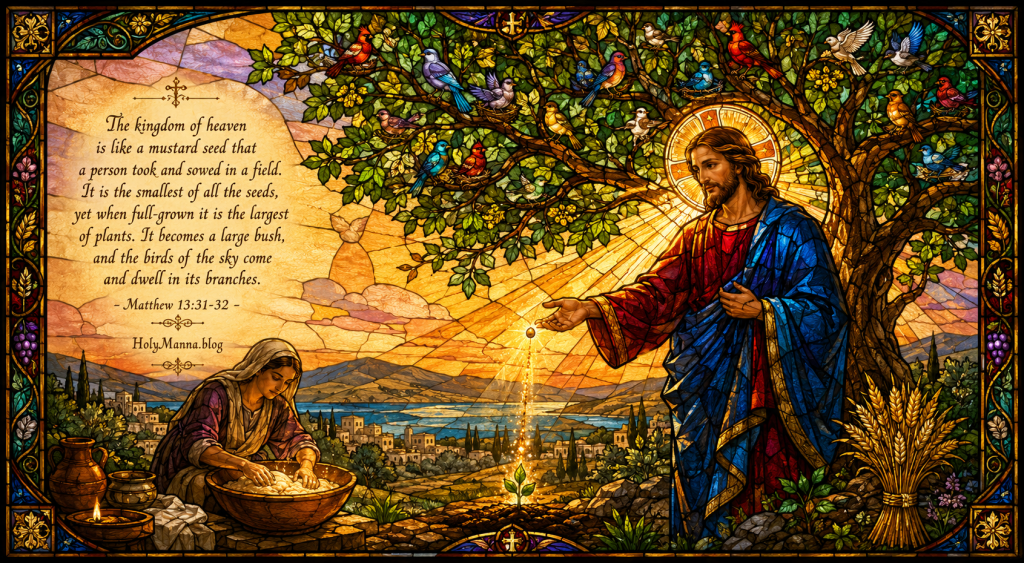
After the sorrow of Jeremiah and the Song of Moses, the Gospel arrives like sunrise. Jesus is in the middle of the great parable discourse of Matthew 13, teaching the crowds beside the Sea of Galilee, and He offers two miniature parables, each a single sentence, each drawn from the most ordinary corners of village life: a farmer’s field and a woman’s kitchen. The mustard seed was proverbial in Jewish speech for the smallest thing imaginable, yet the black mustard plant of Galilee grows into a bush taller than a man. The image of birds dwelling in its branches deliberately echoes Ezekiel 17:23 and Daniel 4, where a great tree sheltering the birds of the air symbolizes a kingdom gathering the nations. The leaven parable hides a joke of extravagance: three measures of flour is an enormous quantity, roughly enough bread for a hundred people, the same amount Sarah kneaded for her heavenly guests in Genesis 18:6. These parables answer the day’s theme from the other side. What rots when detached from God flourishes beyond all proportion when joined to Him.
Matthew 13:31-35 – New American Bible (Revised Edition)
31 He proposed another parable to them. “The kingdom of heaven is like a mustard seed that a person took and sowed in a field. 32 It is the smallest of all the seeds, yet when full-grown it is the largest of plants. It becomes a large bush, and the ‘birds of the sky come and dwell in its branches.’”
The Parable of the Yeast. 33 He spoke to them another parable. “The kingdom of heaven is like yeast that a woman took and mixed with three measures of wheat flour until the whole batch was leavened.”
The Use of Parables. 34 All these things Jesus spoke to the crowds in parables. He spoke to them only in parables, 35 to fulfill what had been said through the prophet:
“I will open my mouth in parables,
I will announce what has lain hidden from the foundation [of the world].”
Detailed Exegesis
Verse 31: “He proposed another parable to them. ‘The kingdom of heaven is like a mustard seed that a person took and sowed in a field.’” The Kingdom begins with a deliberate act of sowing, small, intentional, and easily overlooked. The Fathers saw in the sower Christ Himself, planting His word, and ultimately His own life, into the field of the world.
Verse 32: “It is the smallest of all the seeds, yet when full-grown it is the largest of plants. It becomes a large bush, and the ‘birds of the sky come and dwell in its branches.’” Jesus speaks in the proverbial language of His hearers, for whom the mustard seed was the byword for smallness. The birds dwelling in the branches, echoing Ezekiel 17:23, promise that this Kingdom will shelter the nations, the very “no-people” of today’s canticle finding a home in God at last.
Verse 33: “He spoke to them another parable. ‘The kingdom of heaven is like yeast that a woman took and mixed with three measures of wheat flour until the whole batch was leavened.’” Yeast works invisibly, from within, transforming the whole mass without replacing it. The astonishing quantity of flour signals a feast of biblical proportions, and the woman’s hidden kitchen work dignifies every unseen labor done for the Kingdom.
Verse 34: “All these things Jesus spoke to the crowds in parables. He spoke to them only in parables,” Matthew pauses the parables to explain the method itself. Jesus wraps divine mysteries in ordinary images so that hearts willing to ponder can enter, while hardened hearts pass by unaware, a mercy that meets each listener exactly where his openness allows.
Verse 35: “to fulfill what had been said through the prophet: ‘I will open my mouth in parables, I will announce what has lain hidden from the foundation [of the world].’” Matthew quotes Psalm 78:2, presenting Jesus as the definitive revealer of God’s hidden plan. The mysteries of the Kingdom are not late improvisations; they have lain in the heart of God from before creation, waiting for the mouth of the Son to announce them.
Teachings
The Catechism teaches in CCC 543: “Everyone is called to enter the kingdom. First announced to the children of Israel, this messianic kingdom is intended to accept men of all nations. To enter it, one must first accept Jesus’ word.” The birds of every feather nesting in the mustard bush are precisely this universal welcome. On the method of the parables, CCC 546 teaches: “Jesus’ invitation to enter his kingdom comes in the form of parables, a characteristic feature of his teaching. Through his parables he invites people to the feast of the kingdom, but he also asks for a radical choice: to gain the kingdom, one must give everything. Words are not enough; deeds are required.” St. John Chrysostom, preaching on this passage in his Homily 46 on Matthew, saw the seed as an image of the apostles themselves: “For his disciples were weakest of all and least of all. Nevertheless, because of the great power that was in them, it has grown and been unfolded in every part of the world.” History proved him right; twelve ordinary men from Galilee became a Church of every nation. And on the leaven, the Catechism makes the image intimate in CCC 2660, teaching that it is important “to bring the help of prayer into humble, everyday situations; all forms of prayer can be the leaven to which the Lord compares the kingdom.” The kitchen, the commute, and the cubicle are all dough waiting to rise.
Reflection
These parables rescue believers from the tyranny of visible results. God’s ordinary way of working is small, slow, and hidden, which means the smallest faithful acts carry real Kingdom weight. Consider choosing one hidden act of charity each day this week, done with no possibility of recognition, as deliberate leaven in the dough of daily life. Consider also planting one mustard seed of evangelization, perhaps simply mentioning Sunday Mass naturally in a conversation or offering to pray for a coworker who is struggling, and then trusting God with the growth. Patience with slow spiritual progress, in oneself and in loved ones who have drifted from the faith, is itself an act of faith in these parables. Where in your life have you given up on something small because you could not yet see it growing? What hidden act of love could you mix into today like yeast into flour? Do you truly believe God can build something great from the little you have to offer Him?
Cling to Him, and Watch What Grows
Today’s readings tell one story in two movements, and the hinge between them is closeness to God. Jeremiah’s loincloth, buried far from the body it was made to cling to, rotted into uselessness, and the Song of Moses names the quiet tragedy behind that rot, a people who simply forgot the God who gave them birth. It is the oldest sorrow in the covenant, and it still happens one distracted, ungrateful, idol-cluttered day at a time.
But then Jesus steps forward with a seed in one hand and a pinch of yeast in the other, and everything changes. What remains joined to God does not rot. It grows, secretly and unstoppably, from the smallest beginning into a bush where every bird of the sky can build a nest, into bread enough for a feast. The same hiddenness that concealed Judah’s decay becomes, in the Kingdom, the hiddenness of grace at work, announcing what has lain hidden from the foundation of the world.
So the invitation of this Monday in Ordinary Time is wonderfully simple. Stay close. Cling to God the way that garment was meant to cling, through daily prayer, frequent Confession, gratitude that refuses to forget, and the Eucharist that presses the faithful against the very Body of the Lord. Then plant the small things without anxiety, the short prayer, the unseen kindness, the gentle word about the faith, and trust the God who specializes in mustard seeds. He made His people to be His praise and His glory, and He has never stopped wanting them near. The only question left is whether His people will listen this time, and the answer begins today.
Engage With Us!
The conversation does not end here, and every reflection shared helps another reader grow closer to Christ. Please share your thoughts, experiences, and prayers in the comments below; this community becomes richer every time someone speaks up.
- In Jeremiah 13:1-11, God says He made His people cling to Him as a loincloth clings to the body, yet they did not listen. What attachment, habit, or idol in your life has quietly pulled you away from clinging to God, and what is one concrete step you can take this week to draw close again?
- In Deuteronomy 32:18-21, Israel is accused of forgetting the God who gave them birth. What daily practice of gratitude could you adopt to make sure you never become unmindful of the Rock who made you?
- In Matthew 13:31-35, Jesus compares the Kingdom to a mustard seed and to yeast hidden in flour. What is one small, hidden act of faith or love you can plant this week, trusting God to give the growth?
- Taking all the readings together, today’s liturgy teaches that what detaches from God decays, while what remains joined to Him grows beyond all expectation. Where is God inviting you to trade a rotting attachment for a living seed?
Living a life of faith is not built from grand gestures but from small seeds planted daily and yeast worked quietly into ordinary hours. Stay close to the Lord, remember the God who gave you birth, and do everything, the seen and the unseen alike, with the love and mercy Jesus taught us.
Sacred Heart of Jesus, we trust in You!
Immaculate Heart of Mary, pray for us!
Saint Michael the Archangel, defend us in battle!
Follow us on YouTube, TikTok, Instagram and Facebook for more insights and reflections on living a faith-filled life.


Leave a Reply