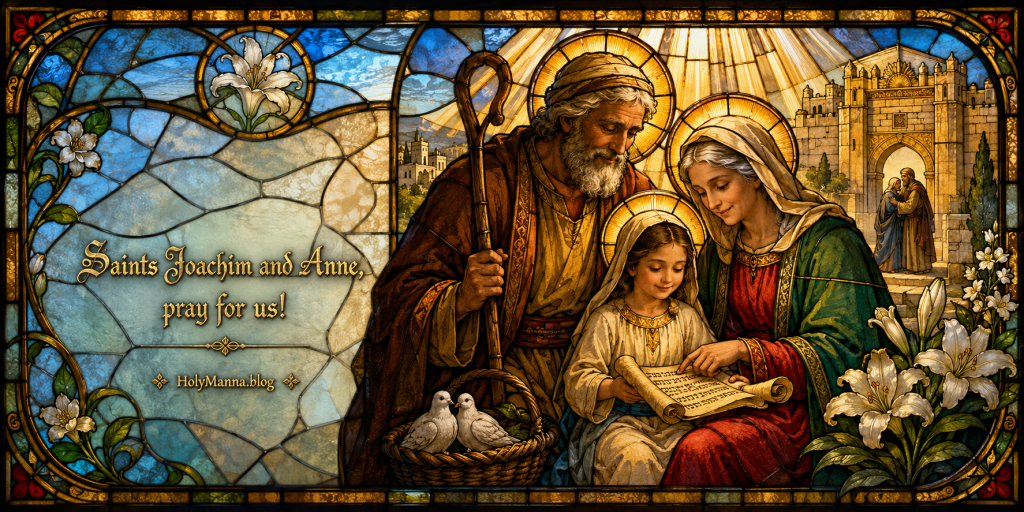
The Grandparents of God
Every family tree has quiet branches, the people whose names rarely come up but without whom nothing else would exist. In the family tree of salvation, those quiet branches are named Joachim and Anne. The Church honors them together on July 26th as the parents of the Blessed Virgin Mary and, therefore, the grandparents of Jesus Christ. Think about that for a moment. Somewhere in first century Israel, an ordinary married couple rocked a baby girl to sleep, taught her to pray the Psalms, and formed her heart so completely that when the angel Gabriel arrived years later, she was ready to say yes to God on behalf of the entire human race.
Here is the honest and fascinating part: the Bible never mentions Joachim or Anne by name. Everything the Church knows about them comes from early Christian tradition, and the Church has always been careful to distinguish that tradition from the inspired Word of God. Yet the theological reality behind their names is absolutely certain. Mary had parents. Those parents were part of God’s long, patient preparation of Israel for the coming of His Son. The Catechism teaches that “Throughout the Old Covenant the mission of many holy women prepared for that of Mary” and that Mary herself stands “at the summit” of this line of the humble and poor who awaited salvation (CCC 489). Joachim and Anne stand at the threshold of that summit.
Their intercession has been sought for centuries, and their patronages reflect the shape of their lives. Saint Anne is the patroness of mothers, grandmothers, women in labor, childless couples, miners, cabinetmakers, and sailors, and she is the principal patroness of Brittany in France and of the province of Quebec in Canada. Saint Joachim is the patron of fathers, grandfathers, and grandparents, and married couples have long invoked his prayers. Together, they are the heavenly champions of every hidden, faithful family.
A Long Wait in Nazareth
Since Scripture is silent about Mary’s parents, the earliest account of their lives comes from a text called the Protoevangelium of James, written around the year 150. The Church has never accepted this document as inspired Scripture, and its details cannot be treated as verified history. But the names Joachim and Anne, and the broad outline of their story, entered Christian devotion so early and so universally, in both East and West, that the Church made their veneration her own. What follows, then, is told as the ancient tradition hands it down, not as documented fact.
According to that tradition, Joachim was a devout and prosperous man of Israel, generous to the poor and faithful in his offerings to the Temple. His wife Anne, whose name comes from the Hebrew Hannah, meaning grace, matched him in piety. Later traditions attach various birthplaces to them, including Nazareth, Jerusalem, Bethlehem, and Sepphoris, and the sources conflict with one another; none of these claims can be verified.
The heart of the story is their suffering. Joachim and Anne were married for some twenty years without a child. In ancient Israel, childlessness was widely seen as a mark of divine disfavor, a public shame carried in private grief. The tradition says that Joachim brought his offering to the Temple and was turned away because he had produced no offspring for Israel. Crushed, he withdrew into the wilderness, where he fasted and prayed for forty days and forty nights, refusing to return home until the Lord answered him. Anne, alone, poured out her own lament, grieving that even the birds of the air had their young while she had none. Then, the tradition continues, an angel of the Lord appeared separately to each of them with the same message: Anne would conceive, and their child would be spoken of in the whole world. The couple ran to meet each other at the Golden Gate of Jerusalem, embracing in a joy that Christian art would depict for centuries. In due time Anne bore a daughter and named her Mary. This entire narrative comes from the Protoevangelium of James and later tradition, and it cannot be verified.
Anyone who knows the Old Testament will hear the echoes at once, and that is precisely the point the early Christians were making. Anne’s story mirrors that of her namesake Hannah, the mother of the prophet Samuel, who wept before the Lord at the sanctuary and prayed, as 1 Samuel 1 records, “O Lord of hosts, if you will indeed look on the affliction of your maidservant, and remember me… then I will give him to the Lord all the days of his life” (1 Sam 1:11). Like Hannah, and like Sarah and Elizabeth, Anne stands in the great biblical line of barren women through whom God works His most fruitful wonders. The Catechism gathers this whole lineage together, teaching that Mary “stands out among the poor and humble of the Lord, who confidently hope for and receive salvation from him” (CCC 489). The daughter of Joachim and Anne would be the flowering of every one of those ancient hopes.
One doctrinal point deserves crystal clarity, because confusion about it is common. The Church teaches that Mary was immaculately conceived, and that conception happened in the womb of Saint Anne. The Immaculate Conception does not mean that Anne conceived Mary virginally; it means that Mary, conceived in the ordinary way by her parents, was preserved from the stain of original sin from the first instant of her existence. The Catechism states it plainly: “Through the centuries the Church has become ever more aware that Mary, ‘full of grace’ through God, was redeemed from the moment of her conception” (CCC 491). In other words, the single greatest miracle of grace ever worked in a merely human person took place hidden inside the body of Saint Anne, and neither she nor Joachim likely ever knew it.
Raising the Ark of the New Covenant
No miracles are recorded as performed by Joachim or Anne during their lifetimes, and not a single word either of them spoke has been preserved in any verified source. That silence is not a defect in their story. It is their story. Their greatness lies not in wonders worked but in a person formed. The Church Fathers understood that when God prepared to enter the world, He did not bypass the ordinary machinery of family life; He sanctified it. Somebody taught Mary the Shema. Somebody taught her the Psalms she would later weave into her Magnificat. Somebody modeled for her what trusting obedience to God looked like, day after unremarkable day. Tradition gives those somebodies the names Joachim and Anne.
Saint John Damascene, the great eighth century Doctor of the Church, preached a homily on the Nativity of Mary that the Church still reads in the Office of Readings on this very feast, and his words remain the most beautiful verified tribute ever paid to this couple: “Joachim and Anne, how blessed a couple! All creation is indebted to you. For at your hands the Creator was offered a gift excelling all other gifts: a chaste mother, who alone was worthy of him.” He goes on to measure their holiness by the only evidence that exists, their daughter: “Joachim and Anne, how blessed and spotless a couple! You will be known by the fruit you have borne, as the Lord says: ‘By their fruits you will know them.’”
That standard, drawn from The Gospel of Matthew (Mt 7:16), is worth sitting with. The world measures a life by output, visibility, and achievement. God, apparently, is content to measure a life by what it quietly makes possible in someone else. Joachim and Anne matter because they show every parent, grandparent, godparent, and mentor that the most consequential work a person can do may never be seen by anyone. The Catechism teaches that “The Christian family constitutes a specific revelation and realization of ecclesial communion, and for this reason it can and should be called a domestic church” (CCC 2204). Joachim and Anne ran the first and greatest domestic church, the home in which the Mother of God learned to love God.
Tradition adds one final scene to their parenting: the Presentation of Mary in the Temple. According to the same ancient sources, when Mary was about three years old, Joachim and Anne brought her to the Temple in Jerusalem and offered her to the Lord, fulfilling the promise they had made in their years of longing. The Church commemorates this event liturgically on November 21st, while acknowledging that the account itself comes from tradition rather than Scripture and cannot be verified. Whether or not the details happened exactly that way, the gesture captures the couple perfectly. They had waited twenty years for this child, and their first great act was to give her back to God.
The Hardship of the Empty Cradle
Joachim and Anne were not martyrs, and the Church does not present them as such. Their cross took a quieter, longer shape: two decades of unanswered prayer. Anyone who has ever begged God for something good and heard only silence knows the particular weight of that trial. It is not the sharp pain of persecution but the grinding ache of hope deferred, made heavier in their case by a culture that read their empty cradle as a verdict from heaven.
The tradition of Joachim being turned away from the Temple, whether or not it happened historically, captures something painfully real. There are seasons when faithful people feel rejected precisely in the place where they came seeking God, judged by their community for a suffering they never chose. Joachim’s response, as the tradition tells it, was not to abandon the Temple, curse God, or quit. He went deeper. He took his anguish into the wilderness and fasted and prayed harder. Anne did the same at home. They aimed their pain directly at God rather than away from Him.
This is exactly the school of prayer that The Catechism describes when it addresses the battle of perseverance: “Prayer is both a gift of grace and a determined response on our part. It always presupposes effort” (CCC 2725). And again, on the temptation to give up when prayer seems to fail: “Trustful boldness” and “filial trust is tested… in tribulation” (CCC 2610, CCC 2734). Joachim and Anne passed through that testing over a span of years that would break most people, and the answer God finally gave them was immeasurably greater than the request. They asked for a child. They received the Mother of God.
There is a lesson buried here that a younger generation especially needs to hear, in an age that treats waiting as a system failure. God’s delays are not God’s denials. The twenty silent years were not wasted time; they were the forge in which was hammered out the kind of faith capable of raising a daughter who would one day tell an angel, as The Gospel of Luke records, “Behold, I am the handmaid of the Lord; let it be to me according to your word” (Lk 1:38). Mary’s yes did not come from nowhere. It came from a home where yes to God had been practiced through disappointment for a very long time.
Crutches on the Pillars
Devotion to Saint Anne is astonishingly old. In the East, the Emperor Justinian built a church in her honor in Constantinople around the year 550, and the Eastern churches have celebrated the conception of Mary by Anne for well over a millennium. In the West, devotion grew steadily through the Middle Ages until Anne became one of the most beloved saints in Europe. One famous and well documented historical episode shows just how deep that devotion ran: in the year 1505, a young German law student caught in a violent thunderstorm cried out in terror, “Help me, Saint Anne, I will become a monk!” His name was Martin Luther. Whatever came afterward in his story, the instinct of that moment testifies that when medieval Christians feared for their lives, Grandmother Anne was the name on their lips.
Her feast was extended to the entire Latin Church by Pope Gregory XIII in 1584. Joachim’s feast took a more winding road through the calendar, introduced by Pope Julius II, later removed, then restored by Pope Gregory XV in 1622, and moved several times, until the calendar reform of 1969 finally united husband and wife on July 26th, where they have remained together ever since, which seems only right.
The miracles attributed to their intercession cluster around two of the most remarkable shrines in the Catholic world. The first is Sainte-Anne-de-Beaupré in Quebec, Canada, founded in 1658 and today one of the largest pilgrimage destinations in North America. The shrine’s own annals record that in that founding year, a local laborer named Louis Guimont, so crippled by rheumatism that he could barely move, insisted on placing three stones in the new church’s foundation out of devotion to Saint Anne, and was instantly and completely healed. That healing, recorded in the parish records, opened a flood that has never stopped. The great basilica’s interior pillars are famously covered with crutches, canes, and braces left behind by pilgrims who walked out without them. These individual healings are acts of devotion and testimony; apart from the documented Guimont account in the shrine annals, they cannot be individually verified. Each July, the shrine also welcomes a major pilgrimage of First Nations Catholics, who have honored Saint Anne as “Grandmother” for centuries, and in 1876 Blessed Pope Pius IX declared her the patroness of the province of Quebec.
The second great shrine is Sainte-Anne-d’Auray in Brittany, France. Between 1623 and 1625, a Breton peasant farmer named Yves Nicolazic reported repeated apparitions of Saint Anne, who asked him to rebuild a chapel that had once stood on his land. Following her indications, diggers reportedly unearthed an ancient statue on the very spot. After investigation, the Bishop of Vannes approved the devotion in 1625, giving these apparitions official diocesan approval. The shrine that rose there became the spiritual heart of Brittany, and its Grand Pardon pilgrimage every July 26th remains the largest in the region, drawing tens of thousands of pilgrims.
Pilgrims also venerate St. Anne’s Church in Jerusalem, a stunning Crusader era basilica built beside the Pool of Bethesda at the site that tradition identifies as the home of Joachim and Anne and the birthplace of Mary; the identification rests on tradition and cannot be verified. Regarding relics, the honest picture is complicated. The city of Apt in Provence has an ancient tradition that relics of Saint Anne were brought to Gaul in early Christian times and rediscovered in the age of Charlemagne, while Düren in Germany has venerated a head relic of Saint Anne since 1506. These claims overlap and conflict, and none of them can be verified; they are recounted here as the traditions of those places.
The couple’s cultural reach continues into the present day. In 2021, Pope Francis instituted the World Day for Grandparents and the Elderly, celebrated each year on the fourth Sunday of July, deliberately placed beside this feast, so that the whole Church now honors living grandparents in the shadow of the grandparents of the Lord.
What the Grandparents of Jesus Teach a Generation in a Hurry
The lives of Joachim and Anne land differently depending on where a person is standing, and that is part of their genius as saints for this moment.
For anyone carrying an unanswered prayer, they are proof that God’s silence is not God’s absence. Their twenty years of waiting were, unknown to them, the runway for the Incarnation. How might God be using a season of waiting right now to prepare something that cannot yet be seen? The invitation is not to pretend the waiting does not hurt; Joachim fasted in the wilderness precisely because it hurt. The invitation is to keep aiming the hurt at God.
For parents, the couple reframes the entire vocation. The Catechism teaches that “Parents have the first responsibility for the education of their children” and that they “bear witness to this responsibility first by creating a home where tenderness, forgiveness, respect, fidelity, and disinterested service are the rule” (CCC 2223). No parenting achievement on a résumé will ever outrank that hidden work. Joachim and Anne never saw most of what their daughter would become. They simply built the home, and God did the rest. What is one concrete habit of prayer or tenderness that could be added to family life this week?
For grandparents, and for the many young adults who owe their faith to one, this feast is practically a personal holiday. Saint Paul wrote to Timothy, in The Second Letter to Timothy, “I am reminded of your sincere faith, a faith that dwelt first in your grandmother Lois and your mother Eunice and now, I am sure, dwells in you” (2 Tim 1:5). Faith very often travels exactly that route, skipping and looping across generations through a grandmother’s rosary or a grandfather’s quiet example. Who handed the faith down, and has that person ever been thanked, in person or in prayer? The fourth commandment, The Catechism reminds us, extends honor to the elderly and calls families to surround them with care and gratitude (CCC 2218).
And for everyone who feels anonymous, unimportant, or invisible, Joachim and Anne are the patron saints of the uncredited. They appear in no Gospel, spoke no recorded word, worked no recorded miracle, and yet the entire drama of salvation passed through their living room. Faithfulness in hidden places is never wasted. God has a long memory and a habit of building His greatest works on foundations nobody was watching.
A simple way to live this feast: call or visit a grandparent or an elderly member of the parish; pray for couples struggling with infertility, entrusting them to Anne’s intercession; and bring one long abandoned prayer intention back to God with the stubborn hope of Joachim in the wilderness.
Engage With Us!
The story of Saints Joachim and Anne belongs to every family that has ever waited on God, and every reader has a piece of that story to tell. Share thoughts, memories, and reflections in the comments below; this community grows stronger every time someone speaks up about how God has worked through the hidden people in their lives.
- Who in your own family tree quietly handed the faith down to you, and how can you honor that person this week?
- Joachim and Anne waited twenty years for an answered prayer. What unanswered prayer are you tempted to give up on, and what would it look like to bring it back to God with renewed trust?
- If your holiness were measured, as Saint John Damascene suggests, “by the fruit you have borne,” what fruit is your daily life producing in the people closest to you?
- The home of Joachim and Anne was the first “domestic church” (CCC 2204). What is one concrete change that could make your home a truer place of prayer, tenderness, and forgiveness?
- Pope Francis placed the World Day for Grandparents and the Elderly beside this feast. Which elderly person in your parish or neighborhood might God be asking you to visit, call, or serve this month?
Saints Joachim and Anne prove that no act of faithfulness is ever too small, too hidden, or too ordinary for God to use in a magnificent way. Whatever this season holds, whether the joy of the Golden Gate or the long silence of the wilderness, keep showing up, keep praying, keep loving the people God has placed nearby. Do everything, in the home and far beyond it, with the love and mercy that Jesus taught us, and trust that God is already weaving that quiet faithfulness into a story far bigger than anyone can see. Saints Joachim and Anne, pray for us!
Saints Joachim and Anne, pray for us!
Follow us on YouTube, TikTok, Instagram and Facebook for more insights and reflections on living a faith-filled life.


Leave a Reply