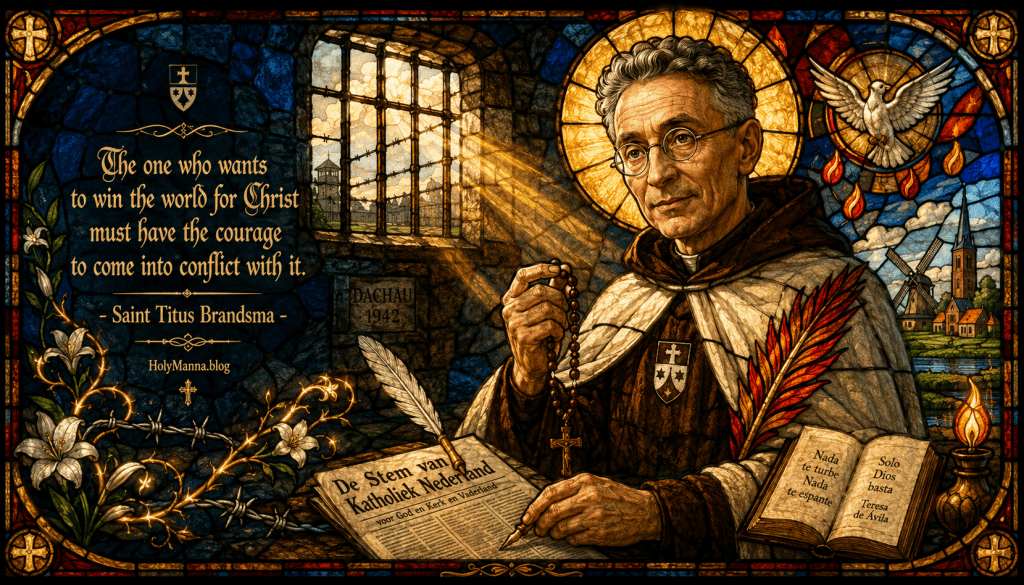
The Journalist Who Would Not Print a Lie
Some saints feel distant, wrapped in centuries of incense and stained glass. Saint Titus Brandsma is not one of them. He rode trains. He gave lectures. He wrote newspaper columns on deadline. He wore round spectacles, smoked a pipe, and was famous among his students for never turning anyone away from his office door. And on July 26th, 1942, in the infirmary of the Dachau concentration camp, a nurse ended his life with a lethal injection because he had refused, calmly and repeatedly, to let the Catholic press of the Netherlands print Nazi propaganda. The Church celebrates his memorial on July 27th, the day after his death, since July 26th belongs to Saints Joachim and Anne, and the Carmelite Order keeps his memory with particular devotion as one of its own.
Titus Brandsma was a Carmelite priest, a professor of philosophy, a scholar of mysticism, and a working journalist, and it is that last vocation that gives him his patronage. He is the patron of Catholic journalists, a title rooted in his 1935 appointment as ecclesiastical adviser to the Catholic journalists of the Netherlands and confirmed by the witness of his martyrdom. He was beatified as a martyr by Pope John Paul II on November 3rd, 1985, and canonized by Pope Francis on May 15th, 2022, after a miraculous healing that reads like something out of his own beloved mystical tradition. The Catechism of the Catholic Church teaches that “martyrdom is the supreme witness given to the truth of the faith: it means bearing witness even unto death” (CCC 2473). Titus Brandsma bore that witness with a pen in his hand and forgiveness on his lips, and his story belongs to anyone who has ever wondered whether the truth is worth the trouble it causes.
The Boy Who Took His Father’s Name
Anno Sjoerd Brandsma was born on February 23rd, 1881, in Oegeklooster, a tiny farming hamlet just outside the town of Bolsward in Friesland, the stubbornly distinct northern province of the Netherlands with its own language and its own fierce identity. Many references list Bolsward itself as his birthplace, and both claims point to the same patch of Frisian farmland. His parents, Titus Brandsma and Tjitsje Postma, ran a dairy farm and raised six children in a Catholic faith that was anything but casual. Friesland was overwhelmingly Protestant, and the Brandsma family belonged to a Catholic minority that had learned to hold its faith with quiet tenacity. That tenacity bore remarkable fruit: five of the six Brandsma children entered religious life.
Anno was small, frail, and relentlessly bright. At age eleven he left home for minor seminary, and in September 1898, at seventeen, he entered the Carmelite novitiate at Boxmeer. There he took a new name, and the choice tells you everything about the man: he took Titus, his own father’s name, binding his religious vocation to the farm and the family that had formed him. He professed first vows in 1899 and was ordained a priest on June 17th, 1905.
His superiors sent him to Rome, where he earned a doctorate in philosophy in 1909. Back in the Netherlands he threw himself into a working life that would exhaust three ordinary men. He taught at the Carmelite house in Oss. He founded and edited journals. He undertook the translation of the works of Saint Teresa of Ávila into Dutch, planting the Spanish mystics deep in the soil of Dutch Catholic life. In 1923 he helped found the Catholic University of Nijmegen, where he became professor of philosophy and of the history of mysticism, and in 1932 the university elected him Rector Magnificus, its highest academic office. Contemporary Carmelite accounts remember one detail above all his titles: he was noted for his constant availability to everyone. Students, journalists, strangers, and the poor all found his door open. He crossed the Atlantic in 1935 to deliver lectures on Carmelite mysticism in the United States, and in that same year the Archbishop of Utrecht appointed him ecclesiastical adviser to the Catholic journalists of the Netherlands. That appointment, which must have seemed like one more committee assignment in a crowded life, would cost him everything.
The Professor Who Saw the Lie Coming
What makes Titus Brandsma matter is not simply that he died at Dachau. It is that he saw the evil of National Socialism clearly, named it early, and opposed it publicly while it was still profitable and safe for others to look away. As early as the 1930s, years before the German invasion, he was lecturing and writing against Nazi ideology, identifying its racial theories as fundamentally incompatible with the Gospel. When anti-Jewish regulations began to press on Dutch life, he defended the right of Jewish students to remain in Catholic schools. This was not abstract philosophy. It was the concrete application of what the Church teaches, that every human person is created in the image of God and that “the equal dignity of persons requires the effort to reduce excessive social and economic inequalities” and to eliminate every form of unjust discrimination (CCC 1935, CCC 1938).
His famous saying, preserved in the Carmelite tradition and translated from the Dutch, distills his whole approach: “Those who want to win the world for Christ must have the courage to come into conflict with it.” Notice what that sentence does not say. It does not glorify conflict for its own sake. Brandsma was by every account a gentle, cheerful, almost disarmingly friendly man. The courage he described was the courage to accept conflict as the price of love, and the Catechism calls that virtue fortitude, “the moral virtue that ensures firmness in difficulties and constancy in the pursuit of the good”, the virtue that “enables one to conquer fear, even fear of death, and to face trials and persecutions” (CCC 1808).
There are no wonder stories attached to his working years, no multiplications or levitations, and honesty requires saying so plainly. The marvel of his life before Dachau was of a quieter kind: a frail man with chronic ill health who taught, wrote, edited, translated, founded, traveled, and still had time for every person who knocked. He lived what the Church teaches about the vocation of those who work in the media, that “the information provided by the media is at the service of the common good” and that “society has a right to information based on truth, freedom, justice, and solidarity” (CCC 2494). For Brandsma, a Catholic newspaper that printed lies was a contradiction in terms, and he was about to be asked to accept exactly that contradiction.
Prisoner 58286
When Germany occupied the Netherlands in May 1940, the pressure on the Catholic press began almost immediately. By late 1941 the occupation authorities demanded that Dutch newspapers, including Catholic ones, accept Nazi advertisements and propaganda. The Dutch bishops, led by Archbishop Johannes de Jong of Utrecht, refused, and it was Titus Brandsma, as adviser to the Catholic journalists, who personally carried the archbishop’s directive to newspaper editors across the country, visiting them one by one through the winter to strengthen them in their refusal. The occupiers were watching. On January 19th, 1942, the Sicherheitsdienst arrested him in Nijmegen.
He was taken to the prison at Scheveningen, the notorious Oranjehotel where Dutch political prisoners were held. The Nazis offered him a way out: he could live quietly in a monastery if he would publicly announce that Catholic newspapers should accept Nazi propaganda. He refused. Instead, invited by his interrogator to explain the Dutch Catholic position in writing, he composed a calm, lucid defense of why the Dutch people, and Catholics above all, resisted the Nazi movement. The interrogator, Captain Hardegen, concluded in his official report that Brandsma was genuinely a man of firm convictions who wanted to protect Christianity against National Socialism, that he was anti-Nazi in principle and showed it everywhere, and he recommended that this dangerous little friar be sent onward to the camps. The Nazis understood him perfectly. They simply could not bend him.
What Brandsma did inside his cell is one of the treasures of twentieth century Catholic spirituality. Deprived of the Mass, he made daily spiritual communions. He wrote a biography of Saint Teresa of Ávila from memory. He wrapped the chessboard in his cell with packing paper and fixed to it small pictures from his breviary, so that an image of Christ crucified stood before him as he wrote. On the wall of his cell he copied out, from memory and with visible corrections in the surviving autograph, the famous prayer of Saint Teresa: “Let nothing disturb thee, let nothing frighten thee. All things are passing. God does not change. Who possesses God wants for nothing. God alone suffices.” And on February 12th and 13th, 1942, he wrote a poem before that little picture of Jesus, a poem that was smuggled out of the prison, circulated across the occupied Netherlands, and has since been translated into many languages. Two manuscripts survive in the Carmelite archives at Boxmeer. Rendered in English from the Dutch, its opening confesses: “O Jesus, when I gaze on You, I know again that You love me, and that Your friendship will not end; You look on me as on a friend.” In the loneliness of a Nazi prison, this professor of mysticism discovered that everything he had taught was true.
In March he was transferred to the brutal transit camp at Amersfoort, where fellow prisoners later testified that he quietly heard confessions, comforted the despairing, and even gave a clandestine series of talks on the mystics. After further transfers he arrived in June 1942 at Dachau, the concentration camp where the Nazis gathered thousands of priests into the infamous priest blocks. He was now Prisoner 58286. He was sixty one years old, chronically ill, and subjected to forced labor, starvation rations, and beatings. Witnesses from Dachau who survived testified during his cause that he shared his scraps of bread, urged his fellow prisoners to pray for their guards, and kept his unbreakable Frisian cheerfulness even there. Within weeks his body gave out, and he was moved to the camp infirmary, a place prisoners rightly feared, since the doctors there conducted medical experiments on the sick.
On July 26th, 1942, on the order of the authorities, a camp nurse administered a lethal injection of carbolic acid, and Titus Brandsma died within minutes. His body was cremated at Dachau, most likely the following day, which is why no bodily relics of the saint exist; his relics are second class, taken from his clothing. The Church examined his death for decades and answered without ambiguity. The diocesan process opened at Den Bosch in 1952, the first cause of a presumed martyr of National Socialism, and on November 3rd, 1985, Pope John Paul II beatified him as a true martyr, killed in hatred of the faith. His martyrdom is exactly what the Catechism describes: the martyr “bears witness to Christ who died and rose, to whom he is united by charity” and “endures death through an act of fortitude” (CCC 2473).
The Nurse’s Rosary and the Cancer That Vanished
The most astonishing story of Titus Brandsma’s death concerns the woman who killed him, and it is not a pious embellishment; it comes from sworn testimony given during his beatification process by the nurse herself, who testified under the protective name Titia. She was a lapsed Catholic turned atheist who, by her own admission, openly despised priests. In his final days Brandsma treated her with unfailing gentleness, at one point pressing his simple wooden rosary into her hand. She protested that she could not pray and no longer believed. He told her she did not need to say the whole prayer; she needed only to pass from bead to bead and say “pray for us sinners.” Not knowing what to do with the rosary, she kept it in her apron pocket. On the day she administered the fatal injection she felt, she testified, nervous and irritated, and some time afterward she was pierced with emotion when she came upon that rosary again. In her testimony she attributed her abandonment of Nazi ideology and her return to the Catholic faith to Titus Brandsma. His last apostolate was the conversion of his executioner, a living icon of the Lord’s command, which the Catechism echoes when it teaches that Christian prayer “extends to the forgiveness of enemies” and transfigures the disciple by configuring him to his Master (CCC 2844).
For decades the faithful sought his intercession, and the miracle that opened the door to his canonization arrived through a brother Carmelite. In 2004, Father Michael Driscoll, a Carmelite priest serving in Boca Raton, Florida, was diagnosed with advanced metastatic melanoma, a stage 4 cancer that had spread from his scalp into his neck. Surgeons performed an eleven hour operation, removing the tumor along with eighty four lymph nodes and a salivary gland, followed by thirty five radiation treatments, and his doctors told him frankly that this cancer nearly always returns and that most patients in his condition die within five to ten years. Father Driscoll had been present at the 1985 beatification and regarded Titus Brandsma as his hero. A fellow priest gave him a second class relic, a small patch of black cloth from Brandsma’s tunic, and every day he held it to his forehead and asked Titus to take care of him. The cancer never returned. Years later his own physician told him there was no need to come back, because no cancer could be found in him. The Diocese of Palm Beach conducted a formal investigation lasting more than a year, interviewing his physicians and reviewing the medical records, and sent over twelve hundred pages of documentation to Rome in 2017. Vatican medical consultants found no natural explanation, a congress of theologians affirmed the healing as a miracle, and on November 25th, 2021, Pope Francis signed the decree recognizing it. On May 15th, 2022, in Saint Peter’s Square, Pope Francis canonized Saint Titus Brandsma. In a detail almost too fitting to believe, Father Driscoll, alive and healthy, attended the canonization and then concelebrated the saint’s first feast day Mass on July 27th, 2022, exactly eighty years after the martyrdom. At the canonization Pope Francis preached that holiness does not consist in a few heroic gestures but in “many small acts of daily love.”
This is what the Church means when she canonizes: “by canonizing some of the faithful, i.e., by solemnly proclaiming that they practiced heroic virtue and lived in fidelity to God’s grace, the Church recognizes the power of the Spirit of holiness within her and sustains the hope of believers by proposing the saints to them as models and intercessors” (CCC 828). And the saints do intercede, for “they do not cease to intercede with the Father for us” and “their intercession is their most exalted service to God’s plan” (CCC 956). Devotion to Saint Titus flourishes today. His major shrine is the Titus Brandsma Memorial in Nijmegen, the university city where he taught, and pilgrims also seek him in his native Friesland, where a museum in Bolsward preserves his memory. The Titus Brandsma Institute at Nijmegen continues his scholarly work on mysticism, and in the Netherlands he stands as a national figure of conscience, the little Frisian friar who would not bend. A Carmelite monastery of nuns keeps prayerful vigil at Dachau itself, on the edge of the former camp, so that the ground of his martyrdom is now, quite literally, Carmel.
Standing in the Truth When the Truth Costs Something
Saint Titus Brandsma is uncomfortably relevant, and that is precisely his gift. He lived in an age drowning in propaganda, when powerful voices insisted that some human beings mattered less than others and that the press existed to serve power rather than truth. His resistance did not begin at Dachau. It began decades earlier, in classrooms and newspaper columns and ordinary daily choices, long before anyone was watching. That is the pattern worth imitating, because fortitude in the great moment is built out of fidelity in a thousand small ones, those many small acts of daily love that Pope Francis named at his canonization.
Consider where this touches your own life. You may never face a concentration camp, but you face, every single day, the quiet pressure to shade the truth, to share what is convenient rather than what is honest, to stay silent when someone’s dignity is trampled in a meeting, a group chat, or a comment thread. The Catechism teaches that “all Christians by the example of their lives and the witness of their word, wherever they live, have an obligation to manifest the new man which they put on in Baptism” (CCC 2472). Where in your daily life are you tempted to trade the truth for comfort, approval, or safety? Saint Titus would tell you that this is exactly where your sanctity is waiting.
There is also his interior life to imitate. Stripped of the Mass, of his books, of his community, he did not collapse, because his soul was furnished long before his cell was emptied. He had memorized the prayers of Teresa. He carried the mystics in his heart. He could make a chapel out of a chessboard and three breviary pictures. Building that kind of interior fortress is available to everyone: a daily habit of prayer, Scripture committed to memory, a rosary in a pocket, an act of spiritual communion when Mass is out of reach. If everything external were taken from you tomorrow, what would remain of your prayer life? Start furnishing the interior rooms now, in ordinary time, the way Titus did.
Finally, there is his forgiveness. He looked at the very system that was killing him and refused to hate the people inside it, praying for his guards and handing his rosary to his executioner. In an age that runs on outrage, this may be his most countercultural lesson. Is there someone you have written off as an enemy whom Christ is asking you to treat, instead, as a soul? Try one concrete act this week: pray, by name, for the person who most opposes or irritates you, and let Saint Titus, who won his own executioner for Christ, intercede for the outcome.
Engage With Us!
Saint Titus Brandsma’s story stirs something deep: the hope that ordinary, busy, tired people can still stand for the truth and love their enemies. Share your thoughts and reflections in the comments below; this community grows stronger every time someone speaks honestly about the journey of faith. Here are some questions to pray with and to discuss.
- Saint Titus opposed Nazi ideology publicly while it was still dangerous to do so. Where is God asking you to speak the truth even though it may cost you socially or professionally?
- In his prison cell, Titus built a rich life of prayer from almost nothing. What one practice could you begin this week to strengthen your interior life before trials come?
- Titus gave his rosary to the nurse who would end his life, and she later returned to the faith. Who in your life seems farthest from God, and how might a small act of undeserved kindness reach them?
- As patron of Catholic journalists, Saint Titus believed the media must serve truth and human dignity. How do your own habits of sharing, posting, and speaking measure up to that standard?
- Pope Francis said at the canonization that holiness is built from many small acts of daily love. What small act of love is God placing in front of you today?
Saint Titus Brandsma shows that the road to heaven can run through a lecture hall, a newsroom, and even a prison infirmary, so long as it is walked in love. Live this day in the truth, guard the dignity of every person God places in your path, and do everything, from the greatest sacrifice to the smallest kindness, with the love and mercy that Jesus taught us. Saint Titus Brandsma, patron of Catholic journalists and martyr of Dachau, pray for us.
Saint Titus Brandsma, pray for us!
Follow us on YouTube, TikTok, Instagram and Facebook for more insights and reflections on living a faith-filled life.


Leave a Reply