Seventeenth Sunday in Ordinary Time – Lectionary: 109
When God Asks What You Want
Imagine God appearing tonight and saying, ask for anything, and it is yours. That is not a hypothetical for the Seventeenth Sunday in Ordinary Time. It is the opening scene. The Church places before the faithful a young king standing at the edge of an impossible task, a poet who has fallen in love with God’s word, an apostle unveiling the hidden architecture of providence, and the Lord Himself telling stories about buried treasure and priceless pearls.
The central theme uniting these readings is this: the wise heart recognizes the kingdom of God as the one treasure worth everything, and gladly gives up every lesser good to possess it. Solomon, offered a blank check from heaven at the high place of Gibeon, asks not for riches or long life but for a listening heart. The psalmist, writing the longest and most intricate poem in the Psalter, declares that the law of God’s mouth is worth more than heaps of silver and gold. St. Paul, writing to the Romans around the year 57, pulls back the curtain to show that God is weaving all things, even suffering, toward the glory of those who love Him. And Jesus, closing the great parable discourse of The Gospel of Matthew, describes a man so overjoyed by what he has found in a field that selling everything feels like winning.
In the ancient world, burying wealth in the ground was ordinary prudence, and pearls were among the costliest goods known. Jesus chose images His hearers understood in their bones. The question these readings press on every generation is not whether the treasure exists. It is whether anyone still wants it that much.
First Reading — 1 Kings 3:5, 7-12
The Young King Who Asked for the Right Thing
Solomon inherited a throne he never expected to fill smoothly. His father David’s final years were marked by rebellion and rival claims, and the kingdom Solomon received around 970 BC was vast, wealthy, and fragile. The scene of this reading unfolds at Gibeon, the great high place where, according to 2 Chronicles 1:3, the Tabernacle of Moses still stood before the Temple was built in Jerusalem. Solomon has gone there to offer sacrifice, and God meets him in a dream, a mode of revelation Scripture treats with full seriousness. What follows is one of the most revealing prayers in the Old Testament, because when God offers everything, what a person asks for exposes what that person truly loves. This reading opens the day’s theme perfectly: before the Gospel shows a man selling all for treasure, the First Reading shows a king refusing every treasure except one.
1 Kings 3:5, 7-12 – New American Bible (Revised Edition)
5 In Gibeon the Lord appeared to Solomon in a dream at night. God said: Whatever you ask I shall give you.
7 Now, Lord, my God, you have made me, your servant, king to succeed David my father; but I am a mere youth, not knowing at all how to act— 8 I, your servant, among the people you have chosen, a people so vast that it cannot be numbered or counted. 9 Give your servant, therefore, a listening heart to judge your people and to distinguish between good and evil. For who is able to give judgment for this vast people of yours?”
10 The Lord was pleased by Solomon’s request. 11 So God said to him: Because you asked for this—you did not ask for a long life for yourself, nor for riches, nor for the life of your enemies—but you asked for discernment to know what is right— 12 I now do as you request. I give you a heart so wise and discerning that there has never been anyone like you until now, nor after you will there be anyone to equal you.
Detailed Exegesis
Verse 5: In Gibeon the Lord appeared to Solomon in a dream at night. God said: Whatever you ask I shall give you.
God initiates. Solomon does not summon this encounter; grace comes first, as it always does. The open-ended offer is a test of the heart, echoed later when Jesus asks the blind man in The Gospel of Mark 10:51 what he wants done for him. God already knows the answer. The question is whether Solomon knows himself.
Verse 7: Now, Lord, my God, you have made me, your servant, king to succeed David my father; but I am a mere youth, not knowing at all how to act.
Solomon begins with humility, calling himself a servant and a mere youth. Ancient Jewish tradition places him around twenty years old. He names his own insufficiency before naming his request, and that order matters. Honest self-knowledge is the doorway to wisdom.
Verse 8: I, your servant, among the people you have chosen, a people so vast that it cannot be numbered or counted.
Solomon sees his people the way God sees them, as chosen, as the fulfillment of the promise to Abraham in Genesis 15:5 that his descendants would outnumber the stars. The weight of governing them is not a career problem. It is a sacred trust.
Verse 9: Give your servant, therefore, a listening heart to judge your people and to distinguish between good and evil. For who is able to give judgment for this vast people of yours?
Here is the hinge of the whole passage. The Hebrew phrase is lev shomea, a listening heart. Biblical wisdom is not cleverness; it is a heart tuned to God’s voice, ordered toward justice for others. Solomon asks for a gift he intends to spend on his people, not on himself.
Verse 10: The Lord was pleased by Solomon’s request.
Scripture rarely tells us directly that God is pleased. When it does, the reader should stop and take notes. This is what delights the heart of God: a person who, offered everything, asks for the wisdom to love well.
Verse 11: Because you asked for this, you did not ask for a long life for yourself, nor for riches, nor for the life of your enemies, but you asked for discernment to know what is right.
God names the three things Solomon could have requested: longevity, wealth, and vengeance. These are the standard ambitions of ancient kings, and honestly of modern hearts. Solomon’s greatness lies in what he declined.
Verse 12: I now do as you request. I give you a heart so wise and discerning that there has never been anyone like you until now, nor after you will there be anyone to equal you.
God grants the request superabundantly. Yet the Christian reader knows this superlative awaits one greater still. Jesus declares in The Gospel of Matthew 12:42 that something greater than Solomon is here, and Colossians 2:3 teaches that in Christ are hidden all the treasures of wisdom and knowledge.
Teachings
The Church names Solomon’s request among the highest of gifts. CCC 1831 lists wisdom first among the seven gifts of the Holy Spirit, teaching that these gifts complete and perfect the virtues of those who receive them. Closely related is the cardinal virtue of prudence, which CCC 1806 defines this way: Prudence is the virtue that disposes practical reason to discern our true good in every circumstance and to choose the right means of achieving it. The same paragraph calls prudence the charioteer of the virtues, the one that guides all the others by setting rule and measure. Solomon’s listening heart is precisely this: discernment ordered toward choosing the true good.
Church history offers a striking echo in St. Thomas Aquinas, the Dominican Doctor of the Church who died in 1274. The tradition handed down by his early biographers recounts that Thomas, asked in a vision what reward he desired for writing well of Christ, answered that he would have nothing but the Lord Himself. Like Solomon at Gibeon, the greatest minds ask for the Giver rather than the gifts.
Reflection
Solomon’s prayer is a mirror. Every person eventually stands where he stood, not in a dream at Gibeon, but in the quiet moments when desire shows its true face. The practical invitation this week is simple and searching. Set aside ten minutes of silence, place yourself before God, and let Him ask the question He asked Solomon. Then answer honestly, without editing. A second step is to pray daily for a listening heart before making any significant decision, even a small one, asking the Holy Spirit for the gift of wisdom by name.
If God offered you anything tonight, what would rise first in your heart, and what does that answer reveal? Where in your life right now do you most need a listening heart rather than a quick solution?
Responsorial Psalm — Psalm 119:57, 72, 76-77, 97, 127-130
Falling in Love with the Law
Psalm 119 is the longest chapter in the Bible, an astonishing acrostic poem of 176 verses in which each set of eight lines begins with a successive letter of the Hebrew alphabet. It is, quite literally, love for God’s word from A to Z. St. Augustine saved his commentary on this psalm for last among all the psalms, confessing in his Enarrationes in Psalmos that its depth had long deterred him, because the psalm seemed simple on the surface and proved bottomless underneath. The verses the Church selects for this Sunday share one thread: they weigh the word of God against wealth, against silver and the finest gold, and declare the word more precious. Sung between Solomon’s choice and the parables of the treasure, this psalm becomes the congregation’s own voice making the same wager: God’s word over everything.
Psalm 119:57, 72, 76-77, 97, 127-130 – New American Bible (Revised Edition)
57 My portion is the Lord;
I promise to observe your words.72 The law of your mouth is more precious to me
than heaps of silver and gold.76 May your mercy comfort me
in accord with your promise to your servant.
77 Show me compassion that I may live,
for your law is my delight.97 How I love your law, Lord!
I study it all day long.127 Truly I love your commandments
more than gold, more than the finest gold.
128 Thus, I follow all your precepts;
every wrong way I hate.129 Wonderful are your testimonies;
therefore I keep them.
130 The revelation of your words sheds light,
gives understanding to the simple.
Detailed Exegesis
Verse 57: My portion is the Lord; I promise to observe your words.
In ancient Israel, every tribe received a portion of land except the Levites, whose inheritance was the Lord Himself, as Numbers 18:20 records. The psalmist claims that priestly privilege for every believer. God is not one asset in a portfolio. He is the whole inheritance.
Verse 72: The law of your mouth is more precious to me than heaps of silver and gold.
The phrase “law of your mouth” is intimate; this is not legislation carved on stone but words breathed from a living God. The psalmist has done the math of the marketplace and found that heaps of precious metal lose the comparison.
Verse 76: May your mercy comfort me in accord with your promise to your servant.
Love for the law is not stoicism. The psalmist still needs comfort, and he seeks it in God’s hesed, the covenant mercy that runs through the entire Old Testament like a golden seam.
Verse 77: Show me compassion that I may live, for your law is my delight.
Notice the logic: compassion leads to life, and the evidence offered is delight. The psalmist does not obey through gritted teeth. Delight in God’s word is itself a plea that God will recognize His own.
Verse 97: How I love your law, Lord! I study it all day long.
This verse is pure exclamation. All-day meditation on Scripture was the ideal of Psalm 1:2, and it became the pattern of Christian monasticism, where the slow, prayerful chewing of the sacred text shaped entire civilizations.
Verse 127: Truly I love your commandments more than gold, more than the finest gold.
The psalm intensifies its own claim, moving from gold to the finest gold. Whatever the world holds up as its most refined and dazzling good, the word of God outshines it.
Verse 128: Thus, I follow all your precepts; every wrong way I hate.
Love has consequences. Genuine delight in God’s word produces both obedience and a healthy hatred of what destroys, the way a person who loves health comes to hate poison.
Verse 129: Wonderful are your testimonies; therefore I keep them.
The word translated wonderful is the vocabulary of miracle in Hebrew. God’s testimonies belong to the same category as the parting of the sea. Obedience flows from wonder, not from fear.
Verse 130: The revelation of your words sheds light, gives understanding to the simple.
Scripture is not reserved for scholars. The simple, the unlettered, the ordinary believer receives light and understanding from God’s word. This is the great democracy of divine revelation.
Teachings
The Church has enshrined this psalm’s estimation of Scripture in her own teaching. CCC 141 declares that the Church has always venerated the divine Scriptures as she venerated the Body of the Lord, an astonishing parallel that places the lectionary beside the tabernacle. And CCC 133 exhorts all the faithful to frequent reading of Scripture, quoting the blunt warning of St. Jerome, the fourth-century Doctor who translated the Bible into Latin: Ignorance of the Scriptures is ignorance of Christ. Jerome lived that conviction in a cave in Bethlehem for decades, laboring over the sacred text beside the very place where the Word became flesh.
Reflection
The psalmist’s claim can be tested, and the test is time. A person’s true treasure receives that person’s hours. The practical step this week is to give Scripture a fixed daily appointment, even fifteen minutes, perhaps with the day’s Mass readings, and to guard that time the way one guards anything made of the finest gold. A second step is to memorize a single verse from this psalm, carrying it through the week the way the psalmist carried the law all day long.
What actually receives your first attention each morning, and what would change if God’s word held that place? When has a single line of Scripture given you light in a dark and confusing moment?
Second Reading — Romans 8:28-30
The Hidden Architecture of Grace
St. Paul wrote his letter to the Romans around AD 57, likely from Corinth, addressing a Church he had not yet visited but longed to see. Chapter 8 is the summit of the letter, a sustained hymn to life in the Holy Spirit, written against the backdrop of real suffering; Paul has just spoken of creation groaning and believers groaning with it. Into that groaning he drops one of the most consoling sentences in the entire New Testament, followed by what theologians have long called the golden chain: foreknown, predestined, called, justified, glorified. This reading fits the day’s theme as its deepest foundation. Solomon chose wisdom, the psalmist chose the word, the man in the parable will choose the treasure, and Paul reveals the secret beneath every such choice: God chose first, and God is working all things toward glory for those who love Him.
Romans 8:28-30 – New American Bible (Revised Edition)
God’s Indomitable Love in Christ. 28 We know that all things work for good for those who love God, who are called according to his purpose. 29 For those he foreknew he also predestined to be conformed to the image of his Son, so that he might be the firstborn among many brothers. 30 And those he predestined he also called; and those he called he also justified; and those he justified he also glorified.
Detailed Exegesis
Verse 28: We know that all things work for good for those who love God, who are called according to his purpose.
Paul does not say all things are good. Betrayal, illness, and loss remain evils. He says all things work for good, that God’s providence is powerful enough to bend even evil toward the salvation of those who love Him. The cross itself is the proof: the worst crime in history became the source of the world’s redemption.
Verse 29: For those he foreknew he also predestined to be conformed to the image of his Son, so that he might be the firstborn among many brothers.
The destination of predestination is not a place but a Person. God’s plan is to make every believer look like Jesus, conformed to His image, so that the Son who is eternally begotten becomes the firstborn of a vast family. Heaven, in Paul’s telling, is family resemblance.
Verse 30: And those he predestined he also called; and those he called he also justified; and those he justified he also glorified.
Paul writes even glorification in the past tense, though it lies in the future, because from God’s eternal vantage the plan is already accomplished. Each link holds the next. The chain is not a cage around human freedom; it is the unbreakable grip of a Father who does not lose His children who cling to Him.
Teachings
The Church guards this passage against fatalism. CCC 600 teaches: To God, all moments of time are present in their immediacy. When therefore he establishes his eternal plan of “predestination”, he includes in it each person’s free response to his grace. God’s plan and human freedom are not rivals; the plan contains the freedom.
On verse 28 itself, CCC 313 gathers three saints as witnesses. It records that St. Catherine of Siena, the fourteenth-century Doctor of the Church, told those scandalized by their sufferings: Everything comes from love, all is ordained for the salvation of man, God does nothing without this goal in mind. The same paragraph recalls St. Thomas More consoling his daughter before his martyrdom in 1535, assuring her that nothing could happen unless God willed it, and that whatever God willed, however bad it seemed, would prove to be the best. More wrote those words from the Tower of London, awaiting the axe. He was not theorizing. Finally, CCC 2013 draws out the meaning of being conformed to the image of the Son, teaching that all Christians in any state or walk of life are called to the fullness of Christian life and to the perfection of charity. Predestination’s practical face is the universal call to holiness.
Reflection
This reading is medicine for the seasons when life feels random or cruel. The invitation is not to pretend suffering is pleasant but to trust the Weaver while seeing only the back of the tapestry. A concrete practice is to keep a providence journal: each evening, write one way God brought good out of something difficult, even something small. Over months, the pattern becomes visible, and trust grows roots. A second step is to pray verse 28 aloud, slowly, whenever anxiety rises this week, letting the inspired words carry what willpower cannot.
Looking back five years, where did God quietly work good out of something you would never have chosen? What present difficulty are you being invited to place inside God’s purpose rather than outside His care?
Holy Gospel — Matthew 13:44-52
The Joy That Sells Everything
These verses conclude the great parable discourse of The Gospel of Matthew, chapter 13, where Jesus tells seven parables of the kingdom. The crowds have gone; these final three are spoken privately to the disciples, the insiders being trained to become teachers themselves. The images come straight from Galilean life. In an age without banks, burying valuables in a field was ordinary security, and a hidden hoard could outlive its owner and pass unknown to whoever held the land. Pearls, harvested at great risk from the Red Sea and the Persian Gulf, were among the most expensive goods in the Roman world, worth more per weight than gold. And the dragnet was the daily equipment of the fishermen standing in front of Jesus as He spoke. Here the day’s theme reaches its summit: the treasure Solomon glimpsed and the psalmist sang, Jesus now names outright, and He tells His friends what it costs and what it pays.
Matthew 13:44-52 – New American Bible (Revised Edition)
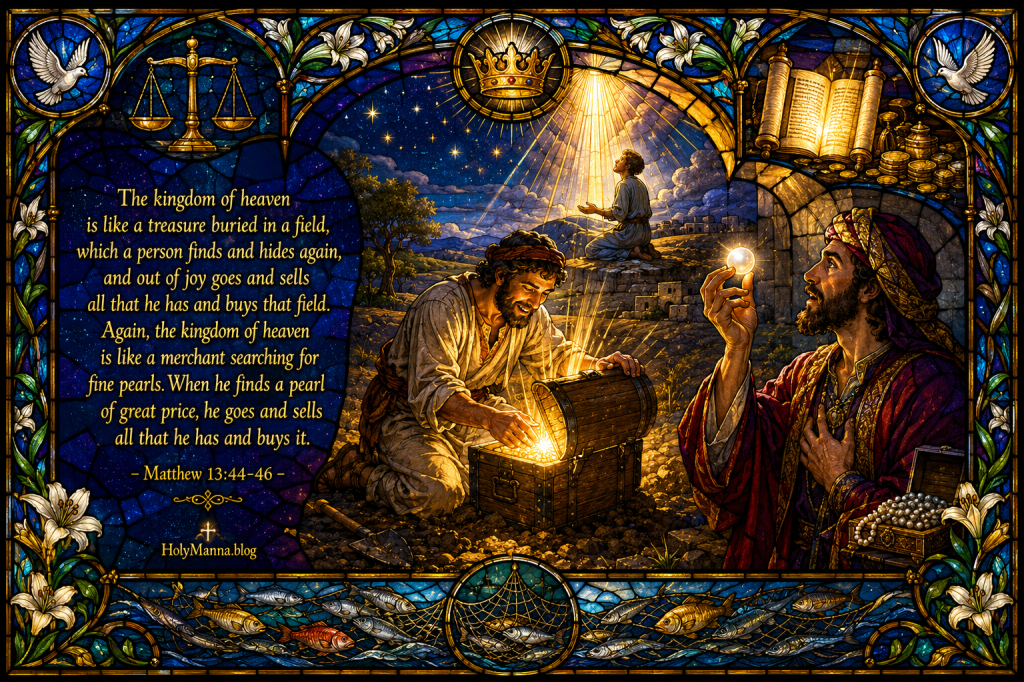
44 “The kingdom of heaven is like a treasure buried in a field, which a person finds and hides again, and out of joy goes and sells all that he has and buys that field. 45 Again, the kingdom of heaven is like a merchant searching for fine pearls. 46 When he finds a pearl of great price, he goes and sells all that he has and buys it. 47 Again, the kingdom of heaven is like a net thrown into the sea, which collects fish of every kind. 48 When it is full they haul it ashore and sit down to put what is good into buckets. What is bad they throw away. 49 Thus it will be at the end of the age. The angels will go out and separate the wicked from the righteous 50 and throw them into the fiery furnace, where there will be wailing and grinding of teeth.
Treasures New and Old. 51 “Do you understand all these things?” They answered, “Yes.” 52 And he replied, “Then every scribe who has been instructed in the kingdom of heaven is like the head of a household who brings from his storeroom both the new and the old.”
Detailed Exegesis
Verse 44: The kingdom of heaven is like a treasure buried in a field, which a person finds and hides again, and out of joy goes and sells all that he has and buys that field.
Everything hinges on three words: out of joy. The man does not sell everything through gritted teeth. He sells it grinning, because he knows what he is getting. Discipleship costs everything and feels like winning the lottery. The finder also stumbles on the treasure; some people find Christ without ever searching, surprised by grace.
Verse 45: Again, the kingdom of heaven is like a merchant searching for fine pearls.
Unlike the finder in the field, the merchant is a seeker, an expert who has spent his life pursuing beauty. Some souls come to Christ after a long deliberate search through philosophies and half-answers. Both roads end at the same treasure.
Verse 46: When he finds a pearl of great price, he goes and sells all that he has and buys it.
A merchant who sells his entire inventory for one pearl has stopped being a merchant. He no longer owns the pearl to trade it; the pearl now defines him. So it is with the kingdom. Christ is not an asset to leverage but a love to belong to.
Verse 47: Again, the kingdom of heaven is like a net thrown into the sea, which collects fish of every kind.
The dragnet gathers everything indiscriminately. The kingdom in its earthly phase, the Church, holds saints and sinners side by side, fish of every kind. This parable answers those scandalized that the Church contains imperfect people; it always has, by design and by patience.
Verse 48: When it is full they haul it ashore and sit down to put what is good into buckets. What is bad they throw away.
The sorting comes at the shore, not in the sea. Judgment belongs to the end, and it belongs to God. In the meantime, the net keeps gathering.
Verse 49: Thus it will be at the end of the age. The angels will go out and separate the wicked from the righteous.
Jesus interprets His own parable. The separation deferred in the parable of the weeds earlier in this same chapter arrives here with finality. History has a direction and a deadline.
Verse 50: And throw them into the fiery furnace, where there will be wailing and grinding of teeth.
Jesus, the most merciful voice in Scripture, speaks of hell more than anyone else in Scripture, precisely because mercy warns. The stakes of the treasure are real; it can be refused.
Verse 51: Do you understand all these things? They answered, “Yes.”
The disciples’ quick yes carries a gentle irony, since the rest of the Gospel will test that understanding severely. Yet Jesus accepts it. Understanding grows by being lived.
Verse 52: Then every scribe who has been instructed in the kingdom of heaven is like the head of a household who brings from his storeroom both the new and the old.
The disciple formed by Christ becomes a householder of revelation, drawing from the Old Covenant and the New as one treasury. Many commentators hear in this verse a quiet self-portrait of Matthew himself, the evangelist who constantly weaves the prophets into the story of Jesus.
Teachings
CCC 546 distills the demand of these parables: Through his parables he invites people to the feast of the kingdom, but he also asks for a radical choice: to gain the kingdom, one must give everything. Words are not enough; deeds are required. Pope St. Gregory the Great, preaching on this very passage in his Homily 11 on the Gospels in the late sixth century, observed that the finder hides the treasure again to protect it, because a soul that parades its interior riches invites spiritual robbery along the road of this life; as the old translation of his homily puts it, he therefore inviteth robbery who carrieth his treasure ostentatiously. Interior devotion needs the shelter of humility. On the dragnet, CCC 1036 teaches that the Church’s words about hell are a call to the responsibility incumbent upon man to make use of his freedom in view of his eternal destiny and an urgent call to conversion. And St. Augustine, describing his own discovery of the treasure after years of searching like the merchant, wrote at the opening of his Confessions: You have made us for yourself, O Lord, and our heart is restless until it rests in you.
Reflection
The parables ask one question: what is the kingdom actually worth to the person hearing them? A concrete way to answer is an honest inventory. This week, name the one possession, habit, ambition, or resentment that most competes with Christ for the center, and take a single deliberate step to loosen its grip, whether that means giving something away, confessing something long avoided, or finally forgiving someone. Then do it the way the man in the field did it, cheerfully, because the exchange is absurdly in your favor.
What would you find genuinely hard to sell if Christ asked for it, and why? Are you more like the finder surprised by grace or the merchant who searched for years, and how does your story shape your gratitude?
The Field Is for Sale
Every reading this Sunday tells the same story from a different angle, and it is the oldest story there is: a choice between the treasure and everything else. Solomon stood in the dark at Gibeon with a blank check in his hands and asked for a listening heart, and God was pleased. The psalmist counted out heaps of silver and the finest gold, set them beside the word of God, and walked away singing about the word. Paul, writing to Christians who would soon face lions, promised that every thread of their lives, even the black ones, was being woven into glory by a God who finishes what He starts. And Jesus told His friends about a man who found something in a field so good that losing everything else felt like joy.
The astonishing part of the parable is not the treasure. It is that the field is for sale. God has hidden the kingdom where ordinary people can find it, in the words of Scripture, in the sacraments of the Church, in the quiet of prayer, in the Eucharist where the Treasure Himself waits under the appearance of bread. No one is priced out. The only currency is everything, and everything is exactly what every person has.
So the invitation this week is simple. Ask for the listening heart. Open the Book that outweighs gold. Trust the Weaver with the tangled threads. And when grace turns over the soil of an ordinary day and something gleams, do what the wise have always done. Sell all, buy the field, and count it the best trade ever made. The kingdom of heaven is not far away. It is buried right here, waiting for the joyful.
Engage With Us!
The conversation does not end with the final blessing at Mass, so please share your reflections in the comments below. This community grows richer every time someone tells the truth about where these readings met their life. To help start that conversation, here are a few questions to pray with this week.
- In 1 Kings 3:5, 7-12, Solomon asks for a listening heart instead of riches, long life, or victory over enemies. What would you have asked for, and what is one decision this week that needs God’s wisdom more than your own?
- In Psalm 119:57, 72, 76-77, 97, 127-130, the psalmist declares God’s word more precious than the finest gold. What practical change would let Scripture claim a daily place in your schedule?
- In Romans 8:28-30, Paul promises that all things work for good for those who love God. Where have you seen God quietly bring good out of something painful in your own story?
- In Matthew 13:44-52, the finder sells everything out of joy to buy the field. What is the one thing you would find hardest to surrender for the kingdom, and what small step could loosen its hold?
- Taking all the readings together, what would your life look like this month if you truly treated God’s kingdom as the treasure worth everything?
Keep seeking, keep asking for that listening heart, and keep digging in the field of everyday life, because the Treasure is real and He wants to be found. Live this week with the love and mercy Jesus taught us, and let the joy of the man in the field be yours.
Sacred Heart of Jesus, we trust in You!
Immaculate Heart of Mary, pray for us!
Saint Michael the Archangel, defend us in battle!
Follow us on YouTube, TikTok, Instagram and Facebook for more insights and reflections on living a faith-filled life.


Leave a Reply