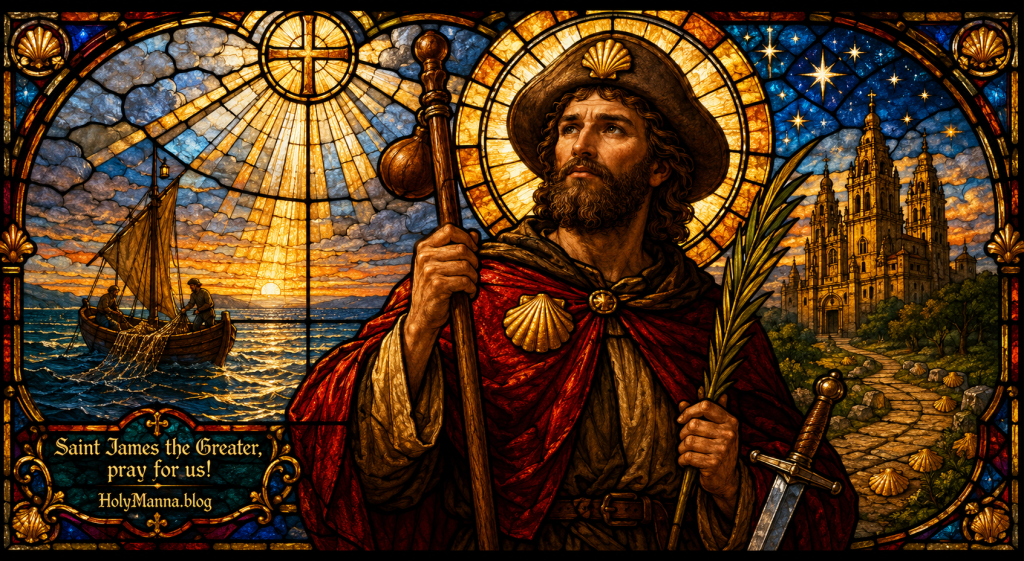
The Fisherman Who Set the World Walking
Every year, hundreds of thousands of people lace up their boots, hang a scallop shell from their backpacks, and start walking across Spain. Some walk for weeks. Some walk for months. They come from every continent, every background, and every possible spiritual starting point, and they are all heading to the same place: a granite cathedral in the rainy northwest corner of Spain where, according to a tradition the Church has honored for over a thousand years, the bones of a Galilean fisherman lie beneath the high altar. That fisherman is Saint James the Greater, apostle of Jesus Christ, member of His inner circle, and the first of the Twelve to shed his blood for the Gospel.
James is celebrated on July 25th, and his story is one of the most remarkable in all of Christian history precisely because of how it unfolds in two acts. The first act is written in the pages of the New Testament itself, where James appears as a hot tempered, ambitious, utterly devoted follower of Jesus who is transformed by grace into a martyr. The second act unfolds across centuries of tradition, pilgrimage, and devotion, as the memory of this apostle quite literally reshaped the map of Europe. The Church teaches that the apostles are the foundation stones of the Church, chosen and sent by Christ Himself, and that “the Church is apostolic because she is founded on the apostles” (CCC 857). James is one of those foundation stones, and his witness still carries weight today.
Saint James the Greater is the patron of Spain and the patron of pilgrims, and Catholic sources also honor him as a patron of several Latin American nations, including Guatemala, Nicaragua, and Chile. For anyone who has ever felt that their faith is a journey rather than a finished destination, James is a saint worth knowing well.
Nets, Thunder, and a Voice by the Sea
James was born in Galilee, the son of a fisherman named Zebedee and a devoted woman named Salome, and the older brother of John, the beloved disciple and evangelist. The Gospels suggest the family business was reasonably successful; Mark 1:20 mentions that Zebedee had hired servants working alongside his sons, which was no small thing for a Galilean fishing operation. Salome herself would later follow Jesus and minister to Him, and she stood near the cross on Good Friday (Matthew 27:56, Mark 15:40 to 41). Faith clearly ran in this family. Beyond these details, the Catholic Encyclopedia notes honestly that nothing certain is known of James’s early life, and it is worth saying so plainly rather than filling the silence with invention.
He is called “the Greater” not because the Church ranked his holiness above anyone else’s, but simply to distinguish him from the other apostle named James, called “the Less,” most likely because the son of Zebedee was older or was called first.
What is known, and known vividly, is the moment everything changed. Jesus was walking beside the Sea of Galilee. He had just called Simon Peter and Andrew, and a little farther on He saw two more brothers in a boat with their father, mending their nets. The Gospel describes what happened next with breathtaking economy: “Immediately he called them; and they left their father Zebedee in the boat with the hired servants, and followed him” (Mark 1:20). No negotiation, no delay, no request to think it over. James left the nets, the boat, the business, and his own father standing in the stern, and walked after a Rabbi from Nazareth.
That decisiveness, that all in temperament, would define James for the rest of his life, for better and sometimes for worse. Jesus Himself seems to have recognized it, because He gave James and John a nickname recorded in Scripture: “Boanerges, that is, sons of thunder” (Mark 3:17). The Gospels never fully explain the name, but the brothers earned it more than once. When a Samaritan village refused to welcome Jesus, it was James and John who asked, “Lord, do you want us to bid fire come down from heaven and consume them?” (Luke 9:54). Jesus rebuked them. The thunder was real, but it needed converting.
Inside the Inner Circle
Among the Twelve, three apostles held a unique place: Peter, James, and John. These three alone were brought by Jesus into the most intimate moments of His ministry, and the Gospels are consistent about it. When Jesus raised the daughter of Jairus from the dead, “he allowed no one to follow him except Peter and James and John the brother of James” (Mark 5:37). When Jesus was transfigured in glory on the mountain, His clothes shining and Moses and Elijah appearing beside Him, it was Peter, James, and John who saw it (Mark 9:2). And when Jesus entered the darkness of Gethsemane on the night He was betrayed, sorrowful unto death, He took with Him “Peter and the two sons of Zebedee” (Matthew 26:37).
Think about what that means. James saw the glory of the Transfiguration and the agony of the Garden. He saw Christ raised in light and Christ face down in anguish. Very few human beings have ever been trusted with both sights, and the Church has always understood this as a preparation. The Catechism teaches that Jesus associates His disciples with His own sacrifice: “Apart from the cross there is no other ladder by which we may get to heaven” (CCC 618, quoting Saint Rose of Lima). James was being shown the whole ladder.
The most revealing episode of James’s discipleship, though, is also the most humbling one. At some point on the road to Jerusalem, the mother of James and John came to Jesus with a request, and her sons stood behind it: that they might sit at His right hand and His left in His kingdom. Jesus’s answer is one of the most quietly devastating lines in the Gospels: “You do not know what you are asking. Are you able to drink the cup that I am to drink?” (Matthew 20:22). And James, ambitious, confident, thunderous James, answered with his brother: “We are able.”
He had no idea what he was promising. And Jesus, who did know, replied with words that would become prophecy: “You will drink my cup” (Matthew 20:23). Then He gathered all the apostles and taught them the lesson James would spend the rest of his life learning: “Whoever would be great among you must be your servant” (Matthew 20:26). Greatness in the Kingdom is not a throne. It is a cup.
There are no miracles attributed specifically to James alone during his lifetime in the Scriptural record; the Gospels show the apostles collectively being sent out with authority to heal the sick and cast out demons (Mark 6:7 to 13), and James shared fully in that mission. His greatness during life was not a catalog of wonders. It was proximity to Jesus, and the slow transformation of a fiery heart into a faithful one. That is precisely why he matters for ordinary believers. Most people will never work a public miracle. Every person is invited to what James actually did: stay close to Christ through glory and through agony, and let grace do its work on an imperfect temperament.
The First Cup Poured Out
Roughly a decade after the Resurrection, the prophecy came due. The Acts of the Apostles records it with stark, unadorned brevity: “About that time Herod the king laid violent hands upon some who belonged to the church. He killed James the brother of John with the sword” (Acts 12:1 to 2). The year was around AD 44, and the king was Herod Agrippa I, grandson of the Herod who slaughtered the innocents, seeking to please the enemies of the young Church.
One sentence. That is all Scripture gives to the death of an apostle. And yet that one sentence carries enormous weight, because James is the only one of the Twelve whose martyrdom is actually recorded in the New Testament. He was the first apostle to die for Christ, the first to drink the cup he had so rashly promised to drink, and he went to it not by fire called down from heaven but by a sword laid on his own neck. The Son of Thunder died as a lamb.
The Church teaches that this kind of death is the highest form of Christian witness: “Martyrdom is the supreme witness given to the truth of the faith: it means bearing witness even unto death” (CCC 2473). The very word martyr means witness, and the Catechism adds that the martyr “bears witness to Christ who died and rose” (CCC 2473). James’s beheading was not a defeat. It was the moment his “We are able” finally became true, not by his own strength but by grace.
One of the earliest traditions of the Church adds a luminous detail to that day. Eusebius of Caesarea, in his Ecclesiastical History, quotes Clement of Alexandria, who wrote that the man who led James to the tribunal was so moved by the apostle’s fearless testimony that he confessed himself a Christian on the spot. The two were led away together, and as they went, the accuser begged James’s forgiveness. James considered for a moment, then said, “Peace be with you,” and kissed him, and both men were beheaded together. This account comes from an early and respected patristic source, but it stands outside Scripture and cannot be verified as historical fact. Even so, it rings true to everything the Gospels show about what Jesus had made of James: a man whose last recorded act was forgiveness.
A later tradition also tells that James healed a paralyzed man while being led to his execution, which is one reason some Catholic sources associate his intercession with those who suffer from rheumatism and arthritis. This story arises much later than the events and cannot be verified.
Before his death, a much larger tradition places James far from Jerusalem. From at least the seventh century, Spanish and wider Latin tradition has held that James traveled to the Iberian Peninsula and preached the Gospel there before returning to Judea to die. The Catholic Encyclopedia itself notes the historical difficulties with this tradition, including indications that the apostles had not yet dispersed from Jerusalem by the time of James’s death. Within that same tradition stands one of the most beloved stories in all of Spanish Catholicism: that while James labored with little fruit near the Ebro River at Zaragoza, the Blessed Virgin Mary, still living in Jerusalem, appeared to him standing upon a pillar, encouraging him to persevere. This is the origin of the devotion to Our Lady of the Pillar, which the Church honors liturgically on October 12th, and Zaragoza’s basilica remains one of Spain’s great Marian shrines. Both the Spanish preaching and the apparition of Our Lady of the Pillar are venerable traditions of long standing in the Church, but they cannot be verified as historical fact, and honesty requires saying so even while treasuring what they have meant to generations of the faithful.
A Tomb at the End of the World
If the first act of James’s story ends with a sword in Jerusalem, the second act begins with a boat. Tradition, recorded by the twelfth century in the Codex Calixtinus, tells that after his martyrdom, James’s disciples Athanasius and Theodore carried his body by sea all the way to Iria Flavia on the coast of Galicia, in the far northwest of Spain, and buried him inland. There the tomb lay forgotten for centuries. Then, around the year 813 or 814, during the reign of King Alfonso II, tradition tells that a hermit named Pelayo was drawn by mysterious lights shining over a wooded hill, and Bishop Theodomir of Iria examined the site and declared that the tomb of the apostle had been found. A popular explanation of the name Compostela derives it from campus stellae, the field of the star, though scholars dispute this etymology. The story of the miraculous voyage and the discovery by heavenly lights is a tradition and cannot be verified, and sources even differ between 813 and 814 for the date of the discovery.
What happened next, however, is simply history. A church rose over the tomb, then a greater church, then the magnificent Romanesque cathedral that stands today. And the people of Europe began to walk. Through the Middle Ages, Santiago de Compostela became one of the three great pilgrimage destinations of Christendom, ranked alongside Jerusalem and Rome. Kings and beggars, scholars and penitents, saints and sinners all took the road. Saint Francis of Assisi is recorded to have made the pilgrimage around 1213 to 1215. The scallop shell, gathered on the Galician shore, became the universal badge of the pilgrim, and pilgrims wore it home as proof that they had reached the apostle. The network of routes across Europe became known as the Camino de Santiago, the Way of Saint James, and it never fully died. In modern times it has exploded back to life, with hundreds of thousands of pilgrims arriving each year, and the historic city was recognized by UNESCO in 1985.
The relics themselves have their own dramatic history. In the sixteenth century, amid fear of raids on the Galician coast, the remains were hidden away so effectively that their exact location was lost. In January of 1879, excavations ordered by Cardinal Payá y Rico rediscovered the remains of three men behind the apse of the cathedral, understood to be James and his two disciples. After a formal investigation, Pope Leo XIII issued the bull Deus Omnipotens on November 1, 1884, confirming the authenticity of the relics and warmly inviting the faithful of the whole world to return in pilgrimage to Compostela. That papal confirmation is fully documented, and the modern revival of the Camino flows in no small part from it. In 2010, Pope Benedict XVI himself traveled to Santiago as a pilgrim during the Compostela Holy Year, praying at the apostle’s tomb.
Spanish tradition also tells of Saint James appearing on a white horse to aid Christian soldiers at the Battle of Clavijo in 844, the origin of the title Santiago Matamoros and of the ancient battle cry invoking his name. Historians regard the battle itself as unhistorical, and this story cannot be verified. What the Church actually venerates in James is not a warrior on horseback but an apostle and martyr who gave his life rather than take one, and that is where devotion rightly rests.
The cultural reach of this fisherman is staggering. The very name Santiago, evolved from the Latin Sancti Iacobi, marks cities across Spain and the Americas, from Santiago de Compostela to Santiago de Chile. When July 25th falls on a Sunday, the Church celebrates a Compostela Holy Year, with the cathedral’s Holy Door opened and special graces attached to the pilgrimage; the next such year arrives in 2027. Pilgrims who attend the pilgrim Mass may witness the botafumeiro, the enormous swinging censer that fills the cathedral with incense, a sight that has moved countless travelers to tears at the end of their long road. The Catechism helps explain why all of this speaks so deeply to the human heart: “Pilgrimages evoke our earthly journey toward heaven and are traditionally very special occasions for renewal in prayer” (CCC 2691). Every footstep on the Camino is a small rehearsal of the whole Christian life.
As for the words of the saint himself, no verified sayings of James survive outside of Scripture. Readers should be aware that quotations from the Letter of James are often attributed to him online, but the Church’s tradition attributes that epistle to James the brother of the Lord, not to the son of Zebedee, so those beautiful words belong to another James.
Walking Your Own Camino
So what does a first century fisherman, beheaded almost two thousand years ago, have to say to someone living now, juggling work, family, doubts, and a faith that sometimes feels more like a flicker than a fire? Quite a lot, actually.
Start with the call. James was not praying in the Temple when Jesus found him. He was at work, elbow deep in wet nets, doing the same thing he had done a thousand times. Grace interrupted an ordinary Tuesday. The lesson is simple and unsettling: Christ does not wait for a convenient season to call, and the only fitting answer is the one James gave, which was to move. When Jesus interrupts your ordinary routine, through a nudge of conscience, a person in need, or a truth you can no longer ignore, do you move immediately, or do you stay in the boat?
Then there is the thunder. James’s zeal was real, but it was raw. He wanted fire on his enemies and thrones for himself, and Jesus refused him both, not by extinguishing his fire but by converting it. The Church teaches that grace perfects nature rather than destroying it, for “the grace of Christ is not in the slightest way a rival of our freedom” (CCC 1742). God did not make James passive. He made James’s passion holy. That is tremendously good news for anyone with a strong personality, a quick temper, or an ambitious streak. Those traits are not disqualifications from sanctity. They are raw material. What is the strongest force in your personality, and have you ever seriously asked God to convert it rather than simply suppress it?
Then there is the cup. James said “We are able” long before he was able, and Jesus accepted the offer anyway, then spent years making it true. Most believers overpromise God something: at Confirmation, at a wedding, in a moment of fervor. The story of James teaches that God takes those promises seriously and, better still, supplies the grace to keep them, usually slowly, usually through ordinary faithfulness, sometimes through real suffering. The Catechism teaches that Christ “calls his disciples to take up their cross and follow him” (CCC 618), and no one carries it alone. What promise have you made to God that you have quietly stopped trying to keep, and what would it look like to pick it up again this week?
Finally, there is the road. The Camino endures because it makes visible what is true of every life of faith: it is long, it is walked one step at a time, it hurts in places, it is better in company, and it ends at the tomb of a witness who points beyond himself to Christ. Not everyone can walk to Compostela. Everyone can make this day a stretch of the Way, through a rosary walked around the block, a Mass attended with intention, a grudge released like a heavy pack, an act of service done quietly. The communion of saints means James is not a museum piece but a companion, for the saints “do not cease to intercede with the Father for us” (CCC 956). Ask him to pray for you, especially for a braver, warmer, more converted zeal.
Engage With Us!
HolyManna.blog would love to hear from you, so please share your thoughts and reflections on Saint James the Greater in the comments below. His story has a way of finding the thunder in each of us, and hearing how it speaks to your journey encourages everyone who reads along. To get the conversation started, consider these questions:
- James left his nets immediately when Jesus called. What is one “net” in your life, a habit, a fear, or a comfort, that you sense Jesus asking you to set down?
- Jesus renamed James a Son of Thunder and then spent years converting that fire into holy zeal. Where do you see God working on your own rough edges right now?
- James promised to drink the cup of Christ without understanding it, and God made him able. Has God ever asked something of you that you only grew strong enough to give later?
- Millions have walked the Camino to the tomb of Saint James. What would a small, daily “pilgrimage” toward Christ look like in your ordinary week?
- James’s last recorded act in early tradition was forgiving the man who accused him. Is there someone in your life waiting on your “Peace be with you”?
May the witness of Saint James the Greater stir up a holy boldness in you this day. Say yes quickly, let God convert your thunder, drink whatever cup He offers with trust, and keep walking the road toward Him one faithful step at a time. And in everything, at home, at work, and along every mile of your own camino, act with the love and mercy that Jesus taught us. Saint James the Greater, pray for us.
Saint James the Greater, pray for us!
Follow us on YouTube, TikTok, Instagram and Facebook for more insights and reflections on living a faith-filled life.


Leave a Reply