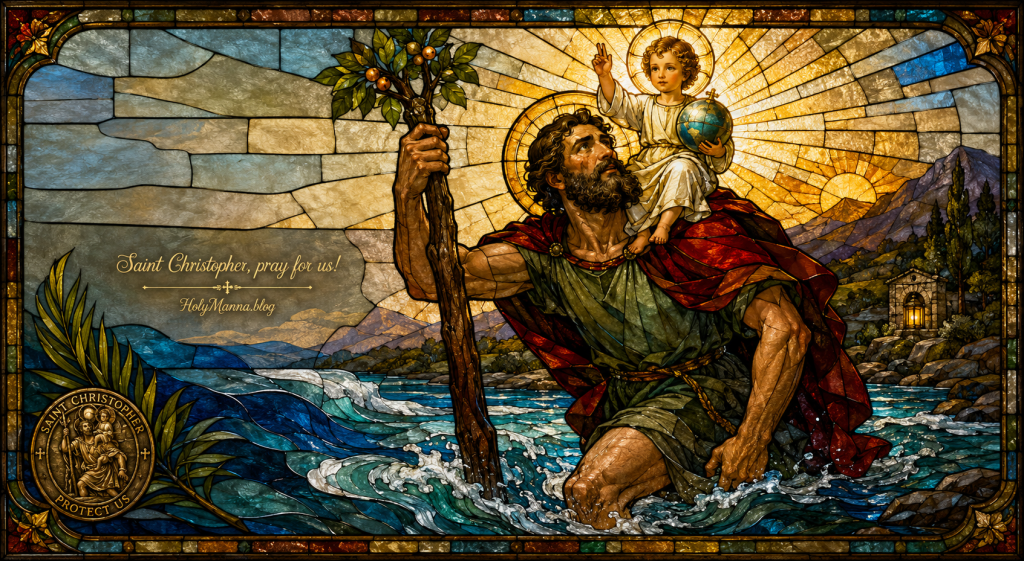
The Giant Who Carried the Weight of the World
Somewhere in a car right now, maybe stuck in traffic, maybe crossing a state line at two in the morning, there is a small medal clipped to a visor or hanging from a rearview mirror. It shows an enormous man leaning on a staff, wading through water, with a small child perched on his shoulders. That image belongs to Saint Christopher, whose feast the Church remembers on July 25th, and it may be the single most recognizable devotional object in the Catholic world. His very name tells the whole story before a word of it is spoken. Christopher comes from the Greek Christophoros, which means “Christ-Bearer,” and everything the Church loves about this saint flows from that one idea: a strong man who put his strength at the service of Christ by carrying others.
Saint Christopher is honored in the Roman Martyrology as a martyr who died in Lycia, in Asia Minor, during the persecution of the Emperor Decius, around the year 251. He is the patron saint of travelers, and by extension of motorists, sailors, pilgrims, and all who journey far from home. He is also counted among the Fourteen Holy Helpers, a group of saints whose intercession the faithful of medieval Europe sought with particular confidence, especially in times of plague and against the danger of sudden death. The Church teaches that this kind of devotion is not superstition but family love within the Body of Christ. As the Catechism explains, “When the Church keeps the memorials of martyrs and other saints during the annual cycle, she proclaims the Paschal mystery in those ‘who have suffered and have been glorified with Christ.’” (CCC 1173) Christopher’s memorial is one of those proclamations, and it has been echoing for more than fifteen centuries.
Here is what makes his story unusual, and what this post will be honest about from the very first section. Almost nothing about Christopher’s earthly life can be historically documented. The Roman Martyrology preserves the essential fact of his martyrdom, and ancient churches preserve the antiquity of his veneration, but the rich narrative that generations have loved comes to us through tradition rather than through records. That does not make him less worth knowing. It makes him a fascinating case study in how the Church remembers her martyrs, and why a man about whom so little is certain has been loved so much for so long.
The Search for the Greatest King
The historical record of Christopher’s early life is, quite simply, silent. No contemporary account of his birth, family, or formation survives. What survives instead is a tradition, told and retold across both East and West, and it deserves to be told here as tradition, because it is one of the most spiritually rich stories the Christian imagination has ever handed down.
According to this tradition, preserved most famously in the Legenda Aurea, the great thirteenth century collection of saints’ lives compiled by Blessed James of Voragine, Christopher was born in the land of Canaan and was originally called Reprobus in the Eastern accounts, or Offero in some Western tellings. He was a man of enormous size and strength, described in the stories as a giant. Eastern tradition even adds the striking detail that he was depicted with the head of a dog, an image that appears in some ancient icons; the Church has always understood this as symbolic hagiographic imagery describing his fierce, foreign appearance before baptism, not as a biological claim.
The heart of the tradition is Christopher’s search. He resolved that a man of his strength should serve only the greatest king in the world, so he attached himself to a mighty human king. One day he noticed that the king made the Sign of the Cross whenever the devil was mentioned. Realizing that his master feared someone greater, Christopher left him and went looking for the devil. He found him, or someone claiming to be him, at the head of a band of raiders, and served him until the day the devil made a wide detour around a roadside cross. Christopher pressed him for the reason and learned that the devil feared Christ. So the giant abandoned that master too and set out to find this Christ who stood above kings and demons alike.
His search led him to a hermit who instructed him in the faith. The hermit proposed fasting and long prayers, but Christopher, a simple and physical man, felt unsuited to both. So the hermit gave him a different penance shaped exactly to his gifts. A dangerous river nearby drowned many who tried to cross it. Christopher would live beside it and carry travelers across on his shoulders, and in that service he would serve Christ. It is a beautiful picture of something the Church still teaches, that God calls each person according to the gifts actually given to them. None of this early narrative can be verified as historical fact, and it is presented here plainly as the tradition the Church has received.
The River, the Child, and the Blossoming Staff
Tradition says Christopher took up his post at the river and carried travelers across for a long time, leaning on a great staff against the current. Then came the night that gave the world its most beloved image of him. A small child asked to be carried across. Christopher lifted him easily and stepped into the water, but with every step the child grew heavier, until the giant was bent nearly double, straining as though the whole world were pressing down on his shoulders. When he finally staggered to the far bank, he said that he felt he had carried the entire world. The child answered him with words the Legenda Aurea records this way: “Thou hast not only borne all the world upon thee, but thou hast borne him that created and made all the world, upon thy shoulders.” The child was Christ Himself, and as a sign, He told Christopher to plant his staff in the earth, where by morning it had blossomed with leaves and fruit like a living palm. This is the moment that gave Reprobus his new name, Christopher, the Christ-Bearer. This whole account, treasured as it is, comes from later devotional tradition and cannot be verified as historical fact.
Why does this story matter so much, and why should anyone remember and imitate a man whose biography is mostly hidden from history? Because the story is a nearly perfect parable of the Christian life, and the Church has always read it that way. Every baptized person is called to be a Christ-bearer. Every act of service to another person is, in the deepest reality, service to Christ, exactly as the Lord Himself promised in The Gospel of Matthew: “Amen, I say to you, whatever you did for one of these least brothers of mine, you did for me.” (Mt 25:40) Saint Paul says the same thing from the other direction in his Letter to the Galatians: “Bear one another’s burdens, and so you will fulfill the law of Christ.” (Gal 6:2) Christopher’s river is every place where a strong person puts their strength under someone else’s weight. The Catechism teaches that the Church proposes the saints to the faithful precisely for this reason, “as models and intercessors” (CCC 828), and few models are as immediately understandable as the giant who discovered that carrying people is a way of carrying God.
The tradition continues that after his encounter with the Christ Child, Christopher went to the province of Lycia to strengthen the Christians suffering persecution there. Though he had no gift for preaching, the stories say that his witness converted thousands in the city, a reminder that holiness communicates itself even without eloquence. These conversions, like the river account, belong to tradition rather than documented history, and that must be stated plainly.
Fire, Arrows, and a Crown That Could Not Be Refused
What the Church has always held with confidence is the ending: Christopher died a martyr. The Roman Martyrology commemorates him on July 25th as a martyr in Lycia under the Emperor Decius, whose empire-wide persecution beginning in the year 250 is one of the best documented in Roman history and claimed an enormous number of Christian lives. It is worth being honest that the sources do not agree on every detail. The Legenda Aurea names the persecuting ruler “Dagnus,” some scholars have placed the martyrdom under Diocletian or Maximinus Daza instead, and the traditions locate his death variously in Lycia, Perga, or Antioch. Some scholars have even suggested that Christopher may be identical with the Egyptian martyr Saint Menas. The Church’s liturgical memory, expressed in the Roman Martyrology, holds to Lycia and Decius, and that is the account followed here, with the discrepancies acknowledged rather than hidden.
The traditional narrative of his passion runs like this. Brought before the king for refusing to sacrifice to the pagan gods, Christopher could not be broken by threats, so the ruler tried seduction instead, sending two women to tempt him in prison. The Eastern tradition names them Callinika and Aquilina. Instead of corrupting Christopher, the women were converted by him, confessed Christ before the king, and won the crown of martyrdom themselves. Enraged, the king ordered Christopher tortured. The stories describe scourging, burning plates of iron, and fire that would not harm him, and then a rain of arrows that the tradition says left him untouched, with one account adding that an arrow rebounded and blinded the king, who was later healed through the martyr’s intercession. Finally Christopher was beheaded, with the traditional date given as July 25th in the year 251. The fact of his martyrdom is the Church’s ancient testimony; the dramatic details of the tortures come from later tradition and cannot be verified, and that is stated here plainly.
What should not be lost in the drama is what martyrdom actually is. The Catechism defines it with precision: “Martyrdom is the supreme witness given to the truth of the faith: it means bearing witness even unto death.” (CCC 2473) The Christ-Bearer’s final act of carrying was to carry his own witness all the way to the executioner. Whatever historical fog surrounds the details, the early Church did not build shrines to fictional conveniences. She built them to martyrs, and she built one to Christopher astonishingly early.
From a Stone in Chalcedon to the Dashboard of a Car
Here is where the story moves back onto solid historical ground, and the ground is remarkably old. In 1878, archaeologists working in the ruins of ancient Chalcedon, near modern Istanbul, uncovered a large stone inscription recording the foundation, construction, and consecration of a church dedicated to the martyrdom of Saint Christopher. The inscription dates the church to about the year 452, the very era of the Council of Chalcedon, barely two centuries after the traditional date of his death. This is the earliest surviving evidence of his veneration, and it means devotion to Christopher was already strong enough in the mid fifth century to raise a church in his honor. The trail continues from there. Saint Remigius of Rheims, the bishop who baptized Clovis, was buried in the year 532 in a church dedicated to Saint Christopher. Pope Saint Gregory the Great mentioned a monastery bearing his name in his letters before the year 604. The ancient Mozarabic liturgy of Spain, associated with Saint Isidore of Seville, contains a special office in his honor, and a convent in Galatia was consecrated to him around the year 600.
Through the Middle Ages his cult became one of the most visible in Europe. Enormous images of Christopher were painted on church walls opposite the main doors, often larger than any other figure in the building, because of the popular belief that whoever looked upon his image would not die suddenly and unprepared that day. A medieval rhyme captured it: “Christophorum videas, postea tutus eas,” which means, “Gaze upon Christopher, then go your way in safety.” This belief was popular piety rather than Church doctrine, but it reveals how deeply people trusted his intercession against sudden death, which is also why he was numbered among the Fourteen Holy Helpers invoked during the age of plagues. The Catechism explains the sound theology underneath all of it: the saints “contemplate God, praise him and constantly care for those whom they have left on earth,” and their “intercession is their most exalted service to God’s plan.” (CCC 2683)
Specific miracle accounts after his death are largely bound up with this tradition of protection from sudden death and safe travel rather than with a catalog of individually recorded healings, and where such stories circulated they cannot be verified, which is stated here plainly. His relics have their own traditions. The Museum of Sacred Art at the Church of Saint Justine on the island of Rab, in Croatia, holds a gold plated reliquary said to contain the skull of Saint Christopher, and the saint is the beloved patron of that island; the authenticity of the relic is a tradition of the local church and cannot be independently verified. His cultural footprint is genuinely global. The Caribbean island that Christopher Columbus’s successors named Saint Christopher’s Island became the modern nation of Saint Kitts and Nevis. Cities including Vilnius and Havana claim him as patron. The Eastern Churches celebrate him on May 9th with their own liturgical hymns. And in the twentieth century, as the automobile remade daily life, Christopher naturally became the patron of motorists, which is why his medal rides on dashboards and keychains across the world to this day.
One point deserves special clarity, because confusion about it is everywhere. In 1969, as part of the liturgical reform ordered by the Second Vatican Council and enacted by Pope Saint Paul VI in Mysterii Paschalis, Christopher’s feast was removed from the General Roman Calendar. He was never “de-canonized,” and the Church never declared him a myth. He remains listed in the Roman Martyrology on July 25th, devotion to him remains fully approved, and Masses may still be celebrated in his honor. The calendar change simply reflected that his feast had entered the universal Roman calendar late, around 1550, and that July 25th belongs universally to the Apostle Saint James the Greater. The Catechism reminds the faithful that the Church canonizes saints by “solemnly proclaiming that they practiced heroic virtue and lived in fidelity to God’s grace” (CCC 828), and nothing in 1969 withdrew Christopher from the communion of saints that the faithful profess in the Creed (CCC 957).
Carrying Christ Into Ordinary Life
Christopher’s life, hidden as it is behind the veil of tradition, still preaches with unusual clarity, and his lessons land squarely in the middle of ordinary modern life. The first lesson is about how God calls. Christopher, in the tradition, could not fast well and could not pray long, and the hermit did not force him into someone else’s vocation. He was given a mission built out of the strength he actually had. There is enormous freedom in that. The person who cannot lead a Bible study can drive an elderly neighbor to Mass. The person who will never write theology can carry groceries, carry children, carry someone else’s crisis at two in the morning. The Gospel of Matthew leaves no doubt about how Christ receives such service: “Whatever you did for one of these least brothers of mine, you did for me.” (Mt 25:40)
The second lesson is about weight. The child on Christopher’s shoulders grew heavier the farther he carried Him, and anyone who has ever committed to loving one difficult person for a long time knows exactly what that means. Real service usually gets heavier before it gets lighter. Marriage, parenthood, caregiving, and honest friendship all grow heavy in the middle of the river. Christopher’s answer was not to put the burden down but to lean on the staff and keep walking, and the Church calls that virtue perseverance. The third lesson is about who is really being carried. Christopher thought he was helping a child and discovered he was serving the Creator of the world. Every Christian who serves the poor, the sick, the annoying, and the inconvenient is standing in that same river, whether the water feels mystical or not.
There is also a quieter lesson for travelers of every kind, which is that the Christian life itself is a journey under protection. The psalmist prays in Psalm 121, “The LORD will guard your coming and going both now and forever.” (Ps 121:8) A Christopher medal is not a magic charm, and the Church has never taught that it is; it is a small, visible request for the intercession of a saint who spent his life getting people safely to the other side. So the questions worth sitting with are these. Who has God placed on your shoulders right now, and are you still carrying them, or have you quietly set them down? What actual gift or strength do you have that you have never seriously offered to Christ? When the weight of your commitments grows heavier midstream, do you lean on prayer the way Christopher leaned on his staff, or do you try to power through alone?
Engage With Us!
Saint Christopher has been carrying people toward Christ for more than seventeen centuries, and his story always sounds different depending on what river a person happens to be crossing. Share your thoughts and reflections in the comments below; this community grows stronger every time someone tells the truth about their own journey. Here are some questions to start the conversation.
- What is the heaviest thing you are carrying right now, and have you asked Christ to carry it with you?
- Christopher served Christ with physical strength because that was the gift he had. What is the one gift you actually have that God may be asking you to use?
- Is there a person in your life you have been avoiding carrying, someone whose burden you could genuinely help bear this week?
- Do you keep a Saint Christopher medal or another sacramental, and how do you keep that devotion rooted in trust in God rather than superstition?
- Christopher searched for the greatest king through trial and error, serving lesser masters first. What lesser masters have you served on the way to Christ?
Whatever answers rise up, hold on to this. The giant of the river became a saint not by becoming someone else but by giving Christ exactly who he already was, and then carrying whomever God sent, one crossing at a time. Go and do the same. Carry the people God has given you, lean hard on prayer when the water rises, and do everything, every commute, every errand, every heavy mile, with the love and mercy that Jesus taught us.
Saint Christopher, pray for us!
Follow us on YouTube, TikTok, Instagram and Facebook for more insights and reflections on living a faith-filled life.


Leave a Reply