Feast of Saint James, Apostle – Lectionary: 605
When a Fisherman Asked for a Throne
Every family has that story about someone who asked for far more than they understood, and the Church’s family story for July 25th is exactly that. Today the Church celebrates the Feast of Saint James, Apostle, the fisherman from Galilee who, along with his brother John, wanted a throne beside Jesus and received something far greater: a martyr’s cup. James was one of the three closest companions of the Lord, present on the mountain of the Transfiguration and in the garden of the Agony, and he became the first of the apostles to shed his blood for Christ, killed by the sword under Herod Agrippa around the year 44, as Acts 12 records. A cherished tradition holds that his relics rest at Santiago de Compostela in Spain, where millions have walked the Camino in his honor.
The readings the Church selects for his feast form a single, luminous lesson. Saint Paul tells the Corinthians that the treasure of the Gospel is carried in earthen vessels so that the power belongs to God alone. Psalm 126 sings of exiles who sowed in tears and reaped with cries of joy. And in the Gospel, Jesus takes the raw ambition of James and John and transforms it into the promise of the cup, teaching all the apostles that greatness in His Kingdom means service, and being first means becoming a slave of all. The central theme uniting these readings is this: true greatness comes from drinking the cup of Christ, pouring out fragile lives in humble service so that God’s power, not human strength, is glorified. That is the story of Saint James, and it is meant to become the story of every believer.
First Reading — 2 Corinthians 4:7-15
Clay Jars Carrying the Glory of God
When Saint Paul wrote his second letter to the Corinthians in the mid-50s, his authority was under attack. Rival preachers in Corinth, polished and impressive, pointed to Paul’s sufferings, his unimpressive presence, and his constant hardships as proof that he could not be a true apostle. Paul’s answer is one of the most beautiful paradoxes in all of Scripture: weakness is not the argument against his ministry, it is the argument for it. In the ancient world, precious treasure was sometimes stored in cheap, disposable clay pots, and Corinth itself was full of ordinary earthenware lamps. Paul seizes that image to explain the entire logic of apostleship, a logic Saint James lived to the point of death by the sword. On this feast, the Church holds up this passage as the definitive portrait of what an apostle actually is.
2 Corinthians 4:7-15 – New American Bible (Revised Edition)
The Paradox of the Ministry. 7 But we hold this treasure in earthen vessels, that the surpassing power may be of God and not from us. 8 We are afflicted in every way, but not constrained; perplexed, but not driven to despair; 9 persecuted, but not abandoned; struck down, but not destroyed; 10 always carrying about in the body the dying of Jesus, so that the life of Jesus may also be manifested in our body. 11 For we who live are constantly being given up to death for the sake of Jesus, so that the life of Jesus may be manifested in our mortal flesh.
12 So death is at work in us, but life in you. 13 Since, then, we have the same spirit of faith, according to what is written, “I believed, therefore I spoke,” we too believe and therefore speak, 14 knowing that the one who raised the Lord Jesus will raise us also with Jesus and place us with you in his presence. 15 Everything indeed is for you, so that the grace bestowed in abundance on more and more people may cause the thanksgiving to overflow for the glory of God.
Detailed Exegesis
Verse 7: “But we hold this treasure in earthen vessels, that the surpassing power may be of God and not from us.” The treasure is the light of the knowledge of the glory of God shining in the face of Christ, which Paul has just described in the preceding verse. The vessel is the apostle’s mortal, breakable body. God deliberately chooses fragile instruments so that no one can mistake the source of the power. The Catechism echoes this in CCC 1420, teaching that the new life received in the sacraments of initiation is carried in these same earthen vessels.
Verse 8: “We are afflicted in every way, but not constrained; perplexed, but not driven to despair.” Paul begins a rhythmic catalogue of contrasts. Each pressure is real, yet each has a limit that grace imposes. The Christian is pressed but never crushed, confused but never hopeless, because the vessel’s contents are indestructible.
Verse 9: “Persecuted, but not abandoned; struck down, but not destroyed.” Persecution isolates a person from human support, yet the apostle is never alone, for God does not abandon His servants. Being struck down is not being destroyed; James was struck down by Herod’s sword, yet the Church has celebrated his victory for nearly two thousand years.
Verse 10: “Always carrying about in the body the dying of Jesus, so that the life of Jesus may also be manifested in our body.” Paul describes apostolic suffering as a living participation in the Passion. The wounds of ministry are not accidents; they are the dying of Jesus made visible, and precisely through them the Resurrection life of Jesus shines out.
Verse 11: “For we who live are constantly being given up to death for the sake of Jesus, so that the life of Jesus may be manifested in our mortal flesh.” The paradox intensifies. The living are handed over to death daily, and mortal flesh becomes the canvas on which immortal life is painted. This verse reads almost as a prophecy of James’s martyrdom.
Verse 12: “So death is at work in us, but life in you.” Apostolic suffering is fruitful for others. The preacher’s dying produces the hearer’s living, just as the martyrdom of the apostles produced the faith of the nations.
Verse 13: “Since, then, we have the same spirit of faith, according to what is written, ‘I believed, therefore I spoke,’ we too believe and therefore speak.” Paul quotes Psalm 116, uniting himself to the psalmist who trusted God amid affliction. Faith cannot stay silent; belief overflows into bold proclamation, whatever the cost.
Verse 14: “Knowing that the one who raised the Lord Jesus will raise us also with Jesus and place us with you in his presence.” Here is the engine of apostolic courage. The Resurrection is not merely a past event but a personal promise. James could face the sword because he knew the One who raised Jesus would raise him too.
Verse 15: “Everything indeed is for you, so that the grace bestowed in abundance on more and more people may cause the thanksgiving to overflow for the glory of God.” All of it, the affliction, the perseverance, the preaching, exists for the sake of others, so that grace multiplies, gratitude overflows, and God alone is glorified.
Teachings
The Catechism gives this passage a permanent home in the Church’s understanding of martyrdom. CCC 2473 teaches, “Martyrdom is the supreme witness given to the truth of the faith: it means bearing witness even unto death. The martyr bears witness to Christ who died and rose, to whom he is united by charity.” Saint James embodies this definition perfectly: an earthen vessel shattered by the sword, yet witnessing to the risen Lord. The Church has also long treasured Saint Rose of Lima’s words preserved in CCC 618: “Apart from the cross there is no other ladder by which we may get to heaven.” Paul’s catalogue of afflictions is not a detour from glory; it is the ladder itself. Pope Benedict XVI, reflecting on Saint James in his General Audience of June 21, 2006, drew this same lesson from the apostle’s life, teaching that “In following Jesus, like St James, we know that even in difficulties we are on the right path.”
Reflection
Everyone knows the feeling of being an earthen vessel: fragile, ordinary, sometimes cracked. This reading invites you to stop apologizing for the clay and start marveling at the treasure. Begin each morning this week by naming one weakness honestly before God and asking Him to display His power precisely there. When affliction presses in, whether stress at work, illness, or misunderstanding, consciously offer it in union with the dying of Jesus, trusting that His life will shine through it. Where in your life are you tempted to believe your weakness disqualifies you from serving God? What would change if you truly believed that the one who raised the Lord Jesus will raise you also?
Responsorial Psalm — Psalm 126
The God Who Turns Tears into Harvest
Psalm 126 belongs to the songs of ascents, the pilgrim hymns sung by Israelites climbing the roads toward Jerusalem for the great feasts. This particular song remembers the return from the Babylonian exile after 538 BC, when King Cyrus of Persia allowed the captives to go home. After seventy years of loss, the reversal was so sudden and so complete that the returnees could only describe it one way: it felt like a dream. The psalm then pivots from memory to petition, asking God to complete the restoration, and closes with one of the most beloved images in the Psalter, the sower who weeps while planting and rejoices at harvest. On the feast of the first apostolic martyr, the Church sings this psalm because James sowed his very life in tears, and the harvest has been beyond counting.
Psalm 126 – New American Bible (Revised Edition)
The Reversal of Zion’s Fortunes
1 A song of ascents.
When the Lord restored the captives of Zion,
we thought we were dreaming.
2 Then our mouths were filled with laughter;
our tongues sang for joy.
Then it was said among the nations,
“The Lord had done great things for them.”
3 The Lord has done great things for us;
Oh, how happy we were!
4 Restore our captives, Lord,
like the dry stream beds of the Negeb.5 Those who sow in tears
will reap with cries of joy.
6 Those who go forth weeping,
carrying sacks of seed,
Will return with cries of joy,
carrying their bundled sheaves.
Detailed Exegesis
Verse 1: “When the Lord restored the captives of Zion, we thought we were dreaming.” The restoration was entirely God’s work, so unexpected that reality outran imagination. Grace often arrives this way, exceeding what anyone dared to hope.
Verse 2: “Then our mouths were filled with laughter; our tongues sang for joy. Then it was said among the nations, ‘The Lord had done great things for them.’” Israel’s joy became evangelization. The pagan nations, watching the impossible happen, confessed the Lord’s power. Authentic joy is missionary; it announces God without a single argument.
Verse 3: “The Lord has done great things for us; Oh, how happy we were!” The people take up the nations’ words and make them their own testimony. Remembering God’s past mercies is the foundation of present trust, a spiritual discipline the saints practiced constantly.
Verse 4: “Restore our captives, Lord, like the dry stream beds of the Negeb.” The Negeb desert’s wadis lie bone dry most of the year, then flood in an instant when the rains come. The psalmist asks God to do again what only God can do: turn desolation into rushing abundance overnight.
Verse 5: “Those who sow in tears will reap with cries of joy.” Sowing in the ancient world was an act of costly trust; precious seed grain, which could have been eaten, was buried in the ground instead. The verse promises that no faithful sacrifice is wasted. God guarantees the harvest.
Verse 6: “Those who go forth weeping, carrying sacks of seed, will return with cries of joy, carrying their bundled sheaves.” The picture completes itself: the same person who wept while planting returns singing, arms full. In the Church’s reading, this is the martyr’s psalm. James went forth weeping to Herod’s sword; he returns eternally carrying sheaves.
Teachings
The Church has always understood martyrdom through this psalm’s agricultural logic. The Catechism, in CCC 852, describing the path of the Church’s mission, preserves Tertullian’s immortal principle: “the blood of martyrs is the seed of Christians.” What looks like defeat, blood soaking the ground, is in truth a sowing, and the Church herself is the harvest. The Second Vatican Council, in Lumen Gentium 8, drawing on Saint Augustine, described the Church on pilgrimage in words that could caption this entire psalm, teaching that the Church “like a stranger in a foreign land, presses forward amid the persecutions of the world and the consolations of God.” Tears and joy are not alternating seasons for the Christian; they are woven together in one pilgrimage toward the eternal Jerusalem, just as the songs of ascents were sung on the climb toward the earthly one. The tradition of the Camino de Santiago, where pilgrims for centuries have walked hundreds of miles to honor Saint James, is a living enactment of this psalm: the hard road walked in hope of joy at journey’s end.
Reflection
Everyone is sowing something in tears right now: a difficult marriage season, a prodigal child, a career setback, a hidden grief. This psalm is God’s promise that faithful tears are never wasted water; they irrigate a harvest only He can see. This week, choose one painful situation and deliberately reframe it as sowing. Pray over it, entrust it to God, and refuse despair. Keep a small journal of the great things the Lord has already done for you, and read it aloud when the dry season feels endless. What seed are you being asked to plant in tears right now, trusting God for the harvest? When has the Lord already turned one of your dry stream beds into a flood of grace?
Holy Gospel — Matthew 20:20-28
A Mother’s Request and the Cup That Changed Everything
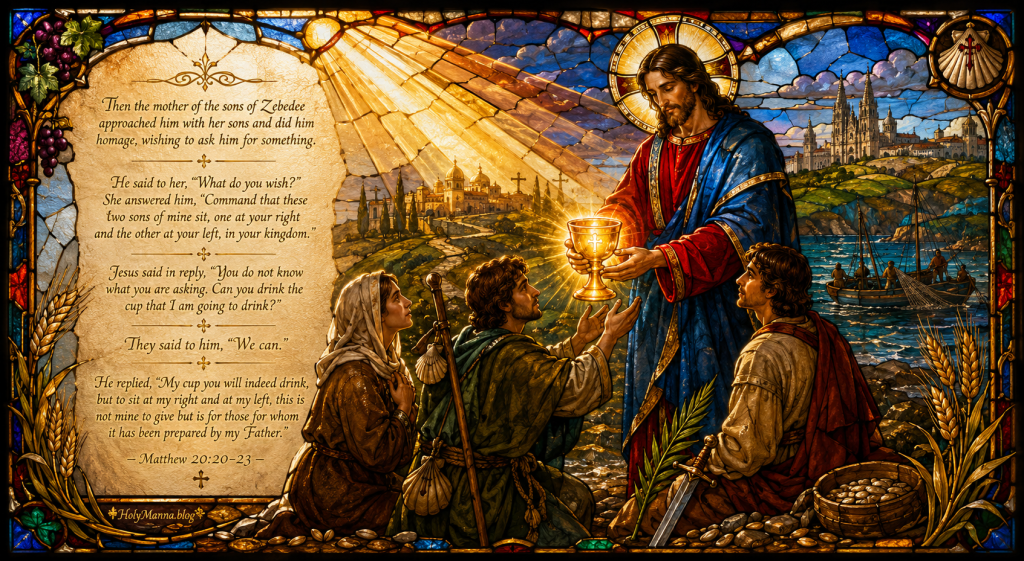
The scene unfolds at the worst possible moment. Jesus has just finished telling the Twelve, for the third time, that He is going up to Jerusalem to be mocked, scourged, and crucified. And immediately, a mother approaches with her two sons, James and John, asking for the best seats in the Kingdom. It would be comic if it were not so painfully human. Ancient Near Eastern courts placed the highest honors at the king’s right and left, and this Galilean family, perhaps encouraged by Jesus’s promise that the Twelve would sit on thrones, wanted those places locked in. Jesus does not humiliate them. Instead, He redirects their ambition toward the only path to glory that exists in His Kingdom: the cup of His Passion. On this feast, the Church proclaims this Gospel because James answered “We can” with more courage than understanding, and then, by grace, grew into his answer, drinking the cup first among the apostles.
Matthew 20:20-28 – New American Bible (Revised Edition)
20 Then the mother of the sons of Zebedee approached him with her sons and did him homage, wishing to ask him for something. 21 He said to her, “What do you wish?” She answered him, “Command that these two sons of mine sit, one at your right and the other at your left, in your kingdom.” 22 Jesus said in reply, “You do not know what you are asking. Can you drink the cup that I am going to drink?” They said to him, “We can.” 23 He replied, “My cup you will indeed drink, but to sit at my right and at my left [, this] is not mine to give but is for those for whom it has been prepared by my Father.” 24 When the ten heard this, they became indignant at the two brothers. 25 But Jesus summoned them and said, “You know that the rulers of the Gentiles lord it over them, and the great ones make their authority over them felt. 26 But it shall not be so among you. Rather, whoever wishes to be great among you shall be your servant; 27 whoever wishes to be first among you shall be your slave. 28 Just so, the Son of Man did not come to be served but to serve and to give his life as a ransom for many.”
Detailed Exegesis
Verse 20: “Then the mother of the sons of Zebedee approached him with her sons and did him homage, wishing to ask him for something.” The mother, identified by tradition and by comparison with other Gospel passages as Salome, kneels in genuine reverence, yet her homage carries an agenda. Mark’s account has the brothers ask directly, showing they stood fully behind the request.
Verse 21: “He said to her, ‘What do you wish?’ She answered him, ‘Command that these two sons of mine sit, one at your right and the other at your left, in your kingdom.’” The request assumes the Kingdom is imminent and political. Jesus’s gentle question draws the desire into the open, because He heals ambition by exposing it, not by shaming it.
Verse 22: “Jesus said in reply, ‘You do not know what you are asking. Can you drink the cup that I am going to drink?’ They said to him, ‘We can.’” In the Old Testament, the cup often signifies the portion God assigns, including suffering. Jesus replaces the image of thrones with the image of the chalice of His Passion. The brothers’ instant reply is naive, generous, and ultimately prophetic.
Verse 23: “He replied, ‘My cup you will indeed drink, but to sit at my right and at my left, this is not mine to give but is for those for whom it has been prepared by my Father.’” Jesus solemnly prophesies their martyrdom of blood and of endurance. James died by Herod’s sword; John suffered persecution and exile. The seats of honor belong to the Father’s hidden plan, teaching that even apostles must surrender outcomes to God.
Verse 24: “When the ten heard this, they became indignant at the two brothers.” The indignation of the ten is not righteousness; it is rivalry. They are angry because they wanted those seats too. The whole apostolic college needs conversion, which is strangely comforting for every struggling parish and family since.
Verse 25: “But Jesus summoned them and said, ‘You know that the rulers of the Gentiles lord it over them, and the great ones make their authority over them felt.’” Jesus names the world’s model of power: domination, self-assertion, authority as a weight pressed down on others. Every generation recognizes this portrait.
Verse 26: “But it shall not be so among you. Rather, whoever wishes to be great among you shall be your servant.” With one sentence, Jesus founds an entirely new civilization of authority. He does not abolish the desire for greatness; He redefines its currency as service.
Verse 27: “Whoever wishes to be first among you shall be your slave.” The teaching intensifies from servant to slave, the lowest social position in the ancient world. Primacy in the Church is measured by the depth of self-gift, which is why the Pope’s ancient title is servant of the servants of God.
Verse 28: “Just so, the Son of Man did not come to be served but to serve and to give his life as a ransom for many.” Jesus grounds the entire teaching in His own mission, echoing the Suffering Servant of Isaiah 53. The ransom saying is one of the clearest statements of the redemptive purpose of the Cross in all the Gospels.
Teachings
Saint John Chrysostom, whose commentary on this very passage the Church reads in the Office of Readings for this feast, marvels at how Jesus draws the brothers upward, writing in his Homily 65 on Matthew: “He is really prophesying a great blessing for them, since he is telling them: ‘You will be found worthy of martyrdom; you will suffer what I suffer and end your life with a violent death, thus sharing all with me.’” Chrysostom also notes the depth hidden in the image of the chalice, observing that Jesus “calls his suffering a baptism, to show that it will effect a great cleansing of the entire world.” The Catechism enshrines verse 28 at the heart of its teaching on the royal dignity of the baptized, declaring in CCC 786 that “Christ, King and Lord of the universe, made himself the servant of all,” and that for the Christian, “to reign is to serve him.” Pope Benedict XVI, in his General Audience of June 21, 2006, saw James’s whole life in the arc between two mountains, teaching that the journey “from the mount of the Transfiguration to the mount of the Agony, symbolizes the entire pilgrimage of Christian life, among the persecutions of the world and the consolations of God.” Scripture itself records the fulfillment of the prophecy of the cup, for Acts 12:2 states plainly that Herod “had James, the brother of John, killed by the sword.”
Reflection
This Gospel meets everyone exactly where ambition lives: at work, on social media, even in ministry. Jesus never condemns the desire to be great; He converts it. This week, practice greatness His way. Choose one hidden act of service daily that no one will see or credit, whether washing dishes unasked, covering a colleague’s task, or sitting with someone lonely. When recognition passes you by, quietly pray, my cup You will indeed drink, and unite the sting to Christ. Examine honestly whether your leadership at home, at church, or on the job presses down on people or lifts them up. What throne are you secretly asking Jesus for, and is He offering you a cup instead? Who in your daily life is God inviting you to serve as if you were the least, not the greatest?
The Fisherman Who Learned to Drink the Cup
Here is the beautiful ending to the story that began with a mother asking for thrones. James got neither the right hand nor the left, at least not in the way his family imagined that day on the road to Jerusalem. He got something the Father had prepared instead: the first martyr’s crown among the apostles, a sword in Jerusalem, and a name so beloved that centuries of pilgrims still walk across Spain to honor him. The ambitious son of thunder became an earthen vessel gladly broken so that the treasure inside could pour out for the world.
Today’s readings tell one story from three angles. Saint Paul reveals the secret of the vessel: the power is God’s, never ours, and affliction cannot destroy what grace sustains. Psalm 126 reveals the secret of the seed: tears sown in faithfulness always come home as sheaves of joy. And the Gospel reveals the secret of the throne: it is won on one’s knees, with a towel, or with a chalice raised in trembling hands, saying yes to whatever the Father has prepared. Greatness in the Kingdom has never been about the seat; it has always been about the cup.
The invitation of this feast is wonderfully practical. Stop negotiating with Jesus for position, comfort, or recognition, and start asking Him for the courage James found: the courage to answer “We can” and then let grace make it true. Serve someone today who cannot repay it. Offer one hidden sacrifice for someone who will never know. Sow the tears honestly and trust God completely for the harvest. Saint James, first among the apostles to drink the cup of the Lord, pray for every reader walking this pilgrimage of faith.
Engage With Us!
The conversation does not end here, and every reflection shared helps someone else walking the same road. Please share your thoughts, experiences, and prayers in the comments below; this community grows stronger every time someone speaks honestly about where these readings met their life.
- In 2 Corinthians 4:7-15, Saint Paul says the treasure of the Gospel is held in earthen vessels so the surpassing power may be of God. Where has God shown His power through your weakness rather than your strength?
- Psalm 126:1-6 promises that those who sow in tears will reap with cries of joy. What are you sowing in tears right now, and how can you entrust its harvest to God this week?
- In Matthew 20:20-28, Jesus teaches that whoever wishes to be great must become a servant, and He asks James and John if they can drink His cup. What ambition in your heart is Jesus inviting you to convert into service, and what would answering “We can” cost you?
- Taken together, today’s readings teach that true greatness comes from pouring out fragile lives in humble service so God’s power is glorified. What is one concrete, hidden act of service you will commit to this week in honor of Saint James?
Living a life of faith is not about winning the best seat; it is about loving from the lowest one, exactly as Jesus did when He came not to be served but to serve. Walk this week like a pilgrim on the Camino, one faithful step at a time, doing everything with the love and mercy Jesus taught us. Buen Camino, and may Saint James pray for us all.
Sacred Heart of Jesus, we trust in You!
Immaculate Heart of Mary, pray for us!
Saint Michael the Archangel, defend us in battle!
Follow us on YouTube, TikTok, Instagram and Facebook for more insights and reflections on living a faith-filled life.


Leave a comment