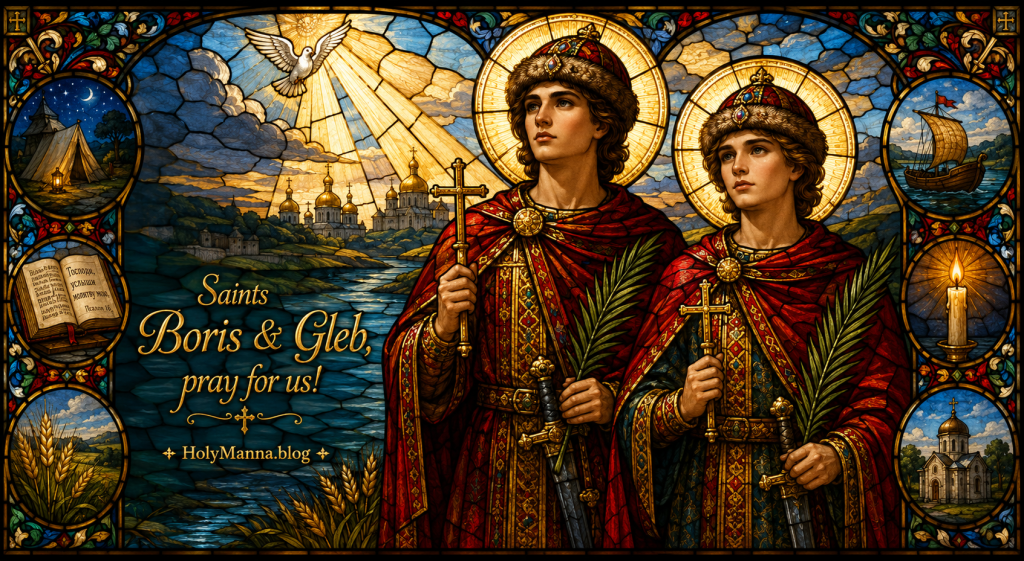
The Brothers Who Refused to Draw the Sword
Some saints change the world by what they build. Saints Boris and Gleb changed the world by what they refused to do. They were princes of Kyivan Rus, sons of Saint Vladimir the Great, the ruler who brought an entire people to the waters of Baptism in the year 988. When the moment came that would have justified war by every worldly standard, when armies stood ready and a throne hung in the balance, these two young men laid down their swords and accepted death rather than shed the blood of their own brother. The Church of the East gave them a title that had never existed before: passion-bearers, those who suffer and die in imitation of the innocent, unresisting Christ. Their feast is celebrated on July 24th, the day of Boris’s martyrdom in 1015, and their witness stands today as one of the most startling acts of Gospel obedience in the history of Christendom.
Their story matters for Catholics, not only for the Orthodox. Boris and Gleb died decades before the tragic division between East and West hardened in 1054, and the Catholic Church formally confirmed their veneration in 1724 under Pope Benedict XIII. Byzantine Catholic and Ukrainian Greek Catholic communities honor them on this very day. They belong to the undivided inheritance of the whole Church, and their sacrifice speaks a language every Christian understands: “Greater love has no man than this, that a man lay down his life for his friends” (The Gospel of John, Jn 15:13). The Catechism teaches that “martyrdom is the supreme witness given to the truth of the faith: it means bearing witness even unto death” (CCC 2473). Boris and Gleb bore that witness not in a Roman arena but in a tent by a quiet river and a boat on a northern waterway, and the echo of it has never faded.
Sons of Vladimir, Children of the Baptism of Rus
To understand Boris and Gleb, the reader has to picture a world that had only just met Jesus Christ. Their father, Vladimir, had been a pagan warlord, a man of many wives and many wars, until his conversion transformed both his soul and his realm. In 988 he led the people of Kyiv into the Dnipro River for Baptism, and the land of Rus, stretching across what is today Ukraine, Belarus, and western Russia, became Christian territory almost overnight. Churches rose where idols had stood. The Psalms began to be sung in the Slavonic tongue. Yet the old world did not vanish. Beneath the new faith, the ancient habits of dynastic violence, blood feud, and ruthless ambition still ran like a cold current under ice.
Boris and Gleb were born into this in-between age. Tradition holds that they were full brothers, sons of the same mother, whom some later accounts describe as Bulgarian, though her identity is not securely documented in the historical record. At their Baptism the boys received Christian names: Boris was christened Roman, and Gleb was christened David. Those names were not decoration. Roman recalled Saint Romanus, and David recalled the king of Israel who twice spared the life of Saul, the rival who hunted him, because he would not lift his hand against the Lord’s anointed. The name would prove prophetic.
Their father entrusted each of them with a principality, as was the custom. Boris received Rostov, and by most accounts he was regarded as the likely heir to the great throne of Kyiv itself, beloved by the people and trusted with command of his father’s army. Gleb, still quite young, was given the town of Murom in the east. The ancient sources describe both brothers as devout in a way that stood out even in that first fervent generation. The Tale of Boris and Gleb, a hagiographic account written within living memory of the events, portrays Boris as a young man who loved to read the lives of the martyrs and who prayed that he might be found worthy to walk their path. Whether or not those inner prayers were recorded word for word, the shape of his life confirms the substance of them. These were princes formed by Scripture, raised at the side of a father who had learned, late but truly, that power is a stewardship before God and not a possession to be seized.
A Kingdom Offered and Refused
There are no miracles recorded from the lifetimes of Boris and Gleb, and honesty requires saying so plainly. They healed no lepers, calmed no storms, and multiplied no loaves. Their entire claim on the memory of the Church rests on a single, blazing act of obedience, and that is precisely what makes them so important. The Church does not canonize résumés. She canonizes conformity to Christ, and in the summer of 1015 these two brothers were conformed to Christ in the most literal way imaginable.
The crisis broke on July 15, 1015, when Saint Vladimir died. Boris was away from Kyiv at that moment, returning at the head of his father’s army from a campaign against the Pecheneg raiders. His elder half-brother Sviatopolk moved instantly, seizing the capital and the treasury and buying the loyalty of the city’s leading men. Word reached Boris on the march, and with it came the counsel of his own retainers. Here was the heir the people loved, standing at the head of a loyal veteran army, facing a usurper whose claim was weaker and whose character was worse. Every calculation of politics, and even many calculations of justice, pointed one direction. His advisers urged him to march on Kyiv and take the throne.
The Primary Chronicle, the great early record of Rus, preserves his answer, and it deserves to be read slowly: “Be it not for me to raise my hand against my elder brother. Now that my father has passed away, let him take the place of my father in my heart.” With those words Boris dismissed the army that could have saved his life. The soldiers, seeing that he would not fight, melted away and left him with only his small household. He encamped in a tent by the River Alta and waited, knowing full well what was coming, because messengers had already warned him that Sviatopolk desired his death.
Why should the reader remember this and emulate it? Because Boris’s refusal was not weakness, passivity, or political naivety. It was a deliberate theological decision made by a man holding real power in his hands. He had absorbed the Sermon on the Mount as a description of reality rather than a beautiful impossibility. The Catechism teaches that “in the Sermon on the Mount, the Lord recalls the commandment, ‘You shall not kill,’ and adds to it the proscription of anger, hatred, and vengeance. Going further, Christ asks his disciples to turn the other cheek, to love their enemies. He did not defend himself and told Peter to leave his sword in its sheath” (CCC 2262). Boris looked at a fratricidal war for a throne and concluded that no crown on earth was worth becoming Cain. In a culture where princes killed brothers as routinely as they collected tribute, that conclusion was revolutionary. It planted in the soul of a newly baptized people the idea that the Gospel actually governs politics, ambition, and family, and not merely private devotion.
The Tent by the Alta and the Boat near Smolensk
What followed is narrated in the Primary Chronicle, the Tale of Boris and Gleb, and the monk Nestor’s Lesson, all composed within a few generations of the events. The documented core is firm: Sviatopolk sent assassins, and both brothers were murdered in 1015. The vivid details come from the hagiographic accounts, and the reader should receive them as the Church’s cherished early testimony rather than as a modern court transcript.
Sviatopolk first sent Boris a false message of peace, promising to increase his lands, even while dispatching killers from Vyshhorod under a man named Putsha. The accounts tell that Boris spent his final night in his tent in prayer, chanting the Psalms through the darkness, words such as “O Lord, how many are my foes! Many are rising against me” (Psalm 3, Ps 3:1). At dawn he asked his priest to serve matins. The assassins, gathered outside, heard the sound of the young prince singing the morning office and attacked as it ended, driving their spears through the tent and into his body. His servant George, a Hungarian who loved him, threw himself across his master and was killed with him; the tradition adds the grim detail that the killers later cut off George’s head to strip the gold torque, Boris’s gift, from his neck. The Tale recounts that Boris, still breathing, asked for a moment to finish his prayer, forgave his murderers aloud, and then told them to complete what they had been sent to do. It further tells that as his body was carted through the forest he was found to be alive still, and two Varangian mercenaries finished the martyrdom with a sword thrust to the heart. It was July 24, 1015. These final details rest on the early hagiographic tradition and cannot be independently verified, and the Church hands them on as tradition.
Then came Gleb’s turn. Sviatopolk lured the youngest brother from Murom with a forged message claiming that their father lay gravely ill and longed to see him. Gleb set out at once, as a loving son would. On the journey a message from his brother Yaroslav reached him with the double blow of truth: their father was already dead, and Boris had been murdered. The accounts describe the young prince weeping in his boat for his father and his brother when Sviatopolk’s men overtook him on the river near Smolensk. In a detail almost too painful to write, the assassins forced Gleb’s own cook, a man named Torchin, to kill his master with a kitchen knife. The boy who bore the baptismal name of David, the king who refused vengeance, offered no resistance and died as his brother had died. His body was thrown carelessly on the riverbank between two trees. It was September 5, 1015.
The two princes had followed their Lord step for step, and Scripture supplies the pattern the ancient authors saw in them: “When he was reviled, he did not revile in return; when he suffered, he did not threaten; but he trusted to him who judges justly” (The First Letter of Peter, 1 Pet 2:23). The Catechism honors exactly this kind of witness: “Those who renounce violence and bloodshed and, in order to safeguard human rights, make use of those means of defense available to the weakest, bear witness to evangelical charity, provided they do so without harming the rights and obligations of other men and societies” (CCC 2306). As for Sviatopolk, history remembers him as “the Accursed.” Their brother Yaroslav, later called the Wise, took up the cause of justice, and in 1019 he defeated Sviatopolk in battle at the very banks of the Alta where Boris had been slain. Sviatopolk fled westward and died wretchedly in exile. A word of scholarly honesty belongs here: some modern historians, drawing on sources such as the Norse Eymund’s Saga, debate details of the chronology and of responsibility in these murky years of civil war, and a few references even give a death range reaching to 1019. The constant tradition of the Church, following the ancient Rus sources, holds to the account given above, and it is that tradition the faithful have venerated for a thousand years.
A Pillar of Light and Relics That Would Not Burn
The veneration of Boris and Gleb began almost immediately, and the stories of what God worked through them after death form one of the richest miracle traditions of the Christian East. Boris had been buried quietly at the Church of Saint Basil in Vyshhorod, near Kyiv. Gleb’s body, however, lay unburied and unmarked on the riverbank for roughly four years while the civil war raged. When Yaroslav the Wise finally secured the realm, he ordered a search for his youngest brother’s remains. Tradition tells that the searchers were guided to the spot because a pillar of unearthly light, like the flame of a great candle, was seen standing over the place, and that when the body was found it was whole and incorrupt despite the years of exposure. This story cannot be verified.
Gleb was solemnly buried beside Boris at Saint Basil’s in Vyshhorod, and the tomb of the brothers quickly became a fountain of reported graces. When that church later burned to the ground, the relics were found unharmed in the ashes, and a tradition recounts that when Metropolitan John of Kyiv and his clergy opened the caskets, the bodies appeared white as snow, the faces radiant, and a heavenly fragrance filled the building. This story likewise cannot be verified. What is documented beyond doubt is the explosion of devotion that followed. Metropolitan John I composed a liturgical service in their honor and established their joint feast on July 24th within decades of their deaths. The brothers were glorified as saints in Rus around 1071, with some scholarship tying the formal act to the great translation of their relics in 1072; they were the first saints ever canonized by the Church in that land. Another solemn translation followed in 1115. The chronicles of the following centuries record healing after healing at their shrine, the blind receiving sight and the lame walking, so that Vyshhorod became one of the great pilgrimage centers of the East Slavic world.
The brothers also entered the memory of their people as heavenly defenders. Tradition holds that on the eve of the Battle of the Neva in 1240, Boris and Gleb appeared in a vision to a soldier of Prince Alexander Nevsky, sailing in a boat and promising help to their kinsman, and that the outnumbered Rus won the day. Other traditions place their intercession at the Battle on the Ice in 1242 and with Grand Prince Dimitri Donskoy at Kulikovo Field in 1380. These battle apparitions are pious traditions preserved in chronicles and saints’ lives, the sources vary on the details, and none of them can be verified. Yet even the skeptic can verify what the traditions reveal: a whole civilization chose two men who refused to fight as its favorite protectors in battle, which is perhaps the most eloquent tribute of all.
There is a touching Catholic thread in the story of the relics. In 1095, portions of the relics of both saints were carried west to the Sázava Monastery in Bohemia, a Latin land, and sealed in an altar there, a quiet sign that the brothers belonged to the whole undivided Church. The main relics at Vyshhorod were hidden for safekeeping when the Mongol armies of Batu Khan destroyed Kyiv in 1240, and their location was lost; they have never been found. The devotion, however, proved indestructible. The Catholic Church confirmed the cult of Boris and Gleb in 1724 under Pope Benedict XIII, and to this day Ukrainian Greek Catholic and other Byzantine Catholic communities keep their feast on July 24th. Churches and monasteries beyond counting bear their names, from the exquisite twelfth-century Church of Boris and Gleb at Kideksha to the ancient cathedral of Chernihiv, and towns like Borisoglebsk carry their memory on the map. In 2011 a monument to the two princes was raised in Vyshhorod, in modern Ukraine, where their story began. Their icon, two slender young princes standing side by side with the cross of martyrdom, remains one of the most beloved images in all of Slavic Christianity. The Catechism explains why such veneration is no mere nostalgia, teaching that the saints in heaven “do not cease to intercede with the Father for us” (CCC 956), and that our communion with them joins the whole Church, on earth and in glory, into one Body.
Laying Down the Sword in an Age of Outrage
What do two eleventh-century princes have to say to a person navigating the twenty-first century? Almost everything, once the reader translates the throne of Kyiv into modern terms. Few people today are offered a kingdom, but nearly everyone is daily offered the same underlying bargain Boris refused: seize the advantage, win the argument, destroy the rival, and justify it afterward. The weapons have changed from spears to screenshots, from armies to audiences, but the temptation is identical. Boris stood at the head of an army with every excuse to use it, and he chose the Cross instead. His question is now the reader’s question. When power to retaliate is sitting in your hands, what do you actually do with it?
The witness of Boris and Gleb is emphatically not a counsel of cowardice or indifference to justice. Yaroslav’s later fight against the usurper shows that the early Church of Rus understood the legitimate defense of others. What the brothers refused was something more specific and more spiritually deadly: the willingness to shed a brother’s blood to secure their own position. Their sacrifice teaches that some victories cost more than any defeat, because they cost the soul. The Lord Himself put it without softening: “Put your sword back into its place; for all who take the sword will perish by the sword” (The Gospel of Matthew, Mt 26:52). Saint Paul gives the positive command that the brothers embodied: “Do not be overcome by evil, but overcome evil with good” (The Letter to the Romans, Rom 12:21).
Living this in daily life is concrete, not abstract. It looks like declining to answer a cruel email with a crueler one, and waiting a day before responding at all. It looks like refusing to advance a career by quietly undermining a colleague, even when the opportunity is easy and deniable. It looks like being the family member who absorbs a provocation at the holiday table instead of escalating it, because peace in the home is worth more than the satisfaction of a winning retort. It looks like praying, by name, for the person who has genuinely wronged you, which the Catechism describes as the summit of Christian prayer, teaching that “Christian prayer extends to the forgiveness of enemies, transfiguring the disciple by configuring him to his Master” (CCC 2844). It also looks like Boris’s final night: when a trial cannot be avoided, meet it with the Psalms, with the sacraments, and with forgiveness already on your lips. The Catechism reminds the faithful that “Christ died out of love for us, while we were still ‘enemies’” (CCC 1825), and every renunciation of vengeance is a small share in that love. Where in your life right now is God inviting you to lay down a weapon you have every right to use? Is there a brother, a sister, a parent, or a friend whose relationship matters more than the grievance you are holding against them?
Engage With Us!
The story of Saints Boris and Gleb has stirred hearts for a thousand years, and HolyManna would love to know how it stirs yours. Share your thoughts, questions, and reflections in the comments below; your witness may be exactly what another reader needs today. To help the conversation begin, here are some questions for prayerful reflection this week.
- Boris held real power and refused to use it against his brother. Where do you hold power over someone, at work, at home, or online, and how is Christ asking you to use it?
- Gleb was betrayed by his own family and killed by his own servant. How do you respond when the deepest wounds come from the people closest to you?
- The brothers prepared for death with prayer, the Psalms, and forgiveness. What would you want in your heart if you knew a great trial was coming tomorrow?
- The people of Rus chose two men who refused to fight as their protectors in battle. What does that paradox teach you about where real strength comes from?
- Is there one act of retaliation, however small, that you can renounce this week as an offering to God?
However the Lord speaks to you through these holy brothers, do not let their witness remain a story on a screen. Take one concrete step this week toward peace with someone, and entrust the outcome to God, asking Saints Boris and Gleb to intercede for you. Live this day, and every day, with the love and mercy that Jesus taught us, and He will make even your smallest surrender a seed of His kingdom.
Saints Boris & Gleb, pray for us!
Follow us on YouTube, TikTok, Instagram and Facebook for more insights and reflections on living a faith-filled life.


Leave a Reply