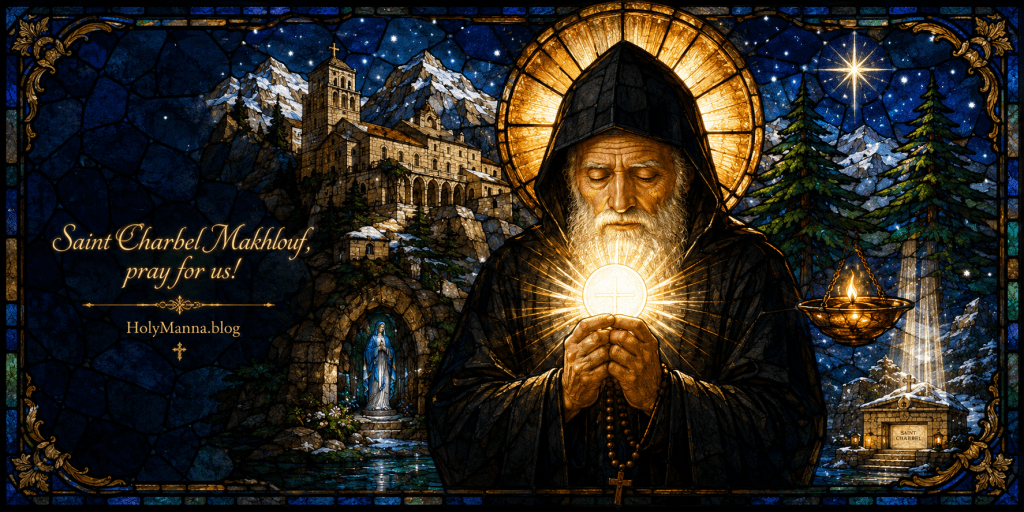
The Miracle Monk of Lebanon
There is a mountain in Lebanon where the silence is louder than any sermon. High above the Mediterranean, at a hermitage attached to the Monastery of Saint Maron in Annaya, a quiet monk spent twenty three years doing something the world would call nothing at all. He prayed. He fasted. He worked the rocky soil with his hands. He said almost nothing. And then he died on Christmas Eve of 1898, and heaven apparently decided that the world was going to hear about him whether he liked it or not.
Saint Charbel Makhlouf is the patron saint of Lebanon, and Lebanese Christians lovingly call him the Miracle Monk of Lebanon. He is one of the most extraordinary wonder workers in the modern history of the Church, a hermit whose tomb reportedly glowed with light, whose body remained incorrupt and flexible for decades while exuding a mysterious blood-like fluid, and whose intercession has been credited with thousands upon thousands of healings that continue right up to the present day. He was beatified by Pope Paul VI on December 5, 1965, at the close of the Second Vatican Council, and canonized by the same pope on October 9, 1977, becoming the first officially recognized Lebanese saint of modern times.
What makes Charbel so magnetic is the sheer contrast of his life and his legacy. He fled every form of attention, and God gave him global fame. He never wrote a book, never founded a movement, never preached to crowds, and yet pilgrims of every faith, Christian and Muslim alike, stream to his tomb by the millions. His story is living proof of what the Catechism teaches, that the saints in heaven do not stop caring for those of us still on the road; they “constantly care for those whom they left on earth” and their intercession is their “most exalted service to God’s plan” (CCC 2683, CCC 2635). Charbel took that job seriously. He may be the busiest hermit in heaven.
A Boy, a Grotto, and Two Hermit Uncles
Youssef Antoun Makhlouf was born on May 8, 1828, in Bekaa Kafra, the highest village in Lebanon, perched among the peaks of the north. He was the youngest of five children born to Antoun Zaarour Makhlouf and Brigitta Elias Chidiac, a poor and devout Maronite Catholic family. The Maronite Church, for readers newer to this corner of the Catholic world, is one of the Eastern Catholic Churches in full communion with Rome, with its own ancient Syriac liturgy and a married clergy alongside its monks. The Catechism reminds us that this rich diversity of rites and traditions, far from dividing the Church, reveals her catholicity, since the Church’s unity is expressed through “the great richness of this diversity” which “is not opposed to the Church’s unity” (CCC 814, CCC 1202).
Tragedy arrived early. When Youssef was only three years old, his father was taken from the family. Like many Christian men of the Lebanese mountain under Ottoman rule, Antoun was forced into labor, required to transport the harvest to the local emir. On the journey home he developed a high fever and died, and he was buried far from his village, in Gherfeen, without his family able to pay their last respects. Brigitta later remarried, and in keeping with the Maronite custom of a married priesthood, her second husband was eventually ordained a priest. So Youssef grew up in a home where faith was not a Sunday accessory; it was the air the family breathed.
Two of his maternal uncles were hermits at the Monastery of Saint Anthony of Qozhaya, and their example lit a fire in the boy. While he tended the family’s cattle on the mountainside, Youssef would slip away to a grotto dedicated to the Blessed Virgin Mary to pray and meditate for hours. The villagers of Bekaa Kafra noticed. They began calling him the saint, which is either the sweetest compliment a village can give or a lot of pressure to put on a teenager, depending on how you look at it. In many respects, that little grotto became his first hermitage and his first altar.
At the age of twenty three, in 1851, Youssef made his decision. He left home, without fanfare, and entered the Lebanese Maronite Order at the Monastery of Our Lady of Mayfouq. He soon transferred to the Monastery of Saint Maron in Annaya, where he received the monastic habit and took a new name: Charbel, in honor of a second century Christian martyr of Antioch. He professed his solemn vows of poverty, chastity, and obedience on November 1, 1853. This is exactly what the Catechism describes when it speaks of the consecrated life, a state in which the faithful “can bind themselves more closely to Christ’s manner of life” through the profession of the evangelical counsels (CCC 915, CCC 916).
Then came a detail so beautiful it feels scripted, except that it is documented history. Charbel was sent to study philosophy and theology at the Monastery of Saints Cyprian and Justina in Kfifan, and one of his professors and spiritual directors there was Father Nimatullah Kassab al-Hardini, a monk of such holiness that he himself was canonized by Pope Saint John Paul II in 2004. A future saint formed a future saint in the same classroom. Holiness, it turns out, is contagious. Charbel was ordained a priest on July 23, 1859, at Bkerke, the seat of the Maronite Patriarchate, and returned to Annaya to begin his priestly and monastic life.
The Hermit Whose Lamp Burned on Water
For roughly sixteen years, Father Charbel lived the ordinary rhythm of monastic community life at Annaya, and he lived it in a way that was anything but ordinary. His brother monks remembered him for near total silence, joyful obedience, crushing manual labor accepted without complaint, strict fasting, and an all-consuming devotion to the Holy Eucharist and to the Blessed Virgin Mary. He arranged his entire day around the Mass, celebrating close to noon so that the whole morning could be spent in preparation and the rest of the day in thanksgiving. That habit alone is a homily. The Catechism teaches that the Eucharist is “the source and summit of the Christian life” (CCC 1324), and Charbel structured his very hours around that truth as though it were the most obvious thing in the world. For him, it was.
In 1875, Charbel asked his superiors for something rare in his order: permission to withdraw to the Hermitage of Saints Peter and Paul, a small dwelling and chapel on the heights above the monastery. Permission was granted, and on February 15, 1875, he climbed to the hermitage and essentially never came back down. For the next twenty three years he lived there in prayer, penance, and silence, sleeping little, eating less, wearing a rough habit, and spending long nights adoring the Blessed Sacrament. The Church has always treasured this mysterious vocation. The Catechism says of hermits that they “devote their life to the praise of God and salvation of the world through a stricter separation from the world, the silence of solitude and assiduous prayer and penance” (CCC 920), and that the hermit “manifests to everyone the interior aspect of the mystery of the Church, that is, personal intimacy with Christ” (CCC 921). Charbel is arguably the most vivid modern illustration of those two paragraphs anywhere on earth.
The most famous story from his hermit years is the story of the lamp. According to the tradition handed down by the Monastery of Saint Maron, Charbel asked one evening to have his oil lamp refilled. Some attendants, deciding to play a trick on the old hermit, filled the lamp with water instead of oil. Watching through a crack in the door, they saw him light it, and it burned as though filled with the finest oil. Astonished, they summoned another monk, who tried and failed to light the lamp himself and tasted the liquid to confirm it truly was water. When the lamp was returned to Charbel, he lit it again. It is a tradition preserved by his own monastery and connected to the testimony gathered for his cause, though as a story resting on the monks’ account, it cannot be independently verified. Even so, it captures something true about the man: the ordinary rules of the world seemed strangely negotiable around Father Charbel, because he lived so completely inside the rules of heaven.
Contemporary accounts also relate that Charbel was at times observed lifted in prayer, gifted with levitations during his long hours before God. This too comes down through Catholic tradition and the memory of his order rather than through documentation that can be verified today, and it should be received in that spirit. What is beyond dispute is the assessment of everyone who knew him. His charity and kindness endeared him to all his neighbors on the mountain, Christians and Muslims alike, and people climbed to the hermitage to ask the silent monk for his blessing and his prayers. Why should you remember him? Because Charbel proves that you do not need a platform to change the world. You need a soul completely given to God. The Catechism calls all the faithful, every single one of us, to “the fullness of Christian life and to the perfection of charity” (CCC 2013), and Charbel shows what that looks like when someone actually says yes without reservation.
Twenty Three Years of Hidden Warfare
Charbel was not a martyr, and no responsible account claims he was. His battlefield was quieter and, in some ways, longer. His hardships began in childhood with the loss of his father to forced labor under Ottoman rule, a grief shared by countless Christian families of the Lebanese mountain in that era. They continued in the daily, grinding asceticism he freely embraced for the sake of Christ: the cold of the mountain, the poverty of the hermitage, the hunger of constant fasting, the discipline of silence, the surrender of every comfort, every ambition, and every scrap of human recognition for forty seven years of religious life. Anyone who has tried to give up so much as coffee for Lent knows that this kind of daily self-denial is not a personality quirk. It is warfare. The Catechism is honest about this, teaching that “the way of perfection passes by way of the Cross” and that “there is no holiness without renunciation and spiritual battle” (CCC 2015).
The final battle came at the altar, which is exactly where Charbel would have chosen to fight it. On December 16, 1898, while celebrating the Divine Liturgy at the hermitage, Charbel suffered a massive stroke at the most solemn moment of the prayer. He was reciting the ancient words of the Maronite liturgy, “Father of Truth, behold Your Son, a sacrifice pleasing to You. Accept this offering of Him who died for me.” He collapsed to the floor, and witnesses recounted that his hands remained clasped around the Holy Eucharist. His fellow hermit, Father Makarios, and other monks carried him to his cell, where he lingered for eight days in suffering, repeating the prayer of the liturgy he could no longer finish. On Christmas Eve, December 24, 1898, he died at the age of seventy, murmuring the names of Jesus, Mary, and Joseph. The priest who had poured out his life drop by drop for decades finished the offering in one final, literal act. The Catechism teaches that the priest acts “in the person of Christ the Head” (CCC 1548), and Charbel died conformed to Christ the Priest and Victim so completely that his death itself became a kind of Mass.
His superior, Father Antonios Mishimshany, then wrote a line in the monastery’s record of the dead that reads today like prophecy. Recording the hermit’s death and burial, he declared, “What God will perform after his death will be sufficient proof of his exemplary behavior in the observance of his vows, to a degree such that we can say that his obedience was angelic, not human.” One small flag for the historically curious: that same necrology entry lists Charbel’s age as sixty eight, though his documented birth in 1828 makes him seventy at death, a small clerical discrepancy in an otherwise remarkable document. The superior’s larger point, however, was about to be vindicated beyond anyone’s imagination.
The Tomb That Glowed
The signs began almost immediately. One of the pallbearers, George Emmanuel Abi-Saseen, testified that heavy snow was falling and dark clouds hung low as the monks prepared to carry Charbel’s body from the hermitage to the monastery on Christmas Day, and that as they carried him, the clouds disappeared and the weather cleared. That is his personal testimony, told here as testimony.
Then, a few months after the burial, villagers and monks began reporting a bright light surrounding Charbel’s grave in the monastery cemetery. The reports grew so persistent that the superiors opened the tomb, and what they found stunned them. The body was intact, incorrupt, still soft and flexible, and from that time it exuded a mysterious blood-like liquid mixed with sweat, so continuously that his mattress and pillow were stained with it. Doctors and experts could offer no medical explanation for either the incorruptibility or the flow of fluid. On April 15, 1899, the Maronite Patriarch authorized the transfer of the body to a special coffin placed in a new tomb inside the monastery.
The examinations did not stop there. The body was exhumed and examined in 1899, in 1927, and again in 1950, when the phenomenon drew enormous crowds and a wave of reported healings. Between 1950 and 1975 the tomb was opened eight times, with medical doctors examining the body in the presence of representatives of the Maronite Patriarchate and the Vatican, and each time they found that the body still resembled that of a living man, without any natural explanation. The Church, it is worth saying clearly, does not teach that incorruptibility is required for sanctity, nor does she worship relics; she venerates the bodies of the saints because they were temples of the Holy Spirit and instruments of God’s grace, an expression of the “religious sense of the Christian people” that surrounds the sacramental life (CCC 1674). But when God chooses to underline a life this emphatically, the Church pays attention.
And the healings came like a flood. By 1977, the Monastery of Saint Maron in Annaya had received 135,000 letters from 95 countries reporting cures and graces attributed to Charbel’s intercession. Two healings were carefully examined and accepted by Church authorities on the road to beatification: Sister Maria Abel Kamari, healed of a painful and debilitating ulcer condition, and Alessandro Obeid, a man blinded in his right eye after an accident, whose sight was restored after Charbel appeared to him and called him to the monastery. On December 5, 1965, at the closing of the Second Vatican Council, Pope Paul VI beatified him, the only beatification celebrated at the Council’s close, declaring, “Great is the gladness in heaven and earth today for the beatification of Charbel Makhlouf, monk and hermit of the Lebanese Maronite Order.” The healing of Mariam Awad, a woman instantly cured of advanced throat cancer in 1967 after a pilgrimage to the tomb, is widely cited in connection with his canonization, which Paul VI celebrated on October 9, 1977. Bishop Francis Zayek, shepherd of the Maronites in the United States, summed up the Church’s wonder by calling Charbel “the second St. Anthony of the Desert, the Perfume of Lebanon” and describing him as “like a Cedar of Lebanon standing in eternal prayer, on top of a mountain.”
The miracles did not politely stop at canonization. The most famous of all came nearly a century after his death. In January 1993, Nohad El Shami, a fifty five year old mother of twelve from Mezarib in Mount Lebanon, suffered a paralysis of her left side caused by arterial blockages in her brain, confirmed at the hospital in Jbeil, where doctors concluded that no treatment could cure her. Her son brought oil and soil from Charbel’s tomb, and the family prayed. On the night of January 22, 1993, Nohad related that she saw in a dream two Maronite monks standing beside her bed; one placed his hands on her neck and performed a surgery while the other supported her with a pillow. When she woke, she found two fresh surgical wounds on her neck, one on each side, and discovered that she could move and walk normally. She was completely healed. She further related that Saint Charbel appeared to her the following night and told her that he had performed the operation so that people would see and return to their faith, asking her to attend Mass faithfully and to visit his hermitage on the 22nd of every month. The tradition identifies the second monk as Saint Maroun himself. Devotional accounts add that her scars would reopen and bleed on the 22nd of each month; that particular detail comes from devotional literature and cannot be verified. What can be verified is the astonishing fruit: since 1993, crowds from Lebanon and across the world have gathered at Annaya on the 22nd of every month to pray and celebrate Mass, a monthly pilgrimage born from one woman’s healing. Nohad El Shami herself passed to the Lord on May 14, 2025, after three decades of quiet witness.
The stream continues into our own day. In 2016, Dafne Gutierrez, a young mother in Phoenix, Arizona, who had been declared legally blind from a degenerative condition, reported the full restoration of her sight after receiving a blessing with a relic of Saint Charbel at a Maronite Catholic church, a case that drew investigation and worldwide attention, though it is not a formally decreed miracle of the canonization process. The monastery at Annaya remains one of the great pilgrimage destinations of the Middle East, drawing Christians and Muslims alike, and Charbel stands at the heart of Lebanon’s remarkable family of saints alongside Saint Maron, Saint Rafka, and Saint Nimatullah al-Hardini, his own teacher. All of this is simply the Catechism in action: the saints’ intercession is real, their communion with us is real, and “being more closely united to Christ, those who dwell in heaven fix the whole Church more firmly in holiness” (CCC 956).
What the Silence of a Hermit Says to a Noisy World
Here is the uncomfortable, wonderful question Charbel poses to every one of us: if a man who did nothing the world counts as productive became one of the most powerful intercessors in modern history, what does that say about what actually matters? Charbel had no followers, no content, no reach, and no strategy. He had God, and he wanted nothing else. The Catechism describes contemplative prayer as a “gaze of faith, fixed on Jesus” (CCC 2715), and Charbel spent twenty three years perfecting that gaze until his whole life became transparent to Christ.
You do not need to move to a hermitage on a Lebanese mountain to imitate him, and for most of us that is emphatically not the calling. But every believer can build a hermitage of the heart. Try claiming fifteen minutes of genuine silence each day, no phone, no music, no noise, just you and the Lord; Charbel would recognize that as the beginning of everything. Let the Eucharist reorder your schedule the way it ordered his, perhaps by arriving ten minutes early for Mass to prepare and staying five minutes after to give thanks, or by making a monthly holy hour of adoration, since the Catechism insists the Eucharist is “the source and summit of the Christian life” (CCC 1324) and Charbel died holding onto that truth with his literal hands. Practice hidden charity the way he did, doing one act of kindness each week that no one will ever discover or credit to you. And when suffering comes, offer it quietly in union with Christ instead of broadcasting it, letting the Cross do its slow, holy work in you, for “there is no holiness without renunciation and spiritual battle” (CCC 2015).
Where in your daily life has noise crowded out the voice of God? If every like, follower, and achievement disappeared tomorrow, what would be left of your identity, and would it be rooted in Christ? What is one comfort you could sacrifice this week, hidden from everyone but God, as a small act of love? Charbel answered questions like these with his entire life, and heaven has been answering back ever since.
Engage With Us!
Saint Charbel’s story has a way of unsettling our busy, noisy hearts in the best possible way, and this community would love to hear how it lands in yours. Please share your thoughts, your experiences, and even your favorite Saint Charbel stories in the comments below, and if his intercession has touched your life or the life of someone you love, your testimony might be exactly the encouragement another reader needs today. To help spark your reflection, consider these questions:
- What draws you most to Saint Charbel’s story: his silence, his devotion to the Eucharist, or the miracles that followed his death, and why?
- Charbel structured his entire day around the Mass. What one concrete change could you make this week to place the Eucharist closer to the center of your life?
- The villagers called young Youssef “the saint” because his faith was visible even in ordinary chores. What would the people around you say your daily life points to?
- Charbel’s greatest works happened after his death, completely outside his control. How does that challenge the way you measure success and productivity?
- Is there a “grotto” in your life, a quiet place and time where you can meet God daily, and if not, where could you create one?
However God is calling you, whether to deeper silence, to the adoration chapel, or simply to fifteen unhurried minutes with Him tomorrow morning, take one step this week. Live your faith boldly and quietly at the same time, the way Charbel did, and do everything, the hidden things most of all, with the love and mercy that Jesus taught us. The Miracle Monk of Lebanon is praying for you; it seems to be his favorite thing to do.
Saint Charbel Makhlouf, pray for us!
Follow us on YouTube, TikTok, Instagram and Facebook for more insights and reflections on living a faith-filled life.

 Holy Manna!
Leave a comment