Friday of the Sixteenth Week in Ordinary Time – Lectionary: 399
When God Refuses to Let Go
There is a moment in every family when someone wanders off, and everyone else must decide what to do about it. Today’s readings reveal what God decides, every single time. He goes and gets His people back.
The Church places before the faithful this Friday a remarkable pairing. The First Reading and the Responsorial Psalm both come from the prophet Jeremiah, a man who watched his nation collapse under the weight of its own infidelity, yet who carried in his heart some of the most tender promises God ever spoke. Israel had scattered itself through idolatry. The northern kingdom was already gone, swallowed by Assyria. Judah was next in line for Babylon. And into that wreckage God speaks not condemnation but invitation: return, and He will provide shepherds, gather the nations, and turn mourning into dancing.
Then the Gospel shows where all of this gathering finally lands: not in a city or a temple, but in the human heart. Jesus explains His Parable of the Sower and lays bare the four conditions of the soul that hears God’s word. The path, the rocks, the thorns, and the rich soil are not four kinds of people so much as four possibilities living inside every person on any given day.
The central theme uniting these readings is this: God gathers what sin scatters, sowing His word with astonishing generosity, and the harvest depends on the heart that receives it. Jeremiah shows the gathering. The psalm shows the flourishing. The Gospel shows the receiving. Together they trace the whole journey of the spiritual life, from wandering to homecoming to fruitfulness beyond anything imagined.
First Reading — Jeremiah 3:14-15
The Husband Who Will Not Stop Calling His Bride Home
Jeremiah began preaching around 627 BC, during the reign of the reforming king Josiah, and his early oracles in chapter 3 are built on the most intimate image in all of Scripture: marriage. Israel is the bride who ran off with other lovers, the false gods of the nations. Any human husband would have walked away. God does not. This passage sits at the hinge of the chapter, where accusation gives way to invitation, and it introduces the day’s central theme by showing that the gathering of God’s people begins not with their effort but with His call.
Jeremiah 3:14-17 – New American Bible (Revised Edition)
14 Return, rebellious children—oracle of the Lord—
for I am your master;
I will take you, one from a city, two from a clan,
and bring you to Zion.
15 I will appoint for you shepherds after my own heart,
who will shepherd you wisely and prudently.
16 When you increase in number and are fruitful in the land—
oracle of the Lord—
They will in those days no longer say,
“The ark of the covenant of the Lord!”
They will no longer think of it, or remember it,
or miss it, or make another one.17 At that time they will call Jerusalem “the Lord’s throne.” All nations will gather together there to honor the name of the Lord at Jerusalem, and they will no longer stubbornly follow their wicked heart.
Detailed Exegesis
Return, rebellious children, oracle of the Lord, for I am your master; I will take you, one from a city, two from a clan, and bring you to Zion. (Verse 14)
The Hebrew word behind “master” is ba’alti, which means both master and husband, and it is a deliberate jab at Baal, the false god Israel had chased. God is saying that He, not Baal, is the true spouse of His people. Notice also the strange arithmetic: one from a city, two from a clan. This is remnant theology, the consistent biblical pattern that God rebuilds His people not through majorities but through the faithful few. The Church has always seen herself in this promise, a people gathered person by person into the true Zion.
I will appoint for you shepherds after my own heart, who will shepherd you wisely and prudently. (Verse 15)
This is one of the most consequential verses in the prophetic literature. It echoes God’s description of David as a man after His own heart in 1 Samuel 13:14, and it looks forward to the Good Shepherd Himself. The Church reads this verse as a standing promise about the priesthood, which is why Pope Saint John Paul II chose it as the opening line and very title of Pastores Dabo Vobis, his great exhortation on priestly formation.
When you increase in number and are fruitful in the land, oracle of the Lord, they will in those days no longer say, “The ark of the covenant of the Lord!” They will no longer think of it, or remember it, or miss it, or make another one. (Verse 16)
To Jeremiah’s hearers this was almost blasphemous. The Ark was the holiest object on earth, the golden chest containing the tablets of the Law, over which God’s glory dwelt. Yet Jeremiah says a day is coming when no one will miss it. The Ark did in fact vanish when Babylon destroyed the Temple in 587 BC, and it was never remade. Why not? Because it was always a sign pointing beyond itself. God was preparing a presence no gold box could contain: the Word made flesh, dwelling first in the womb of the Virgin and now in every tabernacle on earth.
At that time they will call Jerusalem “the Lord’s throne.” All nations will gather together there to honor the name of the Lord at Jerusalem, and they will no longer stubbornly follow their wicked heart. (Verse 17)
The vision explodes outward. Not just Israel but all nations stream to the Lord’s throne. This is fulfilled in the Catholic Church, gathered from every people, and finally in the heavenly Jerusalem of Revelation 21. Note the last phrase: the gathering ends when hearts stop being stubborn. The exterior homecoming requires an interior conversion, which is exactly where the Gospel will take this theme.
Teachings
Pope Saint John Paul II built his entire vision of the priesthood on verse 15. In the opening paragraph of Pastores Dabo Vobis, he teaches that in these words God promises that “he will never leave them without shepherds to gather them together and guide them,” and that Jesus Christ, the Good Shepherd, is the living and definitive fulfillment of the promise. Every faithful priest in every parish is verse 15 coming true again.
On the mystery of the vanished Ark, the Church’s tradition gives a breathtaking answer. The Catechism of the Catholic Church teaches: “Mary, in whom the Lord himself has just made his dwelling, is the daughter of Zion in person, the ark of the covenant, the place where the glory of the Lord dwells” (CCC 2676). Saint Ambrose, the great fourth-century bishop who baptized Saint Augustine, preached the same truth: “The prophet David danced before the Ark. Now what else should we say the Ark was but holy Mary? The Ark bore within it the tables of the Testament, but Mary bore the Heir of the same Testament itself.” No one made another Ark because God Himself did, and her name is Mary.
Reflection
This reading invites an honest question about direction. Everyone drifts. Careers, screens, resentments, and comforts all quietly pull the heart away from Zion, and God’s response is always the same tender word: return. Consider going to Confession this week, since that sacrament is the doorway of return that Jeremiah’s hearers could only long for. Consider also praying for priests by name, because shepherds after God’s own heart are formed partly through the prayers of the flock. When was the last time drifting felt easier than returning? Which priest, living or deceased, has been a shepherd after God’s own heart in this journey of faith, and has anyone ever thanked God for him by name?
Responsorial Psalm — Jeremiah 31:10-13
The Shepherd Who Turns Funerals Into Weddings
Today the Church does something unusual: the Responsorial Psalm is not taken from the Book of Psalms but from Jeremiah himself, specifically from chapters 30 and 31, the section scholars call the Book of Consolation. These are the love songs God sang to a people headed into exile. Babylon would come, Jerusalem would burn, and families would be marched away in chains, yet God insisted on speaking about homecoming, harvests, and dancing. This passage continues the day’s theme by showing what the gathered people will look like: not merely returned, but flourishing.
Jeremiah 31:10-13 – New American Bible (Revised Edition)
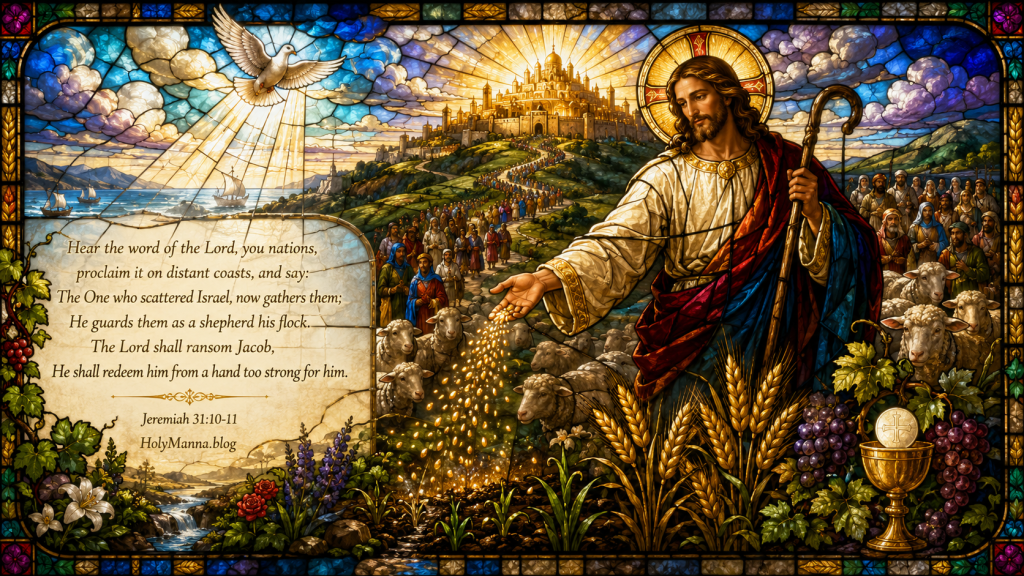
10 Hear the word of the Lord, you nations,
proclaim it on distant coasts, and say:
The One who scattered Israel, now gathers them;
he guards them as a shepherd his flock.
11 The Lord shall ransom Jacob,
he shall redeem him from a hand too strong for him.
12 Shouting, they shall mount the heights of Zion,
they shall come streaming to the Lord’s blessings:
The grain, the wine, and the oil,
flocks of sheep and cattle;
They themselves shall be like watered gardens,
never again neglected.
13 Then young women shall make merry and dance,
young men and old as well.
I will turn their mourning into joy,
I will show them compassion and have them rejoice after their sorrows.
Detailed Exegesis
Hear the word of the Lord, you nations, proclaim it on distant coasts, and say: The One who scattered Israel, now gathers them; he guards them as a shepherd his flock. (Verse 10)
God takes responsibility for both halves of the story. He scattered, as a father disciplines, and He gathers, as a father forgives. Strikingly, the announcement is addressed to the pagan nations and the distant coasts. Israel’s restoration was never a private affair; it was meant to be a testimony to the whole world, just as the Church’s life is meant to be a light to the nations today.
The Lord shall ransom Jacob, he shall redeem him from a hand too strong for him. (Verse 11)
The word “redeem” here carries the weight of the go’el, the kinsman-redeemer of Israelite law, the family member obligated to buy back a relative who had fallen into slavery or lost his land. God claims that family obligation for Himself. And the phrase “a hand too strong for him” is brutally honest: Israel could not save itself, and neither can anyone else. This verse points straight to Calvary, where the true Kinsman paid the ransom in His own Blood.
Shouting, they shall mount the heights of Zion, they shall come streaming to the Lord’s blessings: The grain, the wine, and the oil, flocks of sheep and cattle; They themselves shall be like watered gardens, never again neglected. (Verse 12)
Grain, wine, and oil are the classic covenant blessings promised in Deuteronomy, but Catholic eyes cannot help seeing further: the grain that becomes the Host, the wine that becomes the Precious Blood, the oil of Baptism, Confirmation, Holy Orders, and Anointing. The sacramental life of the Church is this verse in motion. And the final image is the most personal one: the people themselves become watered gardens, souls so irrigated by grace that neglect becomes a memory.
Then young women shall make merry and dance, young men and old as well. I will turn their mourning into joy, I will show them compassion and have them rejoice after their sorrows. (Verse 13)
The restoration ends in a party. Young and old dance together, which in the ancient world was the mark of a wedding feast. Jesus takes up this exact promise the night before He dies, telling His apostles in The Gospel of John that their grief will become a joy no one can take from them. Mourning is real in this life, but for the gathered people of God, it is never the last word.
Teachings
This passage belongs to the same chapter in which God promises the New Covenant written on hearts, and the Catechism teaches how to read it: “Through the prophets, God forms his people in the hope of salvation, in the expectation of a new and everlasting Covenant intended for all, to be written on their hearts” (CCC 64). Every Mass fulfills what Jeremiah glimpsed, because at the consecration the priest speaks of the new and eternal covenant in Christ’s Blood.
The image of the watered garden found its greatest commentator in Saint Teresa of Ávila, Doctor of the Church. In chapter 11 of her autobiography, The Life of Teresa of Jesus, she describes the soul as a garden planted by the Lord in poor soil full of weeds, which the beginner must water so that the Lord may take His delight in it. She famously outlines four ways of watering it, from the hard labor of drawing water by bucket, which is beginning prayer, all the way to the soaking rain that God sends Himself, which is mystical union. Her point matches Jeremiah’s exactly: a soul that stays close to the water source becomes lush, and one that wanders dries up.
Reflection
The practical question this passage poses is about irrigation. Gardens do not water themselves. A daily holy hour may not be possible in every season of life, but fifteen unhurried minutes with Scripture, a Rosary in the car, or a weekday Mass are all buckets drawn from the well. Choose one concrete source of living water and commit to it every day for the next week. Also, take verse 13 personally: name one sorrow being carried right now and hand it explicitly to God, asking Him to keep His promise to turn mourning into joy. What is currently watering this soul, honestly, and is it enough? Where has God already turned a past mourning into an unexpected joy?
Holy Gospel — Matthew 13:18-23
Four Soils, One Seed, and the Farmer Who Wastes Nothing
Matthew 13 is the great parable discourse, the third of the five great teaching blocks in The Gospel of Matthew, and it opens with the Parable of the Sower. In today’s passage Jesus does something rare: He explains His own parable, privately, to His disciples. The farming details were vivid to His hearers. In Galilee, sowers often scattered seed before plowing, so seed truly did land on footpaths, on thin soil hiding limestone shelves, and among dormant thorns. Here the day’s theme reaches its destination. God gathers His people and waters His gardens, but the decisive terrain is the human heart, and Jesus maps it with unsettling precision.
Matthew 13:18-23 – New American Bible (Revised Edition)
18 “Hear then the parable of the sower. 19 The seed sown on the path is the one who hears the word of the kingdom without understanding it, and the evil one comes and steals away what was sown in his heart. 20 The seed sown on rocky ground is the one who hears the word and receives it at once with joy. 21 But he has no root and lasts only for a time. When some tribulation or persecution comes because of the word, he immediately falls away. 22 The seed sown among thorns is the one who hears the word, but then worldly anxiety and the lure of riches choke the word and it bears no fruit. 23 But the seed sown on rich soil is the one who hears the word and understands it, who indeed bears fruit and yields a hundred or sixty or thirtyfold.”
Detailed Exegesis
“Hear then the parable of the sower.” (Verse 18)
The command to hear frames everything. Jesus is not offering an interesting agricultural observation but demanding a response. In Scripture, hearing always implies obeying, which is why the same Lord who tells this parable ends His Sermon on the Mount distinguishing those who hear His words and act on them from those who hear and do nothing.
“The seed sown on the path is the one who hears the word of the kingdom without understanding it, and the evil one comes and steals away what was sown in his heart.” (Verse 19)
The path is soil packed hard by constant traffic. Nothing penetrates. Jesus attributes the loss not to bad luck but to the evil one, a sobering reminder that the spiritual life has a real adversary who targets the word before it can take root. Distraction is not spiritually neutral. A heart trampled by noise, hurry, and endless scrolling becomes a heart where the word cannot even break the surface.
“The seed sown on rocky ground is the one who hears the word and receives it at once with joy.” (Verse 20)
This hearer looks like the best of the bunch at first. The reception is immediate and emotional. But Galilean fields often had a shelf of rock inches beneath the topsoil, so a plant could spring up fast precisely because its roots had nowhere to go. Enthusiasm without depth is a sprint, not a life.
“But he has no root and lasts only for a time. When some tribulation or persecution comes because of the word, he immediately falls away.” (Verse 21)
The test of faith is not the retreat weekend but the Tuesday after. Persecution in the early Church was literal, and in much of the world it still is, while elsewhere it arrives as mockery, professional cost, or family tension. Roots grow in hidden places: quiet prayer, regular Confession, study of the faith. No one falls away suddenly; they fall away shallowly.
“The seed sown among thorns is the one who hears the word, but then worldly anxiety and the lure of riches choke the word and it bears no fruit.” (Verse 22)
Notice that the thorny soil actually sustains the plant. This hearer keeps the faith, technically. But two rivals grow alongside it, anxiety and wealth, and they win by crowding rather than attacking. This may be the most accurate portrait of comfortable modern believers ever spoken: not hostile to God, just too preoccupied to bear Him any fruit.
“But the seed sown on rich soil is the one who hears the word and understands it, who indeed bears fruit and yields a hundred or sixty or thirtyfold.” (Verse 23)
Rich soil is defined by two verbs, hearing and understanding, and by one result, fruit. A tenfold yield would have thrilled a Galilean farmer; a hundredfold is miraculous abundance, God’s grace multiplying beyond all natural arithmetic. Saint Jerome saw in the three yields the varied degrees of holiness among the faithful, a reminder that God does not demand identical harvests, only genuine ones.
Teachings
Saint John Chrysostom, Doctor of the Church, preached on this exact passage in his Homilies on the Gospel of Matthew, Homily 44, and asked the obvious question: what farmer would deliberately sow on rocks and paths? With literal soil it would be foolish, he admits, but “in the case of souls and doctrine, it is altogether praiseworthy.” His reason is the most hopeful line in all the commentary on this parable: soil cannot change its nature, but souls can. Rocky ground can become fertile, the trampled path can become rich earth, and thorns can be cleared away. The sower is extravagant because no heart is a lost cause.
The Catechism observes that among the reasons people turn from God are precisely “the cares and riches of this world” (CCC 29), naming the thorns by their modern address. And on how fruit actually grows, it teaches: “The Decalogue, the Sermon on the Mount, and the apostolic catechesis describe for us the paths that lead to the Kingdom of heaven. Sustained by the grace of the Holy Spirit, we tread them, step by step, by everyday acts. By the working of the Word of Christ, we slowly bear fruit in the Church to the glory of God” (CCC 1724). Slowly, step by step, by everyday acts. Holiness is agriculture, not fireworks.
Reflection
The soils are not four fixed categories of people but four conditions that can describe the same soul in a single week. So the work is soil preparation. Break up the hardened path by building silence into the day, even ten minutes without a phone. Deepen the roots by committing to prayer on the difficult days especially. Pull the thorns by naming the one anxiety or attachment that most reliably chokes prayer, and surrendering it explicitly. And receive the seed constantly: the word of God read slowly, and the Word made flesh received worthily in the Eucharist. Which of the four soils best describes this heart today, not last year? What is one thorn that could be pulled, by name, this very week?
The Harvest Begins at Home
Step back and watch the whole story these readings tell. It begins with a scattered family and a Father who refuses to accept the scattering. Through Jeremiah He calls His rebellious children home, promises shepherds after His own heart, and hints at a presence so intimate that even the Ark of the Covenant will be forgotten, a promise kept in Mary and in every tabernacle on earth. Through the Book of Consolation He shows what homecoming looks like: ransomed captives streaming to Zion, souls like watered gardens, mourning turned into dancing.
And then Jesus quietly reveals where the entire drama is decided. Not in Babylon or Jerusalem, but in the half-acre of soil every person carries in the chest. God has done His part with almost reckless generosity. The seed is sown, the shepherds are given, the water is flowing, the Kinsman has paid the ransom in full. The only open question in the whole story is the condition of the ground.
That is not a burden; it is a dignity. The God who commands galaxies waits on the freedom of a single human heart, and as Saint John Chrysostom saw so clearly, He keeps sowing on rocks and paths and thorn patches because He knows what grace can do with bad soil. No heart is finished. No path is too hardened, no roots too shallow, no thorns too thick for the Sower who never gives up.
So this Friday, let Him gather what has scattered. Return to Him in Confession, water the garden in prayer, pull one thorn by name, and receive the Word, in Scripture and in the Eucharist, with soil turned over and ready. The hundredfold harvest is not a fantasy. It is a promise, and it begins today.
Engage With Us!
The comment section below is open, and the community here would genuinely love to hear how God spoke through today’s readings. Reflections, struggles, and stories of grace are all welcome, because faith grows best when it is shared among friends walking the same road home to Zion.
Here are some questions to pray with and respond to:
- In Jeremiah 3:14-17, God promises shepherds after His own heart and a presence greater than the Ark. Who has been a shepherd after God’s own heart in this life, and how has his faithfulness made returning to God easier?
- In Jeremiah 31:10-13, God promises to make His people like watered gardens and to turn mourning into joy. What is currently watering the garden of the soul, and where has God already transformed a season of mourning into unexpected joy?
- In Matthew 13:18-23, Jesus describes the path, the rocky ground, the thorns, and the rich soil. Which soil best describes the heart this week, and what is one concrete step toward becoming richer ground for the word?
- Taking all the readings together, God gathers what sin scatters and sows His word with boundless generosity. What is one scattered area of life that needs to be gathered back to Him, starting today?
However these questions land, take courage. The Sower is patient, the Shepherd is faithful, and the garden is never beyond restoration. Live this day rooted deeply in Him, bearing whatever fruit He asks, and doing everything, in word and in deed, with the love and mercy Jesus taught us.
Sacred Heart of Jesus, we trust in You!
Immaculate Heart of Mary, pray for us!
Saint Michael the Archangel, defend us in battle!
Follow us on YouTube, TikTok, Instagram and Facebook for more insights and reflections on living a faith-filled life.


Leave a Reply