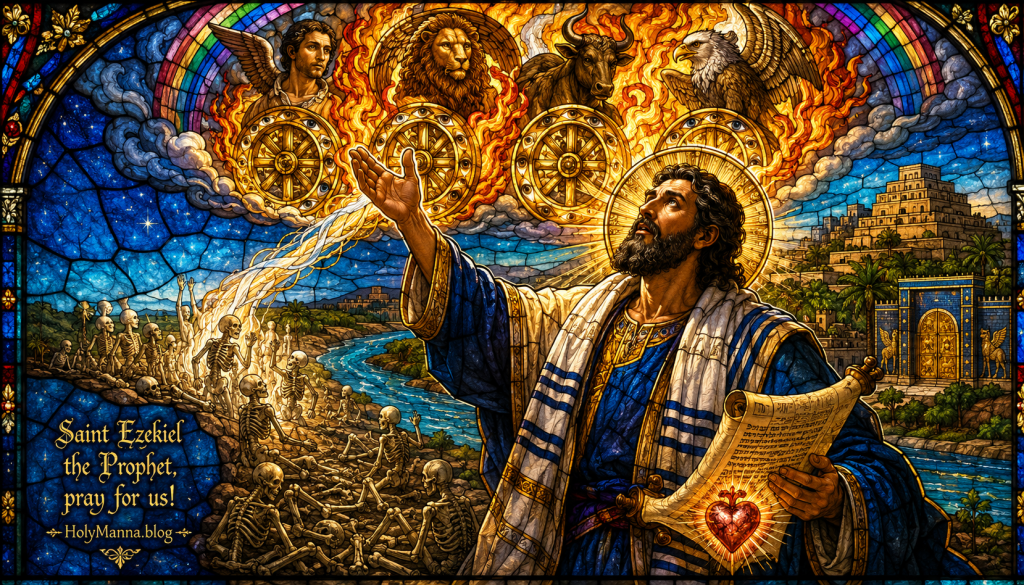
The Exile Who Saw God
On July 23rd, the Church pauses to commemorate one of the most astonishing figures in all of salvation history: the Prophet Ezekiel. He is one of the four Major Prophets of the Old Testament, standing alongside Isaiah, Jeremiah, and Daniel, and yet he remains, for many Catholics, the least familiar of the four. That is a shame, because few voices in Scripture speak more directly to people who feel displaced, discouraged, or spiritually dried out. Ezekiel was a priest who never got to serve in his temple, an exile who never saw his homeland again, and a man who watched everything he loved collapse. In the middle of all that loss, God opened the heavens over a muddy canal in Babylon and showed him glory beyond human words.
Ezekiel matters to the Church because his prophecies run like a golden thread straight into the New Testament. Jesus takes up Ezekiel’s title, calling Himself the Son of Man. The Good Shepherd discourse in The Gospel of John fulfills Ezekiel’s promise that God Himself would come to shepherd His scattered flock. The Book of Revelation borrows Ezekiel’s living creatures, his scroll, his measured temple, and his river of life. The Catechism teaches that through the prophets, God formed His people in the hope of salvation and announced a new and everlasting covenant intended for all and written on their hearts, and it names Ezekiel among the chief witnesses of that promise (CCC 64). When the Church proclaims at the Easter Vigil, “A new heart I will give you, and a new spirit I will put within you; and I will take out of your flesh the heart of stone and give you a heart of flesh” (Ezek 36:26), she is praying in Ezekiel’s words over every soul about to be baptized.
The current Roman Martyrology commemorates Ezekiel on July 23rd, praising him as the son of the priest Buzi who was marked by a vision of the glory of the Lord, set as a watchman over the house of Israel, and who, placed among the captives, nourished their hope and prophesied that the dry bones would rise to life. Readers of older resources may notice that the pre-conciliar Roman Martyrology listed him on April 10th; the revised Martyrology moved his commemoration to July 23rd, which is also the day many Eastern calendars honor him. Different books give different dates, but they honor the same towering prophet.
A Priest Torn from His Temple
Ezekiel introduces himself with priestly precision: “the word of the LORD came to Ezekiel the priest, the son of Buzi, in the land of the Chaldeans by the river Chebar” (Ezek 1:3). He was born into a priestly family in the Kingdom of Judah, almost certainly in or near Jerusalem, likely around the year 623 BC. That dating comes from the opening verse of his book, which speaks of “the thirtieth year” (Ezek 1:1); many commentators, ancient and modern, understand this as the prophet’s own age at the time of his call, since thirty was the age when a priest began his full service. This interpretation is widely held, though it cannot be proven with certainty, and honest readers should hold it as a strong tradition of reading rather than a settled fact.
It is worth pausing to imagine what his formation would have looked like. A boy of priestly lineage in the last decades of the Kingdom of Judah would have grown up in the shadow of the temple, memorizing the Law, learning the sacrifices, the vestments, the feasts, and the architecture of the house of God down to the cubit. He came of age during the reign of King Josiah, the great reformer king who rediscovered the Book of the Law and tried to turn the nation back to the Lord. Ezekiel’s entire life was aimed at one thing: standing before the altar of God in Jerusalem.
He never got to do it. In 597 BC, King Nebuchadnezzar of Babylon besieged Jerusalem, and the young King Jehoiachin surrendered. The Babylonians carried off the king, the queen mother, the officials, the soldiers, and the craftsmen, thousands of the leading citizens of Judah, as recorded in 2 Kings 24. Ezekiel, the priest in waiting, was among them. He was marched roughly a thousand miles from the city of God to the flat, irrigated plains of Babylonia and resettled with his fellow exiles at a place called Tel Abib, along the Chebar canal near the ancient city of Nippur. He was married, and he and his wife made their home among a community of the displaced, people asking the hardest question in the Old Testament: has God abandoned us?
Five years into that exile, around 593 BC, the answer came. Ezekiel stood by the Chebar canal and the heavens opened. He saw a storm wind, a great cloud flashing fire, and four living creatures, each with four faces, the face of a man, a lion, an ox, and an eagle, moving with gleaming wheels that were full of eyes, wheels within wheels. Above them stretched a crystal firmament, and above the firmament a throne like sapphire, and on the throne a figure of glowing splendor wrapped in brightness like a rainbow. Ezekiel does not dare to describe God directly; he says only that “such was the appearance of the likeness of the glory of the LORD” (Ezek 1:28). His response was the only sane one: he fell on his face.
This was not conversion in the sense of turning from sin, for Ezekiel was already a devout priest. It was the deepening that changes everything, the moment when inherited faith becomes firsthand encounter. The revolutionary message hidden inside the vision was this: the glory of the Lord had appeared in Babylon. God was not confined to the temple in Jerusalem. He had gone into exile with His people, and no empire on earth could stop Him.
Visions by the River Chebar
From that day, Ezekiel’s life became one long act of prophecy. God addressed him again and again with a striking title: “Son of man, stand upon your feet, and I will speak with you” (Ezek 2:1). The phrase, which appears throughout the book, underlines the distance between the mortal prophet and the immortal God who speaks to him, and centuries later Jesus would take up that very title, Son of Man, and fill it with divine meaning. Ezekiel was then given one of the strangest and most beautiful commissions in Scripture. God handed him a scroll covered in words of lamentation and mourning and woe, and told him to eat it. He obeyed, and he reports, “Then I ate it; and it was in my mouth as sweet as honey” (Ezek 3:3). The servant of God must take the word of God into himself completely before he can speak it, and even hard words, digested in obedience, turn sweet.
Then came the job description that defines Ezekiel forever: “Son of man, I have made you a watchman for the house of Israel; whenever you hear a word from my mouth, you shall give them warning from me” (Ezek 3:17). A watchman on a city wall does not have the luxury of silence. If he sees the sword coming and stays quiet, the blood of the people is on his hands. Ezekiel took that responsibility with total seriousness, and the Church has always seen in the watchman a model for bishops, priests, parents, and every Christian entrusted with the truth.
The miracles of Ezekiel’s life are not the healings and multiplications familiar from other saints. His miracles were the visions themselves and the prophecies that came true against all expectation. Scripture records that the Spirit repeatedly lifted him and carried him in visions; in one extended vision he was brought in spirit from Babylon to Jerusalem, where he was shown the idolatry being committed inside the temple itself, and then watched the glory of the Lord rise up and depart from the temple (Ezek 8 to 11). While false prophets in Jerusalem and Babylon promised a quick end to the exile, Ezekiel announced the unthinkable: the holy city would fall, and the temple would burn. He performed shocking symbolic actions to drive the message home. He built a clay model of Jerusalem under siege. He lay bound on his side for a long period, bearing the guilt of the people in his own body. He shaved his head and beard and divided the hair with a sword, burning some, scattering some, and binding a small remnant in the hem of his garment, a sign that only a remnant would survive. He ate rationed bread and water like a man in a besieged city. His neighbors surely thought he had lost his mind. He had, instead, given his whole body to the word of God.
In 587 BC the prophecy was fulfilled. Jerusalem fell, the temple was destroyed, and a new wave of shattered exiles arrived in Babylon. At that exact moment, Ezekiel’s message pivoted from judgment to hope, and the greatest of his prophecies poured out. He proclaimed God’s tender oracle against the failed shepherds of Israel, in which the Lord promises, “I myself will be the shepherd of my sheep, and I will make them lie down, says the Lord GOD. I will seek the lost, and I will bring back the strayed, and I will bind up the crippled, and I will strengthen the weak” (Ezek 34:15 to 16). The Catechism cites this very prophecy when it teaches that the Church is the flock of which God Himself foretold that He would be the shepherd (CCC 754), a promise fulfilled when Jesus declares Himself the Good Shepherd in The Gospel of John.
Ezekiel likewise insisted on personal responsibility before God at a time when the exiles blamed everything on their fathers, and he delivered one of the most consoling verses in the Old Testament: “Have I any pleasure in the death of the wicked, says the Lord GOD, and not rather that he should turn from his way and live?” (Ezek 18:23). Every confessional in the world stands on that verse. And in the vision that has captured imaginations for twenty six centuries, God set him down in a valley full of dry bones and commanded him to prophesy: “O dry bones, hear the word of the LORD… Behold, I will cause breath to enter you, and you shall live” (Ezek 37:4 to 5). Bone came together to bone, flesh covered them, breath entered them, and a vast army stood on its feet. The Catechism points to this prophecy, together with the promise of the new heart, as the great announcement of the Holy Spirit who would raise God’s people to new life (CCC 715).
The Watchman Who Paid with Everything
Ezekiel was never recorded as being imprisoned like Jeremiah or thrown to lions like Daniel, yet his hardships were relentless and intimate. He spent more than two decades, from about 593 BC until at least 571 BC, prophesying to a community that often refused to listen. God warned him from the start that he was being sent to “a rebellious house” (Ezek 2:5), a people with hard faces and stubborn hearts, and told him bluntly that they would treat his preaching as entertainment, coming to hear him the way people come to hear a singer with a beautiful voice, while doing nothing he said. There may be no loneliness quite like being heard and ignored for twenty years.
His obedience cost him his body. He carried the weight of siege rations, of lying bound, of public humiliation, of being the neighborhood spectacle whose every strange action was a sermon. Then it cost him the dearest thing he had. God told him, “Son of man, behold, I am about to take the delight of your eyes away from you at a stroke; yet you shall not mourn or weep nor shall your tears run down” (Ezek 24:16). That evening his wife died. The next morning, in obedience, he did not perform the public rituals of mourning, and when the stunned exiles asked what this meant, he told them: just as the delight of his eyes had been taken, so the delight of their eyes, the temple of Jerusalem, would be taken, and grief too deep for ritual would swallow them. Ezekiel’s marriage, his widowhood, and his silent grief all became prophecy. It is difficult to find, anywhere in Scripture, a servant of God who surrendered more of his private life to his mission.
Was he martyred at the end? Here the Church’s honesty matters. The Bible says nothing about Ezekiel’s death. An ancient tradition, recorded in an early apocryphal work called the Lives of the Prophets and later echoed in the old Roman Martyrology, tells the story that Ezekiel was slain in Babylon by a leader of his own people because the prophet had rebuked him for worshiping idols, and that he was buried in the land of the Chaldeans in a burial place associated with Shem and Arphaxad, the ancestors of Abraham. It is a fitting story for a watchman who never stopped warning, but it must be told as exactly that, a story handed down. This tradition cannot be verified, and the current Roman Martyrology makes no mention of martyrdom in its commemoration of the prophet. What is certain is that he endured exile, ridicule, bereavement, and a lifetime of costly obedience, and that he persevered to the end. His final dated prophecy comes from about 571 BC, after which the voice by the Chebar falls silent.
A Tomb on the Euphrates and a Voice That Never Fell Silent
No formally authenticated miracles have been attributed to Ezekiel after his death, and honesty requires saying so plainly. His enduring wonder is of a different kind: a dead man’s words have been raising hearts to life for two and a half thousand years.
There is, however, a remarkable site of veneration. In the small town of al-Kifl in modern Iraq, on the Euphrates south of ancient Babylon, stands a shrine honored for many centuries as the tomb of the Prophet Ezekiel. The earliest written account of it comes from the Jewish traveler Benjamin of Tudela, who visited around the year 1170 and described a synagogue attached to the tomb. For centuries the shrine was one of the most important pilgrimage sites of Babylonian Jewry, and Muslims also venerate the site, identifying Ezekiel with a prophet they call Dhu’l-Kifl, from whom the town takes its name. Pilgrims of different faiths have prayed there side by side for generations, and tradition holds that several ancient leaders of the exiled community were buried near the prophet. It is a moving thought that the man who saw the glory of God beside a Babylonian canal may rest beside the Euphrates to this day. Yet the identification of this tomb as Ezekiel’s actual resting place rests on tradition rather than on historical or archaeological proof, and this story cannot be verified.
Ezekiel’s truest legacy after death is written across the Church herself. Saint Irenaeus and Saint Jerome saw in his four living creatures the symbols of the four Evangelists, the man for Matthew, the lion for Mark, the ox for Luke, and the eagle for John, an image carved and painted in churches across the world. The Fathers read his vision of the closed east gate of the temple, “This gate shall remain shut; it shall not be opened, and no one shall enter by it; for the LORD, the God of Israel, has entered by it” (Ezek 44:2), as a prophecy of the perpetual virginity of Mary, and Saint Bonaventure taught that the closed gate signifies the Virgin and the prince who enters it is Jesus. That reading helped give Our Lady the beloved title Gate of Heaven.
The greatest minds of the Church have labored over his book. Origen preached homilies on Ezekiel that Saint Jerome translated into Latin. Jerome himself wrote a monumental commentary on the prophet in the years after Rome fell in 410, and he records the reverent Jewish custom that the mysterious beginning and end of the book were not to be studied by anyone under the age of thirty. Saint Gregory the Great preached his celebrated homilies on Ezekiel to the people of Rome in 593 while the Lombards were besieging the city, finding in the exiled prophet a companion for a Church surrounded by ruin. From those homilies comes Gregory’s luminous principle about Scripture: “The divine words grow with the one who reads them” (Homilies on Ezekiel I, 7, 8), a line Pope Benedict XVI quoted in Verbum Domini to describe how the Word opens itself ever more deeply to the praying reader. Michelangelo painted Ezekiel in massive turning motion on the ceiling of the Sistine Chapel, and Raphael painted his chariot vision blazing above the earth. Every Easter Vigil, the Church reads his promise of the new heart and the sprinkling of clean water over the catechumens about to be baptized, and on the Solemnity of Christ the King she proclaims his prophecy of the Shepherd who seeks the lost. The watchman’s voice never fell silent. It simply moved into the liturgy.
Dry Bones Can Live Again
Ezekiel’s life presses one question on every reader: what do you do when everything falls apart? He lost his homeland, his vocation as he had imagined it, his temple, and his wife. By every human measure his life was a ruin. Yet precisely there, in the ruins, God showed him glory, gave him a mission, and made him the prophet of resurrection. The Catechism teaches that conversion is first of all a work of the grace of God who makes hearts return to Him, and it reaches for Ezekiel’s own imagery: “The human heart is heavy and hardened. God must give man a new heart” (CCC 1432, citing Ezek 36:26 to 27). Whatever valley of dry bones a person is standing in, whether a dead marriage, a dead career, a dead prayer life, or a faith that feels like a museum of something that used to be alive, Ezekiel’s witness is that God’s breath can raise it.
His watchman calling belongs to every baptized Christian in some measure. Parents are watchmen for their children. Friends are watchmen for friends drifting from the sacraments. Speaking the truth in love, without softening it into flattery or hardening it into cruelty, is Ezekiel’s art, and it is learned by first eating the scroll, taking God’s word into oneself through daily Scripture and the Catechism before ever presuming to hand it to others. When was the last time you warned someone you love, gently and honestly, about something endangering their soul, and when was the last time you let someone do that for you?
Ezekiel also teaches the sanctity of the ordinary offered to God. His grief became prophecy. His strange obediences became sermons. Nothing in his life was wasted, because everything was surrendered. A practical way to imitate him is to offer one concrete hardship each day, a commute, an illness, a disappointment, as an intentional prayer for someone far from God. Another is to pray Ezekiel 36:26 slowly before Confession, asking sincerely for the heart of flesh. Another is to spend ten minutes before the Blessed Sacrament remembering that the glory Ezekiel saw over the Chebar now waits humbly in every tabernacle. Where in your life have you quietly concluded that the bones are too dry, and what would change if you truly believed that God disagrees? Do you trust that God has followed you into your own Babylon, or do you still believe He stayed behind in some holier chapter of your past?
Engage With Us!
The story of the Prophet Ezekiel is vast, strange, and wonderfully alive, and hearing how it lands in real lives is a joy. Please share your thoughts, favorite passages, and reflections in the comments below. To help the conversation begin, here are some questions to ponder.
- Ezekiel saw the glory of God not in the temple but in exile. Where has God surprised you by showing up in a place you thought He would never be?
- God made Ezekiel a watchman and required him to speak hard truths. Who has been a faithful watchman in your life, and for whom might God be asking you to be one?
- The exiles listened to Ezekiel as entertainment without changing their lives. In what ways can consuming Catholic content become a substitute for conversion, and how do you guard against that?
- In the valley of dry bones, Ezekiel prophesied to the bones before the breath came. What dead situation in your life is God asking you to keep praying over, even before you see any sign of life?
- God promises through Ezekiel a heart of flesh in place of a heart of stone. What one habit, resentment, or fear is keeping part of your heart stony, and can you bring it to Confession this month?
Ezekiel stood in a valley of death and watched God build an army of the living. The same Spirit who breathed over those bones was poured out at Pentecost and is given to every soul in Baptism and Confirmation. Let his witness stir a bolder faith: speak the truth with courage, surrender the losses that cannot be undone, and never once declare a soul, a family, or a situation beyond the reach of God. Live this day as a watchman full of hope, and do everything with the love and the mercy that Jesus taught us.
Saint Ezekiel the Prophet, pray for us!
Follow us on YouTube, TikTok, Instagram and Facebook for more insights and reflections on living a faith-filled life.

 Holy Manna!
Leave a comment