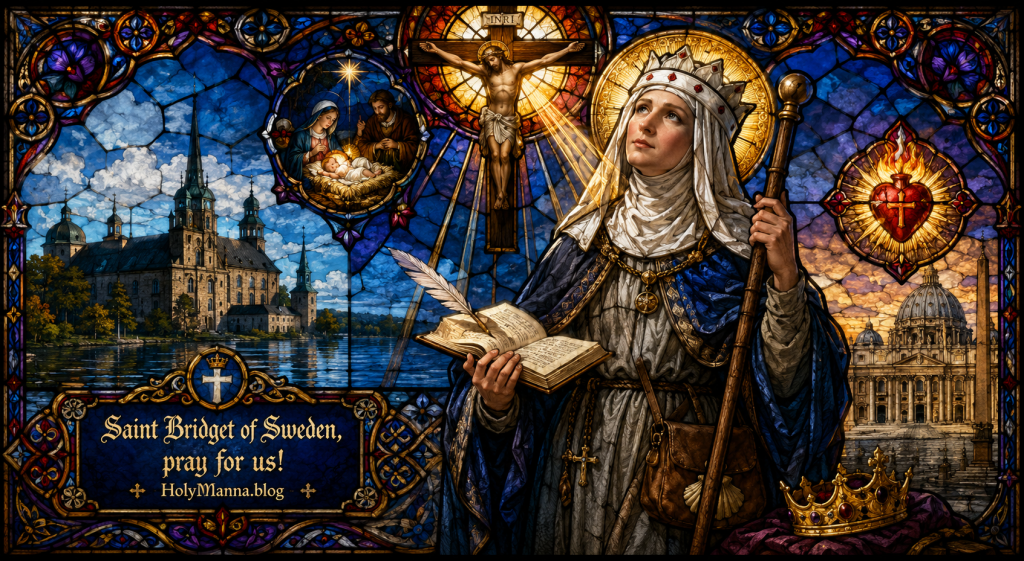
A Voice from the North That All of Europe Heard
Every year on July 23rd, the Church lifts up a woman whose life refuses to fit into a single category. Saint Bridget of Sweden, known in her homeland as Birgitta Birgersdotter, was a wife for twenty-eight years and a mother of eight children. She was also a mystic who filled eight volumes with heavenly revelations, a foundress whose order still exists today, a counselor who admonished kings, and a widow who spent decades pleading with popes to leave Avignon and come home to Rome. She managed all of this in the fourteenth century, an age when few imagined that a laywoman from the far edge of Christendom could shape the heart of the Church.
The Church has never stopped being amazed by her. Pope Boniface IX canonized her in 1391, less than two decades after her death. Six centuries later, on October 1st, 1999, Pope Saint John Paul II named her Co-Patroness of Europe in the apostolic letter Spes Aedificandi, placing her alongside Saint Catherine of Siena and Saint Teresa Benedicta of the Cross. Pope Benedict XVI, teaching about her at his General Audience of October 27th, 2010, called her “an eminent figure in European history.” She is the patroness of Europe, of Sweden, and of widows.
Before her story unfolds, one clarification helps. Saint Bridget of Sweden is not Saint Brigid of Kildare, the beloved fifth-century Irish abbess. The two are often confused online, but they lived nearly nine hundred years apart. Today belongs to the Swedish Bridget, and her life is a stunning witness to a truth the Church proclaims for every believer: “all Christians in any state or walk of life are called to the fullness of Christian life and to the perfection of charity” (CCC 2013). Bridget lived that fullness twice over, first at a kitchen table surrounded by children, and then in the streets of Rome with a pilgrim’s staff in her hand.
A Childhood Lit by the Cross
Bridget was born around 1303 at Finsta, in the Swedish province of Uppland. Sources differ slightly on the year; the Vatican gives 1303, while some reference works print 1304, and the post follows the Vatican’s dating. Her father, Birger Persson, was the lawspeaker of Uppland and one of the wealthiest landowners in Sweden. Her mother, Ingeborg Bengtsdotter, came from a family closely related to the Swedish royal house. Benedict XVI noted that her parents were very devout people, and that Sweden itself had by then welcomed the Christian faith for three centuries. Bridget did not grow up on the margins of the faith. She grew up soaked in it.
An early tradition, drawn from the biography her spiritual fathers compiled to support her canonization, holds that Bridget received her first vision of the crucified Christ while she was still a young girl, somewhere around the age of seven to ten. In the story, the wounded Lord drew her gaze and her pity, and the Passion never released its hold on her heart for the rest of her life. This account comes from early testimony gathered soon after her death, but the precise details of her childhood cannot be independently verified, and the story is offered here as the tradition hands it on.
At about thirteen years of age, following the custom of noble families of her time, Bridget was married to a young nobleman named Ulf Gudmarsson. Nothing about that arrangement sounds promising to modern ears, and yet God wrote something beautiful with it. Bridget did not undergo a dramatic conversion from sin to grace. Her path was a steady, lifelong deepening, and marriage became its first great school. A learned religious guided her spiritually and initiated her into the study of Sacred Scripture, a remarkable formation for a laywoman of the fourteenth century. Under her influence, the household changed. Benedict XVI observed that thanks to Bridget’s presence her family became a true “domestic church.” That phrase is not a poetic flourish; it is the Church’s own teaching about what every Christian home is meant to be, “a community of grace and prayer, a school of human virtues and of Christian charity” (CCC 1666).
Bridget and Ulf together adopted the Rule of the Franciscan Tertiaries. She practiced generous works of charity for the poor and founded a hospital. Eight children were born of the marriage, and the second of them, Karin, is venerated today as Saint Catherine of Sweden. A mother whose daughter becomes a canonized saint has taught something at home that no classroom can supply. Benedict XVI added a detail that would make any husband smile and wince at once: at his wife’s side, Ulf’s character improved, and he advanced in the Christian life.
The Wife, the Widow, and the Words of Heaven
Bridget’s reputation for wisdom reached the throne. King Magnus of Sweden so appreciated her pedagogical gifts that he summoned her to court for a time, entrusting her with introducing his young wife, Blanche of Namur, to Swedish culture. Court life did not seduce her. If anything, it sharpened her tongue. Bridget became known for speaking hard truths to powerful people, always with respect, never with flattery.
In 1341, Bridget and Ulf undertook a long pilgrimage to the shrine of Santiago de Compostela in Spain, together with other members of their family. The Church has always treasured such journeys, teaching that “pilgrimages evoke our earthly journey toward heaven” (CCC 2691). This one changed the couple’s life. On their return, they resolved to live in continence and give themselves more completely to God. A short time later, in 1344, in the peace of the Cistercian monastery of Alvastra to which he had retired, Ulf’s earthly life came to an end.
Bridget was now a widow in her early forties. She distributed her possessions to the poor and, though she never became a consecrated religious, settled near the monastery of Alvastra. There, the defining grace of her second life began: the divine revelations that would accompany her until death. Bridget dictated what she received to her confessor-secretaries, chief among them Master Mathias of Linköping and Prior Peter of Alvastra, who translated her words from Swedish into Latin and gathered them into eight volumes titled Revelationes, followed by a supplement called Revelationes extravagantes.
The content of the Revelations is astonishingly varied. At times they unfold as dialogues among the divine Persons, the Virgin Mary, the saints, and even demons, with Bridget herself taking part. At other times a specific vision is described, or the Blessed Mother reveals something concerning the life and mysteries of her Son. Two threads run through everything: the Passion of Christ, contemplated in vivid detail as the measure of God’s love, and the sorrowful motherhood of Mary. In one of the most famous passages, Bridget places these words on the lips of the Lord: “O my friends, I love my sheep so tenderly that were it possible I would die many other times for each one of them that same death I suffered for the redemption of all” (Revelations, Book I, chapter 59). The Church teaches that the cross is the unique sacrifice of Christ, the one mediator between God and men, and that he calls his disciples to take up their cross and follow him (CCC 618). Bridget heard that call as a personal declaration of love. In another passage the Lord tells her, “My Daughter, I have chosen you for myself, love me with all your heart… more than all that exists in the world” (Revelations, Book I, chapter 1).
What should a Catholic make of private revelations like these? The Church gives a clear framework. Private revelations do not belong to the deposit of faith, and as the Catechism teaches, “it is not their role to improve or complete Christ’s definitive Revelation, but to help live more fully by it in a certain period of history” (CCC 67). Bridget’s Revelations were scrutinized seriously, including at the Councils of Constance and Basel, and they drew criticism in her own day and afterward. The Church’s mature judgment was expressed by John Paul II in Spes Aedificandi: “The Church, which recognized Bridget’s holiness without ever pronouncing on her individual revelations, has accepted the overall authenticity of her interior experience” (Spes Aedificandi, n. 5). No Catholic is required to believe any particular vision of Bridget’s; every Catholic is invited to learn from the holiness the visions nourished.
Bridget understood that framework better than her critics. Benedict XVI stressed that she knew every charism is given to build up the Church, which is why so many of her revelations took the form of admonishments, sometimes severe ones, addressed to believers of her time, including religious and political authorities. Yet she always reprimanded with respect and with full fidelity to the Magisterium and to the Successor of Peter. That combination, boldness wrapped in obedience, is the signature of authentic Catholic reform in every century.
Her charism soon took institutional shape. Bridget conceived a religious order dedicated to the Holy Savior, composed of monks and nuns under the authority of the abbess, a structure not unusual for medieval double monasteries. In 1349 she left Sweden for good and traveled to Rome, both to take part in the Jubilee Year of 1350 and to seek papal approval for her rule. In 1370, Pope Urban V approved the order, which took root at Vadstena in Sweden and became known as the Order of the Most Holy Savior, or the Bridgettines. In Rome, accompanied by her daughter Karin, Bridget gave herself to intense prayer and apostolate, caring for the poor and calling everyone she met, from beggars to cardinals, back to fervor. From Rome she went on pilgrimage to Italian shrines, especially Assisi, home of Saint Francis, for whom she had lifelong devotion.
Regarding wonders during her lifetime, honesty serves her memory best. Her contemporaries attested above all to her prophetic counsel, her revelations, and her heroic charity rather than to a catalog of spectacular miracles worked by her hands. The marvel her own generation saw was the woman herself: a laywoman and widow who feared no earthly power because she feared God alone.
Exile, Loss, and the Long Wait for Avignon
Bridget was not a martyr, but her road was steep, and her hardships deserve to be told in full. The first was grief. She buried the husband of her youth after twenty-eight years of marriage, and she carried that loss into a widowhood that lasted nearly three decades. The second was self-imposed exile. When she left Sweden in 1349, she never saw her homeland again. She gave up rank, property, familiarity, and the comfort of her native tongue to live as a pilgrim in a foreign city.
The third hardship was suspicion. A woman claiming heavenly visions in the fourteenth century invited doubt, mockery, and accusation. An early tradition from her biography relates that Bridget herself was initially alarmed by her visions, fearing they might come from the devil, and found peace only after careful spiritual discernment with learned guides. That story cannot be verified in its particulars, but the caution it describes fits everything the Church knows about her, for she submitted her experiences to her confessors and to the judgment of the Church rather than trusting herself. Criticism of her Revelations continued even after her death, which is precisely why the conciliar examinations at Constance and Basel mattered, and why John Paul II’s careful formulation quoted above remains the Church’s settled voice on the question.
The fourth hardship was Rome itself. The city she reached in 1349 was not the glorious capital of Christendom but a half-abandoned, violent, fever-ridden town, precisely because the popes had been living at Avignon in France since the beginning of the century. Bridget’s heart broke over it. She addressed heartfelt pleas to the popes to return to the See of Peter in the Eternal City, and she did so for more than twenty years. Urban V did return in 1367, and Bridget rejoiced; then he went back to Avignon in 1370, and she warned him with tears. She spent her final years still waiting. She died in 1373, four years before Pope Gregory XI returned to Rome definitively. Like Moses gazing at a promised land he would not enter, Bridget labored for a homecoming she never witnessed with her own eyes.
The fifth hardship was the sharpest. In 1371 and 1372 she fulfilled her deepest desire, a pilgrimage to the Holy Land, traveling with the little band of spiritual children she called the friends of God. On the way, in Naples, her beloved son Karl died. She continued the pilgrimage as a grieving mother, and at Bethlehem and on Calvary she received some of her most celebrated revelations on the Nativity and the Passion, visions that would shape Christian art and devotion across Europe for centuries. She walked the ground where Christ suffered while carrying a mother’s fresh sorrow, and she gave both to God. Saint Rose of Lima’s words, preserved in the Catechism, could be the caption of Bridget’s whole later life: “Apart from the cross there is no other ladder by which we may get to heaven” (quoted in CCC 618).
From a Roman Deathbed to the Blue Church of Vadstena
Bridget died on July 23rd, 1373, in her house in Rome near the square known today as the Piazza Farnese, where the Casa di Santa Brigida still stands in the care of her order. She was buried temporarily in the church of San Lorenzo in Panisperna. In 1374 her children Birger and Karin brought her body home in a solemn journey across Europe to the monastery of Vadstena, the motherhouse of her order on the shores of Lake Vättern, where her relics rest to this day.
Devotion to her spread immediately, and her spiritual fathers compiled her biography at once to further her canonization. The formal process gathered sworn testimony of miracles, healings, and favors attributed to her intercession, reported both in Sweden and in Italy, and these accounts, preserved in the acts of her canonization process, supported her cause. Many individual miracle stories from that process and from later devotional literature continue to circulate, telling of cures granted at her tomb and through her relics. These stories are handed on here as the tradition reports them, and it must be said plainly that their particulars cannot be verified today. What is verified is the Church’s judgment on the whole: Pope Boniface IX solemnly canonized Bridget on October 7th, 1391, and amid the confusion of the Western Schism her canonization was reconfirmed at the Council of Constance in 1415. The Catechism explains what such an act means: “By canonizing some of the faithful… the Church recognizes the power of the Spirit of holiness within her” (CCC 828). The saints in glory do not retire from the Church’s life, for as the Catechism teaches, “they do not cease to intercede with the Father for us” (CCC 956).
One famous devotion connected to her name requires careful handling. The Fifteen Prayers on the Passion, often called the Fifteen O’s, have long been attributed to Saint Bridget, though scholars doubt the attribution, and the prayers as commonly printed cannot be traced securely to her pen. The prayers themselves are a beautiful meditation on the sufferings of Christ and have never been condemned. The extravagant promises frequently printed alongside them are another matter. On January 28th, 1954, the Holy Office directed bishops not to permit publication of writings containing those promises, precisely because their supernatural origin is uncertain. A faithful Catholic may pray the Fifteen Prayers with profit while setting the alleged promises aside entirely. Similarly, a beloved quotation about politics and peace circulates online under Bridget’s name; because it cannot be traced to a verified primary source, it does not appear in this post.
Her order tells its own story of endurance. The Bridgettines expanded rapidly across Europe, and Vadstena became the spiritual center of Sweden. The Protestant Reformation later swept Sweden into Lutheranism and closed the abbey, yet devotion to Bridget never died in her homeland, where she remains the most celebrated of all Swedish saints, honored even by many outside the Catholic Church. In the twentieth century, Saint Elisabeth Hesselblad, a Swedish convert canonized in 2016, founded a new branch of the order, and Bridgettine sisters serve around the world today. Vadstena, with its abbey church affectionately called the Blue Church, remains Sweden’s foremost pilgrimage destination, and pilgrims still gather there every July. One calendar note for the observant: the current General Roman Calendar keeps her memorial on July 23rd, the day of her death, while the 1960 calendar assigned her October 8th, and Sweden honors her in early October, which explains the differing dates found in older devotional books.
Above all, her Revelations left a permanent mark on the way Christians see Christ. Her vision of the Nativity, with the Virgin kneeling in adoration before the radiant newborn Jesus, reshaped Christmas art across Europe. Her unflinching meditations on the Passion deepened the medieval world’s love for the wounds of Christ. Six centuries before the Church named her a patroness of a divided continent, this daughter of Sweden was already stitching Europe together with prayer.
What a 14th Century Mother Says to a 21st Century Heart
Bridget’s first lesson is that holiness begins wherever a person actually lives. She did not become a saint in spite of marriage, children, in-laws, court politics, and household budgets; she became a saint through them. Benedict XVI drew from her marriage the beautiful idea of an authentic conjugal spirituality, in which spouses walk the road of holiness together, sustained by the grace of the sacrament. The Catechism teaches the same truth about the home as a domestic church (CCC 1666). If your home were described honestly, would anyone recognize it as a school of prayer and charity? The question is not meant to condemn but to invite. Bridget’s home became holy through small, repeated choices: Scripture read, poor people fed, children taught, a spouse patiently loved toward heaven.
Her second lesson belongs to everyone who has lost a spouse, a vocation, or a version of life they expected to keep. Bridget’s widowhood was not an ending but a commissioning. The Church honors her as a patroness of widows because she shows that grief, surrendered to God, can open into an entirely new fruitfulness. What loss in your life might God be asking you to hand over to him, not to erase it, but to transform it?
Her third lesson concerns truth-telling. Bridget corrected kings and popes, yet Benedict XVI noted that she always did so with respect and full fidelity to the Church. In an age of outrage, that balance is nearly miraculous. Speaking hard truths without contempt, and remaining obedient without going silent, is a narrow path, and Bridget walked it for forty years. When you disagree with those in authority, do your words build up the Church or only vent your anger?
Her fourth lesson is her love for the crucified Christ. The Lord’s words to her, that he would willingly die again for each of his sheep, are simply the Gospel spoken to one soul at a time. A practical way to imitate her is to spend a few minutes each Friday meditating on the Passion, perhaps with the Sorrowful Mysteries of the Rosary, asking for even a small share of her tenderness toward the wounds of Christ. Finally, she teaches intercession for unity. John Paul II named her Co-Patroness of Europe partly because she lived before Western Christianity was wounded by division, and he asked her prayers for the full unity of all Christians, a unity the Church holds can never be lost in her but must always grow (CCC 820). Anyone with Protestant family members, as so many believers have, can make Bridget a personal ally in praying for the day when all Christians share one table.
Engage With Us!
Saint Bridget of Sweden lived so many vocations that nearly every reader will find a piece of their own story in hers, and the HolyManna community would love to hear which piece is yours. Share your thoughts and reflections in the comments below, and consider these questions as a starting point.
- Bridget’s family became a true domestic church. What is one concrete habit you could begin this week to make your own home a place of prayer?
- Bridget waited more than twenty years for the popes to return to Rome and died before it happened. How do you keep faith when God’s timing outlasts your own life’s horizon?
- Bridget corrected the powerful with boldness and respect at the same time. Which of those two virtues do you find harder, and why?
- Bridget lost her husband and later her son, and gave both sorrows to God on pilgrimage. How has grief shaped your own walk with Christ?
- The Lord told Bridget he would willingly suffer death again for each of his sheep. What changes in your day when you believe those words are addressed personally to you?
May the example of Saint Bridget of Sweden, wife, mother, widow, mystic, and pilgrim, stir every reader to seek holiness exactly where God has planted them. Live this day with courage, speak the truth with love, keep close to the cross of Jesus, and do everything with the love and mercy that Jesus taught us. Saint Bridget of Sweden, pray for us.
Saint Bridget of Sweden, pray for us!
Follow us on YouTube, TikTok, Instagram and Facebook for more insights and reflections on living a faith-filled life.


Leave a Reply