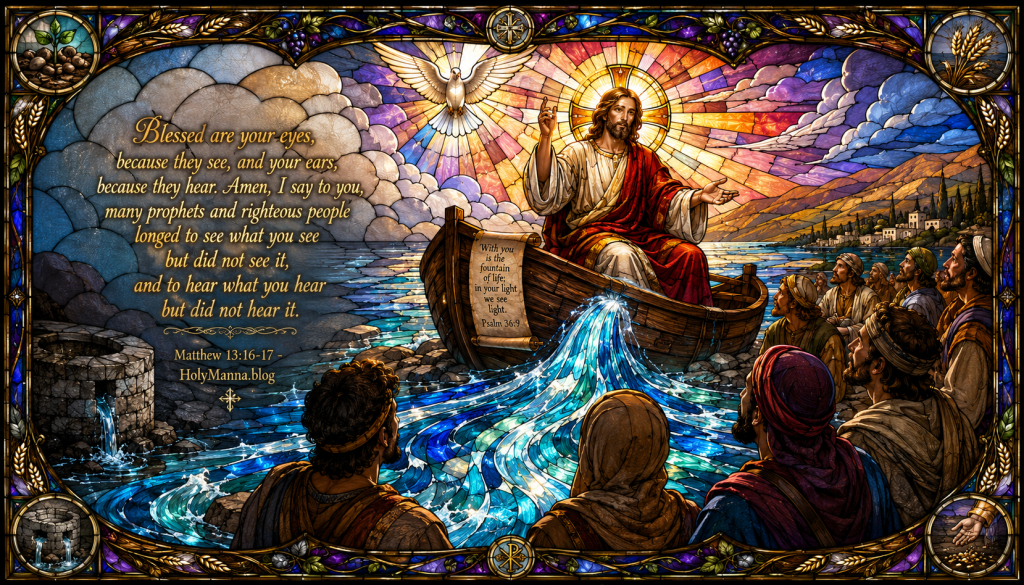
Thursday of the Sixteenth Week in Ordinary Time – Lectionary: 398
The God Who Remembers Our First Love
Everyone remembers what it felt like to fall in love with God for the first time, and here is the astonishing thing: so does He. The readings for Thursday of the Sixteenth Week in Ordinary Time, July 23rd, 2026, open with God doing something almost unbearably tender. Through the prophet Jeremiah, He reminisces. He remembers Israel as a young bride who followed Him into the wilderness with nothing but trust. Then the tone breaks, because the bride wandered, and she traded a living fountain for cracked, leaking cisterns she dug herself. The Responsorial Psalm answers that tragedy with the prayer of the heart that stayed: “with you is the fountain of life.” And in the Gospel, Jesus explains to His disciples why some people standing right in front of the fountain still refuse to drink. They have eyes, but they have chosen not to see.
The thread running through all of it is receptivity. God does not ration His grace; the Catechism insists that prayer itself begins with God’s thirst for us, not ours for Him. The only real question on the table today is the one Jeremiah, David, and Jesus each ask in their own way: when the living water is offered, will the heart open or close? Judah in the 7th century B.C. faced that question with Babylon on the horizon. The crowds in Galilee faced it with the Messiah in a boat 30 feet away. Every reader faces it this morning. The readings are not ancient history. They are a mirror, which, as it happens, is exactly what Jesus says a parable is.
First Reading — Jeremiah 2:1-3, 7-8, 12-13
The Honeymoon, the Betrayal, and the Leaking Cistern
Jeremiah received his call around 627 B.C., during the reign of the reforming King Josiah, and he would spend 4 decades watching Judah slide toward the catastrophe of the Babylonian exile. Chapter 2 contains his first great public oracle, and scholars recognize its form immediately: it is a covenant lawsuit, God formally pressing charges against His own people. Yet the passage does not read like a courtroom transcript. It reads like a love letter written through tears, because the covenant God is prosecuting is not a contract but a marriage. This nuptial frame is precisely what makes the reading fit the day’s theme of receptivity; a bride does not merely obey her husband, she receives his love and returns it, and Judah had stopped doing both.
Jeremiah 2:1-3, 7-8, 12-13 – New American Bible (Revised Edition)
Infidelity of Israel. 1 The word of the Lord came to me: 2 Go, cry out this message for Jerusalem to hear!
I remember the devotion of your youth,
how you loved me as a bride,
Following me in the wilderness,
in a land unsown.
3 Israel was dedicated to the Lord,
the first fruits of his harvest;
All who ate of it were held guilty,
evil befell them—oracle of the Lord.7 I brought you into the garden land
to eat its fine fruits,
But you entered and defiled my land,
you turned my heritage into an abomination.
8 The priests did not ask,
“Where is the Lord?”
The experts in the law did not know me:
the shepherds rebelled against me.
The prophets prophesied by Baal,
and went after useless idols.12 Be horrified at this, heavens;
shudder, be appalled—oracle of the Lord.
13 Two evils my people have done:
they have forsaken me, the source of living waters;
They have dug themselves cisterns,
broken cisterns that cannot hold water.
Detailed Exegesis
Verse 1: “The word of the Lord came to me:”
This is Jeremiah’s standard prophetic formula, and it matters. The oracle that follows is not the prophet’s private grievance against his nation. It carries divine authority, which is why its tenderness is so striking; the wounded voice in this passage is God’s own.
Verse 2: “Go, cry out this message for Jerusalem to hear! I remember the devotion of your youth, how you loved me as a bride, Following me in the wilderness, in a land unsown.”
God begins the indictment with a memory of the honeymoon. The Hebrew word behind “devotion” is hesed, covenant love, the same word the psalm will apply to God Himself. The wilderness generation is remembered here at its best: Israel followed God into an unsown land, trusting Him for manna, water, and direction, the way a young bride follows her husband into an unknown future.
Verse 3: “Israel was dedicated to the Lord, the first fruits of his harvest; All who ate of it were held guilty, evil befell them—oracle of the Lord.”
First fruits belonged to God alone under the Law, set apart as holy. Israel was that consecrated portion among the nations, and anyone who devoured her answered to God directly. The verse quietly establishes what Israel is about to throw away: a protected, cherished, sacred identity.
Verse 7: “I brought you into the garden land to eat its fine fruits, But you entered and defiled my land, you turned my heritage into an abomination.”
The word “garden” deliberately echoes Eden. God led His bride from the wilderness into abundance, and the response to gift was defilement. The pattern of the first sin repeats: abundance received, then corrupted.
Verse 8: “The priests did not ask, ‘Where is the Lord?’ The experts in the law did not know me: the shepherds rebelled against me. The prophets prophesied by Baal, and went after useless idols.”
All 4 pillars of Judah’s religious and civil leadership collapse in a single verse: priests, scribes, kings, and prophets. Those charged with keeping the nation receptive to God led the closing of its eyes instead. Baal was the Canaanite storm god credited with sending rain, which makes the coming water imagery bitterly ironic; they abandoned the true source of water to beg from a false one.
Verse 12: “Be horrified at this, heavens; shudder, be appalled—oracle of the Lord.”
God summons the heavens themselves as witnesses, standard practice in a covenant lawsuit, since heaven and earth witnessed the original covenant in Deuteronomy 30:19. Creation is called to gasp at what the bride has done.
Verse 13: “Two evils my people have done: they have forsaken me, the source of living waters; They have dug themselves cisterns, broken cisterns that cannot hold water.”
Here is the verse the whole liturgy pivots on. In ancient Judah, a cistern was a pit hewn into limestone and sealed with plaster to store winter rain, and a cracked cistern was worthless, holding only stagnant seepage or nothing at all. “Living water” meant flowing spring water, fresh and inexhaustible. The double evil is therefore not just abandoning God but the exhausting absurdity of the substitute: digging, by hand, into rock, for water that leaks away.
Teachings
The Church has never let go of this verse, and she quotes it in a place many readers would not expect: her teaching on prayer. The Catechism teaches in CCC 2561: “Paradoxically our prayer of petition is a response to the plea of the living God: ‘They have forsaken me, the fountain of living waters, and hewn out cisterns for themselves, broken cisterns that can hold no water!’” That is a stunning reversal. Before anyone asks God for anything, God is already pleading with humanity to come back to the fountain. Prayer does not initiate contact; it answers a call already made.
The nuptial reading of the passage is likewise magisterial. CCC 1611 teaches: “Seeing God’s covenant with Israel in the image of exclusive and faithful married love, the prophets prepared the Chosen People’s conscience for a deepened understanding of the unity and indissolubility of marriage.” Jeremiah stands in that prophetic line with Hosea, and the tradition sees in it the foreshadowing of Christ the Bridegroom and the Church His bride.
Finally, the broken cistern is the Bible’s most vivid definition of idolatry, which the Catechism defines with uncomfortable modern precision. CCC 2113 teaches: “Idolatry consists in divinizing what is not God. Man commits idolatry whenever he honors and reveres a creature in place of God, whether this be gods or demons (for example, satanism), power, pleasure, race, ancestors, the state, money, etc.” Every idol on that list is a cistern, and every one of them leaks.
Reflection
The uncomfortable genius of this reading is that cistern digging is hard work. Nobody drifts into idolatry lazily; people pour effort into the substitutes, grinding away at careers, screens, reputations, and comforts that were never designed to hold living water. A practical response starts with an honest inventory. Name the one place where the most energy goes for the least peace in return; that is usually the cistern. Then do what CCC 2561 implies: treat the restlessness itself as God’s plea, and answer it with 10 minutes of actual prayer before reaching for the substitute. Return to Confession, where the Bridegroom restores the bride. Which cistern have you been digging, and how long has it been leaking? What did the devotion of your own youth look like, and what would it take to ask God to remember it with you?
Responsorial Psalm — Psalm 36:6-11
The Prayer of the Heart That Stayed at the Fountain
Psalm 36 carries the superscription of David, the servant of the Lord, and it is a psalm of sharp contrast. Its opening verses, which the lectionary omits today, describe the wicked man whose eyes are closed to any fear of God. Then, at verse 6, the psalm turns its face upward and never looks back down. The Church places this hymn immediately after Jeremiah’s lawsuit for a reason that borders on liturgical genius: the fountain of living water that Judah forsook in the First Reading is placed directly onto the congregation’s lips as a prayer. What the bride abandoned, the worshiper reclaims. This is the sound of a receptive heart, the day’s theme sung rather than argued.
Psalm 36:6-11 – New American Bible (Revised Edition)
6 Lord, your mercy reaches to heaven;
your fidelity, to the clouds.
7 Your justice is like the highest mountains;
your judgments, like the mighty deep;
human being and beast you sustain, Lord.
8 How precious is your mercy, O God!
The children of Adam take refuge in the shadow of your wings.
9 They feast on the rich food of your house;
from your delightful stream you give them drink.
10 For with you is the fountain of life,
and in your light we see light.
11 Show mercy on those who know you,
your just defense to the upright of heart.
Detailed Exegesis
Verse 6: “Lord, your mercy reaches to heaven; your fidelity, to the clouds.”
The Hebrew behind “mercy” is again hesed, covenant love, and “fidelity” is emunah, faithfulness. David measures both against the sky because no earthly measure suffices. Where Judah’s hesed evaporated like morning mist, God’s fills the whole vertical span of creation.
Verse 7: “Your justice is like the highest mountains; your judgments, like the mighty deep; human being and beast you sustain, Lord.”
The imagery now runs from the mountain peaks to the ocean depths, the tallest and deepest things an ancient Israelite could name. God’s justice is unmissable like the mountains and unfathomable like the deep, and His providence is universal, sustaining even the animals.
Verse 8: “How precious is your mercy, O God! The children of Adam take refuge in the shadow of your wings.”
The wings evoke two images the tradition holds together: the mother bird sheltering her young, as in Deuteronomy 32:11, and the outstretched wings of the cherubim over the Ark of the Covenant in the Temple. Refuge under God’s wings is both maternal tenderness and liturgical worship. Notice also “children of Adam”; the invitation is not limited to Israel but extends to the whole human family.
Verse 9: “They feast on the rich food of your house; from your delightful stream you give them drink.”
The “house” is the Temple, and the language of feasting points to the sacrificial banquets eaten in God’s presence. Catholic tradition cannot read this verse without seeing the Eucharist on the horizon: rich food from God’s house and drink from His own stream. The word translated “delightful” shares its root with “Eden,” a deliberate echo of the garden land of Jeremiah 2:7.
Verse 10: “For with you is the fountain of life, and in your light we see light.”
This is the summit of the psalm and the direct answer to Jeremiah 2:13. God is not merely a fountain among others; He is the fountain of life itself. The second line has been treasured by Christian tradition as a glimpse of the Trinity, light seen in Light, and the Nicene Creed’s confession of the Son as light from light stands in this verse’s lineage. On the natural level the line states a simple truth with enormous consequences: light is not seen the way objects are seen, for it is the medium by which everything else becomes visible. So it is with God. He is not one item within human understanding; He is the illumination that makes understanding possible.
Verse 11: “Show mercy on those who know you, your just defense to the upright of heart.”
The psalm ends in petition, asking that the hesed just praised continue to flow. “Those who know you” is covenant language; in Scripture, knowing God is not information but intimacy, the marital knowledge Jeremiah said the experts in the law lacked.
Teachings
The Catechism places its entire theology of prayer beside a well of water, and its teaching reads like a commentary on this psalm. CCC 2560 teaches: “The wonder of prayer is revealed beside the well where we come seeking water: there, Christ comes to meet every human being. It is he who first seeks us and asks us for a drink. Jesus thirsts; his asking arises from the depths of God’s desire for us. Whether we realize it or not, prayer is the encounter of God’s thirst with ours. God thirsts that we may thirst for him.” The fountain of life is not passive. The fountain seeks the thirsty.
The Church’s tradition also connects this psalm’s imagery to the Lord’s own words at the Feast of Tabernacles in John 7:37-38, where Jesus cries out that the thirsty should come to Him and drink, and to the promise of living water made to the Samaritan woman in John 4:10-14. The Fathers of the Church consistently read the fountain of Psalm 36 as fulfilled in Christ and poured out in the Holy Spirit through Baptism. What David glimpsed in the Temple, the Church drinks at the font and the altar. The psalm’s feast of rich food and delightful drink finds its complete meaning at the Mass, where the children of Adam really do eat at God’s house and drink from His stream.
Reflection
The psalm offers a practical test of where a soul is standing. Jeremiah’s cistern digger works frantically and stays thirsty; David’s worshiper rests under the wings and feasts. The difference is not effort but location. A concrete way to relocate is to build one act of receiving into each day: arrive 10 minutes early for Mass and simply sit in God’s house, or pray verse 10 slowly before opening a single app in the morning. Let God be the light things are seen in, rather than one more thing to squeeze into the schedule. When was the last time you let yourself be fed at God’s house rather than grabbing spiritual fast food on the run? What would change if tomorrow began with “in your light we see light” instead of a glowing screen?
Holy Gospel — Matthew 13:10-17
Why the Storyteller Went Quiet About His Secrets
Matthew 13 gathers 7 parables into the third great discourse of the Gospel, delivered from a boat just offshore while the crowds stood on the beach. Jesus has just told the parable of the sower, and before He explains it, the disciples interrupt with a question that has puzzled readers for 2,000 years: why parables at all? His answer, quoting the prophet Isaiah, sounds at first like the harshest thing He ever said, as though the stories were designed to keep people out. The Fathers of the Church read it in exactly the opposite direction, and their reading completes the day’s theme. The fountain flows and the light shines, but eyes and ears are doors that only their owners can open.
Matthew 13:10-17 – New American Bible (Revised Edition)
The Purpose of Parables. 10 The disciples approached him and said, “Why do you speak to them in parables?” 11 He said to them in reply, “Because knowledge of the mysteries of the kingdom of heaven has been granted to you, but to them it has not been granted. 12 To anyone who has, more will be given and he will grow rich; from anyone who has not, even what he has will be taken away. 13 This is why I speak to them in parables, because ‘they look but do not see and hear but do not listen or understand.’ 14 Isaiah’s prophecy is fulfilled in them, which says:
‘You shall indeed hear but not understand,
you shall indeed look but never see.
15 Gross is the heart of this people,
they will hardly hear with their ears,
they have closed their eyes,
lest they see with their eyes
and hear with their ears
and understand with their heart and be converted,
and I heal them.’The Privilege of Discipleship. 16 “But blessed are your eyes, because they see, and your ears, because they hear. 17 Amen, I say to you, many prophets and righteous people longed to see what you see but did not see it, and to hear what you hear but did not hear it.
Detailed Exegesis
Verse 10: “The disciples approached him and said, ‘Why do you speak to them in parables?’”
Saint John Chrysostom noticed the generosity hidden in the question: the disciples do not ask why Jesus speaks to us in parables but why He speaks to them that way. They are worried about the crowds. Mark’s parallel notes they asked privately, showing a delicacy about when and how to question the Master.
Verse 11: “He said to them in reply, ‘Because knowledge of the mysteries of the kingdom of heaven has been granted to you, but to them it has not been granted.’”
The word “mysteries” here is the Greek mysteria, the hidden plan of God now being unveiled. Understanding is called a grant, a gift, before anything else; nobody reasons their way into the kingdom unaided. Yet as the following verses show, the gift is refused by some, so the granting is not arbitrary favoritism.
Verse 12: “To anyone who has, more will be given and he will grow rich; from anyone who has not, even what he has will be taken away.”
This is a spiritual law of use. The person who receives the word and acts on it gains capacity for more, the way a musician who practices gains the ability to hear more in the music. The person who neglects the little he has loses even that, not because God confiscates it but because unused faith atrophies.
Verse 13: “This is why I speak to them in parables, because ‘they look but do not see and hear but do not listen or understand.’”
The order matters enormously. The parables are a response to blindness already chosen, not its cause. These crowds had watched Jesus cast out demons and concluded He worked by Beelzebul; their verdict contradicted their own eyes.
Verses 14 and 15: “Isaiah’s prophecy is fulfilled in them, which says: ‘You shall indeed hear but not understand, you shall indeed look but never see. Gross is the heart of this people, they will hardly hear with their ears, they have closed their eyes, lest they see with their eyes and hear with their ears and understand with their heart and be converted, and I heal them.’”
Jesus quotes Isaiah 6, the scene of Isaiah’s own commissioning, where the prophet was warned his preaching would meet closed ears. Note who does the closing: “they have closed their eyes.” The grammar of the refusal belongs to the people. And note the last clause, because it gives the whole passage away: the sentence ends with healing. God’s standing offer, even inside the indictment, is “and I heal them.”
Verse 16: “But blessed are your eyes, because they see, and your ears, because they hear.”
This is a beatitude, spoken in the same voice as the Sermon on the Mount. The disciples were Galileans raised in the same towns as the unbelieving crowds; the difference was not education or privilege but the willingness to keep looking and keep asking.
Verse 17: “Amen, I say to you, many prophets and righteous people longed to see what you see but did not see it, and to hear what you hear but did not hear it.”
Abraham, Moses, David, and Isaiah himself saw the promises only from a distance, by faith. The fishermen in the boat were watching the fulfillment eat breakfast. The verse quietly asserts the unity of the two Testaments; the prophets longed for this very Messiah, not some rival revelation.
Teachings
Saint John Chrysostom devoted his Homily 45 on Matthew to this passage, and his central point dissolves the apparent harshness. Of the crowds’ condition he preached: “because it was a voluntary and self-chosen blindness, therefore He said not simply, ‘They see not,’ but, ‘seeing, they see not;’ so that the blindness is of their own wickedness.” And of the parables’ purpose he insisted the door remained open: “For if it had not been His will that they should hear and be saved, He ought to have been silent, not to have spoken in parables; but now by this very thing He stirs them up, even by speaking under a veil.” Chrysostom read the veiled speech as a mercy, provoking curiosity where plain speech had already been rejected, and he added that the words about conversion imply “that both their conversion was possible, and that upon their repentance they might be saved.”
The Catechism teaches the same in CCC 546: “Through his parables he invites people to the feast of the kingdom, but he also asks for a radical choice: to gain the kingdom, one must give everything. Words are not enough; deeds are required. The parables are like mirrors for man: will he be hard soil or good earth for the word?” A mirror shows each viewer his own face. The parable does not change; the heart hearing it decides what it reveals.
Reflection
Everyone lives somewhere on the spectrum between the disciples and the crowd, and the honest news is that the position is chosen daily. Hearing a hundred homilies while planning lunch is the crowd’s posture; asking one sincere question afterward is the disciple’s. A concrete practice: take today’s parable discourse in Matthew 13 and read it once through, then come back to whichever line resists understanding and ask Jesus directly what it means, the exact move the disciples made in verse 10. Bring a real question to Adoration this week instead of a wandering mind. Gratitude belongs here too, because verse 17 is addressed to every baptized reader: the prophets ached for what sits available in the nearest tabernacle. Which of Jesus’ teachings have you been hearing without really listening to, perhaps because obeying it would cost something? If the parables are mirrors, what did today’s readings show you about your own soil?
Come Back to the Fountain
Set the three readings side by side and a single story emerges, told in three voices. Jeremiah gives the diagnosis: the bride who once followed God into the wilderness learned to dig her own cisterns, and the leaders who should have asked “Where is the Lord?” stopped asking. David gives the alternative: a heart camped beside the fountain of life, feasting at God’s house, seeing everything else by God’s light. And Jesus gives the explanation for why the same fountain produces two such different lives: eyes and ears are free, and the God who could force them open refuses to, preferring to woo the closed heart with stories until curiosity cracks it open. Even His hardest sentence ends with “and I heal them.”
That is the tenderness hiding inside this Thursday in Ordinary Time. God does not describe Himself today as a judge collecting debts but as a spurned Bridegroom who still remembers the honeymoon, a fountain that never stopped flowing, a storyteller leaving clues for anyone willing to lean in. The Catechism says the wonder of prayer is that God thirsts for us before we ever thirst for Him. The whole spiritual life fits inside that sentence.
So here is the invitation for July 23rd: put down the shovel. Whatever cistern has been absorbing all that effort and returning stagnant water, leave it unfinished today. Go to Mass and eat the rich food of God’s house. Ask Jesus the question that has been sitting unasked. Open the eyes on purpose. The prophets and righteous ones longed for what is freely offered this morning, and blessed, truly blessed, are the eyes that finally choose to see it.
Engage With Us!
The conversation does not end with the final paragraph, so please share your reflections in the comments below. This community grows every time someone tells the truth about where God met them in the readings, and someone else always needs to hear it. Take a few quiet moments with these questions and post whatever the Holy Spirit stirs up:
- In Jeremiah 2:1-3, 7-8, 12-13, God remembers Israel’s bridal devotion before naming her betrayal. What “broken cistern” in your own life has demanded the most digging while holding the least water, and what would returning to the fountain look like this week?
- Psalm 36:6-11 declares that with God is the fountain of life and in His light we see light. Where have you recently tried to see your circumstances by some other light, and what changed, or might change, when you viewed them in His?
- In Matthew 13:10-17, Jesus blesses the disciples’ eyes because they see. What is one teaching of Christ you have been hearing without truly listening to, and what honest question could you bring Him about it, just as the disciples did?
- Taking all the readings together, God offers Himself as living water to hearts free to receive or refuse Him. What is one concrete way you will choose receptivity this week, at Mass, in prayer, or in Scripture?
Living a life of faith is not about digging harder; it is about drinking deeper. Stay close to the fountain, keep the eyes of the heart open, and do everything this week with the love and mercy Jesus taught us. He is already thirsting for you.
Sacred Heart of Jesus, we trust in You!
Immaculate Heart of Mary, pray for us!
Saint Michael the Archangel, defend us in battle!
Follow us on YouTube, TikTok, Instagram and Facebook for more insights and reflections on living a faith-filled life.


Leave a Reply