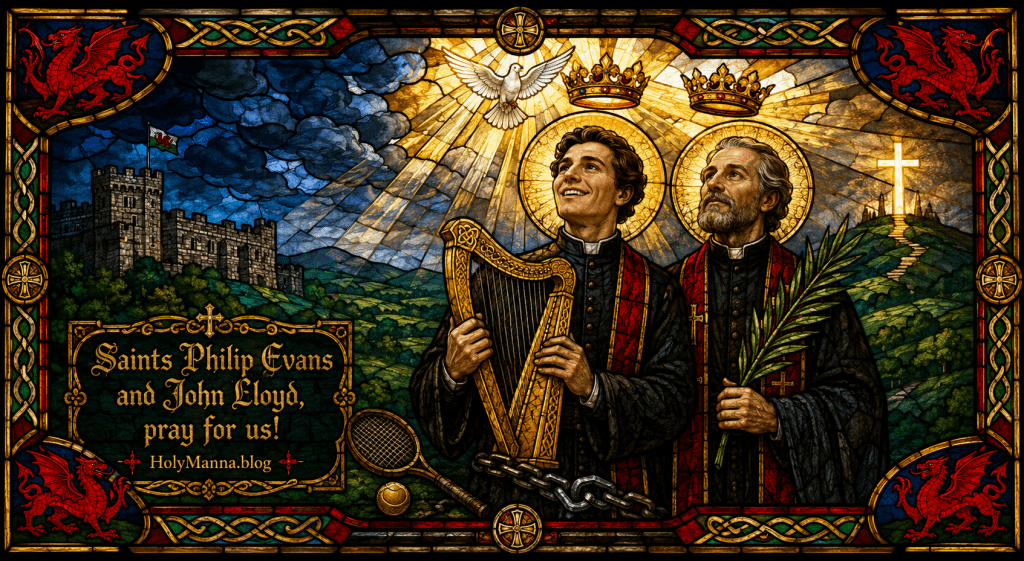
Joy at the Gallows
Some saints are remembered for building cathedrals, founding orders, or writing works of theology that shaped the centuries. Saints Philip Evans and John Lloyd did none of those things. What they did was, in its own way, harder. They stayed. In a Wales where the Catholic faith had been outlawed, where saying Mass was treason and sheltering a priest could ruin a family, these two men kept showing up, kept hearing confessions in hidden rooms, kept placing the Body of Christ on the tongues of people who risked everything to receive Him. And when the law finally caught them, they went to a brutal death not with grim resignation but with a joy so radiant that it still startles readers three and a half centuries later.
Philip Evans was a young Jesuit, thirty-four years old when he died, a musician and an athlete who learned the date of his execution in the middle of a tennis match and asked to finish the game. John Lloyd was a secular priest, likely much older, a quiet man who had spent twenty-four years on the run serving Welsh Catholics in secret and who, at the end, told the crowd simply that he had never been a good speaker in his life. They died together at Gallows Field near Cardiff on July 22, 1679, victims of the anti-Catholic panic stirred up by the fabricated Popish Plot. Pope Paul VI canonized them both on October 25, 1970, among the Forty Martyrs of England and Wales.
The Church teaches that “martyrdom is the supreme witness given to the truth of the faith: it means bearing witness even unto death” (CCC 2473). These two Welshmen bore that witness with a serenity that turned a place of execution into a pulpit. Their story deserves to be told, and it deserves to be remembered.
Sons of Wales in a Hunted Church
To understand these two men, the reader has to understand the Wales they were born into. By the middle of the seventeenth century, more than a hundred years had passed since the English Crown broke with Rome. The Mass was illegal. Under the statute of 1585, the mere presence of a Catholic priest ordained abroad on English or Welsh soil was defined as high treason, punishable by hanging, drawing, and quartering. Catholic families survived by discretion, by loyalty to one another, and by the courage of priests trained overseas who slipped back into the country knowing exactly what awaited them if they were caught.
Philip Evans was born in Monmouthshire in 1645. Welsh biographical sources name his parents as William Evans of Llangattock Vibon Avel and Winifred Morgan of Llanvihangel Crucorney, a family rooted in the recusant gentry networks of southeast Wales. Like so many Catholic boys of his generation, Philip could not be educated in the faith at home, so he was sent across the sea to the Jesuit college of Saint-Omer in Flanders. There he received a rigorous formation, and there he also cultivated two loves that would follow him to the end of his life: the harp and the game of tennis. On September 7, 1665, at the age of twenty, he entered the Society of Jesus. He was ordained a priest at Liège in 1675 and sent immediately to the mission in South Wales. He would serve his people for barely three years as a free man.
John Lloyd’s beginnings are harder to trace, which is itself a testimony to the hiddenness of Catholic life in that era. He was born in Breconshire; his birth year was never recorded, and one modern account describes him as over sixty at the time of his death, though this cannot be established with precision. He was educated at Ghent and then, from 1649, at the English College at Valladolid in Spain, the great seminary founded to train priests for the underground mission. On October 16, 1649, he took the missionary oath, a solemn promise to return to Britain and serve the hidden faithful whatever the cost. In 1654 he was sent home to Wales. For the next twenty-four years he lived as a hunted man, moving from house to house, celebrating Mass in concealed chapels, baptizing, absolving, anointing, always one informer away from the scaffold. There was no conversion moment in either man’s story, no dramatic turning. Their whole lives were a single long act of fidelity, a deepening of the faith they had received, purchased at the price of exile, danger, and finally blood.
Shepherds in the Shadows
Neither Philip Evans nor John Lloyd worked recorded miracles during his lifetime. No cures are attributed to their hands, no wonders to their prayers while they lived. It is worth saying that plainly, because their greatness lies elsewhere, and the Church wants the faithful to see it. What these men carried through the valleys and farmhouses of Glamorgan and Monmouthshire was something greater than any single wonder: the sacramental life of the Church itself. The Catechism teaches that “in the ecclesial service of the ordained minister, it is Christ himself who is present to his Church as Head of his Body” (CCC 1548). Every hidden Mass they offered, every absolution they whispered in a back room, was Christ Himself reaching His scattered Welsh flock. That was the treasure they guarded, and that is why the reader should remember them.
Fr. Evans quickly became known for his zeal in South Wales. He was young, warm, musical, and evidently fearless. Fr. Lloyd, the veteran, had by then spent more than two decades perfecting the quiet disciplines of the underground priest: how to travel unnoticed, whom to trust, how to comfort people who lived their whole religious lives in secrecy. Together they represent the two great streams of the mission, the religious order priest and the secular priest, laboring side by side for the same flock.
Then, in the autumn of 1678, the world turned against them. A failed clergyman named Titus Oates fabricated an elaborate tale of a Catholic conspiracy to assassinate King Charles II. The so-called Popish Plot was a lie from beginning to end, but it ignited a national panic, and priests became its primary victims. In Wales, a justice of the peace named John Arnold of Abergavenny, an indefatigable priest hunter, put a price on Fr. Evans’s head. Catholic sources disagree on the amount; the Catholic Encyclopedia records a reward of two hundred pounds, while the Dictionary of Welsh Biography records fifty. Either sum was a fortune to a poor informer. Friends begged Fr. Evans to flee. He refused to leave his people, and in the first days of December 1678 he was arrested at the house of Christopher Turberville at Sker in Glamorgan. Fr. Lloyd had been taken two weeks earlier, on November 20, at another Turberville house at Penlline. The same faithful gentry family had sheltered them both.
The Dungeon, the Trial, and the Long Wait
Fr. Evans was ordered to take the oath that no Catholic conscience could accept, and when he refused he was thrown into an underground dungeon in Cardiff Castle, alone, in the cold of a Welsh winter. After two or three weeks he was moved up into the common prison, where he found Fr. Lloyd. From that point the two priests were companions in everything: the same cell, the same trial, the same sentence, the same day of death.
Here the record reveals something remarkable. For five months the two men waited without trial, because the prosecution could not find anyone willing to testify against them. The people of Glamorgan, Catholic and Protestant alike, would not sell their priests. Eventually a woman and her daughter testified that they had received the sacraments from Fr. Evans, which was true, and the Catholic Encyclopedia names the chief witness against him as an apostate called Mayne Trott, a former court dwarf then in the service of the priest hunter Arnold. The trial was held at Cardiff in early May 1679; sources conflict on the exact date, with the Catholic Encyclopedia recording May 5, Jesuit sources May 3, and the Dictionary of Welsh Biography May 8 and 9 before Judge Owen Wynne. What no source disputes is the substance. Neither priest was accused of any part in Oates’s imaginary plot. They were condemned to be hanged, drawn, and quartered for one crime only: being Catholic priests who had come into the realm to minister, contrary to the statute of 27 Elizabeth. Their martyrdom was, in the Church’s precise language, suffered in odium fidei, out of hatred for the faith.
Our Lord had prepared His Church for exactly this. “Blessed are those who are persecuted for righteousness’ sake, for theirs is the kingdom of heaven” (The Gospel of Matthew, Mt 5:10). The Catechism adds that the disciple of Christ must not only keep the faith but profess it and confidently bear witness to it, for “service of and witness to the faith are necessary for salvation” (CCC 1816). The two prisoners of Cardiff Castle were about to give that witness in full.
The Tennis Match, the Harp, and the Best Pulpit in Wales
What happened next is the part of this story that Catholics in Wales have never stopped telling. Nearly three months passed between sentence and execution, and during that strange interval the condemned priests were allowed a surprising amount of liberty, even leaving the prison for recreation. On July 21, 1679, word finally came to the gaoler that the executions would take place the next day. He went to inform Fr. Evans and found him on the tennis court near St. John’s church, mid-match. The young Jesuit’s response has echoed down the centuries: “What hurry is there? Let me first play out my game.” The wording survives in slightly different forms across the old accounts, but the substance is consistent and well attested. A man had just been told he would die in the morning, and his first instinct was the unhurried peace of someone whose affairs with God were entirely in order.
Back in his cell, Fr. Evans took up his harp. Contemporary accounts record that he spent his final hours singing praise to God to his own accompaniment, and that when the officials came for him the next morning they found him still playing joyfully. Then came a final cruelty. The heavy chains on his legs had been fastened so tightly that the struggle to remove them lasted more than an hour and caused him terrible pain. This detail comes down through the traditional Catholic accounts of the martyrdom and is consistently reported in the sources, though the reader should know it rests on those early narratives rather than on court records. He bore it, by every account, without complaint.
The two priests were taken to Gallows Field at Pwllhalog, on the edge of Cardiff. Fr. Evans died first. Mounting the ladder, he looked out at the crowd and delivered one of the great one-line homilies in the history of the Church: “This is the best pulpit a man can have to preach in, therefore, I cannot forbear to tell you again that I die for God and religion’s sake.” He addressed the people in both Welsh and English, the two tongues of his flock. Then he turned to his friend and fellow prisoner, who stood waiting his own turn, and said, “Adieu, Mr. Lloyd, though for a little time, for we shall shortly meet again.” He was hanged, drawn, and quartered. He was thirty-four years old and had been a Jesuit for fourteen years.
Then it was the old missionary’s turn. Fr. John Lloyd, who had served in silence for a quarter of a century, kept his silence nearly to the end. He made only the briefest of speeches, telling the crowd, “I never was a good speaker in my life.” After twenty-four years of hidden Masses, his life itself was the sermon. He died the same brutal death, and the two priests who had shared a cell now shared a crown. St. Paul’s words might have been written for them both: “I have fought the good fight, I have finished the race, I have kept the faith” (2 Timothy, 2 Tim 4:7).
They died on July 22, which the universal calendar keeps as the feast of St. Mary Magdalene, and so their joint memorial was assigned to July 23 in Wales, with October 25 also kept as the feast of the Forty Martyrs of England and Wales. Many devotional calendars, honoring the actual day of their birth into heaven, commemorate them on July 22.
The Seed of Welsh Faith
Honesty requires saying something that some saint stories gloss over: no miracles after death are formally attributed to Philip Evans and John Lloyd as individuals. No documented healings at a tomb, no wonder-working relics with an official record. The cause of the English and Welsh martyrs advanced instead on the unimpeachable evidence of their martyrdom itself, and the canonization of the Forty Martyrs in 1970 was supported by a miracle attributed to the collective intercession of the group. Where a saint’s file contains no individual miracle stories, the Church does not invent them, and neither should the faithful. Yet the Catechism teaches that the saints in heaven “do not cease to intercede with the Father for us, as they proffer the merits which they acquired on earth through the one mediator between God and men, Christ Jesus” (CCC 956). Welsh Catholics have sought that intercession from these two martyrs for generations, and the quiet fruit of their deaths has been real.
Pope Pius XI beatified them on December 15, 1929. Pope Paul VI canonized them on October 25, 1970, together with companions such as St. Margaret Clitherow, St. Edmund Campion, and St. David Lewis, the Welsh Jesuit who died just a month after them in that same terrible summer of 1679. In canonizing the faithful, the Catechism explains, the Church “proclaims the power of the Spirit of holiness within her and sustains the hope of believers by proposing the saints to them as models and intercessors” (CCC 828).
Their memory is written into the streets of Cardiff itself. The site of Gallows Field, at what is now the junction of Crwys Road and Richmond Road in the Roath district, is still known locally as Death Junction, and two plaques mark the place where the martyrs died. A Catholic primary school in Cardiff proudly bears the name of St. Philip Evans. In sacred art, St. Philip is shown with his harp, an instrument that has become a small icon of Welsh Catholic identity, calling to mind the psalmist’s cry: “Awake, my soul! Awake, O harp and lyre! I will awake the dawn!” (Psalm 57, Ps 57:8). Above all, the two saints stand within the company of the Forty Martyrs as enduring proof that the faith in Wales was never extinguished, only buried like seed. The Catechism, quoting Tertullian, puts it in words the whole Church knows: “indeed, ‘the blood of martyrs is the seed of Christians’” (CCC 852).
Finishing the Game with Joy
What can a reader in the twenty-first century, who will almost certainly never face a scaffold, take from two Welsh priests who did? More than it might first appear, because the scaffold was not actually the center of their sanctity. The center was everything that came before it: the daily, unglamorous, decades-long choice to be faithful when faithfulness was costly. St. John Lloyd’s twenty-four years on the run were composed of thousands of ordinary mornings on which he simply got up and did his duty to God and to his people one more time. Holiness of that kind is available to everyone. The Catechism teaches that “the way of perfection passes by way of the Cross. There is no holiness without renunciation and spiritual battle” (CCC 2015). For most people the cross arrives not as a gallows but as an inconvenient obligation, a hidden sacrifice, a truth that costs something to speak aloud.
And then there is the joy. Philip Evans did not merely endure his martyrdom; he played tennis, he played the harp, he cracked what can only be called holy jokes on the way to a horrific death. That joy was not a personality quirk. It was the fruit of a man so certain of Christ’s promises that death had lost its power to frighten him. Our Lord said, “Greater love has no man than this, that a man lay down his life for his friends” (The Gospel of John, Jn 15:13), and Philip Evans believed Him so completely that he could finish his game first. When something small is asked of you for the sake of your faith, an awkward conversation, an unpopular stand, a sacrifice of comfort, do you meet it with dread or with trust? Is your relationship with God in such good order that unexpected news, even hard news, would find you at peace?
There is also a lesson in the friendship of these two men. A young Jesuit and an aging secular priest, formed in different schools and different generations, ended their lives as brothers, and Philip’s farewell promised a reunion that faith guarantees. The communion of saints is not poetry; it is doctrine, and it is comfort. Who are the companions God has placed beside you for the battles of your own life, and do you thank Him for them? Consider some practical ways to walk with these martyrs. Learn to hold possessions, plans, and even life itself with open hands, beginning with small daily detachments. Support and pray for priests, especially those serving in places where the faith is restricted today, remembering that the hidden Church did not end in 1679. Bring music into prayer, as Philip did, letting praise steady the heart when fear rises. And practice cheerfulness under trial deliberately, offering the day’s frustrations with a light heart, because joy is one of the most persuasive sermons a Christian can preach.
Engage With Us!
The story of Saints Philip Evans and John Lloyd belongs to everyone who has ever wondered whether faith is worth a real cost, and HolyManna would love to hear how it lands in your life. Share your thoughts, your questions, and your own experiences of costly faithfulness in the comments below. To help the reflection go deeper, here are some questions to pray with this week.
- Philip Evans asked to finish his tennis game after learning he would die the next morning. What would it take for your soul to be that ready and that much at peace?
- John Lloyd served hunted Catholics in secret for twenty-four years with no recognition. Where is God asking you to be faithful in hidden, unrewarded ways right now?
- The people of Glamorgan refused for months to testify against their priests. How do you protect, support, and encourage the priests and fellow believers in your own community?
- Philip called the gallows the best pulpit a man can have. What does your life preach to the people who watch you when you suffer?
- Both martyrs died joyful. What fear is currently robbing you of joy, and can you hand it to Christ today?
May the witness of these two Welsh martyrs stir up courage where there is hesitation and joy where there is fear. Live this week with the readiness of Philip and the quiet perseverance of John, doing everything, the great things and the small, with the love and mercy that Jesus taught us. The gallows could not silence them, and no trial you face today can separate you from the God they died praising.
Saints Philip Evans and John Lloyd, pray for us!
Follow us on YouTube, TikTok, Instagram and Facebook for more insights and reflections on living a faith-filled life.


Leave a Reply