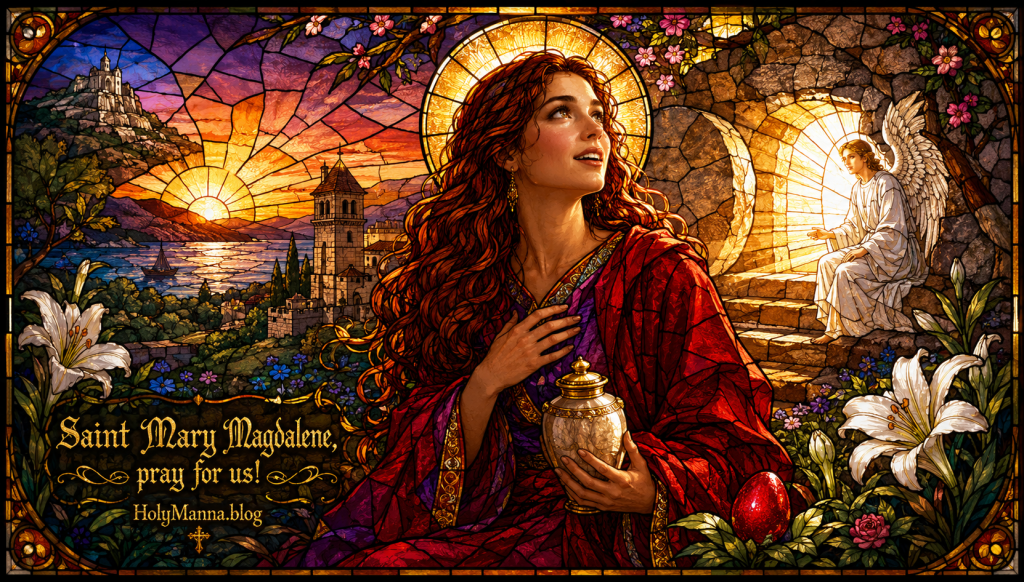
The First Witness the World Ever Heard
Every Easter proclamation the Church has ever made, in every language, on every continent, traces back to one human voice. Before Peter preached at Pentecost, before Paul wrote a single letter, before any evangelist put pen to parchment, a woman ran from a garden tomb outside Jerusalem and told the apostles, “I have seen the Lord” (John 20:18). That woman was Mary of Magdala, and on July 22nd the Church celebrates her with the full rank of a feast, the same liturgical honor given to the apostles themselves.
Saint Mary Magdalene occupies a place in the Gospels that no other woman except the Blessed Mother can claim. She is named twelve times in the four Gospels, more often than most of the Twelve. She followed Jesus through Galilee, supported His ministry from her own resources, stood by His cross when nearly everyone else had fled, watched where His body was laid, and came back before dawn on the first day of the week to find the stone rolled away. The Risen Christ chose her, before Peter, before John, before anyone, to be the first witness of His Resurrection and the first messenger sent to announce it. For this reason the great Carolingian teacher Rabanus Maurus and Saint Thomas Aquinas both called her “apostolorum apostola”, the Apostle of the Apostles, and in 2016 the Church made that ancient title part of her official liturgy.
The Catechism places her at the very hinge of salvation history. It teaches that “Mary Magdalene and the holy women who came to finish anointing the body of Jesus, which had been buried in haste because of the Sabbath, were the first to encounter the Risen One”, and that the women were thus “the first messengers of Christ’s Resurrection for the apostles themselves” (CCC 641).
She is also a saint whom the Church formally invokes as a patroness. Mary Magdalene is the patron saint of penitents and converts, of women, of the contemplative life, of pharmacists and apothecaries, of perfumers, and of hairdressers, patronages rooted in the spices and ointments she carried to the tomb and in the tears with which tradition remembers her. She is likewise the patroness of the Order of Preachers; the Dominicans have honored her for more than seven centuries as the Protectress of the Order, seeing in the woman sent to preach the Resurrection the very pattern of their vocation.
Yet for all this glory, few saints have been so persistently misunderstood. Ask most people about Mary Magdalene and they will tell you she was a prostitute. Scripture never says that. Her real story is stranger, richer, and far more consoling, because it is the story of what the mercy of God does with a life He has reclaimed.
Magdala, Seven Demons, and a Life Reclaimed by Grace
Mary came from Magdala, a fishing town on the western shore of the Sea of Galilee whose name comes from the Aramaic word for tower. Magdala in the first century was a busy, prosperous place, known for its salted fish trade that reached across the Roman world. Scripture tells nothing of Mary’s family, her parents, or any husband; unlike most women in the Gospels, she is identified not by a man’s name but by her hometown, which has led many Catholic commentators to conclude that she was likely an independent woman, perhaps of some means. The Gospel of Luke supports this, listing her among the women who accompanied Jesus and the Twelve and “provided for them out of their means” (Luke 8:3).
What Scripture does tell about her past is a single, staggering fact. Saint Luke introduces her as “Mary, called Magdalene, from whom seven demons had gone out” (Luke 8:2), and Saint Mark repeats it, describing the Risen Jesus appearing “first to Mary Magdalene, from whom he had cast out seven demons” (Mark 16:9). Before she ever followed Jesus, Jesus had already fought for her. Whatever that possession looked like, and Scripture gives no details, the number seven in the biblical mind signals totality. Her affliction was complete, and so was her deliverance. The Church teaches that Jesus’ exorcisms were nothing less than the anticipation of His great victory over the ruler of this world, freeing those under the devil’s power and announcing the coming of God’s Kingdom (CCC 550). Mary of Magdala carried that victory in her own body and memory every day of her life.
Her conversion, then, was not a change of opinion. It was a rescue. From the moment of her deliverance she appears in the Gospel as a disciple in the fullest sense, traveling with Jesus from town to town as He proclaimed the Kingdom, alongside Joanna the wife of Chuza and Susanna and many others (Luke 8:1 to 3). In a culture where a rabbi’s traveling companions were men, the presence of these women, funding and serving the mission, was quietly revolutionary.
Here the honest storyteller must pause and untangle the most famous knot in her story. On September 14, 591, Pope Saint Gregory the Great preached a homily in Rome in which he fused three Gospel women into one. He declared: “She whom Luke calls the sinful woman, whom John calls Mary, we believe to be the Mary from whom seven devils were ejected according to Mark”, and he interpreted those seven demons as the seven vices (Homily 33). With that sermon, Mary of Magdala, the anonymous sinful woman of Luke 7, and Mary of Bethany, the sister of Martha and Lazarus, collapsed into a single figure in the Western imagination: the repentant prostitute weeping at the feet of Jesus. The Christian East never made this identification, and neither does the Church today. When the General Roman Calendar was revised in 1969, the Church removed the title of penitent from her feast and clarified that July 22nd celebrates only Mary of Magdala, the first witness of the Resurrection, not the sister of Martha and not the sinful woman of Luke 7. Saint Gregory intended to preach hope to sinners, and generations of penitents did find real hope in the image of the forgiven Magdalene. But the historical record deserves to be stated plainly: Scripture never calls Mary Magdalene a prostitute, and the Church no longer identifies her as one.
What remains when the confusion clears is more compelling than the myth. A woman was held captive by evil, and Christ set her free, and she spent the rest of her life refusing to leave His side.
Faithful Through Galilee, Faithful at the Cross
Mary Magdalene performed no recorded miracles during her lifetime. The Gospels attribute to her no healings, no wonders, no prophecies. If that seems surprising for so great a saint, it is worth sitting with, because it reveals what the Church actually celebrates in her. The miracles in her story run in two directions, and she stands at the center of both: the miracle Christ worked in her when He drove out the seven demons, and the miracle she witnessed before anyone else on earth when He rose from the dead. Her greatness is not what she did for God but what she allowed God to do in her, and how completely she responded. The Catechism teaches that “the disciple of Christ must not only keep the faith and live on it, but also profess it, confidently bear witness to it, and spread it” (CCC 1816). By that measure, Mary Magdalene is a giant.
Her fidelity is easiest to see in the hours when everyone else’s failed. When Jesus was arrested, the apostles scattered. Peter, the rock, denied Him three times before sunrise. Yet Saint John records that “standing by the cross of Jesus were his mother, and his mother’s sister, Mary the wife of Clopas, and Mary Magdalene” (John 19:25). Every Gospel that names the women at Calvary names her, and usually names her first. She stood within sight of a Roman crucifixion, a public terror designed to shame the victim and intimidate his followers, and she did not leave. When Joseph of Arimathea laid the body in the tomb, Saint Mark notes that “Mary Magdalene and Mary the mother of Joses saw where he was laid” (Mark 15:47). Love kept watching even when hope seemed finished.
Then came the morning that changed everything. “Now on the first day of the week Mary Magdalene came to the tomb early, while it was still dark, and saw that the stone had been taken away from the tomb” (John 20:1). She ran to Peter and John with the only explanation grief could supply: “They have taken the Lord out of the tomb, and we do not know where they have laid him” (John 20:2). The two apostles ran, saw, and went home. Mary stayed. She stood outside the tomb weeping, and when she turned she saw a man she took for the gardener. Then the Risen Lord spoke a single word, her own name: “Mary”. And she answered in Aramaic, “Rabbouni”, which means Teacher (John 20:16). The Good Shepherd had said that His sheep hear His voice and He calls them by name (John 10:3), and in that garden the promise came true in front of one astonished woman.
Jesus then gave her a commission: “go to my brethren and say to them, I am ascending to my Father and your Father, to my God and your God” (John 20:17). She obeyed immediately and became the first herald of the central fact of the Christian faith: “Mary Magdalene went and said to the disciples, ‘I have seen the Lord’” (John 20:18). The Catechism confirms the weight of this moment, teaching that the women, and Mary Magdalene before all, were the first messengers of the Resurrection to the apostles themselves (CCC 641). This is why the reader should remember her and emulate her. Christianity does not rest on an idea but on an encounter with the Risen Christ, and the chain of witnesses to that encounter begins with her. Whoever has ever heard the words Christ is risen stands downstream of Mary Magdalene’s morning run.
Sorrow, Stigma, and the Long Trial of Being Misremembered
Mary Magdalene was not martyred. No credible Catholic source records a violent death for her, and the Church has never celebrated her as a martyr. Her hardships were of another kind, and they were severe.
The first hardship was the one she carried before she ever met Christ. Possession by seven demons meant a life, for however long it lasted, of torment, isolation, and fear, in a society that had no help to offer such a person. Even after her deliverance, she would have carried the memory of it, and likely the whispers of neighbors who remembered what she had been. Every convert knows some version of this cross: the past that others will not let die. Mary Magdalene bore it while walking beside the only One who saw her whole.
The second hardship was Calvary itself. To love someone is to suffer what they suffer, and Mary stood through the entire Passion of the man who had saved her. She heard the crowd choose Barabbas. She watched the scourged, thorn-crowned Jesus die slowly over three hours while soldiers gambled for His clothing. Association with an executed criminal was dangerous in Roman Judea, and the men had largely calculated accordingly. She stayed anyway, then endured the Sabbath with His death sealed behind a stone, and walked back in the dark to anoint a corpse. Her tears at the tomb were so central to her memory that the English word maudlin, meaning tearfully sentimental, descends directly from her name.
The third hardship touched her testimony. In the first century, a woman’s witness carried little legal weight; Jewish courts generally did not accept women as valid witnesses. Yet the Lord entrusted the greatest news in history to a woman first. Saint Luke records the apostles’ initial reaction to the women’s report with painful honesty: “these words seemed to them an idle tale, and they did not believe them” (Luke 24:11). The Church has long noted that this very detail argues for the truth of the account, since no one inventing a resurrection story in that world would have chosen women as its first witnesses. The Catechism acknowledges frankly that even when confronted with the reality of the risen Jesus, the disciples “still doubt, so impossible did the thing seem” (CCC 644). Mary proclaimed the Resurrection to men who did not believe her, and she was vindicated only when Christ Himself appeared to them.
Her final trial unfolded after her death, across fourteen centuries in which the West misremembered her. From Saint Gregory’s homily in 591 until the calendar reform of 1969, the composite Magdalene, the reformed harlot, dominated preaching, art, and imagination. Painters portrayed her half-dressed in caves of penance; novels and films embellished further. There is something fitting, and something for the reader to ponder, in the fact that the first witness of the Resurrection had to wait patiently for her own story to be resurrected. The Church, guided by careful attention to Scripture, eventually corrected the record, and in 2016 crowned the correction with a feast. Heaven is not in a hurry, but heaven does not forget.
From Ephesus to Provence
What became of Mary Magdalene after Pentecost? Scripture falls silent, and two great streams of tradition rise to fill the silence. They cannot both be true, and the honest approach is to tell both and label both.
The Eastern tradition, reported as early as Saint Gregory of Tours in the sixth century and cherished by the Greek Church, holds that Mary Magdalene accompanied the Blessed Virgin Mary and Saint John the Apostle to Ephesus, spent her final years there, and died in peace. This tradition adds that in the year 886 the Byzantine emperor Leo VI translated her relics from Ephesus to Constantinople. Within this Eastern stream lives one of the most beloved stories ever attached to her name. The tradition holds that Mary Magdalene, exercising the right of a citizen to petition the emperor, appeared at a banquet before Tiberius Caesar in Rome, held up an ordinary egg, and proclaimed that Christ had risen from the dead. When the emperor scoffed that a man could no more rise from the dead than the egg in her hand could turn red, the egg turned crimson before his eyes. From this story springs the enduring custom of red Easter eggs in Eastern Christianity, and the icon of Mary Magdalene holding a scarlet egg. It is a beautiful story, and it is told here as a story; it cannot be verified.
The Western tradition tells a different journey. Medieval Provence held that after the persecution described in The Acts of the Apostles began, Mary Magdalene, together with Lazarus, Martha, and companions, was set adrift in a boat without oars, which carried them miraculously to the coast of southern Gaul at the place now called Saintes-Maries-de-la-Mer. From there, the tradition continues, she preached Christ to the people of Provence, then withdrew for the final thirty years of her life to a mountain grotto at La Sainte-Baume, living in prayer, penance, and contemplation, sustained by heavenly consolation, until angels carried her at the end to receive Holy Communion from Saint Maximinus before she died. This Provençal tradition flowered in the eleventh through thirteenth centuries and shaped centuries of French devotion. It too is told here as a tradition; it cannot be verified, and it conflicts directly with the Ephesus tradition, a conflict Catholic scholarship has long acknowledged.
The relics tell their own tangled story. The great abbey of Vézelay in Burgundy claimed her body from the eleventh century and became one of the mightiest pilgrimage centers of medieval Europe, a launching point of Crusades and a station on the road to Compostela. Then in 1279, Charles II of Anjou announced the discovery of her true body in the crypt of Saint-Maximin in Provence, and in 1295 the shrine was entrusted to the Dominican Order, which has guarded it ever since. Today the basilica of Saint-Maximin-la-Sainte-Baume houses a skull venerated as hers in a golden reliquary, carried in solemn procession through the town every July 22nd, while pilgrims still climb the forested mountain to the grotto of La Sainte-Baume as they have for seven centuries. The rival claims of Vézelay and Saint-Maximin were never fully reconciled, and both remain places of pilgrimage; the reader should know that the authenticity of these relics rests on medieval attestation rather than modern verification. The Church encourages the veneration of relics as an expression of the piety of the people of God (CCC 1674), and pilgrimage to these shrines has borne fruit in countless conversions.
Reports of healings and graces attributed to her intercession accumulated around both shrines throughout the Middle Ages, drawing kings of France and ordinary penitents alike; these accounts belong to the tradition of the shrines and cannot be individually verified.
Her impact on Christian culture is hard to overstate. Magdalen College at Oxford and Magdalene College at Cambridge carry her name. The moment Jesus told her not to cling to Him, the “Noli me tangere” of John 20:17, became one of the most painted scenes in all of Christian art, rendered by Fra Angelico, Titian, and countless others. And on June 3, 2016, the Solemnity of the Sacred Heart, by the express wish of Pope Francis, the Congregation for Divine Worship issued the decree Apostolorum Apostola, signed by Cardinal Robert Sarah, raising her celebration to a feast with its own new Preface. Archbishop Arthur Roche explained that the decision calls the faithful to reflect “on the dignity of women, on the new evangelization and on the greatness of the mystery of God’s Mercy”, and noted that Pope Francis acted precisely in the context of the Jubilee of Mercy. The first witness of Easter now stands liturgically shoulder to shoulder with the Twelve.
One final caution belongs to her legacy. Sayings from the so-called Gospel of Mary, a Gnostic text rejected by the Church, circulate online attributed to her. No verified words of Mary Magdalene exist outside the canonical Gospels, and quotations from Gnostic writings should never be repeated as her own.
What the Woman from Magdala Teaches a Restless Heart
Mary Magdalene’s life presses three lessons into the hands of anyone willing to receive them.
The first is that no past disqualifies anyone from closeness to Christ. She entered the Gospel as a woman possessed by seven demons and exited it as the first witness of the Resurrection. The Catechism teaches that “the Gospel is the revelation in Jesus Christ of God’s mercy to sinners” (CCC 1846), and her whole story is that sentence in motion. Whoever believes that their history, their wounds, or their reputation places them beyond the reach of grace should look hard at Magdala. What part of your own past have you quietly decided God cannot redeem?
The second lesson is fidelity in darkness. Mary loved Jesus when following Him was exciting, and she loved Him when following Him meant standing at a public execution. She did not understand Holy Saturday; she went to the tomb anyway, to do the small faithful thing in front of her, carrying spices for a body. The Lord met her precisely there, in the dark, in her tears, doing her duty. The Catechism describes contemplation as a gaze of faith fixed on Jesus, in which the soul keeps watch with Him (CCC 2715), and this is why the Church names her a patroness of the contemplative life. The practical application is simple and demanding. Keep praying when prayer feels like standing at a tomb. Keep going to Mass when consolation is gone. Bring the spices anyway. When faith felt dead in your life, did you keep the vigil, or did you go home?
The third lesson is that an encounter with Christ becomes a mission or it becomes a memory. Jesus did not let Mary linger in the garden; He sent her, and she ran. Every baptized person receives the same structure of grace: met, healed, sent. This can look as ordinary as telling a coworker why Sunday matters, forgiving a family member who does not deserve it, or speaking honestly about faith with a friend who is searching. The witness of a transformed life remains the most persuasive argument the Church possesses. Who in your life is still waiting to hear your version of the words, I have seen the Lord?
Engage With Us!
Saint Mary Magdalene shows what happens when mercy meets a heart that holds nothing back: a rescued life becomes a running witness, and one woman’s testimony becomes the first ripple of an announcement that has now reached the whole world. Share your thoughts and reflections in the comments below; this community grows stronger every time someone speaks honestly about walking with Christ.
- Mary Magdalene’s story begins with a deliverance she could never have accomplished on her own. Where in your life do you need to stop striving and simply let Christ fight for you?
- She stood by the cross when the others fled. Who in your life is suffering right now, and what would it look like for you to simply stay present to them this week?
- For centuries her story was distorted, and she was remembered for sins Scripture never records. Have you ever been defined by something untrue, and can you entrust your reputation to God the way she did?
- Jesus spoke her name, and she recognized Him instantly. How much silence do you build into your day so that you could recognize His voice speaking yours?
- She was sent to proclaim the Resurrection to people who did not believe her. What holds you back from sharing your faith, and what would obedience look like anyway?
Take Mary Magdalene with you into this week. Let her teach you that the tomb is empty, that mercy is real, and that the Lord who called her by name in the garden calls you by name today. Live boldly as she did, love faithfully as she did, and do everything with the love and mercy that Jesus taught us.
Saint Mary Magdalene, pray for us!
Follow us on YouTube, TikTok, Instagram and Facebook for more insights and reflections on living a faith-filled life.


Leave a comment