Feast of Saint Mary Magdalene – Lectionary: 603
When Love Goes Looking in the Dark
There is a particular ache that comes from losing someone and not knowing where to find them. On July 22nd, the Church celebrates the Feast of Saint Mary Magdalene, the woman who knew that ache better than almost anyone in history, and whose seeking love was rewarded with the greatest discovery ever made. In 2016, Pope Francis raised her memorial to the rank of a feast, placing her liturgically alongside the apostles, and the decree recalled the title Saint Thomas Aquinas gave her: “apostolorum apostola,” the apostle of the apostles. Every reading the Church sets before the faithful today circles one burning center: love that seeks Christ through the darkness will find Him, and the one who finds Him is sent. The bride of the Song of Songs rises from her bed to search the night streets for him whom her soul loves. The psalmist in Psalm 63 thirsts for God in a land parched and lifeless. Saint Paul in 2 Corinthians describes a love so overwhelming that it remakes a person entirely, a new creation. And in the Gospel of John, Mary of Magdala stands weeping outside an empty tomb while the whole world sleeps, refusing to leave, until the Risen Lord speaks a single word, her own name, and turns her grief into the first Easter proclamation. Ancient Israel’s love poetry, David’s desert prayer, Paul’s fire, and Magdalene’s tears all tell the same story. God lets Himself be found by those who seek Him with everything they have, and He never lets the encounter end with the finder. He sends her out.
First Reading, Option 1 — Song of Songs 3:1-4
The Bride Who Searches the Night City
The Song of Songs is the Bible’s great love poem, attributed by tradition to Solomon, and from the very beginning the Church has read it as far more than a human romance. The Catechism teaches that “Tradition has always seen in the Song of Solomon a unique expression of human love, insofar as it is a reflection of God’s love” (CCC 1611). The rabbis of Israel read it as the love between God and His people; the Fathers of the Church read it as the love between Christ and His Bride, the Church, and between Christ and each individual soul. On this feast, the Church places this passage on the lips of Mary Magdalene, and the connection is astonishingly old. Saint Hippolytus of Rome, writing in the early third century, applied the seeking bride of this very book to the women at the tomb, and in doing so became the earliest witness to call them apostles to the apostles. The bride searching the dark streets for her beloved becomes the pattern of every soul that refuses to stop seeking Christ.
Song of Songs 3:1-4 – New American Bible (Revised Edition)
Loss and Discovery
1 On my bed at night I sought him
whom my soul loves—
I sought him but I did not find him.
2 “Let me rise then and go about the city,
through the streets and squares;
Let me seek him whom my soul loves.”
I sought him but I did not find him.
3 The watchmen found me,
as they made their rounds in the city:
“Him whom my soul loves—have you seen him?”
4 Hardly had I left them
when I found him whom my soul loves.
I held him and would not let him go
until I had brought him to my mother’s house,
to the chamber of her who conceived me.
Detailed Exegesis
Verse 1: “On my bed at night I sought him whom my soul loves—I sought him but I did not find him.”
The search begins in the dark, and it begins with absence. The bride does not seek a stranger; she seeks the one her soul already loves. Spiritually, this is the experience of desolation, when God feels absent even to the soul that loves Him. The repetition of seeking without finding is not failure; it is the deepening of desire. Saint Gregory the Great taught precisely this about holy longing, as the Teachings section below explores.
Verse 2: “‘Let me rise then and go about the city, through the streets and squares; Let me seek him whom my soul loves.’ I sought him but I did not find him.”
The bride does not stay in bed nursing her sorrow. She rises. Real love moves. In the spiritual life, this rising is the decision to keep praying, keep attending Mass, keep seeking, even when consolation is gone. The city at night is a dangerous place for a woman alone in the ancient world, which makes her rising an act of courage as much as devotion.
Verse 3: “The watchmen found me, as they made their rounds in the city: ‘Him whom my soul loves—have you seen him?’”
Notice that the watchmen find her before she finds her beloved. The seeking soul encounters intermediaries first. The Fathers saw in these watchmen figures of the angels and of the Church’s ministers, who can point toward the Beloved but cannot replace Him. Mary Magdalene will meet exactly such watchmen at the tomb, two angels in white, and her question to them will echo this verse almost word for word.
Verse 4: “Hardly had I left them when I found him whom my soul loves. I held him and would not let him go until I had brought him to my mother’s house, to the chamber of her who conceived me.”
The finding comes suddenly, just past the point of human help. The bride’s instinct is to hold on and never release him. This detail becomes breathtaking when read beside the Gospel, where the Risen Jesus tells Mary to stop holding on to Him because a greater union is coming. The bride brings her beloved home to the mother’s house; the Fathers saw here the soul bringing Christ into the Church, the household of the New Israel.
Teachings
Saint Gregory the Great, preaching on Mary Magdalene in his Homily 25 on the Gospels, drew the connection between this reading and her perseverance explicitly. He taught, “At first she sought but did not find, but when she persevered it happened that she found what she was looking for. When our desires are not satisfied, they grow stronger, and becoming stronger they take hold of their object.” He continued, “Holy desires likewise grow with anticipation, and if they do not grow they are not really desires,” and in the same homily he quoted this very book, noting that in the Song of Songs the Church says, “I was wounded by love.” The Catechism confirms that the desire for God is written on the human heart itself, teaching that “The desire for God is written in the human heart, because man is created by God and for God; and God never ceases to draw man to himself” (CCC 27). The bride’s nighttime search is every soul’s search, and the Church promises it ends in an embrace.
Reflection
Everyone has seasons when God seems absent, when prayer feels like searching empty streets at midnight. This reading teaches that the search itself is precious to God, and that desire which persists through darkness is already a form of love. A concrete way to live this out is to commit to prayer precisely on the days when it feels most empty, treating dryness not as a signal to quit but as an invitation to rise and go about the city. Another is to seek the Beloved where He has promised to be found, in the Eucharist and in Confession, rather than only in feelings. When God has felt absent in your life, did you stop seeking, or did you rise? What would it look like this week to hold on to Christ and refuse to let go?
First Reading, Option 2 — 2 Corinthians 5:14-17
The Love That Remakes a Person from the Inside Out
The Lectionary offers a second option for the first reading, and it explains from the inside what happened to Mary Magdalene. Saint Paul wrote his second letter to the Corinthians around the year 55, defending his apostolic ministry to a community troubled by rival preachers and doubts about his credentials. His answer was not a résumé. It was a confession that the love of Christ had taken hold of him so completely that his old life was simply gone. The Church proclaims this passage on Magdalene’s feast because she is its living illustration: a woman delivered by Christ from seven demons, according to Luke 8:2, who never again lived for herself.
2 Corinthians 5:14-17 – New American Bible (Revised Edition)
14 For the love of Christ impels us, once we have come to the conviction that one died for all; therefore, all have died. 15 He indeed died for all, so that those who live might no longer live for themselves but for him who for their sake died and was raised.
16 Consequently, from now on we regard no one according to the flesh; even if we once knew Christ according to the flesh, yet now we know him so no longer. 17 So whoever is in Christ is a new creation: the old things have passed away; behold, new things have come.
Detailed Exegesis
Verse 14: “For the love of Christ impels us, once we have come to the conviction that one died for all; therefore, all have died.”
The Greek behind “impels” carries the sense of being pressed in on every side, held together, driven. Paul is not describing a hobby or a preference but a force. The logic is stark: if one died for all, then all have died, meaning the old humanity has been put to death in Christ’s death. The Catechism teaches that “By giving up his own Son for our sins, God manifests that his plan for us is one of benevolent love, prior to any merit on our part” (CCC 604).
Verse 15: “He indeed died for all, so that those who live might no longer live for themselves but for him who for their sake died and was raised.”
Here is the purpose of the Cross stated in a single breath. Redemption is not merely rescue; it is reorientation. The redeemed person has a new center of gravity. Mary Magdalene followed Jesus from Galilee, provided for Him out of her resources according to Luke 8:3, stood at the Cross, and came to the tomb in the dark. Her whole life after her deliverance was lived for Him.
Verse 16: “Consequently, from now on we regard no one according to the flesh; even if we once knew Christ according to the flesh, yet now we know him so no longer.”
Paul declares that worldly categories of judging people, by status, appearance, or past, have been abolished. This verse matters enormously for Magdalene, whose reputation history has often reduced to her past. The Church now regards her not according to the flesh but according to who she became in Christ: the first witness of the Resurrection.
Verse 17: “So whoever is in Christ is a new creation: the old things have passed away; behold, new things have come.”
This is one of the most quoted verses Paul ever wrote, and rightly so. The language deliberately echoes Genesis 1. What God did at the beginning of the world, He does again in every soul joined to Christ. The Catechism anchors this in baptism, teaching that “Baptism not only purifies from all sins, but also makes the neophyte ‘a new creature,’ an adopted son of God, who has become a ‘partaker of the divine nature,’ member of Christ and co-heir with him, and a temple of the Holy Spirit” (CCC 1265).
Teachings
The decree of June 3rd, 2016, by which Pope Francis raised this celebration to a feast, drew directly on this Pauline vision, recalling that Saint Gregory the Great called Mary Magdalene a witness of divine mercy. Divine mercy is precisely the power that makes new creations. The Catechism teaches that conversion is first God’s work: “The human heart is heavy and hardened. God must give man a new heart. Conversion is first of all a work of the grace of God who makes our hearts return to him” (CCC 1432). Saint Augustine, himself a famous new creation, described in his Confessions the God who never stopped pursuing him, writing, “You have made us for yourself, O Lord, and our heart is restless until it rests in you” (Confessions, Book I). What grace did in Paul and Augustine, it did in Magdalene, and it stands ready to do in every reader.
Reflection
Many people carry a quiet fear that their past defines them permanently. This reading demolishes that fear. In Christ, the old things have genuinely passed away, and the Church asks the faithful to believe that about themselves and about others. A concrete step is to make a good Confession and then actually accept the newness it confers, refusing to keep exhuming sins God has buried. Another is to stop regarding some difficult person in your life “according to the flesh” and to ask what God might be making of them. What old identity are you still living under that Christ has already put to death? Whose past are you holding against them that God has already forgiven?
Responsorial Psalm — Psalm 63:2-6, 8-9
A Thirst That Water Cannot Touch
Psalm 63 carries an ancient superscription connecting it to David in the wilderness of Judah, likely during his flight from Absalom, when the king found himself in a literal desert with his kingdom collapsing behind him. Out of that physical extremity, David discovered that his deepest thirst was not for water at all. The Church prays this psalm at Lauds on Sundays and solemn feasts precisely because it is the morning prayer of a soul that wants God more than anything else, and on this feast it becomes Magdalene’s prayer in the pre-dawn darkness of Easter morning.
Psalm 63:2-6, 8-9 – New American Bible (Revised Edition)
2 O God, you are my God—
it is you I seek!
For you my body yearns;
for you my soul thirsts,
In a land parched, lifeless,
and without water.
3 I look to you in the sanctuary
to see your power and glory.
4 For your love is better than life;
my lips shall ever praise you!5 I will bless you as long as I live;
I will lift up my hands, calling on your name.
6 My soul shall be sated as with choice food,
with joyous lips my mouth shall praise you!8 You indeed are my savior,
and in the shadow of your wings I shout for joy.
9 My soul clings fast to you;
your right hand upholds me.
Detailed Exegesis
Verse 2: “O God, you are my God—it is you I seek! For you my body yearns; for you my soul thirsts, In a land parched, lifeless, and without water.”
The psalm opens with possession and pursuit in the same breath: God is already “my God,” and yet He must still be sought. Body and soul thirst together, because the human person is a unity, and desire for God is not merely a mental exercise. The parched land is both David’s literal desert and every soul’s experience of a world that cannot satisfy.
Verse 3: “I look to you in the sanctuary to see your power and glory.”
David’s memory turns to the sanctuary, the place of worship where God’s glory dwelt. Thirst drives the soul toward liturgy. For Catholics, this verse points toward the Mass, where the power and glory of God become present on the altar.
Verse 4: “For your love is better than life; my lips shall ever praise you!”
This is one of the most radical claims in the Psalter. Life is the most basic human good, and David ranks God’s steadfast love above it. The martyrs took this verse literally, and so did Magdalene when she stood at the Cross while most of the apostles hid.
Verse 5: “I will bless you as long as I live; I will lift up my hands, calling on your name.”
Praise becomes a lifelong vocation, expressed in the body through lifted hands. Biblical prayer involves posture, gesture, and voice, a truth the Church preserves in her liturgy.
Verse 6: “My soul shall be sated as with choice food, with joyous lips my mouth shall praise you!”
The image shifts from thirst to a rich banquet. God does not merely relieve the soul’s hunger; He satisfies it lavishly. The Fathers heard eucharistic overtones here, the choice food that truly satisfies.
Verse 8: “You indeed are my savior, and in the shadow of your wings I shout for joy.”
The shadow of God’s wings evokes the cherubim over the Ark and the tenderness of a mother bird. In the desert, shade is survival. The one who saves also shelters.
Verse 9: “My soul clings fast to you; your right hand upholds me.”
The psalm closes with mutual grip: the soul clings, and God upholds. This clinging is exactly what Mary Magdalene will do at the tomb, holding on to the Risen Lord, and the verse promises that even when the soul’s grip weakens, God’s right hand does not.
Teachings
The Catechism teaches that this mutual thirst is the very definition of prayer: “Whether we realize it or not, prayer is the encounter of God’s thirst with ours. God thirsts that we may thirst for him” (CCC 2560). Saint Gregory the Great, in the same Homily 25 read on this feast, reached for David’s thirst to explain Magdalene’s perseverance, quoting the psalmist: “My soul has thirsted for the living God; when shall I come and appear before the face of God?” Saint Teresa of Avila, Doctor of the Church, described the satisfaction of that thirst in friendship with God, teaching that “Contemplative prayer in my opinion is nothing else than a close sharing between friends; it means taking time frequently to be alone with him who we know loves us” (quoted in CCC 2709).
Reflection
Modern life offers a thousand ways to numb thirst without ever satisfying it, from endless scrolling to endless consumption. This psalm invites an honest inventory: the restlessness underneath it all is thirst for God. A concrete practice is to begin each morning this week by praying verse 2 aloud before touching a phone, letting the day’s first desire be rightly aimed. Another is to bring that thirst physically to the sanctuary through a weekday Mass or a holy hour. What are you currently using to quench a thirst that only God can satisfy? When did you last let yourself feel that thirst instead of numbing it?
Holy Gospel — John 20:1-2, 11-18
The Woman Who Stayed, and the Name That Changed Everything
Everything in today’s liturgy has been leading to this garden. Saint John’s Resurrection account gives Mary Magdalene the first place, a detail so historically striking that it argues powerfully for its truth, since a woman’s testimony carried little legal weight in the first century, and no one inventing a story would have built it on her word. The Catechism teaches that “Mary Magdalene and the holy women who came to finish anointing the body of Jesus, buried in haste because the Sabbath began on the evening of Good Friday, were the first to encounter the Risen One. Thus the women were the first messengers of Christ’s Resurrection for the apostles themselves” (CCC 641). An honest word about her identity is needed here. Scripture identifies her as the woman from whom Jesus cast out seven demons and who followed and supported Him from Galilee, according to Luke 8:2-3. The familiar portrait of her as a repentant prostitute comes from a later Western tradition that merged her with the unnamed sinful woman of Luke 7, an identification the Eastern Churches never made and the current Roman liturgy no longer asserts. Later traditions about her life after Pentecost, whether death at Ephesus or evangelizing Provence, are traditions, cherished but unverifiable.
John 20:1-2, 11-18 – New American Bible (Revised Edition)
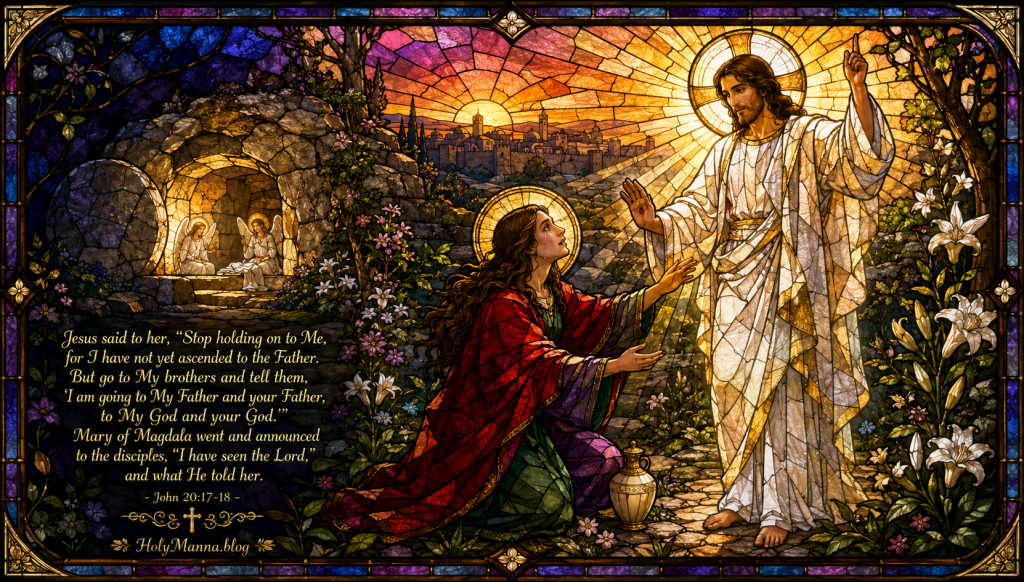
The Empty Tomb. 1 On the first day of the week, Mary of Magdala came to the tomb early in the morning, while it was still dark, and saw the stone removed from the tomb. 2 So she ran and went to Simon Peter and to the other disciple whom Jesus loved, and told them, “They have taken the Lord from the tomb, and we don’t know where they put him.”
11 But Mary stayed outside the tomb weeping. And as she wept, she bent over into the tomb 12 and saw two angels in white sitting there, one at the head and one at the feet where the body of Jesus had been. 13 And they said to her, “Woman, why are you weeping?” She said to them, “They have taken my Lord, and I don’t know where they laid him.” 14 When she had said this, she turned around and saw Jesus there, but did not know it was Jesus. 15 Jesus said to her, “Woman, why are you weeping? Whom are you looking for?” She thought it was the gardener and said to him, “Sir, if you carried him away, tell me where you laid him, and I will take him.” 16 Jesus said to her, “Mary!” She turned and said to him in Hebrew, “Rabbouni,” which means Teacher. 17 Jesus said to her, “Stop holding on to me, for I have not yet ascended to the Father. But go to my brothers and tell them, ‘I am going to my Father and your Father, to my God and your God.’” 18 Mary of Magdala went and announced to the disciples, “I have seen the Lord,” and what he told her.
Detailed Exegesis
Verse 1: “On the first day of the week, Mary of Magdala came to the tomb early in the morning, while it was still dark, and saw the stone removed from the tomb.”
The first day of the week signals a new creation, echoing Genesis 1. The darkness is both literal and interior; Mary comes while hope itself is still dark. Love brought her there before sunrise, when there was nothing left to gain from Jesus except the chance to honor His body.
Verse 2: “So she ran and went to Simon Peter and to the other disciple whom Jesus loved, and told them, ‘They have taken the Lord from the tomb, and we don’t know where they put him.’”
Her first instinct is to run to Peter, the rock, an instinct the Church notices with reverence: even her grief moves through the appointed shepherds. The word “we” suggests other women were present, as the other Gospels confirm.
Verse 11: “But Mary stayed outside the tomb weeping. And as she wept, she bent over into the tomb.”
Peter and John have come and gone. Mary stays. Saint Gregory the Great built his entire homily on this verse, marveling that the one who remained was the one who saw.
Verse 12: “And saw two angels in white sitting there, one at the head and one at the feet where the body of Jesus had been.”
The angels sit where the body lay, at head and feet, an arrangement the Fathers compared to the cherubim flanking the mercy seat of the Ark in Exodus 25. The empty slab has become a throne of mercy.
Verse 13: “And they said to her, ‘Woman, why are you weeping?’ She said to them, ‘They have taken my Lord, and I don’t know where they laid him.’”
Like the bride questioning the watchmen in the Song of Songs, Mary questions the heavenly watchmen. Even angels cannot substitute for the Beloved. Notice she says “my Lord”; her faith is personal possession even in loss.
Verse 14: “When she had said this, she turned around and saw Jesus there, but did not know it was Jesus.”
The Risen Lord is present before He is recognized. Grief, tears, and expectation can hide Him in plain sight, a mercy for every believer who has failed to notice Christ standing near.
Verse 15: “Jesus said to her, ‘Woman, why are you weeping? Whom are you looking for?’ She thought it was the gardener and said to him, ‘Sir, if you carried him away, tell me where you laid him, and I will take him.’”
The first words of the Risen Christ in this Gospel are a question about seeking. Mary’s mistake is also a truth: the Fathers loved to note that the New Adam is indeed a gardener, come to restore the garden lost in Eden. Her offer to carry His body herself is love speaking beyond its strength.
Verse 16: “Jesus said to her, ‘Mary!’ She turned and said to him in Hebrew, ‘Rabbouni,’ which means Teacher.”
One word. The Good Shepherd calls His sheep by name, as John 10:3 promised, and the sheep knows His voice. All the seeking of every reading today resolves in this single spoken name.
Verse 17: “Jesus said to her, ‘Stop holding on to me, for I have not yet ascended to the Father. But go to my brothers and tell them, “I am going to my Father and your Father, to my God and your God.”‘”
The bride of the Song of Songs held her beloved and would not let go; Jesus gently teaches Mary that a deeper union is coming through His Ascension and the gift of the Spirit. He calls the disciples “my brothers” for the first time, announcing that His Father is now their Father. Clinging gives way to commissioning.
Verse 18: “Mary of Magdala went and announced to the disciples, ‘I have seen the Lord,’ and what he told her.”
She obeys immediately. Her announcement is the first Easter homily ever preached, and it is the testimony of an eyewitness: seeing, then sending, then speaking.
Teachings
Saint Gregory the Great preached, “We should reflect on Mary’s attitude and the great love she felt for Christ; for though the disciples had left the tomb, she remained. She was still seeking the one she had not found, and while she sought she wept; burning with the fire of love, she longed for him who she thought had been taken away. And so it happened that the woman who stayed behind to seek Christ was the only one to see him. For perseverance is essential to any good deed” (Homily 25 on the Gospels). Saint Thomas Aquinas, in his Commentary on the Gospel of John, gave her the title “apostolorum apostola,” the apostle of the apostles, because she announced to the apostles what they would announce to the whole world. The Church still sings of her in the Easter Sequence Victimae Paschali Laudes: “Tell us, Mary, what did you see on the way? I saw the tomb of the living Christ and the glory of his rising.” The Catechism teaches that “The Resurrection of Jesus is the crowning truth of our faith in Christ” (CCC 638), and that crowning truth reached the Church first through her voice.
Reflection
The Gospel offers a simple, demanding pattern: stay, listen for your name, then go. Staying means remaining faithful in prayer when God seems absent, not leaving the tomb just because others have. Listening means cultivating enough silence in the day to hear the Shepherd’s voice, perhaps ten minutes with the day’s Gospel each morning. Going means actually telling someone, because an encounter with Christ that stays private is incomplete. Mary was sent to her brothers; every baptized person is sent to someone. If Jesus spoke your name today the way He spoke hers, would you recognize His voice? Who in your life needs to hear you say, in your own words, that you have seen the Lord?
The Seeker Becomes the Sent
Every reading today traces the same golden thread. A bride rises in the night to search the city for him whom her soul loves. A king in the desert discovers that his real thirst was never for water. An apostle confesses that the love of Christ has seized him and made him a new creation. And a woman from Magdala, delivered from seven demons and defined ever after by gratitude, stands weeping in a garden until the Risen Lord speaks her name. The lesson of this feast is not that Mary Magdalene was extraordinary, though she was. The lesson is that her story is the offered pattern for every soul. God allows the search because the search enlarges the heart; as Saint Gregory the Great taught, holy desires grow with anticipation. God permits the darkness because it is in darkness that love proves itself. And God never ends the encounter with a private embrace; He ends it with a mission. “Go to my brothers and tell them” is spoken to everyone who has ever truly found Him. The Church raised her celebration to a feast so that the faithful would look hard at this woman and recognize the shape of their own calling: sought by mercy, found by name, sent with news too good to keep. The invitation today is wonderfully concrete. Seek Him with the bride’s persistence. Thirst for Him with David’s honesty. Let His love impel you with Paul’s abandon. Stay at the tomb with Magdalene’s stubborn devotion. And when He calls your name, and He will, answer as she did, then go find someone who needs to hear that the tomb is empty and the Lord is alive.
Engage With Us!
Saint Mary Magdalene’s story has a way of finding the hidden places in every heart, and hearing how these readings landed for others strengthens the whole community of faith. Please share your reflections in the comments below; every seeker’s voice is welcome here.
- In Song of Songs 3:1-4, the bride searches the night city and refuses to give up until she finds him whom her soul loves. What is one concrete way you can keep seeking Christ during a season when He feels absent?
- In 2 Corinthians 5:14-17, Saint Paul declares that whoever is in Christ is a new creation. What part of your old self is Christ inviting you to finally leave behind?
- In Psalm 63:2-6, 8-9, David thirsts for God in a parched and lifeless land. Where do you feel that thirst most sharply in your life right now, and what have you been using to numb it?
- In John 20:1-2, 11-18, Mary Magdalene stays at the tomb after everyone else leaves, and Jesus rewards her perseverance by speaking her name. When have you experienced Jesus calling you personally, and how did you respond?
- Taking all the readings together, the seeker who finds the Lord is always sent to others. Who is one person you can bring the joy of the Risen Christ to this week, and what is stopping you?
Living a life of faith is not reserved for the spiritually elite. It belongs to everyone willing to rise in the dark and go looking for Jesus, trusting that He is already looking back. May the prayers of Saint Mary Magdalene, the apostle of the apostles, obtain for every reader a seeking heart, and may every word and action this week be done with the love and mercy Jesus taught us.
Sacred Heart of Jesus, we trust in You!
Immaculate Heart of Mary, pray for us!
Saint Michael the Archangel, defend us in battle!
Follow us on YouTube, TikTok, Instagram and Facebook for more insights and reflections on living a faith-filled life.


Leave a Reply