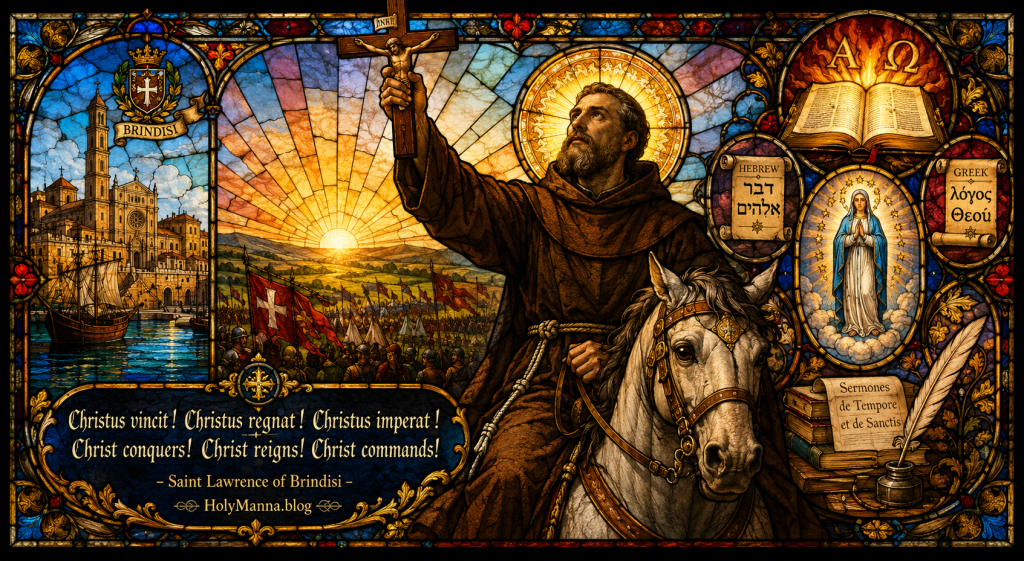
The Friar Who Faced an Army with a Crucifix and Won Europe with the Word
Some saints can be summed up in a single sentence. Saint Lawrence of Brindisi cannot. He was a preacher who filled churches in half a dozen languages, a scholar whom rabbis treated with admiration, a theologian who answered forty Protestant reformers with calm precision, a superior who governed the worldwide Capuchin order, a papal diplomat trusted by popes and princes alike, and, most famously, a frail friar crippled with rheumatism who rode at the head of a badly outnumbered Christian army holding nothing but a crucifix. The Church celebrates him each year on July 21st, one day before the anniversary of both his birth and his death, since July 22nd belongs to Saint Mary Magdalene.
In 1959, Saint John XXIII declared him a Doctor of the Church under the title Doctor Apostolicus, the Apostolic Doctor, making him the first and so far only Capuchin friar to join that select company of teachers whose doctrine the whole Church treasures. He is the patron saint of his native city of Brindisi in southern Italy. When the Church raises someone to her altars, she is not merely honoring an impressive résumé. The Catechism teaches that by canonizing certain of her faithful, the Church recognizes the power of the Spirit of holiness within her and sustains the hope of believers by proposing the saints as models and intercessors (CCC 828). Lawrence is exactly that kind of model: proof that deep learning, deep prayer, and raw courage are not three separate vocations but one integrated life in Christ.
The Boy Named Julius Caesar
He was born on July 22nd, 1559, in Brindisi, a busy port city on the Adriatic heel of the Kingdom of Naples, and his parents gave him a name fit for an emperor: Giulio Cesare, Julius Caesar Russo. His father, Guglielmo Russo, was a merchant of Venetian origin, and his mother, Elisabetta Masella, was known for her piety. Early accounts of his life pass down a delightful story from those Brindisi years. An Italian Christmas custom of the time, recalling the boy Jesus among the teachers in the Temple, allowed young boys to preach in public, and the accounts relate that Giulio Cesare, at roughly six years of age, preached in the cathedral of Brindisi with such force that his hearers were moved to amend their lives. It is a beautiful tradition, but it comes to us from later hagiography and cannot be verified.
Sorrow arrived early. His father died when the boy was about seven years old, and, as Pope Benedict XVI recounted in his General Audience of March 23rd, 2011, his mother entrusted him to the care of the Conventual Franciscan friars in Brindisi. Some years later he moved to Venice, where a priest uncle oversaw his education at the College of Saint Mark. The sources do not fully agree on the timeline of his mother’s death. Some accounts state that both parents had died before he went north, while Pope Benedict XVI describes Lawrence moving to Venice together with his mother. Honesty requires naming that discrepancy rather than smoothing it over; what all sources agree on is that he was substantially orphaned young and that the sons of Saint Francis became his family.
In Venice he encountered the Capuchins, the young and austere branch of the Franciscan family that was pouring itself out for the reform of the Church called for by the Council of Trent. Their poverty, their preaching, and their prayer captured his heart. On February 19th, 1575, at sixteen years of age, he was invested with the Capuchin habit at Verona and received a new name, Brother Lorenzo, Lawrence. He made his religious profession on March 24th, 1576. The Church has always understood this kind of total self-gift through the evangelical counsels as a life consecrated to God and dedicated to the honor of God, the building up of the Church, and the salvation of the world (CCC 916, see also CCC 915).
Sent to study at the University of Padua, the young friar revealed a mind that startled his teachers. He mastered the ancient biblical languages, Greek, Hebrew, and Syriac, alongside modern French, German, Spanish, and the Bohemian tongue of the Czech lands, all added to his native Italian and the Latin every cleric spoke. The exact list varies slightly from source to source, with some adding Aramaic, but every account agrees that his Hebrew in particular was astonishing. He was already such a gifted preacher that he was assigned the Lenten sermons in Venice while still a deacon. On December 18th, 1582, at twenty-three years of age, he was ordained a priest.
Seven Languages, One Gospel
Everything Lawrence learned, he learned in order to give away. Pope Clement VIII, recognizing his rare command of Hebrew, appointed him to preach to the Jewish community of Rome. Here the friar’s scholarship bore remarkable fruit. Pope Benedict XVI, in that same 2011 General Audience, noted that Lawrence’s knowledge not only of the Bible but of rabbinic literature ran so deep that the rabbis themselves, impressed and full of admiration, treated him with esteem and respect. A tradition passed down in the order adds that some who heard him assumed he must have been born a Jew who later converted, so fluent and natural was his Hebrew. That detail is tradition rather than documented fact. Another tradition, repeated in several lives of the saint, holds that he committed the entire Bible to memory in its original languages. It is a story the friars loved to tell, and it cannot be verified.
What can be verified is the furnace at the center of it all: his love for Sacred Scripture. In a Lenten sermon that the Church still reads in the Office of Readings on his feast, Lawrence called the word of the Lord “a light for the mind and a fire for the will”, so that man may know and love God. In the same sermon he goes on to compare the Word to bread and water for the inner man, bread sweeter than honey and water better than wine, and finally to a sword against the flesh, the world, and the devil, able to destroy every sin. This is precisely how the Church herself speaks. The Catechism teaches that the Church has always venerated the Scriptures and finds in them her nourishment and her strength (CCC 104), and she urges all the faithful to frequent reading of the sacred page, recalling the warning of Saint Jerome that “Ignorance of the Scriptures is ignorance of Christ” (CCC 133). Lawrence did not merely study that principle. He lived inside it.
His brothers kept handing him responsibility. He served as professor of theology and as novice master, forming the next generation of friars. At thirty-one he was elected minister provincial of Tuscany. In 1596 he was called to Rome as definitor general, and in 1599 he was sent north to plant the Capuchin order in Bohemia, founding the friary in Prague and, in the following years, houses in Vienna and Graz. In 1602 the order elected him its minister general, then called vicar general, the highest office among the Capuchins, and under his governance the order expanded vigorously through Germany and Austria. When the friars tried to elect him again in 1605, he refused, though he remained the trusted adviser of his successors until his death.
At the same time he was carrying the fight of the Counter-Reformation on his shoulders. Between 1607 and 1609 he composed his great apologetic work, the Lutheranismi Hypotyposis, in which he engages roughly forty Reformation writers, Luther included, and defends the disputed articles of the faith: the primacy of Peter and his successors, the divine origin of the episcopate, justification as a true inner transformation of man, the necessity of good works, the Holy Eucharist as both sacrifice and sacrament, devotion to Mary and the saints, celibacy, and purgatory. What set Lawrence apart was not venom but clarity. Benedict XVI observed that with calm, clear exposition he demonstrated the biblical and patristic foundation of every article of faith under dispute, a method that still instructs genuine ecumenical dialogue today, which must always be rooted in Scripture read within the living Tradition of the Church (CCC 113, CCC 133).
None of this activity was powered by ambition. It was powered by the altar. Contemporary accounts marvel that he hardly ever celebrated Holy Mass without being caught up in ecstasy, and his Masses were often protracted for hours as he was seized by the memorial of the Passion, death, and Resurrection of the Lord. This makes perfect sense to anyone who believes what the Church believes, that the Eucharist is the source and summit of the Christian life (CCC 1324). His devotion to the Blessed Virgin Mary ran just as deep. He authored the Mariale, a celebrated collection of Marian sermons, and he clearly affirmed the Immaculate Conception centuries before Blessed Pius IX solemnly defined in 1854 what the Church now professes, that Mary was preserved immune from all stain of original sin from the first moment of her conception (CCC 491). The Marians of the Immaculate Conception recount that the miracles attributed to Lawrence during his lifetime occurred while he was invoking Mary’s name and asking her intercession, a fitting signature for so thoroughly Marian a soul. One further story belongs here. Devotional accounts of the Hungarian campaign of 1601 relate that when the Christian soldiers were near starvation, their meager provisions were mysteriously replenished after Lawrence celebrated Mass and blessed the stores, an echo of the Lord’s multiplication of the loaves. It is a moving story, and it cannot be verified.
He also never stopped teaching ordinary believers to pray. With the ardor that marked his style, Lawrence marveled aloud that God is truly present to us whenever we speak to Him in prayer, that He hears us even when we pray only in our hearts and minds, and that He not only hears but willingly, even with the greatest pleasure, desires to grant what we ask. The Catechism teaches the same mystery from the other direction: prayer is the encounter of God’s thirst with ours, for God thirsts that we may thirst for Him (CCC 2560), and prayer is a vital and personal relationship with the living and true God (CCC 2558).
A Crucifix Against an Army
Lawrence was never martyred, but no one could call his road easy. The old Capuchin breviary records that in winning souls for Christ he spared neither labors nor vigils nor life itself, which was in danger more than once. Planting the order in Bohemia meant working in territory where Catholic friars were bitterly unwelcome. Decades of relentless travel across Europe, on foot and on horseback, in every season, wrecked his health, and by his early forties he was already tormented by severe rheumatism.
Then came 1601. The Ottoman army of Sultan Mehmed III was driving into Habsburg Hungary, and the fear across Christian Europe was existential. Emperor Rudolf II asked for Capuchin chaplains for the imperial army, and Lawrence, who had also been employed to help unite the fractious Christian princes, including Protestants, into a common defense, was among those sent. The allied Christian force that gathered near the fortress city of Székesfehérvár, known in German as Stuhlweissenburg and in older Italian accounts as Albareale, was small and poorly equipped. Traditional accounts number the Christians at about eighteen thousand facing a Turkish army of roughly eighty thousand; those figures come from later narratives and should be held loosely, but every account agrees the odds were dreadful. The field commanders counseled retreat.
Lawrence counseled attack. Though so crippled with rheumatism that mounting a horse was itself an ordeal, the friar rode to the head of the troops carrying no weapon at all, only a crucifix held high. He made himself the most conspicuous target on the field, and he came through the fighting untouched. The Christian army won. The field commander, Philippe Emmanuel, Duke of Mercœur, who had come all the way from Brittany to answer the pope’s call, testified afterward that the victory was “truly miraculous” and credited it, after God and the Blessed Virgin, to the Capuchin commissary. A report also circulates that Lawrence cried out the ancient acclamation “Christus vincit! Christus regnat! Christus imperat!”, Christ conquers, Christ reigns, Christ commands, as he led the charge. The acclamation itself is venerable and liturgical, but the report that he used it on that field cannot be verified. What Scripture says of the Word he carried in his heart fits the scene of the crucifix in his hand: “For the word of God is living and effectual, and more piercing than any two edged sword” (Hebrews 4:12).
It would badly misread Lawrence to remember him as a man of war. He rode into battle once; he rode out for peace constantly. Popes and Catholic princes repeatedly entrusted him with delicate diplomatic missions to settle controversies and encourage harmony among the European states, and the moral authority he carried made him a counselor both sought after and heeded. He served the Holy See as nuncio to Bavaria and later in Spain, and he labored in the negotiations that shaped the Catholic League in Germany. In this he anticipated what the Church teaches about peace: peace is not merely the absence of war, nor a balance of opposing powers, but the tranquility of order, the work of justice, and the effect of charity (CCC 2304), and earthly peace flows from the peace of Christ, who has reconciled us to God in His own flesh (CCC 2305).
His final hardship was obedience itself. Worn out, he retired in 1618 to a friary hoping at last for quiet and prayer. In 1619 the leading citizens of Naples begged him to undertake one more mission: to travel to King Philip III of Spain and plead the cause of the Neapolitan people, who were suffering under the injustices of their viceroy, the Duke of Osuna. The king was in Lisbon, which meant a brutal journey across the length of Spain in the summer heat for a sick man of sixty. Early accounts record that before departing from Genoa he told certain companions that he would not return; that detail comes from his early biographers and is presented here as they recorded it. He reached Lisbon, won the king’s ear, and completed his mission. Then his body gave out. Saint Lawrence of Brindisi died in Lisbon on July 22nd, 1619, his sixtieth birthday to the day. It was a death that crowned a lifetime of the virtue the Church calls fortitude, the moral virtue that ensures firmness in difficulties and constancy in the pursuit of the good (CCC 1808).
The Tomb on the Pilgrim Road
Lawrence’s story did not end in Lisbon. His body was carried into Spain and buried at the convent of the Poor Clares, the Convento de la Anunciada, in Villafranca del Bierzo, a town that sits directly on the great pilgrimage road to Santiago de Compostela. His tomb remains there to this day and continues to draw pilgrims, above all his Capuchin brothers, who in recent years have organized formal pilgrimages to venerate the remains of their Apostolic Doctor. There is something quietly fitting about it: the friar who spent his whole life on the road now rests beside one of the most walked roads in Christendom, interceding for travelers he never met. This is exactly the communion the Church professes. The saints in heaven do not cease to intercede for us; they proffer the merits they acquired on earth through Christ, and their fraternal concern is of great help to our weakness (CCC 956). Devotion to them is not sentiment but a real exercise of the communion of the whole Body of Christ (CCC 957).
The Church’s formal judgment on his holiness unfolded over the following centuries. He was beatified by Pope Pius VI in 1783; most references give the date as June 1st, though at least one Capuchin source gives May 23rd, a discrepancy noted here rather than resolved. He was canonized by Pope Leo XIII on December 8th, 1881, and the date could hardly have been better chosen, for the Church raised her great defender of the Immaculate Conception to the altars on the very feast of the Immaculate Conception. The beatification and canonization processes of that era required the rigorous examination of miracles attributed to his intercession, and the Church weighed that evidence and judged it credible. Detailed narratives of those approved miracles are difficult to find in accessible English sources, and rather than invent particulars, it is more honest to say plainly that the specifics are not readily documented for the general reader.
His writings had their own resurrection. Beginning in 1928 at Padua, scholars produced the great critical edition of his Opera Omnia, his complete works, consisting mostly of sermons along with biblical commentary and theology. Britannica describes nine volumes published between 1928 and 1945, while Capuchin and Franciscan sources describe the edition continuing into the 1950s and count some fifteen large Latin volumes; the differing figures reflect different stages of the same monumental project, and the discrepancy is flagged here for accuracy. It was this recovered body of doctrine that moved Saint John XXIII, on March 19th, 1959, the fourth centenary year of Lawrence’s birth, to declare him a Doctor of the Church in the apostolic letter Celsitudo ex humilitate, praising him as “a great genius” and conferring the title Doctor Apostolicus. More than half a century later, Pope Benedict XVI devoted an entire General Audience to him on March 23rd, 2011, holding him up as a model for the new evangelization. In Brindisi, the city that gave him his name, he is honored as patron, and his memory remains woven into the identity of the Capuchin order across the world.
Walking with the Apostolic Doctor Today
What does a seventeenth-century polyglot friar have to say to your ordinary Tuesday? More than it might seem. Start where Lawrence started: the Word of God. He did not treat Scripture as a reference book to be consulted in emergencies but as daily bread, a light for the mind and a fire for the will. The Church asks the same of you, urging all the faithful to frequent, prayerful reading of Scripture so that a dialogue takes place between God and the reader (CCC 133, CCC 2653). Is there a Gospel open somewhere in your home, or only on a shelf? Even ten minutes a day with one chapter, read slowly and answered in prayer, is a genuinely Lawrentian habit.
Notice, too, the order of his life. Lawrence carried a workload that would break most people, and yet his contemporaries testified that prayer, above all the Holy Mass, came first, even when it cost him hours. Activity without interior life becomes activism, motion without meaning. If the busiest friar in Europe could give God the first and best portion of his day, the claim that there is no time for prayer deserves a second look. What would it cost to give God the first fifteen minutes of tomorrow morning instead of the leftovers of tomorrow night?
Then there is his courage. Lawrence did not carry a sword up that hill in Hungary; he carried a crucifix, because his confidence was not in his own strength but in Christ crucified. Most believers will never face an army, but nearly everyone faces a moment when the faith is mocked in a meeting, a group chat, or a family dinner, and silence feels safer. The Catechism is bracing here: the disciple of Christ must not only keep the faith and live on it, but also profess it, confidently bear witness to it, and spread it (CCC 1816). Where in daily life is a crucifix quietly being lowered to avoid a fight that love actually requires?
Finally, remember that the same man who charged an army spent far more of his life making peace, reconciling princes, defending the oppressed people of Naples, and dying in the attempt. Courage and gentleness are not opposites in a saint; they are the same charity facing different directions. Ask Saint Lawrence of Brindisi for both, and ask Our Lady, whom he never stopped invoking, to teach the heart that kind of wholeness (CCC 971, CCC 2304).
Engage With Us!
Saint Lawrence of Brindisi packed several lifetimes of scholarship, prayer, courage, and peacemaking into sixty years, and his story raises questions worth sitting with. Share your thoughts and reflections in the comments below; hearing how his witness lands in different lives is one of the joys of this community. Here are a few questions to get the conversation started.
- Saint Lawrence learned seven or more languages so that he could bring the Gospel to more people. What is one concrete skill you could develop, or already have, that God might be asking you to place at the service of your faith?
- He never celebrated Mass casually, sometimes remaining at the altar for hours out of sheer love. What would it look like for you to bring greater reverence and attention to your next Sunday Mass?
- Facing an army of tens of thousands, Lawrence held up a crucifix instead of a weapon. Where in your life right now do you need to trust the power of Christ crucified more than your own strength?
- He read Scripture as bread for the soul and a sword against sin. What is one practical step you can take this week to make the Word of God a daily habit rather than an occasional visit?
- Lawrence spent his final strength pleading the cause of the oppressed people of Naples. Who around you is carrying a burden you could help lift this week, even at real cost to yourself?
However these questions land, take heart from the Apostolic Doctor: holiness is not reserved for the naturally brave or the naturally brilliant, because grace built all of it in him and grace is offered to every baptized soul (CCC 2003). Live this day with faith, do the next right thing with courage, and do everything, from the smallest chore to the hardest conversation, with the love and mercy that Jesus taught us.
Saint Lawrence of Brindisi, pray for us!
Follow us on YouTube, TikTok, Instagram and Facebook for more insights and reflections on living a faith-filled life.


Leave a Reply