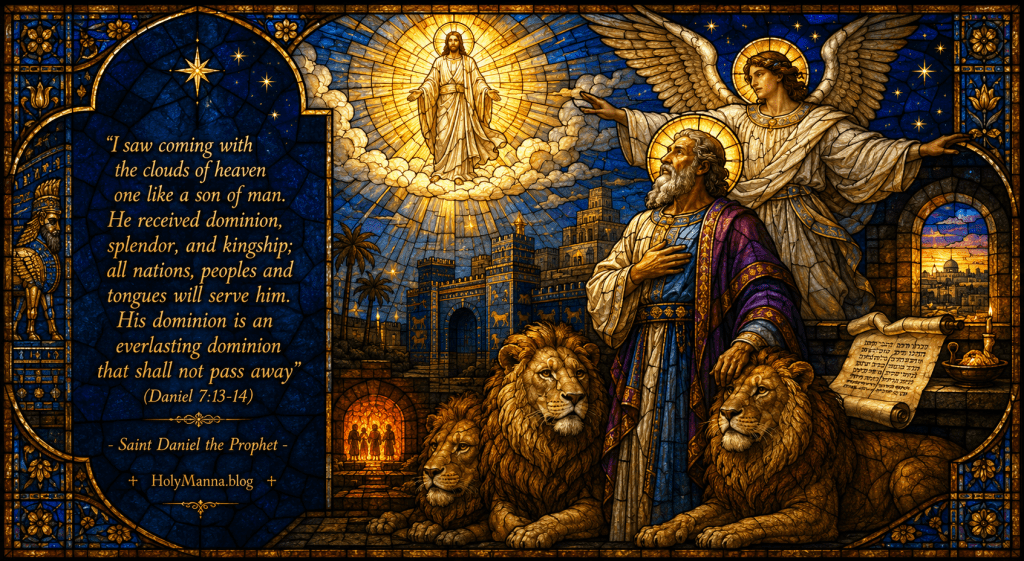
The Man Who Kept His Windows Open Toward Jerusalem
Every July 21st, the Roman Martyrology pauses over one of the most beloved figures in all of Scripture with a single, quiet line: “At Babylon, the holy prophet Daniel.” There is no long entry, no list of titles, no catalogue of wonders. There does not need to be. For nearly three thousand years, believers have known exactly who Daniel is: the young exile who would not defile himself at a pagan king’s table, the interpreter of dreams who stood before four successive rulers of two empires, the old man thrown to the lions who walked out untouched, and the seer who glimpsed “one like a son of man coming, on the clouds of heaven” (Daniel 7:13) five and a half centuries before Jesus of Nazareth claimed that vision as his own.
It sometimes surprises Catholics to learn that the Church venerates Old Testament figures as saints at all. Yet the Catechism teaches it plainly: “The patriarchs, prophets, and certain other Old Testament figures have been and always will be honored as saints in all the Church’s liturgical traditions” (CCC 61). Daniel belongs to that ancient company. He is counted among the four Major Prophets alongside Isaiah, Jeremiah, and Ezekiel, and the book that bears his name stands within the canon of Sacred Scripture that the Church has received and guarded (CCC 120). In the Eastern churches he is commemorated on December 17th together with the three young men of the fiery furnace, while the Roman tradition remembers him on this summer day, one day after the prophet Elijah.
Daniel’s name in Hebrew means “God is my judge,” and his entire life reads like a commentary on that name. He lived his whole adult existence under judges who were not God, and again and again he quietly appealed to a higher court. That is why his story still lands with such force on anyone who has ever felt like an exile in his own workplace, his own culture, or even his own family. Daniel is the saint of fidelity far from home.
A Noble Son Carried Into Babylon
Daniel’s story begins with catastrophe. Around the year 605 BC, King Nebuchadnezzar II of Babylon moved against the kingdom of Judah and carried off the first wave of captives from Jerusalem, years before the city and its Temple would finally be destroyed in 587 BC. Among those first deportees was a young man of noble and possibly royal blood. The Book of Daniel tells us the king ordered his chief chamberlain to bring in “certain Israelites of royal blood and of the nobility, young men without any defect, handsome, proficient in wisdom, well informed, and insightful” (Daniel 1:3-4). Daniel was one of them, together with his three friends Hananiah, Mishael, and Azariah.
Babylon did what empires always do with promising young captives. It tried to remake them. The four youths were enrolled in a three year program of Chaldean language and literature, fed from the royal table, and given new names to replace the Hebrew ones that carried the name of God. Daniel became Belteshazzar; his friends became Shadrach, Meshach, and Abednego.
The first recorded act of Daniel’s life is a refusal. “But Daniel was resolved not to defile himself with the king’s food or wine” (Daniel 1:8). He asked instead for vegetables and water, a diet that would keep him free of food offered in violation of the Law of Moses. It was a small thing on the surface, a matter of menu. Underneath, it was everything. Daniel had decided, at the very start of his exile, that Babylon could have his labor, his intelligence, and his loyalty in all lawful matters, but it could not have his conscience. God honored that resolve. At the end of their training, the text says, the king found Daniel and his companions “ten times better than all the magicians and enchanters in his kingdom” (Daniel 1:20).
A word of honesty is owed here. The traditional view holds that Daniel himself composed the book in the sixth century BC, while many modern scholars, including faithful Catholic ones, argue that it reached its final form in the second century BC, drawing on older traditions about the historical Daniel. The Church has never bound Catholics to one dating theory. What she teaches without hesitation is that the book is inspired Scripture and that its hero stands within her calendar of saints. Readers can hold the historical questions with open hands while receiving the sacred text with full faith.
A further tradition, reported by the Jewish historian Josephus and in some rabbinic sources, holds that Daniel and his companions were made eunuchs in the Babylonian court, which would fulfill the warning God gave through Isaiah that some of the sons of the royal house would serve in the palace of the king of Babylon (Isaiah 39:7). This is a tradition rather than an established fact, and Scripture itself does not state it; it cannot be verified.
Dreams, Kings, and the God Who Reveals Mysteries
What Daniel is most known for, beyond the lions, is his supernatural gift of interpreting dreams and visions, a gift the sacred author is careful to attribute entirely to God. When Nebuchadnezzar dreamed of a colossal statue with a head of gold and feet of iron mixed with clay, and then demanded that his sages tell him both the dream and its meaning on pain of death, Daniel and his friends turned to prayer. The mystery was revealed to Daniel in a night vision, and his first response was not a report to the palace but a hymn of praise: “Blessed be the name of God forever and ever, for wisdom and power are his. He causes the changes of the times and seasons, establishes kings and deposes them” (Daniel 2:20-21). Standing before the most powerful man on earth, Daniel refused to take credit: “But there is a God in heaven who reveals mysteries” (Daniel 2:28). The dream, he explained, foretold a succession of kingdoms that would all crumble before a kingdom set up by God himself, a kingdom that shall never be destroyed. The Church has always read that stone hewn from the mountain without human hands as a figure of the kingdom of Christ.
Daniel’s gift appears again when Nebuchadnezzar dreams of a great tree cut down to a stump, a warning of the madness that would humble the proud king until he acknowledged that the Most High rules over human kingship (Daniel 4). It appears most dramatically on the night Babylon fell, when King Belshazzar profaned the sacred vessels stolen from the Jerusalem Temple at a drunken feast, and a disembodied hand wrote on the plaster of the wall the words “Mene, Tekel, and Peres” (Daniel 5:25). The terrified king’s sages could not read it. The aged Daniel could, and he did not soften the message: the king had been weighed on the scales and found wanting, and his kingdom would be divided. That very night, Scripture records, Belshazzar was slain.
The Catholic canon preserves treasures in this book that many of our Protestant brothers and sisters have never read, and the Church affirms them as inspired Scripture (CCC 120). In the deuterocanonical thirteenth chapter, a beautiful and virtuous woman named Susanna is falsely accused of adultery by two corrupt elders whose real crime was their own lust. As she is led to death, God stirs up the spirit of the young Daniel, who cross examines the two accusers separately, exposes the contradictions in their testimony, and saves an innocent life. It is one of the most striking biblical portraits of the evil that the Catechism condemns when it teaches that false witness and perjury gravely violate the truth and contribute to the condemnation of the innocent (CCC 2476). In the fourteenth chapter, Daniel exposes the fraud of the idol Bel by scattering ashes on the temple floor to reveal the footprints of the priests who secretly ate the offerings, and he destroys a serpent the Babylonians worshiped, proving that only the living God deserves adoration.
And then there is the furnace. When Nebuchadnezzar erected a golden statue and commanded all peoples to worship it, Daniel’s three companions refused and were thrown into a furnace heated seven times beyond its normal blaze. They walked in its heart unbound and unburned, joined by a fourth figure the astonished king described as looking like a son of God, and from the flames they sang the great canticle the Church still sings at Sunday Lauds and hears at the Easter Vigil: “Bless the Lord, all you works of the Lord; praise and exalt him above all forever” (Daniel 3:57). Every Catholic who has prayed the Liturgy of the Hours has stood, without perhaps realizing it, inside Nebuchadnezzar’s furnace with those three young men.
Daniel’s own visions in the second half of the book reach even higher. He is one of only two figures in all the Old Testament to whom the archangel Gabriel is sent by name (Daniel 8:16; Daniel 9:21), and his book is the only one in the Old Testament to name the great prince Michael, the protector of God’s people (Daniel 12:1). Catholic teaching on the angels, those servants and messengers whose whole being praises God and who mysteriously assist the Church, rests in part on these very pages (CCC 328-336). Above all stands the night vision of chapter seven: “I saw coming with the clouds of heaven one like a son of man. He received dominion, splendor, and kingship; all nations, peoples and tongues will serve him. His dominion is an everlasting dominion that shall not pass away” (Daniel 7:13-14). When Jesus stood on trial before the high priest and applied those words to himself, he was quoting Daniel. The Catechism draws the line explicitly, teaching that Christ’s being seated at the Father’s right hand “signifies the inauguration of the Messiah’s kingdom, the fulfillment of the prophet Daniel’s vision concerning the Son of man” (CCC 664). Saint Jerome, who wrote a monumental commentary on this book, put it memorably in his prologue, in the common English rendering: “None of the prophets has so clearly spoken concerning Christ as has this prophet Daniel.” Jesus himself set the seal on Daniel’s prophetic office when he spoke of “the desolating abomination spoken of through Daniel the prophet” (Matthew 24:15).
Why should you remember this man and emulate him? Because Daniel proves that holiness does not require ideal conditions. He never saw Jerusalem again after his teenage years. He never worshiped in the Temple as an adult. He spent roughly seven decades serving pagan governments, surrounded by idolatry, astrology, and court intrigue, and he emerged not merely uncorrupted but radiant. He shows every believer who feels outnumbered that fidelity is possible anywhere, because God is present everywhere.
Faithful in the Lions’ Den
Daniel was never martyred, and this post will not pretend otherwise. But his long life was a slow martyrdom of pressure, envy, and peril, endured with the moral virtue the Catechism calls fortitude, which “ensures firmness in difficulties and constancy in the pursuit of the good” and which “enables one to conquer fear, even fear of death” (CCC 1808).
The most famous trial came in his old age, under Darius the Mede, after the fall of Babylon to the Medes and Persians. Daniel had risen so high in the new administration that the king planned to set him over the whole kingdom, and the other officials, unable to find any corruption in him, engineered his destruction through the one thing they knew he would never abandon: his prayer. They flattered the king into signing an irrevocable decree that for thirty days no petition could be addressed to any god or man except the king himself, on pain of the lions’ den. Daniel’s response is one of the most quietly heroic sentences in Scripture. “Even after Daniel heard that this law had been signed, he continued his custom of going home to kneel in prayer and give thanks to his God in the upper chamber three times a day, with the windows open toward Jerusalem” (Daniel 6:11). He did not stage a protest, and he did not hide. He simply kept praying, visibly, as he always had.
The conspirators pounced, and the anguished king, trapped by his own decree, had Daniel cast into the den, saying to him, “May your God, whom you serve so constantly, save you” (Daniel 6:17). After a sleepless night, Darius rushed to the den at dawn and cried out to Daniel, and the old prophet’s voice rose from among the beasts: “My God sent his angel and closed the lions’ mouths so that they have not hurt me. For I have been found innocent before him” (Daniel 6:23). Daniel was drawn up without a wound, his accusers suffered the fate they had prepared for him, and Darius decreed that throughout his royal domain all should reverence the God of Daniel, “for he is the living God, enduring forever” (Daniel 6:27).
The deuterocanonical fourteenth chapter records a second lions’ den, this one lasting six days, after Daniel destroyed the serpent idol and an enraged mob forced the king’s hand. There God worked a wonder of tender providence: the prophet Habakkuk, far away in Judea, was carried by an angel to Babylon holding a pot of stew, so that Daniel would not go hungry among the lions (Daniel 14:33-39). Daniel’s prayer on that occasion is the whole man in one line: “You have remembered me, O God; you have not forsaken those who love you” (Daniel 14:38).
Beyond these dramatic deliverances, Daniel’s hardships were the grinding kind that most believers know better: decades of exile with no homecoming, the constant envy of colleagues, service under rulers whose values he could not share, and the ache of watching his nation suffer from afar. His answer to all of it was penance and intercession. The ninth chapter shows him fasting in sackcloth and ashes, confessing the sins of his people as if they were his own: “We have sinned, been wicked and done evil; we have rebelled and departed from your commandments” (Daniel 9:5). The Catechism teaches that interior penance finds expression above all in fasting, prayer, and almsgiving (CCC 1434), and Daniel practiced all three so faithfully that the angel Gabriel greeted him as a man specially loved by God (Daniel 9:23).
Scripture last mentions Daniel alive in the third year of King Cyrus (Daniel 10:1), which means he served God in exile for some seventy years. The dominant tradition holds that he died of natural causes in great old age, in Babylon or in Susa. A divergent rabbinic tradition claims he was put to death under a later Persian king, but this stands outside the Catholic tradition entirely and cannot be verified. The book closes with a personal promise from heaven that reads like his true death notice: “But as for you, go your way to the end; you shall rest and arise for your reward at the end of days” (Daniel 12:13).
A Tomb Contested by Nations and a Voice in Every Liturgy
Because Daniel died far from Jerusalem in a distant age, no verified relics and no formally documented posthumous miracles have come down through Catholic channels, and honesty requires saying so plainly. What has come down instead is something remarkable in its own right: a tangle of tomb traditions stretching across the Middle East, and a liturgical and artistic legacy that few saints of any era can match.
The Roman Martyrology’s phrase, “At Babylon,” reflects the oldest assumption about his burial. An ancient tradition preserved in the early Christian work known as the Lives of the Prophets holds that Daniel died in Babylon and was buried with honor in the royal burial place; this account is ancient but cannot be verified. The most famous tradition, however, points to Susa, the old Persian royal city in modern day Shush, Iran. The Jewish traveler Benjamin of Tudela, journeying through the region around the year 1165, reported being shown the tomb of Daniel there, and the shrine at Shush is venerated to this day by Muslims, Jews, and Christians alike, a rare point of shared reverence in a wounded region. Benjamin of Tudela also relates a striking story: the people on the two banks of the river at Susa quarreled over which side should possess the prophet’s coffin, since blessing seemed to follow it, until it was agreed to suspend the coffin from the bridge in the middle of the river, honored by both sides. It is a beautiful medieval account, but it comes from a single traveler’s report and cannot be verified. Competing claims to Daniel’s burial exist as well at Samarkand in Uzbekistan, where tradition holds that the conqueror Timur brought relics of the prophet, and at Kirkuk in Iraq, among other sites. None of these claims can be verified, and the honest conclusion is that God has hidden the resting place of Daniel much as he hid the grave of Moses.
Where Daniel’s presence after death is beyond all dispute is in the life of the Church herself. Walk into the Roman catacombs, the underground burial galleries of the earliest Christians, and Daniel is there on the walls, standing serene between two lions, painted by believers facing their own lions in the arena. He was one of the very first biblical figures in Christian art because the early Church saw in his deliverance the promise of resurrection. Saint Hippolytus of Rome composed a commentary on Daniel around the year 204, the earliest surviving Christian commentary on any book of Scripture, written to steady believers under persecution. Saint Jerome later defended the book at length against the pagan philosopher Porphyry. Every Sunday morning, the Church puts the canticle of the furnace on the lips of all who pray Lauds, and at every Easter Vigil the fire of Babylon gives way to the fire of the paschal candle. Every time the faithful hear Jesus call himself the Son of Man in the Gospels, they hear Daniel’s vision echoing forward. And in Daniel’s twelfth chapter stands one of the clearest Old Testament proclamations of the resurrection of the dead, a truth God revealed to his people progressively (CCC 992): “Many of those who sleep in the dust of the earth shall awake; some to everlasting life, others to reproach and everlasting disgrace. But those with insight shall shine brightly like the splendor of the firmament, and those who lead the many to justice shall be like the stars forever” (Daniel 12:2-3). Few tombs on earth are certain to hold him. The liturgy holds him everywhere.
Windows Open Toward Jerusalem
Daniel’s life speaks with almost embarrassing directness to anyone trying to live the Catholic faith in the modern world. He was a believer embedded in a brilliant, powerful, seductive culture that did not share his faith and periodically punished it. He had a demanding career in the middle of the empire’s machinery, with no monastery to retreat to, and he became a saint precisely there.
Notice first that Daniel’s holiness began with a small refusal about food, made when he was young and had no power at all. He did not wait for a dramatic moment to start being faithful. The lions’ den was only possible because of the vegetables decades earlier. What is the small, unglamorous compromise being asked of you right now, the one that seems too minor to matter? The tradition of the Church would say it matters enormously, because fidelity in little things is the training ground of fortitude (CCC 1808).
Notice, second, the rhythm of his prayer. He prayed three times a day, at fixed hours, with the windows open toward Jerusalem, and he did not change the routine even when it became a capital crime. Daniel did not pray when he felt inspired; he prayed when the clock said so, and the visions came to a man already on his knees. Any Catholic can imitate this tomorrow with a fixed time for morning prayer, a pause at midday, and an examination at night, perhaps through the Liturgy of the Hours itself, which still carries Daniel’s own canticle. If praying openly cost you your reputation, your promotion, or your safety, would your neighbors already know where to find you at prayer time?
Notice, third, that Daniel served his pagan employers with excellence and integrity for seventy years. His enemies audited his entire career and “could find no grounds for accusation or any corruption” (Daniel 6:5). He proves that a believer does not have to choose between professional excellence and spiritual seriousness; the two fed each other. Doing ordinary work extraordinarily well, refusing every small dishonesty, and being known as trustworthy is itself a form of witness. Would an honest audit of your work life find the same incorruptibility, and if not, where would it snag?
Notice, finally, that Daniel confessed the sins of his people as his own and interceded for a city that had enslaved him, seeking its welfare while never bowing to its gods. In an age of contempt and outrage, Daniel models something harder and holier: love for a society one cannot fully approve, expressed through prayer, honesty, and hope in God’s kingdom rather than in any earthly regime, since every golden head and iron leg eventually falls before the stone cut without human hands. Do you pray for the country and culture you complain about?
Engage With Us!
The story of the prophet Daniel has strengthened exiles, prisoners, students, professionals, and martyrs for well over two millennia, and now it belongs to you. Share your thoughts and reflections in the comments below; this community grows when readers bring their own lions, their own furnaces, and their own open windows into the conversation. To help you begin, here are some questions for prayerful reflection.
- Daniel’s sanctity began with a quiet refusal at the king’s table. What small daily compromise is quietly asked of you, and what would it look like to refuse it this week?
- Daniel prayed at three fixed times every day, even under threat of death. What fixed times of prayer could you commit to, starting tomorrow, and what usually breaks your consistency?
- Daniel’s enemies audited his whole career and found no corruption. Where in your work, studies, or home life is God inviting you to greater integrity?
- The three young men praised God from inside the furnace, before their deliverance. Can you thank God from inside a trial you are still walking through, and what would that prayer sound like?
- Daniel interceded for the very empire that had exiled him. Who, or what institution, do you find hardest to pray for, and will you bring them to God today?
May the God of Daniel, the living God who endures forever, who shuts the mouths of lions and walks with his children through the fire, give you the courage to keep your own windows open toward heaven. Live this day with unshakable fidelity in the small things and the great ones alike, and do everything with the love and mercy that Jesus taught us.


Leave a Reply