Tuesday of the Sixteenth Week in Ordinary Time – Lectionary: 396
When Forgiveness Becomes a Front Door
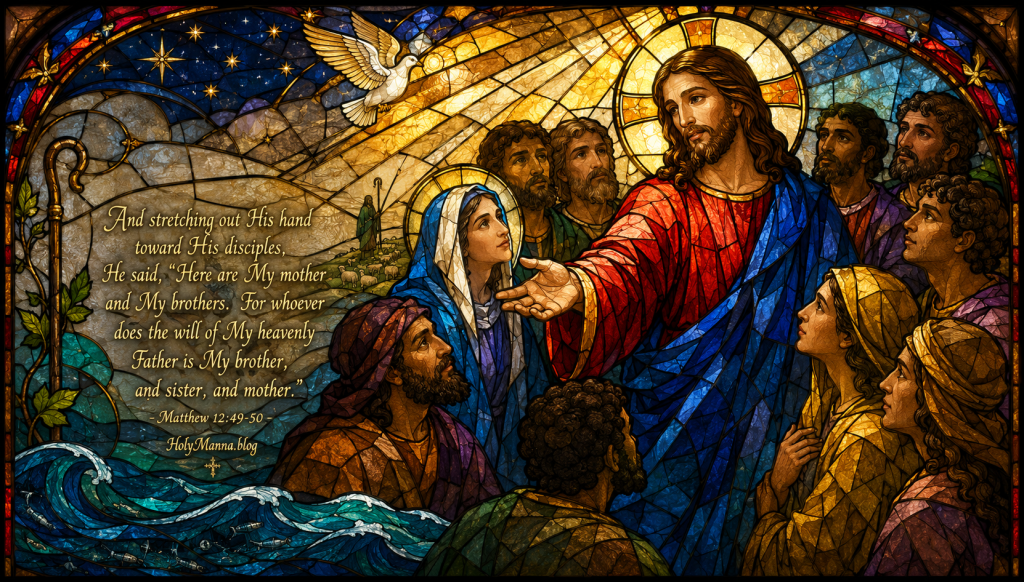
Everyone knows what it feels like to be tolerated, and everyone knows how different it feels to be wanted. Tolerated means someone puts up with you. Wanted means someone pulls out a chair, hands you a plate, and tells you that you belong. Today’s readings insist that God’s mercy is the second kind. The prophet Micah, writing in the shadow of the Assyrian invasions of the eighth century before Christ, ends his book not with doom but with a hymn asking a question that contains its own answer: “Who is a God like you, who removes guilt and pardons sin?” The nations around Israel had gods of storm and war and harvest, but no one had ever heard of a god who delights in mercy, who treads sin underfoot and hurls it into the sea. Psalm 85, likely composed after the exiles returned from Babylon, takes that hymn and turns it into a plea, the prayer of people who have been forgiven before and need forgiving again. Then Jesus, in the Gospel of Matthew, reveals where all that mercy was leading. Standing before a crowd, He stretches out His hand toward His disciples and calls them His brother, His sister, His mother. Mercy was never meant to stop at the pardon. Pardon is the front door, and behind the door is a family. The central theme uniting these readings is that God forgives in order to adopt, and that doing the will of the Father is how a forgiven sinner becomes His kin.
First Reading — Micah 7:14-15, 18-20
The Prophet Whose Name Was a Question
Micah of Moresheth was a small-town prophet from the foothills of Judah, preaching in the same turbulent decades as Isaiah, when the Assyrian war machine swallowed the Northern Kingdom in 722 B.C. and menaced Jerusalem itself. His book thunders against corrupt judges, greedy landlords, and priests for hire, yet it refuses to end in thunder. The final chapter closes with a prayer of the community, and today’s verses are its crescendo. Here is the detail that makes this passage sing: the prophet’s own name, Micah, is a shortened form of the Hebrew Mikayahu, which means “Who is like the LORD.” When verse 18 asks “Who is a God like you?”, the prophet’s very identity becomes the question, and his whole life becomes the answer. This reading fits the day’s theme perfectly, because it defines mercy not as God’s reluctant concession but as His delight, and it roots that mercy in a family promise sworn to Abraham and Jacob.
Micah 7:14-15, 18-20 – New American Bible (Revised Edition)
14 Shepherd your people with your staff,
the flock of your heritage,
That lives apart in a woodland,
in the midst of an orchard.
Let them feed in Bashan and Gilead,
as in the days of old;
15 As in the days when you came from the land of Egypt,
show us wonderful signs.18 Who is a God like you, who removes guilt
and pardons sin for the remnant of his inheritance;
Who does not persist in anger forever,
but instead delights in mercy,
19 And will again have compassion on us,
treading underfoot our iniquities?
You will cast into the depths of the sea all our sins;
20 You will show faithfulness to Jacob,
and loyalty to Abraham,
As you have sworn to our ancestors
from days of old.
Detailed Exegesis
Verse 14: “Shepherd your people with your staff, the flock of your heritage, that lives apart in a woodland, in the midst of an orchard. Let them feed in Bashan and Gilead, as in the days of old.” The prayer opens by asking God to be what Israel’s kings had failed to be, a shepherd. The flock is called God’s “heritage”, His personal inheritance, which is covenant language of belonging. Bashan and Gilead were the lush grazing lands east of the Jordan, lost to Assyria in Micah’s lifetime, so the prayer asks for restoration to abundance. The image points forward to Jesus, who calls Himself the Good Shepherd in The Gospel of John, and the Catechism teaches at CCC 754 that the Church itself is the flock of which God foretold He would be the shepherd.
Verse 15: “As in the days when you came from the land of Egypt, show us wonderful signs.” The community asks God to act again as He acted in the Exodus. Biblical hope always works this way: it remembers what God has done in order to trust what God will do. The Exodus is the Old Testament’s master memory of salvation, and the Catechism notes at CCC 1363 that in the liturgy this remembering makes past events present, which is exactly what happens at every Mass.
Verse 18: “Who is a God like you, who removes guilt and pardons sin for the remnant of his inheritance; Who does not persist in anger forever, but instead delights in mercy?” This is one of the highest peaks of the Old Testament. Other verses say God forgives; this verse says God enjoys forgiving. The Hebrew word behind “mercy” is hesed, the loyal, covenant-keeping love God proclaimed about Himself to Moses on Sinai in Exodus 34. The “remnant” are the survivors of judgment, the people who have nothing left to offer but their need, and precisely they are called God’s inheritance.
Verse 19: “And will again have compassion on us, treading underfoot our iniquities? You will cast into the depths of the sea all our sins.” The verbs are physical and violent, but the violence is aimed at sin, not at the sinner. God tramples iniquity like an enemy soldier and drowns sin the way Pharaoh’s chariots drowned in the Red Sea. Forgiven sin is not filed away for later reference; it is sunk where no one can retrieve it.
Verse 20: “You will show faithfulness to Jacob, and loyalty to Abraham, as you have sworn to our ancestors from days of old.” Mercy is not a mood; it is an oath. God forgives because He has bound Himself to a family by promise. Mary will echo this very verse in her Magnificat in The Gospel of Luke, praising the God who remembered His mercy “according to his promise to our fathers, to Abraham and to his descendants forever.”
Teachings
The Catechism places God’s mercy at the very center of the Gospel. CCC 1846 teaches plainly: “The Gospel is the revelation in Jesus Christ of God’s mercy to sinners.” Commenting on God’s self-revelation after the golden calf, the sin that should have ended the covenant, CCC 211 explains that the divine name “expresses God’s faithfulness: despite the faithlessness of men’s sin and the punishment it deserves, he keeps ‘steadfast love for thousands’.” Micah’s image of sins hurled into the sea finds its sacramental fulfillment in Baptism and Confession. Quoting the Roman Catechism, the Church teaches at CCC 978: “When we made our first profession of faith while receiving the holy Baptism that cleansed us, the forgiveness we received then was so full and complete that there remained in us absolutely nothing left to efface, neither original sin nor offenses committed by our own will.” Pope Francis gave this passage a modern voice in Evangelii Gaudium 3, writing: “God never tires of forgiving us; we are the ones who tire of seeking his mercy.” One historical note deserves honest labeling: verse 19 later inspired the Jewish custom of Tashlich, in which the faithful symbolically cast their sins into flowing water at the New Year. That practice is a post-biblical tradition rather than a command of Scripture, but it shows how deeply this verse shaped the imagination of God’s people.
Reflection
Most people believe God forgives; far fewer believe He delights in it. That gap explains why so many Catholics avoid the confessional for years, imagining an exasperated God rolling His eyes at the same old sins. Micah demolishes that picture. Concrete steps follow naturally. First, get to Confession soon, and walk in remembering that the priest sits there as a minister of a God who enjoys this. Second, practice the discipline of leaving forgiven sins in the depths where God threw them, refusing to fish them back up through morbid replaying of the past. Third, extend the same mercy outward, because a person who delights in being forgiven but resents forgiving has not yet understood the gift. When guilt over an old, confessed sin resurfaces, does it get treated as God’s voice or recognized as an accusation God has already drowned? Who in daily life is still waiting for a mercy that has been withheld from them?
Responsorial Psalm — Psalm 85:2-8
The Prayer of the Already Forgiven
Psalm 85 is widely understood to come from the generation that returned from exile in Babylon. They had received a staggering mercy; the captivity was over, the road home had opened, and yet home was hard. The walls were rubble, the harvests thin, the neighbors hostile. So the community prays a psalm with a bold structure: it reminds God of the forgiveness He has already given in order to ask for the restoration still needed. This is the prayer of people living between mercies, which is to say, the prayer of every Christian. Within the day’s theme, the psalm supplies the response that Micah’s hymn demands. If God truly delights in mercy, then His people can dare to ask for it again and again, and today’s refrain does exactly that: “Show us, Lord, your mercy.”
Psalm 85:2-8 – New American Bible (Revised Edition)
2 You once favored, Lord, your land,
restored the captives of Jacob.
3 You forgave the guilt of your people,
pardoned all their sins.
Selah
4 You withdrew all your wrath,
turned back from your burning anger5 Restore us, God of our salvation;
let go of your displeasure with us.
6 Will you be angry with us forever,
prolong your anger for all generations?
7 Certainly you will again restore our life,
that your people may rejoice in you.
8 Show us, Lord, your mercy;
grant us your salvation.
Detailed Exegesis
Verse 2: “You once favored, Lord, your land, restored the captives of Jacob.” The prayer begins with memory. Before asking for anything, the psalmist recites what God has already done. The return from Babylon was a second Exodus, and naming it aloud builds the confidence to keep praying.
Verse 3: “You forgave the guilt of your people, pardoned all their sins. Selah.” The exile had been Israel’s own doing, the harvest of generations of infidelity, and yet God pardoned it completely. The word Selah is a liturgical or musical notation whose precise meaning is uncertain, but it likely marks a pause, and the pause fits: a forgiveness that total deserves a moment of silence. Honesty requires saying that scholars simply do not know exactly what Selah directed the ancient singers to do.
Verse 4: “You withdrew all your wrath, turned back from your burning anger.” Divine anger in Scripture is not a divine mood swing; it is the settled opposition of holiness to evil. The verse celebrates that God’s opposition to His people’s sin gave way to His deeper commitment to His people themselves.
Verse 5: “Restore us, God of our salvation; let go of your displeasure with us.” Here the psalm pivots from memory to petition. The title “God of our salvation” is itself an argument: saving is who God is, so let Him be Himself toward His people once more.
Verse 6: “Will you be angry with us forever, prolong your anger for all generations?” The question sounds bold, but it is really faith in disguise, because it leans directly on what Micah proclaimed, that God “does not persist in anger forever.” The psalmist holds God to His own self-description.
Verse 7: “Certainly you will again restore our life, that your people may rejoice in you.” Notice the goal of restoration. The people do not merely want relief; they want joy, and not joy in circumstances but joy “in you.” Mercy aims at communion, not just comfort.
Verse 8: “Show us, Lord, your mercy; grant us your salvation.” The psalm’s petition becomes the Church’s refrain today. In the fullness of time, this prayer was answered in a way the psalmist could not have imagined, for the name Jesus means “God saves,” and in Him mercy was not merely shown but made flesh.
Teachings
The Church reads this psalm as a school of repentance. The Catechism teaches at CCC 1431: “Interior repentance is a radical reorientation of our whole life, a return, a conversion to God with all our heart, an end of sin, a turning away from evil, with repugnance toward the evil actions we have committed.” Psalm 85 models exactly that reorientation, turning the whole community back toward the God of its salvation. The psalm also teaches the Church how to ask for pardon repeatedly without shame. Explaining the petition of the Our Father for forgiveness, CCC 2839 says: “With bold confidence, we began praying to our Father. In begging him that his name be hallowed, we were in fact asking him that we ourselves might be always made more holy. But though we are clothed with the baptismal garment, we do not cease to sin, to turn away from God. Now, in this new petition, we return to him like the prodigal son and, like the tax collector, recognize that we are sinners before him.” The Church prays Psalm 85 with special intensity in Advent, and St. Augustine preached on it in his Expositions on the Psalms, hearing in its plea for restoration the world’s long cry for the coming of Christ. The psalm’s genius is its refusal to choose between gratitude and need; it thanks God for yesterday’s mercy in the same breath that begs for today’s.
Reflection
There is a quiet lie that whispers to believers after they fail again: the last forgiveness was the final one, and asking again would be presumptuous. Psalm 85 was written to kill that lie. The returned exiles had already received the mercy of a lifetime, and still they prayed, show us, Lord, your mercy. Living this psalm can be practical. Begin prayer the way the psalm begins, by naming out loud two or three mercies God has already given, because remembered mercy is the fuel of confident petition. Make verse 8 a breath prayer for the week, repeating slowly, show us, Lord, your mercy, in traffic, in line, in tension at work. And when a fall comes, return immediately rather than serving a self-imposed sentence of distance from God. What past mercy, if remembered daily, would change the tone of every prayer that follows it? Is there a part of life where relief is being sought from God while the joy of God Himself is quietly left unrequested?
Holy Gospel — Matthew 12:46-50
The Day Jesus Redefined Family
The scene lands in the middle of the stormiest chapter of Matthew’s Gospel. In Matthew 12, the Pharisees have accused Jesus of working by the power of Beelzebul, demanded a sign, and begun plotting against Him. Opposition is hardening, and into that tension comes word that His mother and His brothers are outside, asking to speak with Him. In the ancient Mediterranean world, blood kinship was the deepest loyalty a person had; family defined identity, honor, and obligation. What Jesus does next would have stunned everyone within earshot. He does not walk out. He stretches His hand toward His disciples, a ragtag circle of fishermen, former tax collectors, and hangers-on, and declares them His family. This reading crowns the day’s theme, because it reveals the destination of all the mercy Micah sang and the psalmist begged. God pardons sin in order to make sons and daughters, brothers and sisters. Mercy builds a household.
Matthew 12:46-50 – New American Bible (Revised Edition)
46 While he was still speaking to the crowds, his mother and his brothers appeared outside, wishing to speak with him. 47 [Someone told him, “Your mother and your brothers are standing outside, asking to speak with you.”] 48 But he said in reply to the one who told him, “Who is my mother? Who are my brothers?” 49 And stretching out his hand toward his disciples, he said, “Here are my mother and my brothers. 50 For whoever does the will of my heavenly Father is my brother, and sister, and mother.”
Detailed Exegesis
Verse 46: “While he was still speaking to the crowds, his mother and his brothers appeared outside, wishing to speak with him.” Two details matter. First, they stand “outside”, a physical position Matthew will turn into a spiritual image, since nearness to Jesus is about to be redefined. Second, the “brothers” require careful reading. Neither Hebrew nor Aramaic had a distinct word for cousin, and Scripture regularly calls close kinsmen brothers, as when Abraham calls his nephew Lot his brother in The Book of Genesis. The Church has always understood these men as relatives of Jesus, not children of Mary, whose perpetual virginity is a dogma of the faith.
Verse 47: “Someone told him, ‘Your mother and your brothers are standing outside, asking to speak with you.’” The NABRE prints this verse in brackets because it is missing from several important ancient manuscripts, a textual fact worth stating plainly rather than hiding. Whether original or an early scribal addition harmonizing with Mark and Luke, it sets up the question that follows.
Verse 48: “But he said in reply to the one who told him, ‘Who is my mother? Who are my brothers?’” The question sounds shocking, almost cold, and it is meant to jolt. Jesus regularly uses startling questions to pry open a deeper truth. He is not rejecting His Mother; He is about to announce a kinship that runs deeper than blood, one that His Mother, of all people, already possesses in the highest degree.
Verse 49: “And stretching out his hand toward his disciples, he said, ‘Here are my mother and my brothers.’” The gesture is everything. In the Old Testament, God’s outstretched hand works salvation; here the Son stretches His hand toward ordinary, flawed followers and claims them as kin. The Church is born in gestures like this one.
Verse 50: “For whoever does the will of my heavenly Father is my brother, and sister, and mother.” The word “whoever” throws the door open to every nation, every background, every sinner willing to obey. Membership in the family of Jesus is not inherited, purchased, or earned by pedigree; it is entered by doing the Father’s will. And by that very standard, Mary stands first, for no creature ever did the Father’s will more completely than the woman who answered the angel, “May it be done to me according to your word.”
Teachings
The Catechism addresses the “brothers” directly. CCC 500 teaches: “Against this doctrine the objection is at times raised that the Bible mentions brothers and sisters of Jesus. The Church has always understood these passages as not referring to other children of the Virgin Mary. In fact James and Joseph, ‘brothers of Jesus,’ are the sons of another Mary, a disciple of Christ, whom St. Matthew significantly calls ‘the other Mary.’ They are close relations of Jesus, according to an Old Testament expression.” St. Jerome defended this same reading in his treatise Against Helvidius around the year 383. Far from slighting Mary, the Church hears this Gospel as her praise. The Second Vatican Council teaches in Lumen Gentium 58 that during her Son’s preaching Mary “received the words whereby in extolling a kingdom beyond the calculations and bonds of flesh and blood, He declared blessed those who heard and kept the word of God, as she was faithfully doing.” St. Augustine drew the beautiful conclusion in Sermon 72/A: “Didn’t the Virgin Mary do the will of the Father? I mean, she believed by faith, she conceived by faith… Yes, of course, holy Mary did the will of the Father. And therefore it means more for Mary to have been a disciple of Christ than to have been the mother of Christ.” St. Gregory the Great pressed the mystery further in his Homily 3 on the Gospels, teaching: “a person who is Christ’s brother and sister through his belief becomes his mother by preaching. He brings forth, as it were, the Lord Jesus, whom he introduces into the heart of the person listening.” The Catechism gathers it all at CCC 2233: “Becoming a disciple of Jesus means accepting the invitation to belong to God’s family, to live in conformity with His way of life: ‘For whoever does the will of my Father in heaven is my brother, and sister, and mother.’”
Reflection
Plenty of people carry a quiet ache about family, whether from distance, dysfunction, or loss, and plenty of others carry a quiet doubt about whether they really belong in the Church. This Gospel answers both aches at once. Belonging to Jesus is not a matter of having the right last name, the right parish pedigree, or an unbroken Catholic childhood; it is a matter of doing the Father’s will today. Concrete steps make the teaching real. Identify one known element of God’s will that has been postponed, perhaps a reconciliation, a return to Sunday Mass, an honest confession, and act on it this week, because obedience is the family resemblance. Treat fellow parishioners as actual kin, learning a name after Mass, checking on someone absent, since Jesus stretched His hand toward a community, not a crowd of strangers. And follow St. Gregory’s insight by speaking of Christ to one person this week, becoming His mother by bringing Him to birth in another heart. If Jesus stretched out His hand today and said, here is my family, would daily choices make that claim recognizable? What single act of the Father’s will, done this week, would move faith from something inherited to something lived?
The God Who Throws Sins Away and Keeps People
Step back and watch the day’s readings become one story. It begins with a question that is really a boast: “Who is a God like you?” Micah, whose own name asks who is like the LORD, sings of a God who does not grudgingly process forgiveness but delights in it, who tramples sin underfoot and hurls it into the depths of the sea, all because of a promise sworn to a family long ago. The psalmist, standing amid the rubble of a half-rebuilt Jerusalem, takes that song and turns it into a plea, teaching every generation that yesterday’s mercy is the best reason to ask for today’s: “Show us, Lord, your mercy; grant us your salvation.” Then Jesus answers the plea in a way no prophet dared imagine. He does not merely show mercy from a distance; He stretches out His hand toward His disciples and speaks the words that turn the forgiven into family: “whoever does the will of my heavenly Father is my brother, and sister, and mother.” This is the full arc of the Gospel. God throws sins away and keeps people. He drowns iniquity and adopts the sinner. And the door into that household is not bloodline or perfection but the daily, deliberate doing of the Father’s will, the very path Mary walked more perfectly than anyone. So take the invitation seriously this week. Bring the old guilt to Confession and leave it in the depths where God delights to sink it. Pray the psalmist’s refrain until it becomes reflex. Then do the one thing the Father is asking right now, and discover the joy of being not merely pardoned but wanted, not merely spared but claimed as kin by the Son of God Himself.
Engage With Us!
The comments below are open, and honest reflections are welcome there. This community grows when readers share how God’s Word landed in real life, so consider leaving a thought, a struggle, or a story of mercy for others to be encouraged by. These questions can guide prayer this week:
- Micah 7:14-15, 18-20 proclaims a God who delights in mercy and casts sins into the depths of the sea. Which forgiven sin still gets fished back out of the water, and what would it take to finally leave it where God threw it?
- Psalm 85:2-8 remembers past mercies in order to ask boldly for new ones. What mercy from the past, recalled at the start of each prayer, would give today’s petitions more confidence and more gratitude?
- Matthew 12:46-50 teaches that whoever does the will of the heavenly Father is brother, sister, and mother to Jesus. What one concrete act of the Father’s will, carried out this week, would make that family resemblance visible?
- Taken together, these readings reveal a God who forgives in order to adopt. Where is the line still being drawn between accepting God’s pardon and actually living as a member of His household?
Faith is not a museum to visit but a family to live in, and every day offers a fresh chance to do the Father’s will in small, real ways. Walk through this week with open hands and a soft heart, doing everything with the love and mercy Jesus taught, and trust that the God who delights in mercy delights in you.
Sacred Heart of Jesus, we trust in You!
Immaculate Heart of Mary, pray for us!
Saint Michael the Archangel, defend us in battle!
Follow us on YouTube, TikTok, Instagram and Facebook for more insights and reflections on living a faith-filled life.

 Holy Manna!
Leave a comment