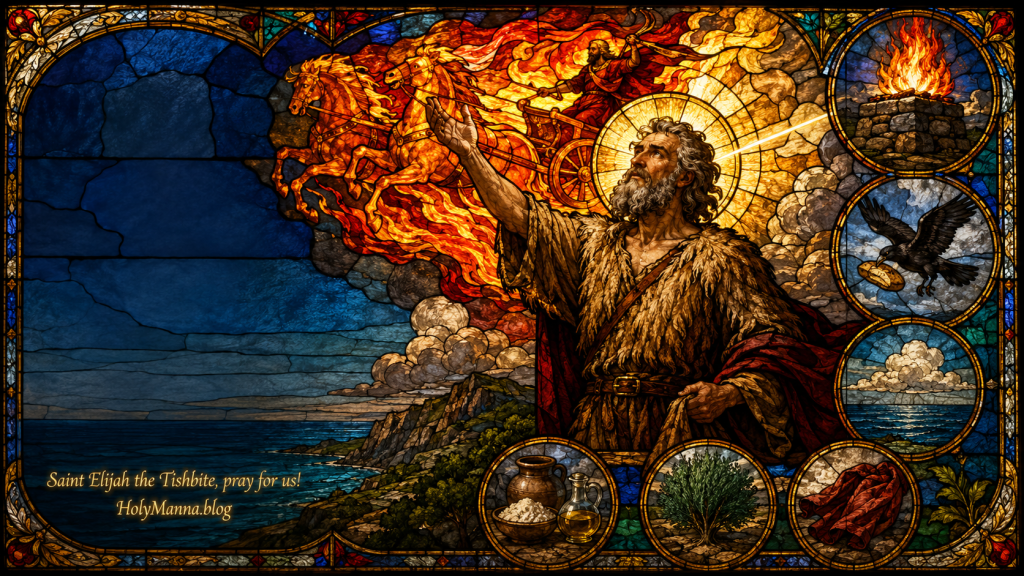
A Voice Like a Torch in a Darkened Kingdom
Every so often the Church’s calendar hands you a saint who feels less like a biography and more like a thunderclap. July 20 is one of those days. On this date the Roman Martyrology commemorates Saint Elijah the Tishbite, declaring that Elijah, a prophet of the Lord in the days of Ahab, king of Israel, vindicated the rights of the one God against an unfaithful people with such strength of soul that he prefigures not only John the Baptist but Christ himself. Read that again slowly. The Church’s official catalogue of saints says this man’s life sketched in advance the outline of the Messiah.
Some readers are surprised to learn that Old Testament figures are venerated as saints at all, but this is the constant teaching of the Church. The Catechism states that the patriarchs, prophets, and certain other Old Testament figures have been and always will be honored as saints in all the Church’s liturgical traditions (CCC 61). Elijah stands at the summit of that company; The Catechism calls him the “father” of the prophets (CCC 2582).
Elijah holds several patronages, and they read like a summary of his life. He is the father and patron of the Carmelite Order, both the Ancient Observance and the Discalced, who trace their spiritual lineage to his mountain and keep July 20 as a solemnity in his honor. He is the principal patron of Bosnia and Herzegovina, where Catholics celebrate his feast, called Ilindan, every July 20. Because he shut the heavens and opened them again by his prayer, he is invoked against drought and for rain. And because he was carried to heaven in a whirlwind with a chariot and horses of fire, he is a traditional patron of drivers and coachmen, and in the modern era of aviators and several national air forces, including the Romanian Air Force. Not bad for a man who owned nothing but a hairy mantle and a leather belt.
The Man Who Came from Nowhere
Here is one of the most striking things about Elijah, and the sacred author clearly intends you to notice it. He has no backstory. Scripture gives no account of his birth, his parents, his tribe, or his call. Other prophets receive elaborate commissioning scenes; Elijah simply appears. The First Book of Kings introduces him in a single verse, standing already before the wickedest king Israel had yet produced, and his first words are a declaration of war on the false god Baal: As the LORD the God of Israel lives, before whom I stand, there shall be neither dew nor rain these years, except by my word (1 Kings 17:1).
What little we know of his origins is packed into his name and hometown. He is called Elijah the Tishbite, from Tishbe in Gilead, the rugged highland country east of the Jordan River in what is today the nation of Jordan. The precise location of Tishbe is uncertain; a long-standing tradition places it near Tell Mar Elias in northern Jordan, where Byzantine church ruins mark the spot pilgrims venerated as his birthplace, but this remains a tradition rather than an established fact. His name, however, is not uncertain at all, and it is the key to everything. Elijah, in Hebrew Eliyyahu, means “My God is the LORD.” His very name was his message. In a kingdom where King Ahab had married the Phoenician princess Jezebel and imported the worship of Baal wholesale, where altars to the true God were torn down and prophets were hunted and killed, this man from the wild eastern hills walked into the capital carrying a name that was itself a battle standard.
Elijah lived in the ninth century before Christ, during the reign of Ahab, roughly 874 to 853 BC, and into the brief reign of Ahab’s son Ahaziah. Because his story comes to us in the inspired pages of The First Book of Kings and The Second Book of Kings, Catholics stand on far firmer ground with Elijah than with many early saints. The drama you are about to read is Scripture.
There was no conversion moment for Elijah, because there was never a time he belonged to anyone but God. His formation was the wilderness itself; Gilead bred hard, weathered, free men, and Elijah carried that wildness into the courts of kings. Centuries later, The Book of Sirach remembered him in a single unforgettable line: Then the prophet Elijah arose like a fire, and his word burned like a torch (Sirach 48:1). The Catechism picks up that image when teaching about the Holy Spirit under the sign of fire, an image of the Spirit who transforms what he touches (CCC 696).
Ravens, a Widow’s Jar, and Fire on the Mountain
Having announced the drought, Elijah vanished into the wilderness, and here begins one of the most remarkable catalogues of miracles in Scripture. God hid him by the brook Cherith, east of the Jordan, and fed him in a way that should make you smile: ravens, unclean scavenger birds, brought him bread and meat morning and evening. When the brook dried up, because the drought Elijah had prayed for spared not even the prophet, God sent him north to Zarephath in the pagan territory of Sidon, into the home of a starving Gentile widow.
The scene at Zarephath is one of the tenderest in the Old Testament. Elijah found the widow gathering sticks to cook a last meal for herself and her son before they died. He asked her, astonishingly, to feed him first, attaching a promise from the God of Israel: The jar of meal shall not be spent, and the cruse of oil shall not fail, until the day that the LORD sends rain upon the earth (1 Kings 17:14). She believed a foreign prophet, gave away her last meal, and the flour and oil did not fail. When her son later fell sick and died, Elijah stretched himself upon the child three times and cried out to God, and the child’s soul returned to him. This is the first raising of the dead recorded anywhere in Scripture, and it happened in the house of a pagan widow. Jesus himself pointed to this episode at Nazareth as proof that God’s mercy overflows the borders of Israel (Luke 4:25-26). The Catechism treasures this chapter as a school of prayer, teaching that after Elijah learned mercy at the brook Cherith, he taught the widow to believe in the word of God, and God confirmed her faith by answering his insistent prayer (CCC 2583).
Then came the third year of the drought, and the confrontation the whole story had been building toward. Elijah returned to Ahab with a challenge: gather all Israel, and the four hundred and fifty prophets of Baal, on Mount Carmel. Before the assembled nation, Elijah posed the question that still cuts to the heart of every divided soul: How long will you go limping with two different opinions? If the LORD is God, follow him; but if Baal, then follow him (1 Kings 18:21). The people answered him not a word.
So he proposed the test. Two bulls, two altars, no fire; the god who answers by fire, he is God. The prophets of Baal raved and limped around their altar from morning until noon, cutting themselves with swords and lances, while Elijah, outnumbered four hundred and fifty to one, mocked them with a prophet’s dry wit, suggesting their god was musing, or on a journey, or asleep. Nothing happened. Then Elijah repaired the broken altar of the Lord with twelve stones for the twelve tribes, laid out his sacrifice, and did something magnificently unnecessary: he had it drenched with water three times until the trench overflowed. He wanted no one to doubt. Then he prayed one short prayer, and the fire of the LORD fell, and consumed the burnt offering, and the wood, and the stones, and the dust, and licked up the water that was in the trench (1 Kings 18:38). The people fell on their faces crying out that the LORD, he is God, which is exactly what Elijah’s own name had been saying all along. The prophets of Baal were put to death at the brook Kishon, in accordance with the law of Israel against those who led the covenant people into idolatry.
And then, having called down fire, Elijah called down water. He climbed to the top of Carmel, bowed with his face between his knees, and prayed seven times until his servant reported a little cloud rising from the sea, no bigger than a man’s hand. Within the hour the rain the land had not seen in three and a half years came down in torrents. The Letter of James holds this up forever as proof of what prayer can do, insisting that Elijah was a man of like nature with ourselves, and he prayed fervently that it might not rain (James 5:17), and then prayed again, and the heavens gave rain. He was a man like us; that is the point Scripture will not let us escape. In a final burst of divine strength, he ran on foot ahead of Ahab’s chariot all the way to Jezreel through the driving rain.
Why should you remember and emulate this man? Because Elijah is what undivided looks like. Every miracle in his life flows from one source, which The Catechism identifies precisely: his prayer was pure faith in the living God, and by his intercession the people had their faith restored (CCC 2582-2583). He did not hedge, he did not limp between two opinions, and heaven answered him.
The Broom Tree, the Cave, and the Sound of Sheer Silence
Now comes the part of Elijah’s story that may console you more than all the fire and glory, because now the strongest man in Israel falls apart. Elijah was never martyred; God had other plans for his departure. But his hardships were real, crushing, and strangely modern. When Queen Jezebel heard what had happened on Carmel, she vowed to have him dead within a day. And the man who had just faced down four hundred and fifty prophets and an entire apostate nation broke. He ran for his life, south into the wilderness beyond Beersheba, collapsed under a solitary broom tree, and prayed the darkest prayer of his life: It is enough; now, O LORD, take away my life; for I am no better than my fathers (1 Kings 19:4). Then he lay down and slept, the way exhausted, despairing people do.
Notice what God did next, because it is one of the most humane scenes in all of Scripture. God did not rebuke him or lecture him. God sent an angel who touched him and said, arise and eat, and there at his head was a cake baked on hot stones and a jar of water. Elijah ate, and slept again, and the angel came a second time, touched him again, and told him to eat, else the journey will be too great for you (1 Kings 19:7). Food, water, sleep, and a gentle touch, twice. Sometimes the mercy of God looks exactly like that. In the strength of that food Elijah walked forty days and forty nights to Horeb, the mountain of God, the same Sinai where Moses had met the Lord, and lodged there in a cave.
What happened on Horeb is the summit of Elijah’s interior life and one of the founding texts of all Christian contemplative prayer. God asked him what he was doing there, and Elijah poured out his grief in words that would become the motto of the Carmelite Order: I have been very zealous for the LORD, the God of hosts; for the people of Israel have forsaken thy covenant, thrown down thy altars, and slain thy prophets with the sword; and I, even I only, am left; and they seek my life, to take it away (1 Kings 19:10). Then God told him to stand on the mountain, and the Lord passed by. A great wind tore the mountains, but the Lord was not in the wind. After the wind an earthquake, but the Lord was not in the earthquake. After the earthquake a fire, but the Lord was not in the fire. And after the fire, a still small voice (1 Kings 19:12). Some modern translations render the Hebrew as a light silent sound, or a sound of sheer silence, and the very difficulty of translating it tells you something true: the deepest presence of God is quieter than language. When Elijah heard it, he wrapped his face in his mantle and went out to stand before his God. The prophet of fire learned that God is not obliged to come in fire.
God then gently corrected Elijah’s despair with facts. He was not alone; the Lord had preserved seven thousand in Israel who had never bowed the knee to Baal, the faithful remnant Saint Paul would later hold up to the Romans (Romans 11:2-5). And God gave him work: anoint new kings, and anoint Elisha to be prophet in his place. Elijah found Elisha plowing, threw his mantle over him, and gained a spiritual son.
His hardships were not finished. When Ahab and Jezebel arranged the judicial murder of the innocent vineyard owner Naboth, Elijah confronted Ahab in the stolen vineyard with the withering question, have you killed, and also taken possession, and pronounced God’s judgment on the whole royal house (1 Kings 21). Astonishingly, Ahab humbled himself, and God softened the sentence; even Elijah’s threats were instruments of mercy. Under Ahaziah, soldiers were twice sent to arrest him, and twice fire fell from heaven at his word, until a third captain came humbly begging for his life, and Elijah went with him peacefully (2 Kings 1). Pride summons fire, and humility disarms the prophet.
The Chariot of Fire and a Mantle Left Behind
Elijah did not die. Let that sentence sit with you, because Scripture means it literally. When his time came, he and Elisha walked together from Gilgal, and Elijah struck the Jordan River with his rolled-up mantle and the waters parted so the two crossed on dry ground. Elisha asked for a double portion of his spirit, the inheritance of a firstborn son. And as they went on, still talking, behold, a chariot of fire and horses of fire separated the two of them, and Elijah went up by a whirlwind into heaven (2 Kings 2:11). Elisha took up the mantle that had fallen, and with it struck the Jordan and parted it again; the spirit of Elijah rested on Elisha. Along with Enoch, Elijah is one of only two figures Scripture describes as taken up without seeing death, which is why The First Book of Maccabees remembers him in one line: Elijah because of great zeal for the law was taken up into heaven (1 Maccabees 2:58). It also means there are no bodily relics of Elijah anywhere on earth, and there never were. His relic was his mantle, a handing on of spirit rather than of bone.
Because he never died, Elijah’s story refused to end. The very last words of the Old Testament prophets are a promise about him: Behold, I will send you Elijah the prophet before the great and terrible day of the LORD comes (Malachi 4:5). The New Testament opens with that promise ringing in the air. The angel Gabriel announces that John the Baptist will go before the Lord in the spirit and power of Elijah (Luke 1:17), and Jesus himself confirms that John was the Elijah who was to come (Matthew 11:14; CCC 718-719). And then comes the most stunning appearance of all. At the Transfiguration, Elijah appeared in glory with Moses, the Law and the Prophets in person, conversing with the transfigured Christ about the exodus he was to accomplish in Jerusalem (Luke 9:30-31; CCC 554-555). Roughly nine centuries after the whirlwind, Elijah stood on another mountain, and this time the glory did not pass by in silence; it stood before him with a human face. Even at Calvary his name hung in the air, when bystanders misheard Our Lord’s cry of Eli, Eli and wondered whether Elijah would come to save him.
One scriptural puzzle deserves honest mention. The Second Book of Chronicles records a letter from Elijah to King Jehoram of Judah (2 Chronicles 21:12-15), which by some reckonings arrives after Elijah had already been taken up. Commentators propose either that the letter was written prophetically beforehand or that the chronologies of the two kingdoms overlap; the question remains debated, and it is enough to note it plainly.
Elijah’s impact after his assumption is almost impossible to overstate. On Mount Carmel his memory never faded, which is exactly what the Roman Martyrology observes when it notes that he left no written oracles, but his memory is faithfully preserved, above all on Mount Carmel. In the late twelfth century, Latin hermits settled on Carmel’s slopes deliberately to imitate Elijah’s solitary life of prayer, and in the early 1200s they received their Rule from Saint Albert, Patriarch of Jerusalem. That community became the Carmelite Order, which regards Elijah as its father, patriarch, and model of contemplation and zeal, and which gave the Church Saint Teresa of Avila, Saint John of the Cross, Saint Thérèse of Lisieux, and Saint Edith Stein. Both Carmelite families celebrate July 20 as the solemnity of their holy father Elijah. A cherished Carmelite tradition tells of an unbroken succession of hermits, sons of the prophets, dwelling on Carmel from Elijah’s day until the medieval friars arrived; the old lessons of the Roman Breviary recounted this story with the cautious note, as the story goes. It is a beautiful tradition, but it cannot be verified as history, and it is presented here as tradition only.
The pilgrim sites tied to Elijah remain among the most beloved in the Holy Land. At Stella Maris Monastery in Haifa, the world center of the Discalced Carmelites, the church rises over a grotto traditionally venerated as a dwelling of the prophet, and its dome is painted with the fiery chariot. Farther along the ridge stands El-Muhraqa, whose Arabic name means the place of burning, the traditional site of the contest with the prophets of Baal, crowned by a Carmelite monastery and a striking statue of Elijah. At the foot of the mountain, Elijah’s Cave draws Jews, Christians, Muslims, and Druze alike. On Mount Sinai, a chapel marks the traditional cave of the still small voice, and in Jordan, Tel Mar Elias preserves Byzantine church ruins at his traditional birthplace. In Bosnia and Herzegovina, where he is the principal patron, Catholics keep Ilindan on July 20 with Masses, processions, and festivals, and across the Christian East hilltop churches of the prophet Elijah dot the landscape from Greece to Russia, with prayers to him rising in every drought. Even the Jewish people still keep a place for him: a cup stands ready for Elijah at every Passover Seder, and a chair of Elijah is set at every circumcision, silent witnesses to the expectation of his return. Miracles of healing and rescue, particularly the breaking of droughts after prayers at his shrines, have been attributed to his intercession across many centuries; these accounts belong to popular devotion, cannot be individually verified, and are noted here plainly as such.
What the Prophet of Fire Asks of You
So what does a ninth-century prophet who rode a whirlwind into heaven have to say to your ordinary Tuesday? More than you might think. The Catechism holds up Elijah and the prophets as the school in which the Church learns conversion of heart and the search for God’s face in prayer (CCC 2581-2584).
Start with the question from Carmel, because it has never stopped being asked. How long will you go limping between two different opinions? Every baptized soul knows the temptation to keep one foot on the altar of the Lord and one foot on the altar of comfort, career, approval, or appetite. Elijah’s whole life is a protest against that limp. His name meant “My God is the LORD,” and he lived so that the statement and the man were indistinguishable. If someone examined your calendar and your spending, would they discover what your God’s name is?
Then take the broom tree seriously. The same man who called down fire lay in the dirt and asked God to let him die. If you have ever been so exhausted or discouraged that prayer itself felt impossible, you are in the company of the father of the prophets. And notice God’s remedy: food, water, sleep, and a gentle touch, given twice, before any word about the journey ahead. Grace does not despise the body. Sometimes the most spiritual thing you can do today is eat and rest. When you hit your own broom tree, do you let God feed you, or do you demand of yourself a strength that even Elijah did not have?
Above all, learn Horeb. Elijah expected God in the spectacular, and God came in a sound of sheer silence. The Carmelite masters built an entire school of prayer on that verse, and you do not need a habit and a cloister to enroll. Carve out ten minutes of genuine silence each day, no phone, no podcast, no agenda, and simply stand at the mouth of your cave before God. Practice Elijah’s posture in ordinary life: defend the truth kindly but without limping; notice the widow of Zarephath in your own parish, quietly running out of flour and oil, and be the provision God sends; intercede stubbornly, seven times if needed; and when tempted to despair that you alone are left, remember the seven thousand, the quiet faithful God always preserves. Where is the still small voice trying to reach you right now, and what noise would you have to turn down to hear it?
Engage With Us!
The story of Saint Elijah belongs to the whole family of God, and that includes you. Share your thoughts and reflections in the comments below; your experience of God’s fire, or of his silence, may be exactly the encouragement another reader needs today. Here are some questions to pray with.
- Where in your life are you still limping between two opinions, and what would it cost you to follow the Lord with both feet?
- Elijah’s greatest despair came right after his greatest victory. Have you experienced spiritual exhaustion after a season of intense faithfulness, and how did God feed you under your broom tree?
- God was not in the wind, the earthquake, or the fire, but in the still small voice. What practical step could you take this week to build real silence into your day?
- The widow of Zarephath gave her last meal away in faith. When has trusting God with your scarcity opened the door to his abundance?
- Elijah handed his mantle to Elisha. Who is the spiritual successor God is asking you to invest in, and what are you passing on to them?
Saint Elijah stood before the living God, and that standing gave him the strength to stand before kings. You are invited to the same posture every day, in the quiet of prayer, at the altar of the Holy Sacrifice, and in the ordinary battles where your own name must mean “My God is the LORD.” So go be zealous, but be zealous the way heaven taught Elijah to be, with a zeal that feeds the widow, raises the fallen, and listens for the whisper. Live your faith boldly, love generously, and do everything with the love and mercy that Jesus taught us. Saint Elijah the Tishbite, prophet of fire and friend of the still small voice, pray for us!
Saint Elijah the Tishbite, pray for us!
Follow us on YouTube, TikTok, Instagram and Facebook for more insights and reflections on living a faith-filled life.


Leave a Reply