The Shepherd Who Kept Coming Back
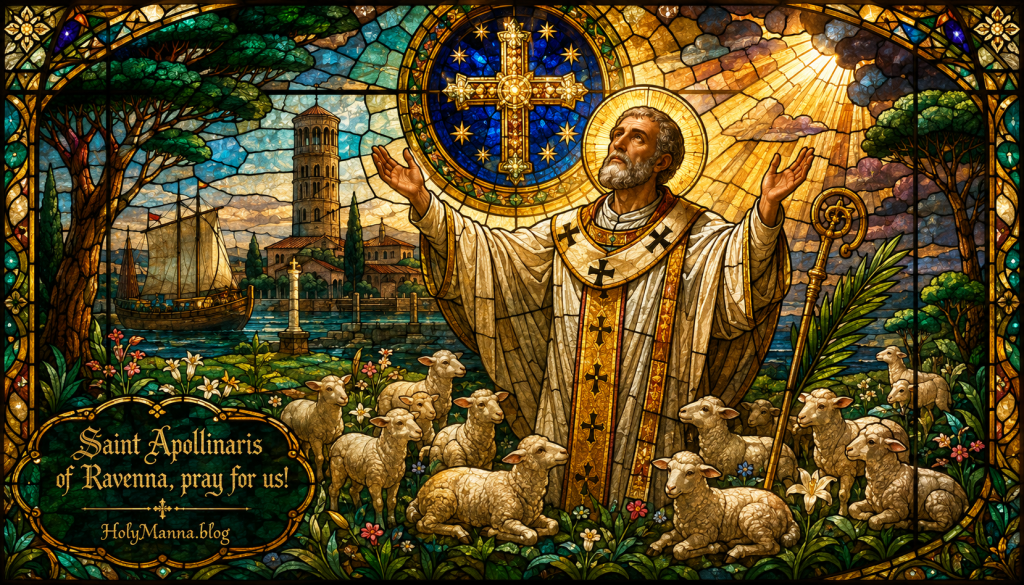
Walk into the Basilica of Sant’Apollinare in Classe, just outside Ravenna in northern Italy, and lift your eyes to the apse. There, glowing in sixth century mosaic, stands a bishop in the ancient posture of prayer, arms raised, surrounded by a garden of impossible green, with twelve white sheep gathered around him. That bishop is Saint Apollinaris, venerated as the first Bishop of Ravenna and the protomartyr of that ancient Church, and the image tells you almost everything the earliest Christians wanted you to know about him. He was a shepherd. He stood in the midst of his flock. And he never stopped standing there, no matter what it cost him.
The Church celebrates Saint Apollinaris on July 20th as an Optional Memorial, honoring him as bishop and martyr. His story reaches back to the very roots of Christianity in Italy, to a time when preaching the Gospel in a Roman port city was an act of staggering courage. Tradition remembers him as a disciple sent out by Saint Peter himself, which places him within that unbroken chain of apostolic succession that the Church still professes today. The Catechism teaches that the apostles “left bishops as their successors” and gave them “their own position of teaching authority” (CCC 77), and Apollinaris stands near the very beginning of that living chain.
Saint Apollinaris is the patron of Ravenna and of the wider Emilia-Romagna region of Italy, and his patronage crossed the Alps centuries ago; he is also honored as a patron in the German cities of Düsseldorf, Remagen, Aachen, and Burtscheid. He is traditionally invoked against gout and epilepsy. For a saint whose earthly life is wrapped in the mists of the first centuries, his reach across Europe is remarkable, and it testifies to something the Church has always believed about the martyrs: their witness does not end with their death. As The Catechism puts it, the Church “has painstakingly collected the records of those who persevered to the end” in the acts of the martyrs (CCC 2474), because their stories are treasures handed from generation to generation.
This is the story of one of those treasures, told honestly, with the documented history and the beloved traditions each given their proper place.
From Antioch to the Edge of the Empire
Here is what the oldest layers of evidence actually tell us, and it is worth being upfront about it, because honesty about sources is itself an act of respect for the saints. The earliest mentions of Apollinaris are liturgical. The ancient Hieronymian Martyrology, drawing on an early Italian calendar, remembers him on July 23rd as a confessor and priest. The earliest named witness to his life is Saint Peter Chrysologus, the golden worded Doctor of the Church who served as Bishop of Ravenna from roughly 433 to 450. In his Sermon 128, Chrysologus affirms that Apollinaris was the first bishop of Ravenna and praises him in words that still stir the heart: “Blessed Apollinaris, first in the priesthood, alone adorned this church of Ravenna with the honor of martyrdom.” Everything else comes later.
The fuller biography that generations of Catholics have loved comes from a document called the Passio Sancti Apollinaris, which scholars date to the seventh century, most likely composed under Archbishop Maurus of Ravenna. According to this tradition, Apollinaris was born in Antioch in Roman Syria, one of the great cities of the ancient world and the place where, as The Acts of the Apostles records, “the disciples were first called Christians” (Acts 11:26). The tradition holds that he became a disciple and companion of Saint Peter, traveled with him to Rome, and was consecrated a bishop by the Prince of the Apostles, who then sent him north to Ravenna, the strategic Adriatic port city, to preach Christ where Christ was not yet known. The traditional Roman Martyrology hands on this account plainly, commemorating “the holy bishop Apollinaris, who was consecrated at Rome by the apostle Peter, and sent to Ravenna.”
Now for the honest complication. Modern Catholic scholarship, including the Vatican’s own published profiles of the saint, notes that Apollinaris more likely lived around the middle or end of the second century rather than in the apostolic age. Analysis of the early lists of Ravenna’s bishops suggests his episcopate may belong to the last decades of the 100s, which would place his death under a later emperor rather than under Vespasian, as the tradition holds. Scholars also observe that the Passio may have pushed the saint’s dates earlier and emphasized the connection to Saint Peter partly to strengthen Ravenna’s prestige and autonomy in the seventh century. The sources genuinely conflict here, and no one can resolve the question with certainty. What no serious scholar doubts is the core: a real bishop named Apollinaris founded or led the earliest Christian community of Ravenna, suffered greatly for the faith, and was venerated there from very early times as the Church’s first shepherd and martyr.
Why does this matter for us? Because the Church has never needed embroidery to honor her saints. Whether Apollinaris received his mission directly from Peter’s hands or from Peter’s successors two or three generations later, the theological truth the tradition guards remains solid: his authority and his mission flowed from the apostles. The Catechism teaches that the whole Church is apostolic “in that she is ‘sent out’ into the whole world” and that all her members share in this mission (CCC 863). Apollinaris lived that sentence before it was ever written.
Miracles at the Port of Classe
The traditional account of Apollinaris’s ministry, drawn from the Passio, paints the picture of a wonderworker whose miracles opened hearts and enraged idolaters in equal measure. According to this tradition, Apollinaris arrived in Ravenna as a stranger and found lodging with a soldier’s family. His preaching was confirmed by healings, the way the Lord promised when He said that signs would accompany those who believe. One story tells that he healed the gravely ill wife of a Roman official, and that she and her husband were converted and baptized together with their household. Another tradition holds that he restored speech to a mute man named Boniface, whose whole family then embraced the faith. Yet another tells that in Bologna he converted the household of the patrician Rufinus after a healing worked in the name of Christ. These stories come from the seventh century Passio and cannot be verified as historical fact.
Still, the shape of these traditions matters, because they echo exactly what the Church teaches about how God works. Miracles in the life of a saint are never magic tricks or personal achievements; they are signs pointing to Christ. The Catechism teaches that the miracles of Christ and the saints “are the most certain signs of divine Revelation” (CCC 156), and that charisms are graces of the Holy Spirit which “directly or indirectly benefit the Church” (CCC 799). Every healing attributed to Apollinaris ends the same way in the tradition: not with applause for the bishop, but with a household coming to the waters of Baptism. That is the fingerprint of authentic Christian witness.
Tradition holds that Apollinaris shepherded the Church of Ravenna for twenty-six years, though some later accounts say twenty-nine, and the figure cannot be confirmed either way. During those years, the tradition says, he ordained clergy, organized the Christian community centered on the port district of Classe, and preached tirelessly to sailors, soldiers, merchants, and slaves. Ravenna was a naval hub of the Roman Empire, a city of arrivals and departures, and a bishop there could reach people from every corner of the Mediterranean. The earliest archaeological evidence agrees with the broad picture: ancient Christian inscriptions found around Classe show that a well organized Christian community existed in Ravenna from a very early date.
Why should you remember Apollinaris and want to imitate him? Because he represents a kind of holiness the modern world desperately needs: the holiness of staying. He was not a missionary who planted a flag and moved on. He was a shepherd who bound himself to one difficult place and one difficult people for decades, through every reversal, and let his life be spent there. The Gospel of John gives us the standard he lived by: “The good shepherd lays down his life for the sheep” (John 10:11). The great apse mosaic in Classe, which shows him standing among his sheep, is believed to draw its inspiration directly from the sermon of Chrysologus, who described Apollinaris as a good shepherd standing in the midst of his flock. The oldest art and the oldest preaching about this saint say the same thing. He stayed.
Beaten, Exiled, and Undefeated
Everything the tradition tells us about Apollinaris’s sufferings comes from that same seventh century Passio, so it must be told as tradition rather than as verified history, and it will be told that way here. But what a tradition it is.
According to the Passio, the miracles and conversions provoked the fury of the city’s pagan establishment. Apollinaris was seized, beaten savagely, and left half dead on the seashore, where the Christians found him and hid him until he recovered. He returned to preaching. Captured a second time, the tradition says he was forced to walk barefoot over burning coals and was driven out of the city. He did not go far. He continued evangelizing in the surrounding province of Aemilia, the region that still bears that ancient name inside Emilia-Romagna today. Seized yet again, the tradition recounts that he was slashed with knives, that scalding water was poured over his open wounds, and that he was struck in the mouth with stones because he would not stop preaching. He was then chained in a dungeon to starve, but after four days his captors put him on a ship bound for Greece instead. Even the voyage became a mission field; the tradition holds that a shipwreck on the Dalmatian coast left him preaching to new hearers, and that in Greece his very presence silenced the pagan oracles, which so alarmed the priests of the idols that after another cruel beating he was shipped back to Italy. After roughly three years of this exile, he returned to Ravenna a fourth time. None of these episodes can be verified, and they are handed on here as the Church of Ravenna handed them on, as treasured tradition.
The tradition of his death runs as follows. Under the Emperor Vespasian, a decree against the Christians gave Apollinaris’s enemies their opening. As the aged bishop was passing out of the city gates, he was ambushed and beaten so brutally at Classe that he never recovered. He lingered for seven days, and the tradition says he spent them encouraging his flock and foretelling that persecution would intensify but that the Church would ultimately triumph over pagan Rome. Then he died of his wounds. This account, including the dating under Vespasian, comes from the Passio and cannot be verified; as noted earlier, scholars think his death may belong to the late second century.
Here the earliest witness gives us something precious and surprising. Saint Peter Chrysologus, preaching in Ravenna four hundred years before the Passio was written, knew a slightly different and more sober memory: that Apollinaris did not die under the executioner’s blade in a single dramatic moment, but poured out his life through repeated sufferings endured over many years. Chrysologus called him a confessor, and then made the stunning theological move of insisting that he deserves the martyr’s crown anyway, teaching in Sermon 128 that “it is devotion and faithfulness, more than death itself, that make the martyr,” and that this confessor “shed his blood many times, bearing witness to his Lord by his wounds and by the faith of his soul.” The Church agreed, and she venerates Apollinaris liturgically as a martyr to this day.
That teaching should stop you in your tracks, because it opens martyrdom’s door to every ordinary life. The Catechism defines martyrdom as “the supreme witness given to the truth of the faith” (CCC 2473), and it also insists that all the faithful are called to bear witness, teaching plainly that “service of and witness to the faith are necessary for salvation” (CCC 1816). Apollinaris shows what that looks like stretched across decades: fidelity renewed after every wound, mission resumed after every exile. He is proof that the martyr’s heart can beat for a lifetime, not only for a moment. Our Lord’s beatitude belongs to him in full: “Blessed are they that suffer persecution for justice’ sake: for theirs is the kingdom of heaven” (Matthew 5:10).
Relics, Mosaics, and a Vision in the Night
The veneration of Apollinaris after his death is not tradition; it is documented history, and it is glorious. On May 9th in the year 549, Bishop Maximian of Ravenna consecrated a great basilica over the site associated with the saint’s burial and martyrdom at Classe. That church, the Basilica of Sant’Apollinare in Classe, still stands today, and it ranks among the most breathtaking Christian buildings on earth. Its apse mosaic, shimmering with gold and every shade of green, shows Apollinaris at prayer beneath a jeweled cross set against a starry sky, with sheep processing toward him through a paradise of trees, lilies, and birds. Together with the Basilica of Sant’Apollinare Nuovo inside the city, it forms part of the Early Christian Monuments of Ravenna, recognized by UNESCO as a World Heritage Site. Pilgrims and travelers have stood under that mosaic for nearly fifteen centuries, and it still catechizes everyone who looks up.
The saint’s relics have their own adventurous history. In the year 856, because of repeated pirate raids along the Adriatic coast, his remains were transferred from Classe into the city, to the Basilica of Sant’Apollinare Nuovo, for safekeeping; they were later returned to Classe, where they rest today. His veneration also traveled north with Benedictine monks into the German lands, and relics of the saint are claimed at the church of Saint Lambertus in Düsseldorf and at the hilltop Apollinariskirche overlooking the Rhine at Remagen, which to this day hosts an annual pilgrimage in the saint’s honor each July. Churches in Aachen and Burtscheid also bear his name. Few saints of the misty early centuries can claim a devotional footprint stretching from the Adriatic to the Rhine.
The tradition of miracles connected to Apollinaris continued long after his death, and one story in particular changed the history of the Church. In the tenth century, a young nobleman of Ravenna named Romuald came to the Basilica of Sant’Apollinare in Classe to do forty days of penance after his father killed a relative in a duel. Tradition, handed down through the hagiography of Saint Romuald, holds that Saint Apollinaris appeared to the young man in a vision there, and appeared again, confirming his call to leave the world. Romuald became a monk in that very basilica and went on to found the Camaldolese reform of Benedictine monasticism, which still flourishes today. The vision cannot be verified, and it is handed on here as the tradition tells it. What is certain is that the house of Apollinaris became the cradle of one of the great monastic families of the Church, which is its own kind of posthumous miracle. As The Catechism teaches, the saints in glory do not stop working for us, for “they do not cease to intercede with the Father for us” (CCC 956), and the Church rightly venerates their relics and memory as part of the piety of the faithful (CCC 1674).
No verified healings against gout or epilepsy can be documented from the early sources, but the long tradition of invoking Apollinaris against these afflictions grew up across medieval Europe, likely nourished by the memory of a bishop whose own battered body knew suffering intimately. The Church has always understood this instinct. We bring our wounds to the wounded saints, and through them to the wounded and risen Christ.
A Faith That Returns
It would be easy to file Apollinaris away as a beautiful mosaic and a distant name, but his life presses a very practical question into modern hands. What do you do when faithfulness gets you nothing but trouble, over and over again?
Apollinaris’s answer was to come back. Beaten and left for dead, he came back. Burned and banished, he came back. Imprisoned, starved, and deported, he came back. The tradition counts four returns to Ravenna, and behind that number stands a spiritual truth that applies to every believer: perseverance is not a personality trait, it is a grace, and it is asked of all of us. The Catechism names fortitude among the cardinal virtues, teaching that it “strengthens the resolve to resist temptations and to overcome obstacles in the moral life” and even “disposes one even to renounce and sacrifice his life in defense of a just cause” (CCC 1808). Most people will never face a Roman mob. Everyone faces the temptation to quietly quit: on a marriage that has grown hard, on a prayer life that has gone dry, on a moral conviction that has become socially expensive, on a parish or a family member who keeps wounding us. Apollinaris preaches to that temptation with his whole scarred life.
His story also teaches something subtler through the words of Chrysologus. If devotion and faithfulness, more than death, make the martyr, then the arena of witness is not somewhere far away; it is Tuesday. It is the coworker who mocks your faith, the choice to tell the truth when a lie would be cheaper, the decision to keep serving people who give nothing back. Saint Paul’s words fit Apollinaris and can, by grace, fit anyone: “I have fought a good fight, I have finished my course, I have kept the faith” (2 Timothy 4:7). Consider carrying his memory into your week in concrete ways. Return to a duty you have been avoiding. Reconcile with someone you have written off. Pray for the people who make your faith costly, as the Lord commanded when He said “pray for them that persecute and calumniate you” (Matthew 5:44). Visit the sick, since the tradition remembers Apollinaris above all as a healer of the suffering. And when you fail, come back, because coming back was his whole spirituality.
When was the last time hostility or mere weariness made you go quiet about your faith? What would it look like, this week, to return to the place where you stopped persevering? Is there a wound in your own story that God might be inviting you to offer as witness rather than hide as shame?
Engage With Us!
The story of Saint Apollinaris belongs to the whole Church, and that includes you. Share your thoughts and reflections in the comments below; your experience of perseverance might be exactly the encouragement another reader needs today. To guide the conversation, here are some questions to pray with and respond to.
- Apollinaris returned to Ravenna four times despite beatings and exile. Where in your life is God asking you to return and persevere rather than walk away?
- Saint Peter Chrysologus taught that faithfulness, even more than death, makes the martyr. How does that change the way you think about witnessing to Christ in ordinary daily life?
- The mosaic at Classe shows Apollinaris as a shepherd standing among his sheep. Who has been that kind of steady, faithful shepherd in your life, and have you ever thanked them?
- The tradition says every miracle Apollinaris worked led a household to Baptism. When God blesses you, do the people around you end up closer to Him because of it?
- Young Romuald’s life was transformed inside the basilica built to honor Apollinaris. What holy place, person, or memory has God used to redirect your own path?
Take Saint Apollinaris with you into this week. Be the one who stays when staying is hard, who returns when returning is costly, and who lets every wound become a witness. Live your faith out loud, love without keeping score, and do everything with the love and mercy that Jesus taught us. Saint Apollinaris of Ravenna, pray for us!
Saint Apollinaris of Ravenna, pray for us!
Follow us on YouTube, TikTok, Instagram and Facebook for more insights and reflections on living a faith-filled life.


Leave a Reply