Monday of the Sixteenth Week in Ordinary Time – Lectionary: 395
When Heaven Calls the Mountains as Witnesses
Imagine receiving a court summons, opening it, and discovering that the plaintiff is God Himself. That is exactly the scene the Church sets before the faithful this Monday of the Sixteenth Week in Ordinary Time. These readings form one continuous courtroom drama stretching across roughly 800 years, and the central theme is unmistakable: God does not want the performance of religion; He wants the heart behind it.
In the First Reading, the prophet Micah, a rural preacher from 8th century BC Judah, delivers what scholars call a covenant lawsuit. God summons the mountains and the foundations of the earth as His witnesses, the same creation that watched Him cut covenant with Israel at Sinai, and He pleads His case like a wounded father: “My people, what have I done to you?” Psalm 50 continues the trial, as God takes the witness stand to declare that He never needed bulls or goats; He wanted fidelity. And in the Gospel, the scribes and Pharisees turn the tables and put God Incarnate on trial, demanding a sign from the very One who had been healing in front of them all day.
Ancient Israel lived among nations that treated worship like a transaction, feeding their gods sacrifices to buy favor, even offering their own children. Into that world, and into this one, God speaks a different word. He asks for justice, mercy, humility, praise, and repentance. The readings end with a warning and a promise: the sign has already been given, and He is greater than Jonah, greater than Solomon, and closer than anyone dares to believe.
First Reading — Micah 6:1-4, 6-8
The Trial Where God Pleads Like a Father
Micah prophesied in the southern kingdom of Judah during the reigns of Jotham, Ahaz, and Hezekiah, roughly 740 to 700 BC, while his contemporary Isaiah preached in Jerusalem. Micah came from Moresheth, a small farming town, and he watched wealthy landowners devour the poor while temple worship carried on at full volume. Chapter 6 opens with a rîb, a formal covenant lawsuit modeled on ancient treaty ceremonies, in which the offended party calls the original witnesses of the covenant to hear the case. The witnesses here are the mountains themselves. This reading fits the day’s theme perfectly because it exposes the gap between ritual and righteousness, and because God’s astonishing answer in verse 8 becomes the measuring line for the Psalm and the Gospel that follow.
Micah 6:1-4, 6-8 – New American Bible (Revised Edition)
1 Hear, then, what the Lord says:
Arise, plead your case before the mountains,
and let the hills hear your voice!
2 Hear, O mountains, the Lord’s case,
pay attention, O foundations of the earth!
For the Lord has a case against his people;
he enters into trial with Israel.
3 My people, what have I done to you?
how have I wearied you? Answer me!
4 I brought you up from the land of Egypt,
from the place of slavery I ransomed you;
And I sent before you Moses,
Aaron, and Miriam.6 With what shall I come before the Lord,
and bow before God most high?
Shall I come before him with burnt offerings,
with calves a year old?
7 Will the Lord be pleased with thousands of rams,
with myriad streams of oil?
Shall I give my firstborn for my crime,
the fruit of my body for the sin of my soul?
8 You have been told, O mortal, what is good,
and what the Lord requires of you:
Only to do justice and to love goodness,
and to walk humbly with your God.
Detailed Exegesis
Verse 1: “Hear, then, what the Lord says: Arise, plead your case before the mountains, and let the hills hear your voice!” God commands the prophet to open formal proceedings. In ancient treaties, heaven and earth were invoked as permanent witnesses, as Moses did in Deuteronomy 32:1. The mountains that watched Sinai will now watch Israel answer for breaking what was sworn there.
Verse 2: “Hear, O mountains, the Lord’s case, pay attention, O foundations of the earth! For the Lord has a case against his people; he enters into trial with Israel.” The Judge of the universe astonishingly takes the role of plaintiff. He does not simply condemn from on high; He submits His grievance to argument, inviting His people to answer Him. Divine justice begins with divine dialogue.
Verse 3: “My people, what have I done to you? how have I wearied you? Answer me!” These may be the most heartbreaking words in the prophets. God speaks not as a tyrant but as a spurned father asking where the relationship went wrong. The Church places this very verse on the lips of the crucified Christ in the Good Friday Reproaches of the Roman Missal, where the Savior asks His people the same question from the Cross.
Verse 4: “I brought you up from the land of Egypt, from the place of slavery I ransomed you; And I sent before you Moses, Aaron, and Miriam.” God presents His evidence: the Exodus. The word “ransomed” is the language of redemption, of buying back a slave. He even names the leaders He provided, including Miriam, showing the fullness of His care for every dimension of Israel’s journey.
Verse 6: “With what shall I come before the Lord, and bow before God most high? Shall I come before him with burnt offerings, with calves a year old?” The people finally speak, but notice their instinct: they reach for transactions. A yearling calf was a costly offering. The question assumes God can be paid off.
Verse 7: “Will the Lord be pleased with thousands of rams, with myriad streams of oil? Shall I give my firstborn for my crime, the fruit of my body for the sin of my soul?” The bidding escalates to absurdity and then to horror. Child sacrifice was practiced among Judah’s neighbors, and even King Ahaz fell into it, as 2 Kings 16:3 records. Micah exposes the pagan logic hiding inside empty religion: the idea that God wants things instead of persons.
Verse 8: “You have been told, O mortal, what is good, and what the Lord requires of you: Only to do justice and to love goodness, and to walk humbly with your God.” The verdict is not a new revelation but a reminder. The Hebrew behind “goodness” is hesed, the covenant love and mercy God Himself shows. Justice toward neighbor, mercy from the heart, and humility before God: this triad summarizes the entire law and anticipates the teaching of Christ.
Teachings
The Catechism addresses this exact prophetic pattern. CCC 2100 teaches: “Outward sacrifice, to be genuine, must be the expression of spiritual sacrifice… The prophets of the Old Covenant often denounced sacrifices that were not from the heart or not coupled with love of neighbor.” The same paragraph recalls that Jesus took up this prophetic thread when He quoted Hosea, saying, “I desire mercy, and not sacrifice.” Micah 6:8 is therefore not a rejection of worship but a demand that worship and life become one offering.
Each element of the triad has deep roots in Church teaching. On justice, CCC 1807 defines the virtue precisely: “Justice is the moral virtue that consists in the constant and firm will to give their due to God and neighbor.” On humility, CCC 2559 teaches that “humility is the foundation of prayer,” which means the humble walk with God that Micah describes is nothing less than a life of continual prayer. And the hesed Micah commands finds its fulfillment in the mercy Christ both taught and embodied, the mercy He extends from the Cross when the Church sings His question from this very chapter each Good Friday.
Reflection
Micah’s courtroom is not ancient history; it reconvenes in every examination of conscience. The temptation to substitute religious activity for actual conversion did not die in the 8th century BC. It is entirely possible to attend Mass, wear the medal, post the Bible verse, and still cheat the customer, gossip about the coworker, and nurse the grudge. Micah 6:8 offers a daily rule of life in a single sentence. Do justice: pay people fairly, tell the truth, honor commitments. Love goodness: choose one concrete act of mercy today, especially toward someone who cannot repay it. Walk humbly: begin each morning by acknowledging dependence on God before checking a single notification.
Where in your life has religious routine quietly replaced real conversion? What is one act of justice you have been postponing, and what would it cost to do it this week? When you walk through an ordinary day, does God walk with you, or does He only appear on Sundays?
Responsorial Psalm — Psalm 50:5-6, 8-9, 16-17, 21, 23
God Takes the Witness Stand
Psalm 50 belongs to Asaph, the Levitical choirmaster appointed by David, and it reads like the continuation of Micah’s trial, even though it was composed in a different century. The psalm opens with a theophany: God appears in fire and storm, summons heaven and earth, and gathers His covenant people for judgment. What makes this psalm extraordinary is that God is not angry about the sacrifices themselves. He explicitly says so. His grievance is the disconnect between the liturgy in the temple and the lives of the worshipers outside it. The psalm builds toward one of the most important phrases in the entire Psalter, the “sacrifice of praise,” which the Church has always heard as a prophecy of the Eucharist. It fits the day’s theme as the divine answer to Micah’s question: this is what the Lord requires.
Psalm 50:5-6, 8-9, 16-17, 21, 23 – New American Bible (Revised Edition)
5 “Gather my loyal ones to me,
those who made a covenant with me by sacrifice.”
6 The heavens proclaim his righteousness,
for God himself is the judge.
Selah8 Not for your sacrifices do I rebuke you,
your burnt offerings are always before me.
9 I will not take a bullock from your house,
or he-goats from your folds.16 But to the wicked God says:
“Why do you recite my commandments
and profess my covenant with your mouth?
17 You hate discipline;
you cast my words behind you!21 When you do these things should I be silent?
Do you think that I am like you?
I accuse you, I lay out the matter before your eyes.23 Those who offer praise as a sacrifice honor me;
I will let him whose way is steadfast
look upon the salvation of God.”
Detailed Exegesis
Verse 5: “Gather my loyal ones to me, those who made a covenant with me by sacrifice.” God summons the hasidim, the faithful ones bound to Him at Sinai, where the covenant was sealed in sacrificial blood as Exodus 24 describes. The trial begins with a reminder that these are not strangers but family under oath.
Verse 6: “The heavens proclaim his righteousness, for God himself is the judge.” As in Micah, creation serves as witness. But here the roles sharpen: God is not merely plaintiff but Judge, and His righteousness is so evident that the skies themselves announce it.
Verse 8: “Not for your sacrifices do I rebuke you, your burnt offerings are always before me.” This verse is the interpretive key. God does not despise the worship He Himself commanded. The problem is never the altar; the problem is the heart approaching it.
Verse 9: “I will not take a bullock from your house, or he-goats from your folds.” The pagan nations imagined their gods needed feeding. The living God needs nothing. Sacrifice was never for God’s benefit but for Israel’s transformation, a truth the surrounding verses drive home when God declares that every beast of the forest already belongs to Him.
Verse 16: “But to the wicked God says: ‘Why do you recite my commandments and profess my covenant with your mouth?’” Now the indictment lands. The accused are not pagans but the religiously fluent, people who can quote the law flawlessly while ignoring it completely. Verbal orthodoxy without obedience becomes evidence for the prosecution.
Verse 17: “You hate discipline; you cast my words behind you!” The image is physical: taking the words of God, the most precious gift Israel possessed, and tossing them over the shoulder like trash. Hating discipline means refusing the correction that love requires.
Verse 21: “When you do these things should I be silent? Do you think that I am like you? I accuse you, I lay out the matter before your eyes.” God’s patience had been mistaken for approval, His silence for indifference. The sinner had quietly remade God in his own image, assuming heaven shrugs at what he shrugs at. God shatters the illusion.
Verse 23: “Those who offer praise as a sacrifice honor me; I will let him whose way is steadfast look upon the salvation of God.” The psalm ends with the true offering: the todah, the thanksgiving sacrifice of praise. And the promise attached to it is breathtaking, for the steadfast will look upon the salvation of God, and salvation in Hebrew is yeshua, the very name of Jesus.
Teachings
St. Augustine meditated deeply on what makes a sacrifice true, and the Catechism enshrines his answer. CCC 2099 teaches: “It is right to offer sacrifice to God as a sign of adoration and gratitude, supplication and communion: ‘Every action done so as to cling to God in communion of holiness, and thus achieve blessedness, is a true sacrifice.’” That interior quotation comes from Augustine’s The City of God, Book 10, and it explains Psalm 50 perfectly: the bull was only ever meant to carry the heart.
The “sacrifice of praise” finds its fulfillment on Catholic altars every single day. CCC 1359 teaches: “The Eucharist, the sacrament of our salvation accomplished by Christ on the cross, is also a sacrifice of praise in thanksgiving for the work of creation.” The Letter to the Hebrews makes the same connection, urging believers, “Through him then let us continually offer God a sacrifice of praise, that is, the fruit of lips that confess his name” (Hebrews 13:15). What Asaph glimpsed from afar, the Church receives at every Mass.
Reflection
Psalm 50 asks an uncomfortable question: is worship changing the worshiper? The people in the psalm had perfect attendance and perfect recitation, and God still called them to account, because the words never traveled the distance from the mouth to the life. The remedy the psalm prescribes is gratitude offered as sacrifice. Try this concretely: before Mass, name three specific gifts from the past week and offer them back to God during the presentation of the gifts. After receiving Communion, resolve on one specific way the coming week will look different because of it. Keep a small evening habit of thanking God before asking Him for anything.
If God laid out the matter of your life before your eyes tonight, where would your professed faith and your practiced faith disagree? What would it mean for you to offer praise as a sacrifice on the days when praise costs something?
Holy Gospel — Matthew 12:38-42
Demanding a Sign From the Sign Himself
By this point in Matthew 12, the tension between Jesus and the religious authorities has become open conflict. He has healed a man with a withered hand on the Sabbath, cured a blind and mute demoniac, and been accused of casting out demons by the power of Beelzebul. Now the scribes and Pharisees, the credentialed experts in the law, approach with a demand that sounds polite and is anything but. They want a sign, as though the day’s miracles had not happened in front of them. The courtroom of Micah and Psalm 50 reconvenes here with a devastating twist: the defendants attempt to put the Judge on trial. Jesus answers with the sign of Jonah, His first veiled prophecy of the Resurrection in this Gospel, and with two witnesses from the pagan world who will rise at the judgment. The theme of the day reaches its summit, for the God who wants the heart now stands in the flesh before hearts that refuse Him.
Matthew 12:38-42 – New American Bible (Revised Edition)
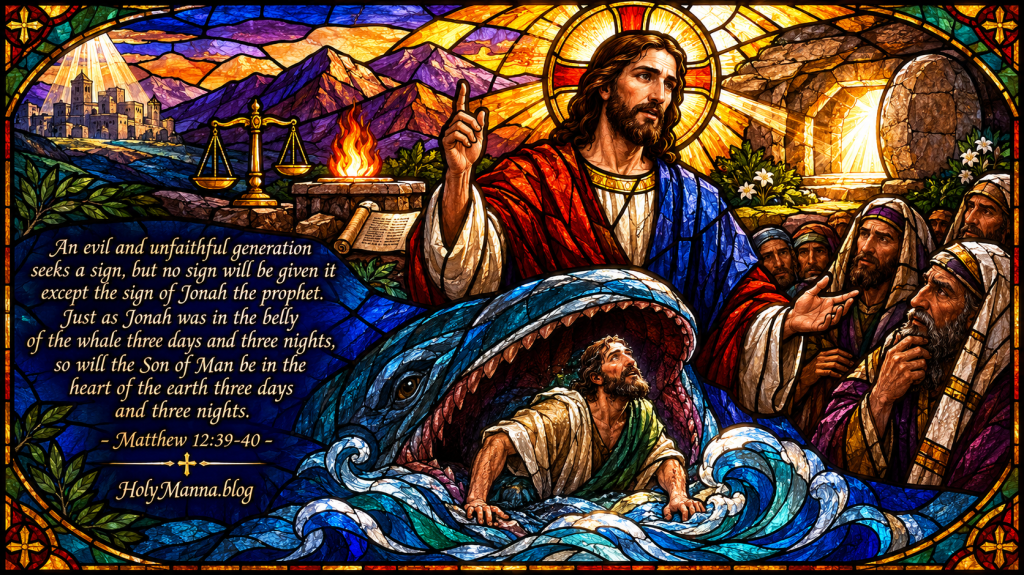
38 Then some of the scribes and Pharisees said to him, “Teacher, we wish to see a sign from you.” 39 He said to them in reply, “An evil and unfaithful generation seeks a sign, but no sign will be given it except the sign of Jonah the prophet. 40 Just as Jonah was in the belly of the whale three days and three nights, so will the Son of Man be in the heart of the earth three days and three nights. 41 At the judgment, the men of Nineveh will arise with this generation and condemn it, because they repented at the preaching of Jonah; and there is something greater than Jonah here. 42 At the judgment the queen of the south will arise with this generation and condemn it, because she came from the ends of the earth to hear the wisdom of Solomon; and there is something greater than Solomon here.
Detailed Exegesis
Verse 38: “Then some of the scribes and Pharisees said to him, ‘Teacher, we wish to see a sign from you.’” The request drips with irony. In the Catena Aurea, St. Jerome observes that “They require a sign of Him, as though what they had seen were not signs,” and St. John Chrysostom marvels that at the very moment they should have been struck silent with wonder, “even at such time they desist not from their malice.” They call Him “Teacher” while refusing to be taught.
Verse 39: “He said to them in reply, ‘An evil and unfaithful generation seeks a sign, but no sign will be given it except the sign of Jonah the prophet.’” The word “unfaithful” carries the prophets’ marriage imagery, in which Israel’s idolatry is adultery against her divine Husband. Demanding proof from God after centuries of His fidelity is itself covenant infidelity. Yet even in refusing their test, Jesus promises the greatest sign in history.
Verse 40: “Just as Jonah was in the belly of the whale three days and three nights, so will the Son of Man be in the heart of the earth three days and three nights.” Jesus reads Jonah’s descent into the deep as a prophecy of His own death, burial, and Resurrection. The phrase reflects the Semitic idiom in which any part of a day counts as a day and a night, so Friday afternoon to Sunday morning fulfills it exactly. The prophet who emerged from the fish to preach becomes the type of the Son who will emerge from the tomb to save.
Verse 41: “At the judgment, the men of Nineveh will arise with this generation and condemn it, because they repented at the preaching of Jonah; and there is something greater than Jonah here.” Nineveh was the capital of Assyria, Israel’s cruelest enemy, yet those pagans repented in sackcloth at the preaching of one reluctant prophet. The scribes and Pharisees have infinitely more, the eternal Word made flesh, and repent of nothing. Grace refused becomes evidence at judgment.
Verse 42: “At the judgment the queen of the south will arise with this generation and condemn it, because she came from the ends of the earth to hear the wisdom of Solomon; and there is something greater than Solomon here.” The Queen of Sheba, whose visit 1 Kings 10 records, crossed deserts on the mere rumor of wisdom. Divine Wisdom Himself now stands in Galilee, and the learned will not cross the street. Jonah represents the prophets and Solomon the kings and sages; Jesus declares Himself greater than both offices combined.
Teachings
The Catechism sees in this passage a direct testimony to the divinity of Christ. CCC 590 teaches: “Only the divine identity of Jesus’ person can justify so absolute a claim as ‘He who is not with me is against me’; and his saying that there was in him ‘something greater than Jonah,… greater than Solomon,’ something ‘greater than the Temple.’” No mere prophet could speak this way without blasphemy. Either Jesus is God, or His words here are indefensible.
On the sign itself, CCC 994 teaches that Jesus “gives ‘the sign of Jonah,’ the sign of the temple: he announces that he will be put to death but rise thereafter on the third day.” The Resurrection is the sign that answers every honest doubt. And on the repentance of Nineveh that shames the sign-seekers, CCC 1430 teaches: “Jesus’ call to conversion and penance, like that of the prophets before him, does not aim first at outward works, ‘sackcloth and ashes,’ fasting and mortification, but at the conversion of the heart, interior conversion.” The circle closes: Micah, Asaph, and Jesus all demand the same offering.
Reflection
The temptation of the Pharisees remains a live temptation now: the endless deferral of faith while waiting for one more proof. One more answered prayer, one more resolved doubt, one more perfect feeling at Mass, and then commitment will come. Jesus gently but firmly refuses that game, because the sign has already been given. The empty tomb stands at the center of history, and the risen Christ, truly present in the Eucharist, waits in every tabernacle on earth. Concrete steps follow naturally. Stop negotiating and pray honestly about the one area of life still withheld from God. Spend fifteen minutes this week before the Blessed Sacrament, coming, like the Queen of the South, simply to listen to Wisdom. Go to Confession like a Ninevite, quickly and completely, without waiting to feel ready.
What sign are you secretly waiting for before fully surrendering to Christ? If pagans repented at the preaching of a reluctant prophet, what excuse remains when the Gospel is preached at every Mass? Would you travel from the ends of the earth for wisdom that is already waiting in the nearest tabernacle?
The Verdict Is Mercy
The court is ready to adjourn, and the verdict is not what anyone expected. God summoned the mountains in Micah, took the stand in Psalm 50, and stood in the flesh before His accusers in Matthew, and at every stage He asked for the same thing. Not thousands of rams. Not myriad streams of oil. Not flawless recitation of commandments or one more spectacular sign. He asked for hearts that do justice, love mercy, walk humbly, offer praise, and repent.
Here is the twist that turns this courtroom drama into a love story: the Judge took the sentence Himself. The same voice that asked, “My people, what have I done to you?” asked it again from the Cross, and then answered it by descending into the heart of the earth for three days, like Jonah into the deep, and rising so that every steadfast soul might look upon the salvation of God. The sign was given. The case is closed. What remains is the response.
So live Micah 6:8 this week as if it were a personal summons, because it is. Do one act of justice that costs something. Show one mercy that nobody will ever repay. Walk humbly enough to pray before scrolling, to confess before excusing, to thank before asking. Bring it all to Mass, where the sacrifice of praise ascends from every altar and something greater than Jonah, greater than Solomon, greater than every longing of the human heart waits to be received. The Ninevites repented at the preaching of one prophet. Imagine what God will do with one soul who says yes today.
Engage With Us!
The conversation does not end here, and every reflection shared helps another reader walk closer to Christ. Share your thoughts in the comments below and join a community of believers seeking to live these readings, not just hear them.
- In Micah 6:8, God asks for justice, goodness, and humility rather than costly offerings. Which of the three do you find hardest to live out, and what is one step you can take this week?
- In Psalm 50:16-17 and 23, God contrasts those who merely recite His covenant with those who offer praise as a sacrifice. What would offering praise as a true sacrifice look like in your busiest, most stressful day?
- In Matthew 12:38-40, Jesus offers the sign of Jonah, His own death and Resurrection, as the only sign. Have you ever caught yourself waiting for a sign from God that He has, in some way, already given?
- Taken together, these readings insist that God wants the heart behind the worship. Where is God inviting you to close the gap between what you profess on Sunday and how you live on Monday?
Every step of faith matters, even the small and stumbling ones. Keep doing justice, keep loving goodness, and keep walking humbly with the God who walked all the way to the Cross and out of the tomb for love of you. Live this day, and every day, with the love and mercy Jesus taught us.
Sacred Heart of Jesus, we trust in You!
Immaculate Heart of Mary, pray for us!
Saint Michael the Archangel, defend us in battle!
Follow us on YouTube, TikTok, Instagram and Facebook for more insights and reflections on living a faith-filled life.


Leave a Reply