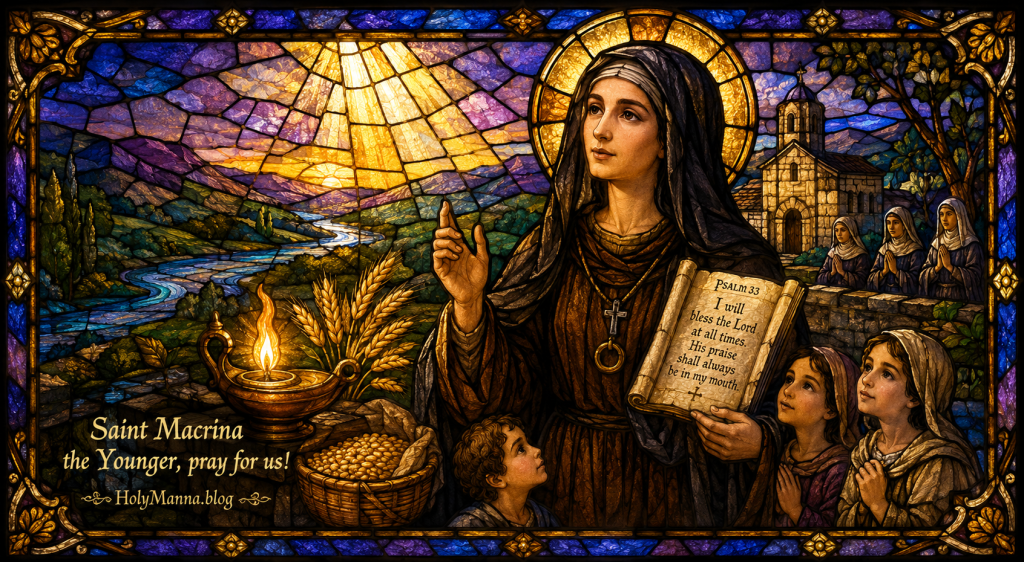
A Quiet Flame at the Center of a Family of Saints
Every so often, God places one soul at the hidden center of a great story, and history nearly forgets her name. Saint Macrina the Younger, whose feast the Church celebrates on July 19th, is that soul. She was the eldest sister of Saint Basil the Great, the father of Eastern monasticism, and of Saint Gregory of Nyssa, one of the most profound theologians the Church has ever produced. She was the granddaughter of Saint Macrina the Elder and the daughter of Saints Basil the Elder and Emmelia. Out of one household in fourth century Cappadocia came a whole constellation of saints, and at the warm center of that constellation stood Macrina, praying, teaching, correcting, and loving her family into holiness.
She never wrote a book that survives under her own name. She never held an office in the Church. Yet her brother Gregory, a bishop and a Father of the Church, called her simply “the Teacher,” and he wrote two works to preserve her memory: The Life of Macrina and On the Soul and the Resurrection, in which she, not he, does the teaching. Many Catholic writers today call her the fourth Cappadocian, placing her alongside Basil, Gregory of Nyssa, and Gregory of Nazianzus, the three great Cappadocian Fathers whose theology shaped how the Church confesses the Holy Trinity. Her life is a stunning witness to what the Catechism teaches, that “all Christians in any state or walk of life are called to the fullness of Christian life and to the perfection of charity” (CCC 2013). Macrina reached that fullness not in a cathedral or a council, but in a farmhouse on a river in Pontus, and the Church has never stopped learning from her.
A Betrothal Broken by Death, a Heart Given to Christ
Macrina was born in Caesarea of Cappadocia, in what is now central Turkey, around the year 327 or 330; the ancient sources allow either date, and honest history holds both loosely. Her family was wealthy, aristocratic, and, more importantly, soaked in the faith. Her grandmother, Macrina the Elder, had been a disciple of the teaching of Saint Gregory Thaumaturgus and had suffered persecution for Christ, hiding in the forests of Pontus with her husband during the last great Roman persecutions. Her mother, Emmelia, was the daughter of a martyr. Faith in that house was not decoration; it had been paid for in blood and exile.
Gregory of Nyssa records a tender tradition about her birth. As Emmelia labored, she is said to have seen a vision in which the child was addressed by a secret name, “Thecla,” after the celebrated virgin of the early Church associated with Saint Paul. The family took it as a sign of the life this daughter would live. This story comes from Gregory’s Life of Macrina as a family account, and it is presented here as the pious tradition he reports rather than as established historical fact.
Emmelia educated her firstborn herself, and she made an unusual choice for an aristocratic Roman household. Instead of the pagan poets, with their tales of gods behaving badly, Macrina’s curriculum was the Word of God. She learned the Wisdom of Solomon, and above all the Psalms, which she prayed at every hour of the day, so that the Psalter became, in Gregory’s telling, her constant companion from childhood. The Catechism echoes exactly this pattern of formation when it teaches that “the Christian family is the first place of education in prayer” (CCC 2685), and that the family is rightly called “the domestic church” (CCC 1666). Macrina’s soul was built on Scripture before the world could build it on anything else.
At twelve years old, following the custom of the age, her father arranged her betrothal to a promising young lawyer from a good family. Then, suddenly, the young man died. Everyone expected the beautiful, brilliant daughter of Basil the Elder to be betrothed again quickly. Macrina refused, and her reasoning stunned her family. She argued that her betrothal had been real, that her intended husband was not gone but living in the hope of the resurrection, and that it would be wrong to abandon a bridegroom who was merely away on a journey. From that moment she considered herself consecrated to God, resolved to live in perpetual virginity. The Church would later give a name and a blessing to exactly this path, teaching that consecrated virgins are “betrothed mystically to Christ, the Son of God, and are dedicated to the service of the Church” (CCC 923). Macrina lived that mystery centuries before the modern rite existed, and she never looked back.
The Woman Who Built a Community and Humbled a Genius
What Macrina is most known for is not one dramatic act but a lifetime of quiet, relentless transformation, first of her own family and then of everyone who came near it. After her father’s death, the family withdrew to an estate at Annesi on the River Iris in Pontus. There Macrina worked a revolution inside her own house. Little by little she persuaded her mother, a noblewoman accustomed to being served, to set aside every social distinction and live on equal footing with her own servants. The maids became sisters. The household became a community of prayer, work, asceticism, and meditation on the truths of the faith. Together with her mother, Macrina had founded one of the earliest known communities of consecrated women in the history of the Church, decades before such communities were common. After Emmelia’s death, Macrina became its head. What she built with her hands and her prayers is exactly what the Catechism describes when it says that “the religious state” manifests to all believers “the heavenly goods already present in this age” (CCC 916), and her asceticism embodied the Church’s teaching that “the way of perfection passes by way of the Cross” (CCC 2015).
Her influence on her brothers changed the history of the Church. When Basil came home from his studies in Athens, Gregory writes that he was, to put it plainly, full of himself, puffed up with pride in his rhetorical skill and looking down on the local dignitaries. Macrina took her brilliant little brother in hand. She drew him, in Gregory’s words, toward the goal of philosophy, by which the family meant the true philosophy, the life wholly given to God. Basil renounced his career, embraced asceticism, and went on to become Saint Basil the Great, bishop, Doctor of the Church, and legislator of Eastern monasticism, whose Rule still governs monasteries today. Behind the great Basil stands an older sister who loved him too much to let pride swallow him.
She did the same, even more directly, for the youngest of the ten children, Peter, born around the time their father died. Macrina became, in Gregory’s phrase, everything to the boy: father, teacher, guide, and mother. Under her formation Peter became a monk, then a priest ordained by Basil himself, and finally bishop of Sebaste. He too is venerated as Saint Peter of Sebaste. One woman, standing in a doorway between generations, formed two bishops, and her deepest imprint may be on the third, Gregory of Nyssa, who never stopped calling her the Teacher.
God confirmed her hidden life with signs. The most famous concerns her own body. Macrina developed a growth on her breast, and her mother begged her to see a physician. Out of modesty, Macrina refused to uncover herself before a doctor’s eyes. Instead she spent the night in the chapel, prostrate before the Lord in prayer, mixing the dust of the ground with her tears. In the morning she asked only that her mother trace the sign of the cross over the affected place. The tumor vanished. A tiny scar remained throughout her life, and Macrina called it a reminder of God’s visitation. Gregory also records that during a time of famine, the grain stores of the community were given away continually to the hungry and yet did not run out, an echo of the widow’s flour in 1 Kings 17 and of the Lord who multiplied loaves in The Gospel of Matthew. These wonders come to us through Gregory’s Life of Macrina, written by an eyewitness brother who gathered the testimony of those who lived with her. Gregory even admits that he heard of still greater wonders, healings and deliverances, which he chose not to record because he feared weak souls would not believe them. The Church receives these accounts through his trustworthy pen, and the Catechism reminds us why such signs accompany the saints, for God grants “miracles or other extraordinary gifts” to manifest the sanctity He works in His Church (CCC 828).
Grief Upon Grief, and a Faith That Would Not Bend
Macrina was not a martyr, and her story needs no invented drama, because the sufferings God actually permitted in her life were heavy enough to crush most souls. Consider the sheer arithmetic of her grief. As a girl of twelve, she lost the young man she was promised to marry. As a young woman, she lost her father. Then came the blow that Gregory says tested her most severely. Her brother Naucratius, the second son, a gifted young man who had abandoned a brilliant career to live as a hermit and care for the poor and the sick, was killed suddenly in an accident while hunting to feed the elderly men in his care. He was in the flower of his youth. Their mother collapsed under the news, and Gregory paints the scene with striking honesty: it was Macrina who held Emmelia together, mastering her own anguish so that she could be a rock for her mother. She grieved, but she refused to let grief become despair, for she lived what Saint Paul commands in 1 Thessalonians 4, that Christians must not grieve “as others do who have no hope” (1 Thess 4:13).
Then she buried her mother. Then, in the year 379, came word that Basil, her brother, her spiritual son in a sense, now the most famous churchman in the East, had died worn out at roughly fifty years of age. Gregory tells us Macrina felt the loss the way gold feels the furnace, and that she shone the brighter for it. Nine months later it was her turn.
Toward the end of 379, Gregory, returning from a synod at Antioch, decided to visit the sister he had not seen in eight years. He arrived at Annesi to find her dying. She was not lying on a bed but on two planks laid on the floor, for she had long ago given away nearly everything; her earthly possessions at death amounted to little more than her rough cloak, her veil, and her worn sandals. She had embraced to the letter the poverty the Lord praises in The Gospel of Matthew, “Blessed are the poor in spirit, for theirs is the kingdom of heaven” (Mt 5:3), the poverty of heart the Church still teaches is necessary for entering that kingdom (CCC 2544 to 2546).
What happened next is one of the most beautiful deathbed scenes in all of Christian literature. Gregory arrived crushed by Basil’s death, and his dying sister comforted him. Burning with fever, struggling for breath, Macrina led her bishop brother through a long discourse on the soul, on death, and on the resurrection of the body, reasoning from Scripture with such clarity and serenity that Gregory later expanded the conversation into his treatise On the Soul and the Resurrection, casting Macrina as the Teacher throughout. A dying woman on a plank floor gave the Church one of its enduring meditations on the truth the Catechism proclaims, that “in death, God calls man to himself,” and that for the Christian, death “has a positive meaning” because “for to me to live is Christ, and to die is gain” (CCC 1010, quoting Philippians 1:21).
Her final hours were pure prayer. As evening fell on July 19th, 379, her couch was turned toward the East, and she stopped speaking to those in the room and spoke only to God. Gregory bent close and caught her words, and he wrote them down for all generations. She prayed, “Thou, O Lord, hast freed us from the fear of death. Thou hast made the end of this life the beginning to us of true life.” She went on, remembering the good thief of The Gospel of Luke, “remember me, too, in Thy kingdom; because I, too, was crucified with Thee, having nailed my flesh to the cross for fear of Thee.” And she asked, “O Thou Who hast power on earth to forgive sins, forgive me, that I may be refreshed and may be found before Thee when I put off my body, without defilement on my soul.” These words survive because her brother heard them and recorded them; readers should know that all of Macrina’s sayings come to us through Gregory’s writings, the loving record of an eyewitness. When the lamp was brought in at dusk, she tried to sing the evening thanksgiving, but her voice failed, and she finished the hymn with her heart and her hands. She signed herself with the cross, and, in Gregory’s unforgettable phrase, she “drew a great deep breath and closed her life and her prayer together.” Her death was itself a catechism lesson, a living icon of the Church’s teaching that the Christian who dies in Christ Jesus goes “away from the body and at home with the Lord” (CCC 1681).
Healings, a Weeping Crowd, and a Legacy That Outlived Empires
The night after her death, the community kept vigil around her body with psalms, and by morning the countryside had emptied itself into Annesi. Gregory describes crowds so large that the funeral procession moved at a crawl, virgins and monks singing, villagers weeping for the woman they called their mother and their nurse. She was buried, as she wished, in the chapel of the Forty Martyrs at Annesi, laid in the same grave as her parents, so that the family that had prayed together in life would await the resurrection together in death. The Church’s conviction shines through that scene, that the bodies of the faithful departed are honored because they were temples of the Holy Spirit and are destined for glory, for “we believe in the true resurrection of this flesh that we now possess” (CCC 1017).
At the funeral itself, God gave Gregory one more story to tell. A soldier of some rank approached him, weeping, and recounted what had happened years before. He and his wife had visited the community with their small daughter, who suffered from a painful ailment of the eye. Macrina, delighted with the child, promised the parents a remedy, an ointment of her own. Amid the farewells, the couple forgot to collect it. On the road home, the wife suddenly cried out in dismay at having left the medicine behind, and then, looking at her daughter, she cried out again, this time in joy. The child’s eye was completely healed. The soldier told Gregory plainly that the true remedy had been Macrina’s prayer, and that it had already done its work. This healing rests on the soldier’s testimony as Gregory records it in the Life of Macrina, and it cannot be independently verified; it is handed on here as Gregory handed it on, as the grateful story of a father.
Gregory adds that many other wonders were attributed to his sister by those who knew her, but he deliberately declined to write most of them down, fearing that people would measure his account by their own weakness and disbelieve. The historian in him protected the saint in her, and his restraint is itself a mark of the account’s honesty.
Macrina’s veneration spread quickly and has never ceased. In the Christian East her feast on July 19th has been kept for centuries, and the Byzantine liturgy sings of her that the image of God was truly preserved in her, for she took up the Cross and followed Christ. The Roman Martyrology commemorates her on the same day, and the Roman Catholic Church honors her as a virgin and model of the consecrated life. Her deepest legacy, though, is not a shrine but an idea, several ideas in fact, that she planted in the Church. Through Basil, whom she converted from pride, her fingerprints rest on the whole tradition of monastic life. Through Peter, whom she raised, her motherhood reached a third bishop’s chair. Through Gregory, who immortalized her as the Teacher, a woman’s theological voice from the fourth century still speaks in classrooms and seminaries today. Scholars and popes alike have marveled at that family; the household of Basil the Elder and Emmelia gave the Church a grandmother saint, two parent saints, and at least four sainted children, with Macrina as the flame at its center. When the Church teaches that the family is “a community of grace and prayer, a school of human virtues and of Christian charity” (CCC 1666), Macrina’s home at Annesi is very nearly the proof text.
What a 4th Century Sister Says to a 21st Century Soul
It would be easy to admire Macrina from a distance, the way one admires a fresco, and miss how directly her life confronts ours. Look closer, and she starts asking uncomfortable, liberating questions.
She was brilliant, wealthy, and beautiful, and she gave it all away, not out of contempt for the world but out of love for Someone better. In an age that measures every life by visibility, Macrina chose hiddenness and became unforgettable. The Catechism insists that every baptized person, not only priests and religious, is called to “the perfection of charity” (CCC 2013). What would it look like, this week, to choose one hidden act of love that no one will ever see or praise?
She treated her family as her first mission field. She did not wait for her brothers to find holiness at a university or a monastery; she loved them, challenged them, and prayed them into sainthood at the kitchen table. Most people will never evangelize a stranger as powerfully as they could evangelize a sibling, a spouse, or a child. Who in your own family needs your patient, stubborn, Macrina-like love right now, and what small step could you take toward them today?
She grieved with hope. Macrina buried a fiancé, a father, a brother cut down in his youth, a mother, and finally the brother she had formed for God, and she never let sorrow curdle into bitterness, because she believed with her whole being that death had been conquered. Her deathbed prayer began with the words that the Lord has freed us from the fear of death. That is not poetry; it is the Gospel, the truth that Christ “by his death has conquered death” and opened to us the possibility of eternal life (CCC 1019). Is there a grief you have been carrying without hope, one you could finally bring to the Lord of the resurrection in prayer?
And she prepared for death her entire life, so that when it came, it found her praying. Practically, her example suggests real habits: pray a psalm every morning as she did from childhood, simplify one corner of life by giving something away, make the sign of the cross with deliberate faith rather than by reflex, and speak of heaven at home so that the people you love learn to long for it. If death turned your bed toward the East tonight, would it interrupt your prayer or occasion it?
Engage With Us!
Saint Macrina’s story has a way of finding the hidden places in a heart, the griefs, the family wounds, the quiet callings. Share your thoughts and reflections in the comments below; this community grows when readers speak honestly about how the saints meet them in real life. To help the conversation begin, consider these questions:
- Macrina formed two bishops and a Father of the Church without ever leaving home. Who has quietly formed your faith, and have you ever thanked them?
- When Basil came home proud, his sister loved him enough to correct him. Is there someone in your life who needs that kind of courageous, gentle honesty from you?
- Macrina considered her deceased fiancé alive in the hope of the resurrection. How would your daily choices change if you believed in the resurrection that concretely?
- She died owning almost nothing and called herself rich. What one possession or habit could you release this month to make more room for God?
- Her last breath and her last prayer were the same act. What practice could you begin today so that prayer becomes as natural to you as breathing?
May Saint Macrina the Younger, teacher of teachers and sister of saints, intercede for every reader of these words. Go into this day resolved to love the people God has placed nearest to you, to grieve every loss with unbreakable hope, and to do everything, the great things and the hidden things alike, with the love and mercy that Jesus taught us.
Saint Macrina the Younger, pray for us!
Follow us on YouTube, TikTok, Instagram and Facebook for more insights and reflections on living a faith-filled life.

 Holy Manna!
Leave a comment