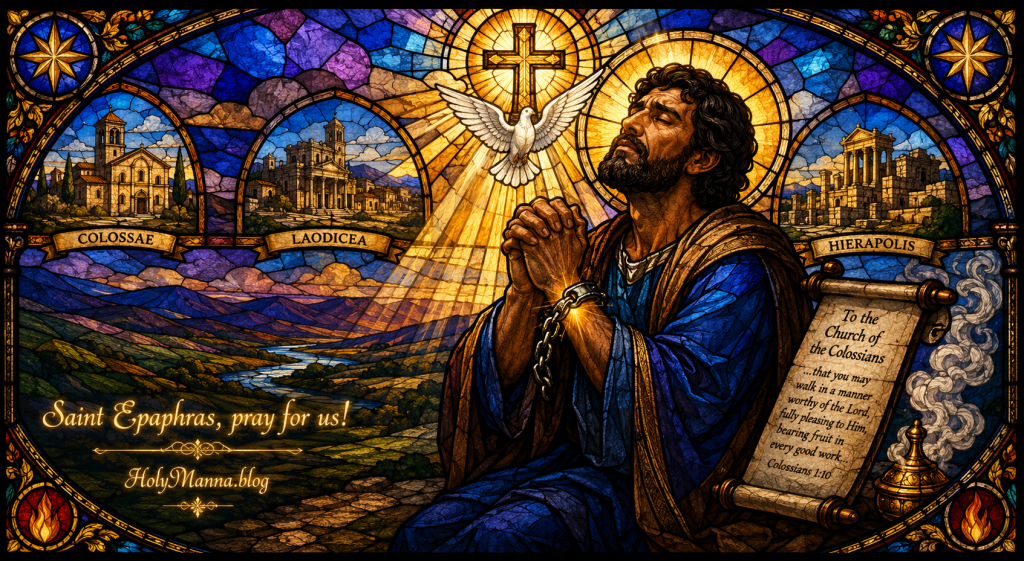
The Man Who Wrestled in Prayer
Some saints fill entire libraries. Others occupy only a few verses of Scripture, and yet those few verses carry the weight of an entire life poured out for Christ. Saint Epaphras, whose feast the Church keeps on July 19th, belongs to that second company. He appears exactly three times in the New Testament, always in letters Saint Paul wrote from prison, and every mention glows with affection and respect. Paul calls him “our most beloved fellow servant, who is for you a faithful minister of Christ Jesus” (Colossians 1:7), and later gives him a title he otherwise reserves in his letters for himself and for Timothy, naming him a “servant of Christ Jesus” (Colossians 4:12).
Epaphras was the founder of the Church at Colossae, and very likely of the neighboring churches of Laodicea and Hierapolis as well. He was the man whose report to an imprisoned Paul prompted the writing of the Letter to the Colossians, one of the most theologically rich letters in the entire Bible. In other words, every time a Christian opens Colossians and reads that Christ is “the image of the invisible God, the firstborn of every creature” (Colossians 1:15), that Christian is benefiting from the pastoral concern of Epaphras. The Catechism teaches that “the Church is apostolic because she is founded on the apostles” (CCC 857), and Epaphras shows what that foundation looked like on the ground: ordinary men, transformed by grace, carrying the Gospel to their own hometowns.
Above everything else, Epaphras is remembered as a man of relentless, wrestling, agonizing intercessory prayer. Paul does not praise his eloquence, his miracles, or his organizational genius. Paul praises his prayer. That is worth sitting with. In an age obsessed with visible results, the Church holds up a saint whose greatest recorded work happened on his knees, out of sight, on behalf of people he loved.
From the Lycus Valley to the Feet of Paul
Epaphras was born in Colossae, a city in the Lycus River Valley of Phrygia, in what is now southwestern Turkey. Paul says so directly when he describes him to the Colossians as “one of you” (Colossians 4:12). Colossae sat clustered with two sister cities, Laodicea and Hierapolis, in a fertile valley known for its wool trade. Once a significant city, Colossae had faded by the first century into the least important of the three, a fact that makes God’s choice of it all the more striking. The Lord has a habit of writing salvation history in overlooked places, from Bethlehem to Nazareth to Colossae.
Nothing certain is known of his family background, but his very name tells a story. Epaphras is a shortened form of the common Greek name Epaphroditus, which means something like “charming” or “lovely” and derives from Aphrodite, the pagan goddess of love. He was, by every indication, born and raised a pagan, a Gentile of Asia Minor immersed in the religious confusion of his age. The old Roman Martyrology and the witness of tradition present him as a convert from paganism, and Scripture supports this picture, since Paul addresses the Colossian church as those who were once “alienated and enemies in mind in evil works” (Colossians 1:21) before God reconciled them.
His conversion almost certainly took place during Saint Paul’s extended ministry at Ephesus, roughly one hundred miles from Colossae. The Acts of the Apostles records that Paul taught there daily for an extended period, “so that all they who dwelt in Asia heard the word of the Lord, both Jews and Gentiles” (Acts 19:10). Colossians traveling to the great port city on business would have encountered this strange new preaching, and Epaphras appears to have been among them. Something in Paul’s proclamation of the crucified and risen Christ pierced him. He did not merely admire the message; he surrendered to it. A man named for a pagan goddess became a slave of Jesus Christ, and he counted that slavery his highest honor.
What Epaphras did next reveals the depth of his conversion. He did not stay comfortably at Ephesus near his spiritual father. He went home. He carried the Gospel back to his own city, to the neighbors who knew him, to the streets where he had grown up. Evangelizing strangers takes courage; evangelizing the people who remember your old life takes something closer to heroism. The Catechism affirms that “the witness of a Christian life and good works done in a supernatural spirit have great power to draw men to the faith and to God” (CCC 2044), and Epaphras staked his mission on exactly that power.
Founder of Three Churches and a Warrior on His Knees
The fruit of his labor was extraordinary. Epaphras is regarded as the founder of the Church at Colossae, and Paul’s words strongly suggest he evangelized the whole valley, since the Apostle testifies that “he hath much labour for you and for them that are at Laodicea and them at Hierapolis” (Colossians 4:13). Three Christian communities, planted in pagan soil, watered by one convert’s tireless work. Remarkably, Paul himself never visited Colossae. He tells the community plainly that he labors for those “who have not seen my face in the flesh” (Colossians 2:1). The faith of the Colossians was, humanly speaking, entirely the work of Epaphras, acting as Paul’s trusted delegate and co-worker. When Paul thanks God for the Colossians’ faith, he immediately credits the man who taught them, “as you learned of Epaphras” (Colossians 1:7).
Honesty requires saying plainly what the record does not contain. Scripture attributes no miracles to Epaphras during his lifetime, and no verified miracle stories from his ministry have come down through Catholic tradition. There are no accounts of healings at his hands, no dramatic signs, no wonders. What Scripture does record is, in its own way, more challenging than any miracle story. Paul pulls back the curtain on the interior life of this man and shows the reader where his real power came from. Epaphras, Paul writes, is “always solicitous for you in prayers, that you may stand perfect and full in all the will of God” (Colossians 4:12). The Greek word behind “solicitous” is far stronger than the English suggests. It is agonizomenos, the word for an athlete straining in competition or a soldier locked in combat. Epaphras wrestled in prayer. He agonized in prayer. He treated intercession as labor, as battle, as the serious work of a serious man.
The Catechism could almost be describing him when it teaches that “intercession is a prayer of petition which leads us to pray as Jesus did” (CCC 2634), and when it insists that “prayer is both a gift of grace and a determined response on our part. It always presupposes effort” (CCC 2725). The same paragraph of the Catechism concludes that the spiritual battle of the Christian life is inseparable from the battle of prayer. Epaphras fought that battle daily, and he fought it for others. He is the New Testament’s clearest portrait of what the Catechism describes among the first Christians, who interceded for one another as a natural expression of their communion in Christ (CCC 2636).
Why should the reader remember and emulate him? Because Epaphras proves that sanctity does not require a spectacular resume. He founded churches, yes, but Paul’s lasting tribute concerns his hidden life. Anyone can imitate that. The exhausted parent praying over sleeping children, the office worker offering a silent decade of the Rosary for a struggling coworker, the grandmother storming heaven for grandchildren who have left the faith: all of them are walking the road of Epaphras. His life declares that wrestling with God on behalf of the people you love is not a lesser form of Christian service. It may be the greatest one.
A Fellow Prisoner in Christ Jesus
The hardships of Epaphras were real and layered, and the first of them was pastoral heartbreak. Years after founding the Colossian church, dangerous errors began creeping into it. False teachers were promoting a confused blend of angel worship, harsh asceticism, and man-made philosophy, a spiritual counterfeit that threatened to pull the community away from the sufficiency of Christ. Paul warns the Colossians against anyone who would “willingly seduce you, in the humility and religion of angels” (Colossians 2:18), and against being despoiled “by philosophy and vain deceit” (Colossians 2:8). Every pastor who has watched beloved parishioners drift toward error knows the particular ache Epaphras carried.
His response teaches as much as his founding work does. Epaphras did not try to handle the crisis alone, and he did not pretend it was not happening. He undertook a long and difficult journey to reach Paul in prison, traditionally understood to be Paul’s imprisonment at Rome, to seek the Apostle’s help and to give an honest report. Notably, his report led with the good. Paul writes that Epaphras “hath manifested to us your love in the spirit” (Colossians 1:8). He named the danger, but he refused to let the danger define his people. There is deep pastoral wisdom in that balance.
Then comes the detail that elevates his hardships to another level entirely. Writing to Philemon, a Colossian Christian, Paul sends greetings from his companions and begins with this: “There salute thee Epaphras, my fellow prisoner in Christ Jesus” (Philemon 23). Epaphras shared Paul’s imprisonment. Scholars have long discussed whether this means he was formally arrested for the Gospel or whether he voluntarily remained in confinement with Paul to serve him, and Scripture does not settle the question. Either reading honors him. If he was arrested, he suffered chains for Christ. If he stayed freely, he chose chains for love of his spiritual father when he could have walked away. The man who agonized in prayer for his flock was willing to agonize in a Roman prison as well.
As for the end of his life, the honest answer is that documented history falls silent, and tradition takes up the story. The traditional Roman Martyrology for July 19th, drawing on the ninth-century martyrology of Ado of Vienne, relates that Epaphras was consecrated the first Bishop of Colossae by Saint Paul himself, that he shepherded his people with renowned virtue, and that he “received the palm of martyrdom” while courageously defending the flock entrusted to his care. The Church’s traditional calendar honors him with the title of martyr on this basis, and the tradition is ancient and venerable. It must be said plainly, however, that this account of his episcopacy and martyrdom comes from later tradition rather than from contemporary records, and it cannot be verified. What can be verified is the shape of the man Scripture reveals, and nothing in that portrait makes his final fidelity hard to believe. A man who wrestled in prayer for his people and sat in prison beside Paul was already living a martyr’s logic, offering his life drop by drop long before any final offering.
Relics, Remembrance, and the Churches He Left Behind
The centuries after his death carried the memory of Epaphras forward in quiet but persistent ways. The same traditional Martyrology entry that recounts his martyrdom adds that his body was later translated from Colossae to Rome and now rests in the Basilica of Saint Mary Major, one of the four great papal basilicas. This tradition of the translation of his relics is longstanding and appears in the Church’s official martyrologies of past centuries, but it too comes from later tradition and cannot be verified. Still, the claim itself testifies to something real: the Church loved this man enough to want him close, to link the memory of Paul’s praying companion to one of the most sacred churches in Christendom.
Honesty again requires plain speech about what the record does not contain. No specific miracle stories, healings, or divine interventions attributed to the intercession of Saint Epaphras after his death have been preserved in the Church’s tradition. There is no famous shrine cycle, no medieval miracle collection, no established pilgrimage devoted to him. For a saint whose entire recorded excellence was intercession, there is something almost fitting in that silence. His prayers were hidden in life, and his intercession remains hidden in death, known fully to God alone. The Catechism assures the faithful that the saints in heaven do not stop caring for those on earth, teaching that “being more closely united to Christ, those who dwell in heaven fix the whole Church more firmly in holiness” (CCC 956). The man who never stopped praying for Colossae has surely not stopped praying now.
His deeper legacy is impossible to miss. The Letter to the Colossians exists because Epaphras made his journey to Paul, and that letter has fed the Church’s understanding of Christ for two thousand years. Its soaring hymn to the primacy of Christ, its warnings against empty philosophy, its vision of a life “hid with Christ in God” (Colossians 3:3): all of it entered the world through the pastoral anxiety of one faithful minister. The cities he evangelized eventually faded, and Colossae itself was devastated by an earthquake in the generation after him and never fully recovered its standing. Yet the church he planted there produced fruit that outlived the city, including the household of Philemon and the whole cast of Colossian believers the New Testament names. The Eastern churches likewise honor Epaphras among the disciples of the apostolic generation and venerate him as a bishop and martyr, so his memory bridges East and West. On July 19th each year, the Church’s martyrology still speaks his name, still calls him what Paul called him, and still holds him up as proof that heaven remembers what history forgets.
Praying Like Epaphras in a Distracted World
Epaphras never expected to be watched, which is exactly why he is worth watching. His life offers three lessons that translate directly into the twenty-first century.
First, go home with the Gospel. Epaphras met Christ in the big city and carried Him back to the small town that knew his past. Most people find it easiest to be Christian among strangers and hardest among family, old friends, and coworkers who remember who they used to be. Epaphras chose the harder mission field, and three churches were born because of it. The reader’s own Colossae might be a family group chat, a workplace, a neighborhood, or a dinner table where faith has gone quiet. Who in your life has never heard you speak honestly about what Christ has done for you?
Second, treat prayer as labor, not leftovers. The defining image of Epaphras is a man straining in intercession, agonizing for people he loved, praying that they would stand “perfect and full in all the will of God” (Colossians 4:12). Notice the ambition of that prayer. He did not pray that his people would merely stay out of trouble; he prayed that they would become saints. Modern prayer lists often shrink to health, safety, and success, all good things, but Epaphras aimed higher. A practical step is to choose three people and pray daily, by name, not just for their circumstances but for their holiness. Another is to bring those names to a weekly Holy Hour or to the Mass, uniting intercession to the one sacrifice of Christ, who as the Catechism teaches is “the one intercessor with the Father on behalf of all men” (CCC 2634). When you pray for the people you love, do you ask for their comfort, or do you dare to ask for their sanctity?
Third, stay beside the suffering. Whether Epaphras wore chains by arrest or by choice, he remained a fellow prisoner with Paul when distance would have been easier. Faithfulness often looks like simply not leaving: not leaving the hospital room, the difficult marriage, the aging parent, the friend in crisis. Compassion, resilience, and faith are rarely dramatic. Usually they look like showing up again tomorrow. Who is enduring a prison of illness, grief, or loneliness right now, and what would it cost you to sit with them in it?
The world measures greatness by visibility. Epaphras was nearly invisible, three verses in a very large book, and yet Paul, who knew apostles and martyrs and miracle workers, singled him out for his prayer. That should recalibrate every reader’s definition of a life well spent.
Engage With Us!
The story of Saint Epaphras belongs to everyone who has ever prayed hard for someone they love, and the HolyManna community would be blessed to hear how it lands in your own life. Please share your thoughts and reflections in the comments below, and consider these questions as a starting point for prayer and discussion.
- Epaphras carried the Gospel back to his hometown, where people knew his past. Where is your Colossae, and what holds you back from evangelizing there?
- Paul praised Epaphras for wrestling in prayer. What would it look like for you to move from casual prayer to labored, persistent intercession this week?
- Epaphras prayed that his people would stand perfect and full in all the will of God. Whose sanctity, not just whose comfort, will you begin praying for by name?
- As a fellow prisoner, Epaphras stayed close to Paul in his suffering. Who in your life needs your steady presence more than your advice?
- Epaphras is remembered for hidden faithfulness rather than visible achievement. How does his life challenge the way you measure your own?
Saint Epaphras never sought a spotlight, and heaven gave him something better: a place in the eternal Word of God and a friendship with Christ that no prison could touch. Let his example send you to your knees for the people you love, and then send you back into your daily life with courage. Live your faith boldly this week, pray without giving up, stay beside those who suffer, and do everything with the love and mercy that Jesus taught us. Saint Epaphras, faithful minister and man of wrestling prayer, pray for us.
Saint Epaphras, pray for us!
Follow us on YouTube, TikTok, Instagram and Facebook for more insights and reflections on living a faith-filled life.


Leave a Reply